Skip to content
Being arrested in Texas can be terrifying—but you don’t have to face it alone. If you’re asking whether steroids are illegal in Texas, you’re asking a question with life-altering stakes. Let's cut through the legal jargon and get straight to the point: yes, possessing anabolic steroids without a valid prescription is a crime in Texas.
Facing a drug charge is an overwhelming experience, and understanding your legal rights and options is the first step toward building a strong defense. A steroid charge is not a minor slap on the wrist. Under the Texas Penal Code, the state classifies them as a Penalty Group 3 controlled substance, and even a small amount can lead to serious criminal consequences. This guide explains what that means for you and how a skilled Texas criminal defense attorney can protect your future.
The Quick Answer Is Yes, Steroids Are Illegal in Texas

If you've been arrested or are worried about a potential charge, it's crucial to know exactly where you stand. Under the Texas Controlled Substances Act, possessing anabolic steroids without a doctor's order is a crime that can derail your life. You can discover more insights about steroid possession laws and their consequences to better understand what you may be up against.
This classification puts steroids in the same legal bucket as illegally possessing certain prescription drugs like Valium or Xanax. A key detail to remember is that penalties are determined not by the type of steroid, but by the total weight of the substance, including any additives or liquids mixed in. This is a critical detail where many people get into serious trouble without realizing it.
How Texas Determines Steroid Penalties
The stakes are high from the moment an investigation begins. Texas law uses a tiered penalty system that escalates quickly based on the amount you allegedly possess. A few extra grams can be the difference between a misdemeanor and a felony conviction that follows you for life.
Here’s a breakdown of what that means for you.
Texas Steroid Possession Penalties at a Glance
The table below outlines the potential penalties for simple possession of anabolic steroids in Texas. It's important to see how quickly the charges ramp up from a misdemeanor to a first-degree felony.
| Amount Possessed | Charge Level | Potential Incarceration | Maximum Fine |
|---|---|---|---|
| Less than 28 grams | Class A Misdemeanor | Up to 1 year in county jail | Up to $4,000 |
| 28 grams to 200 grams | Third-Degree Felony | 2 to 10 years in state prison | Up to $10,000 |
| 200 to 400 grams | Second-Degree Felony | 2 to 20 years in state prison | Up to $10,000 |
| 400 grams or more | First-Degree Felony | 5 to 99 years (or life) in prison | Up to $10,000 |
As you can see, what might seem like a small amount for personal use can easily cross the 28-gram threshold, turning a misdemeanor charge into a felony punishable by years in state prison. The weight includes the entire compound, not just the active steroid ingredient.
Understanding this framework is the first step in recognizing the seriousness of your situation. An arrest for steroid possession in Texas is not something to take lightly, but remember: an arrest is not a conviction.
The Two Layers of Steroid Law: State vs. Federal
If you’re facing a steroid charge in Texas, it’s easy to feel caught in a legal crossfire. That’s because it’s not just one set of laws you have to worry about—it’s two. Both Texas state law and federal law have a say, and understanding how they work together is the first step in making sense of the charges you’re up against.
At the state level, everything revolves around the Texas Controlled Substances Act. This massive piece of legislation sorts drugs into different “Penalty Groups.” Anabolic steroids land in Penalty Group 3, a category for substances that have accepted medical uses but also a high potential for abuse.
This classification puts illegally held steroids in the same legal bucket as some prescription tranquilizers and sedatives. But don't let that fool you. The penalties are anything but minor, and even possessing a small amount can lead to felony charges. This is a common trap—people underestimate the seriousness because steroids aren't in Penalty Group 1 with drugs like heroin or cocaine.
Things get even more complicated when the federal government gets involved. To get a better handle on how Texas prosecutes these offenses, you can learn more by breaking down Texas drug laws in our detailed guide. This dual-jurisdiction reality means that, depending on your specific situation, you could find yourself facing charges from either state or federal prosecutors.
The law that made non-prescription steroids a federal crime is the Anabolic Steroids Control Act of 1990. This was a game-changer. It officially classified anabolic steroids as Schedule III controlled substances, putting them in the same federal category as ketamine and some barbiturates.
Why Both State and Federal Laws Matter to You
This overlap between state and federal law is where things can get tricky. A simple possession case might be handled by your local Texas police department and district attorney. But if the case involves larger quantities, online sales, or distribution across state lines, federal agencies like the DEA are likely to take the lead.
Here’s why this matters to you:
- Different Penalties: Federal sentencing guidelines can be much harsher and more rigid than Texas state penalties.
- Different Prosecutors: You could be up against a local DA or a federal prosecutor, known as an Assistant U.S. Attorney. Each operates with different resources, priorities, and procedural rules.
- Investigative Power: Federal investigations can be incredibly invasive, using tools like wiretaps, extensive surveillance, and financial record subpoenas that local police might not employ for a smaller case.
Figuring out which laws apply and who is running the investigation is one of the most critical first steps in building a solid defense. It’s not just about what you were accused of having; it’s about navigating a complex legal maze with rules at both the state and national levels.
How Penalties Escalate for Steroid Offenses
When you’re asking, "are steroids illegal in Texas," it's easy to focus on simple possession. But that’s only one piece of the puzzle. The legal consequences can explode if a prosecutor believes you planned to do more than just use them yourself. A charge like Possession with Intent to Deliver or Manufacturing a Controlled Substance takes you from a serious problem to a life-changing legal battle.
So what's the difference? It often boils down to quantity and context. Prosecutors build these bigger cases by looking for "plus factors"—clues that suggest you're a seller, not just a user.
- Large amounts of steroids that go way beyond personal use.
- Packaging materials like baggies, extra vials, or shipping boxes.
- Scales, a large number of syringes, or other paraphernalia.
- Written ledgers or digital records that look like sales logs.
- Large sums of unexplained cash found near the substances.
Think about it this way: having less than 28 grams for yourself is a Class A Misdemeanor. But if the state thinks you intended to sell that exact same amount, the charge skyrockets to a state jail felony. From there, the penalties only get steeper.
From Misdemeanor to Major Felony
The weight limits in Texas law are strict and can catch you completely off guard. A handful of vials or a couple of boxes of pills can easily push you over a legal line you never knew existed. What you thought was a minor issue suddenly becomes a felony charge carrying years of potential prison time.
For instance, possessing between 28 and 200 grams with the intent to deliver is a third-degree felony, which comes with a prison sentence of 2 to 10 years. If you have 400 grams or more, you’re looking at a first-degree felony charge. That's the same level as some of the most serious crimes in the Texas Penal Code, punishable by 5 to 99 years or life in prison.
This next graphic shows the simple decision-making process that law enforcement uses to determine if possession is legal.
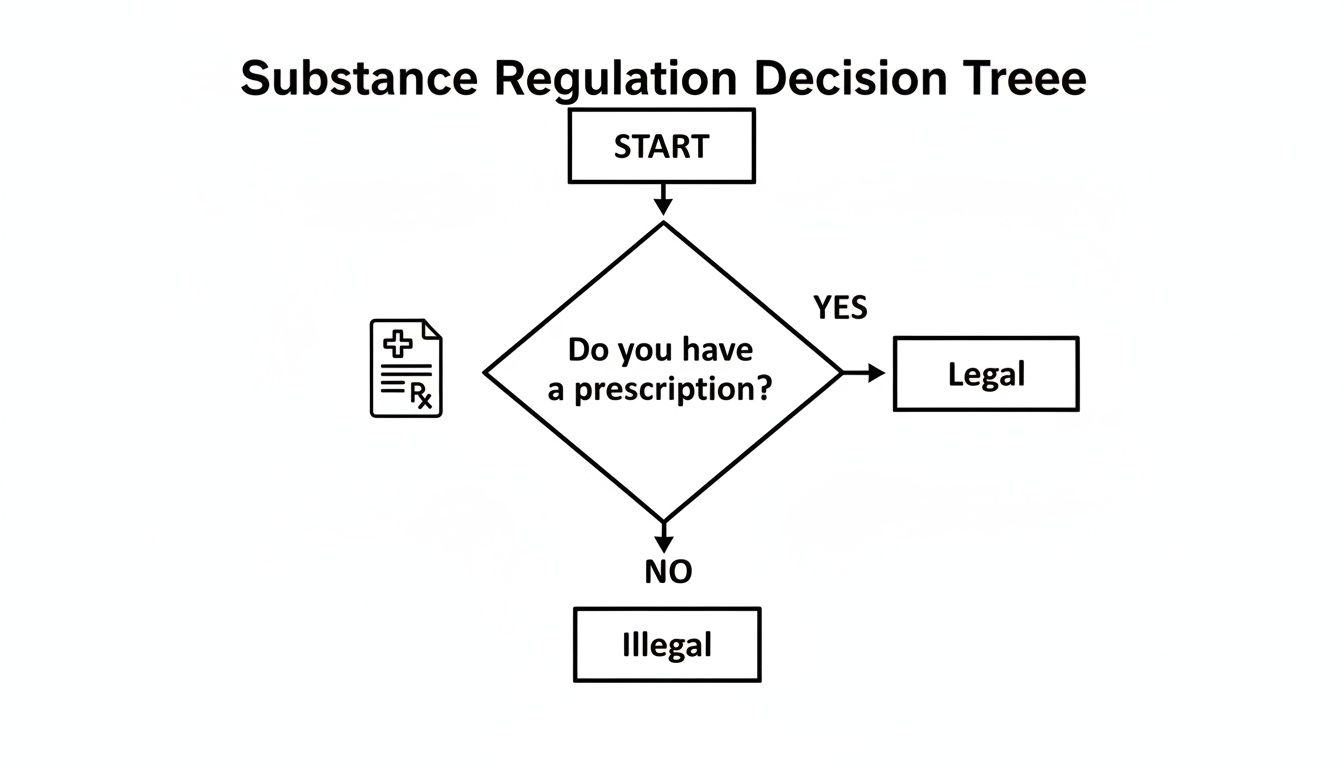
As the flowchart makes crystal clear, the single factor separating legal use from a criminal charge is a valid, current prescription from a doctor. Without one, any amount is illegal.
The most critical factor for escalating charges is the total weight of the substance, including any liquids or powders mixed with the steroid. This means the oil in a vial or the fillers in a pill all count toward that felony threshold, catching many people by surprise.
The jump from simple possession to intent to deliver is where a proactive legal strategy becomes absolutely essential. The state doesn't have to prove you actually sold anything—only that you intended to. This is precisely why having an experienced criminal defense attorney challenge the evidence and the prosecutor's story from day one is your best and only defense.
What to Expect After a Texas Steroid Arrest
Getting arrested for steroid possession in Texas feels like your world has been turned upside down. The flashing lights, the handcuffs, the confusion—it’s an overwhelming experience that can make you feel like your future is over. But it's not. The criminal justice system is a long and winding road, and knowing the process is the first step toward regaining control.
Everything starts with the initial police encounter. Maybe it was a traffic stop that went sideways or law enforcement showing up at your door. The very first thing a good defense attorney will do is put that moment under a microscope. Did the officer have a legitimate reason to stop you? Was the search of your home or vehicle backed by a valid warrant, or did they pressure you into giving consent?
The Fourth Amendment Isn't Just a Suggestion: Your constitutional right to be free from unreasonable searches and seizures is one of the most powerful tools in your defense. If the police violated your constitutional rights to get the evidence, that evidence can often be thrown out. This is done through a "motion to suppress," and it can cripple the prosecution's case before it even gets started.
The Criminal Justice Process Step-by-Step
After an arrest, you’ll be taken to a local jail for booking. This involves fingerprints, a mugshot, and your personal details going into the system. You will then see a magistrate judge for your first court appearance, usually within 48 hours.
This initial hearing is called an arraignment. Here, the judge will formally read the charges against you and ask for your plea. You should always plead "not guilty" at this stage to preserve all your legal options. The judge will also set your bail—the amount of money required for your release while the case moves forward.
Once you’re out on bail, the real work begins. The case enters the pre-trial phase, where your defense team has the opportunity to dismantle the state's case piece by piece. Here’s a practical step-by-step guide on what happens next:
- Discovery: We demand to see every piece of evidence the prosecutor has against you. This includes police reports, lab analysis of the alleged steroids, any witness statements, and all video footage. There should be no surprises.
- Investigation: We don't just take the state's word for it. Our team conducts its own investigation. We re-interview witnesses, find new ones, and look for the holes and inconsistencies in the police report.
- Plea Bargaining: The overwhelming majority of criminal cases are resolved through plea agreements, not dramatic courtroom trials. Your lawyer will negotiate directly with the prosecutor, fighting for a reduction in charges, enrollment in a diversion program, or even a full dismissal.
- Pre-Trial Motions: This is where we go on the offensive. We can file motions to challenge the legality of the search, the reliability of the evidence, or other procedural mistakes the state made.
If negotiations fail and a fair agreement isn't on the table, the case gets set for trial. This is your constitutional right—the chance to tell your side of the story to a judge or a jury of your peers. While it sounds intimidating, understanding each of these stages shows that an arrest is just the beginning of the fight, not the end of it. There are opportunities at every turn to protect your rights and your future.
Building Your Defense Against Steroid Charges

Facing a steroid charge can feel hopeless, but it's critical to remember that an arrest is not a conviction. The state carries the entire burden of proving its case against you beyond a reasonable doubt, and their case often has significant weak spots that an experienced criminal defense attorney can exploit.
A strong defense starts by challenging every single piece of the prosecution's narrative, right from the initial police encounter.
So where do we begin? We immediately investigate the encounter with law enforcement. Your constitutional rights are your shield, and we examine whether the police had a legal reason to stop, search, or even question you in the first place. This is where you need to find a good criminal defense lawyer, because they will be the one to challenge these potential rights violations head-on.
Key Defense Strategies in Steroid Cases
If police overstepped their bounds, we can file a motion to suppress the evidence. If a judge agrees, that evidence gets thrown out, which can cripple the prosecution's case. A very common angle is attacking the search itself. You can read more about what constitutes an illegal search and seizure to better understand the protections you have under the Fourth Amendment.
Other powerful defense strategies we often use include:
- Challenging the Chain of Custody: The state must prove, without a doubt, that the substance collected at the scene is the exact same one presented in court, with zero tampering. Any break in this chain creates serious doubt.
- Questioning Possession: It's not enough for the steroids to be nearby; the prosecutor has to prove you knowingly and intentionally possessed them. This is often harder for them to prove than it sounds, especially in cases involving shared spaces.
- Arguing Lack of Knowledge: If the steroids were found in a shared apartment, a friend's car, or a gym bag someone else had access to, we can build a strong defense that you had no idea they were even there.
Actual vs. Constructive Possession
Understanding the difference between actual and constructive possession is absolutely vital in a Texas drug case. This single legal concept is often the cornerstone of a winning defense.
Actual possession is straightforward. It means the steroids were found directly on your person—in your pocket, your backpack, or your hand. Constructive possession is less direct. It means you had control over the place where the steroids were found, even if they weren't physically on you.
Think about it this way: if steroids were found in the glove box of a car you were driving, the state will almost certainly argue you had constructive possession. Our job is to punch holes in that theory. We'll work to show that other people had access to the car, that you didn't know the substance was there, or that you didn't have exclusive control over that specific area.
By digging into every fact, we find the cracks in the prosecution's case and fight to protect your future.
Clearing Your Record After a Steroid Charge
Winning your steroid case or getting the charges dismissed is a massive relief. But many people are shocked to discover that the arrest can still follow them around for years. Even with a good outcome, the record of the charge remains public, creating a major roadblock for jobs, housing, and even loan applications.
At The Law Office of Bryan Fagan, we believe one mistake shouldn't define your future. That's why our work doesn't stop at the verdict—we’re committed to helping you truly clear your name so you can move forward with a clean slate.
Expunction vs. Order of Nondisclosure
Fortunately, Texas law provides two powerful tools for post-conviction relief: expunctions and orders of nondisclosure. They both help you put an arrest behind you, but they work in different ways and apply to different situations. Understanding the difference is key.
Expunction: This is the gold standard for clearing your name. An expunction legally destroys all records of your arrest. It’s as if it never happened. Government agencies have to erase it from their files, and you can legally deny the arrest ever occurred on any application.
Order of Nondisclosure: This option is more like putting your record in a locked box. It seals the arrest from public view, meaning potential employers, landlords, and the general public can’t see it. However, law enforcement and certain state agencies can still access it if needed.
Which path you can take depends entirely on how your steroid case ended.
The most significant benefit of an expunction is the ability to legally deny that you were ever arrested or charged with the crime. This gives you the ultimate peace of mind when moving forward with your life.
Eligibility for these legal remedies is strict. As a general rule, you might be eligible for an expunction if your case was dismissed outright, you were found not guilty at trial (acquitted), or you received a pardon.
An order of nondisclosure, on the other hand, is typically available for those who successfully completed a deferred adjudication program for a misdemeanor or certain low-level felonies.
Figuring out the eligibility requirements and filing the right petitions is a complex legal process. Having an experienced attorney guide you through every step ensures you have the best shot at putting this chapter behind you for good.
Frequently Asked Questions About Texas Steroid Laws
Getting tangled up in a criminal investigation brings a flood of questions and anxiety. Let's provide some clear, plain-English answers to the most common worries we hear from Texans facing steroid allegations.
What should I do if the police want to talk to me about steroid possession?
This one is simple: you have the right to remain silent, and you should use it. Never speak to law enforcement or agree to any kind of search without your lawyer present.
Calmly and clearly say: "I am exercising my right to remain silent, and I would like to speak with my lawyer." Anything you say—even if you are just trying to be helpful or explain your side of the story—can be twisted and used against you. Protecting your rights from the very first minute is a practical step you must take.
Are prohormones and steroid alternatives illegal in Texas?
This is a legal minefield, and it’s where many people accidentally end up with felony charges. Many supplements marketed as “legal alternatives” or “prohormones” have since been classified as controlled substances by both the state and the federal government.
Possessing something that is chemically similar to a banned anabolic steroid can get you arrested, even if you bought it from a supplement shop. Never assume a product is legal just because it's for sale.
Remember this: a label that says "legal," "research chemical," or "not for human consumption" means absolutely nothing to a prosecutor. If the substance is chemically analogous to a banned steroid under the Texas Penal Code, they can and will treat it as an illegal controlled substance.
What happens if a student athlete gets caught with steroids?
For a student athlete, the consequences explode far beyond the courthouse steps. On top of facing serious criminal penalties like any other Texan, a student caught with steroids will see their academic and athletic future implode.
Practical consequences almost always include:
- Immediate suspension or permanent removal from the team.
- Losing athletic scholarships, a financial blow that can cost a family tens of thousands of dollars.
- Disciplinary action from the school, including potential expulsion under strict UIL rules and district policies.
Texas has a zero-tolerance stance on this issue. In fact, state law requires public schools to display anti-steroid warnings in their gyms, showing just how seriously this is taken. You can see the official policy that mandates these warnings on the Texas government's official code website. The damage to a young person’s future can be permanent, which makes getting a strong legal defense from a Houston criminal lawyer in place immediately an absolute necessity.
If you’ve been charged with a crime in Texas, call The Law Office of Bryan Fagan, PLLC for a free and confidential consultation. Our defense team is ready to protect your rights.