Being accused of arson in Texas can be terrifying. In an instant, your life is turned upside down. A fire has already caused devastation, but now, instead of being treated with compassion, you're being viewed as a criminal suspect. It's an isolating and overwhelming experience, but you don’t have to face it alone.
This guide is your first step toward understanding your rights and building a strong defense. We will break down the complex language of the arson Texas penal code into plain English, giving you a clear, honest look at what you're up against. Remember, an accusation is just that—an accusation. It is not a conviction.
What to Do When You Are Accused of Arson

An arson charge under Texas Penal Code § 28.02 is far more complicated than simply being present when a fire starts. To convict you, the prosecution must prove you intentionally and knowingly started that fire with the specific goal of destroying property. This is a very high bar for them to clear, and it’s where a powerful defense begins.
Understanding the Initial Investigation
After the smoke clears, the investigation begins. Fire marshals, police, and sometimes even federal agents will arrive at the scene to determine the cause. They are trained to look for accelerants, unusual burn patterns, and other signs that a fire was set intentionally.
The problem is, this process isn't always perfect. Innocent, everyday circumstances can suddenly look suspicious through the lens of an arson investigation.
- Financial Stress: Are you behind on your mortgage? Investigators might jump to the conclusion that you burned your property for the insurance money.
- Personal Disputes: A recent argument with a neighbor or a difficult breakup could be twisted into a motive for revenge.
- Stored Materials: That can of gasoline for your lawnmower or the paint thinner in your garage? To an investigator, those might look like pre-planned accelerants.
It's a hard truth, but the property owner is almost always the first person investigators look at. This is a critical time, and every word you say matters.
Remember this critical advice: You have the right to remain silent. Do not speak with fire investigators, police, or insurance adjusters without your criminal defense attorney present. An innocent remark can be taken out of context and used to build a case against you.
An Accusation Is Not a Conviction
Our goal with this guide is to give you immediate clarity on the charges, the potential penalties, and the defense strategies that can protect you. Think of this as your roadmap through the legal storm ahead.
You don’t have to face this alone. An experienced legal team can stand between you and the prosecution, challenge the state’s evidence, and make sure your side of the story is finally heard.
Understanding Texas Penal Code Section 28.02
To build a solid defense against an arson charge, you have to know exactly what the law says. In Texas, every arson case is defined by Penal Code § 28.02. This is the statute that lays out what a prosecutor must prove to get a conviction. Understanding it is your first line of defense.
In plain English, the law says a person commits arson if they start a fire or cause an explosion with the intent to destroy or damage specific types of property. This isn't about accidents. It’s about a deliberate act with a destructive goal. The entire burden of proving this falls on the prosecution.
The Two Pillars of an Arson Charge
For the State to make an arson charge stick, they have to prove two critical facts beyond a reasonable doubt. If they can’t prove even one of them, their case falls apart.
- The Act: You started a fire or caused an explosion. This is the physical part of the crime.
- The Intent: You did it with the specific goal of destroying or damaging property. This is the mental part—and it’s often the hardest thing for a prosecutor to prove.
Without proving what was in your mind—your intent—the State does not have an arson case. This is the crucial line that separates a tragic accident from a serious felony.
Think about it this way: a kitchen fire that gets out of control is not arson. A campfire that spreads because of a sudden gust of wind is not arson. But pouring gasoline on a car and lighting a match specifically to burn it? That’s the very definition of arson under the Texas Penal Code.
What Property Does the Law Cover?
The Texas Penal Code is very specific about what kinds of property fall under the arson statute. The act is only considered arson if the intended target of the fire or explosion was:
- A Building, Habitation, or Place of Worship: This covers everything from homes and businesses to churches and community centers.
- A Vehicle: This includes cars, trucks, boats, and other forms of transportation.
- Open-Space Land: This is often used in cases where someone intentionally starts a wildfire.
- Property Insured Against Damage: Setting your own property on fire to commit insurance fraud is absolutely a form of arson.
- Property Belonging to Another: This applies even if the property is on land you own, like setting fire to a tenant’s belongings inside a rental unit.
Learning the specific classifications of offenses within the Texas Penal Code can give you a better grasp of how these charges are structured.
How a Serious Charge Gets Even Worse
An arson charge is already a serious second-degree felony, but certain factors can escalate it to a first-degree felony—which carries a potential life sentence.
These aggravating factors include:
- Causing bodily injury or death to anyone.
- The target was a place of assembly or worship.
- The fire was set as part of organized criminal activity.
These elements raise the stakes dramatically. History shows just how aggressively these cases are prosecuted. Texas has even seen wrongful convictions based on outdated and debunked fire science, which highlights the urgent need for a sharp, modern defense.
With around 275 new arson convictions in Texas each year, it is vital to challenge every piece of the prosecution's evidence. The law is complex, but the core principle is clear: the state must prove not just what you did, but what you were thinking. And that’s where a powerful defense begins.
The Real Consequences of an Arson Conviction
An arson charge in Texas isn’t just a legal problem—it’s a threat to your entire future. A conviction carries devastating consequences that reach far beyond a prison cell, impacting your rights, your career, and your family for decades to come.
Understanding what’s at stake is the first step. The penalties are designed to be severe, and prosecutors pursue these cases aggressively.
Texas Arson Penalties: Prison Time and Fines
Under Texas Penal Code Chapter 28, arson is a serious felony. The state doesn't take these charges lightly; hundreds of people are currently serving time in Texas prisons for arson convictions, a number that shows just how seriously the courts treat this crime. You can learn more about the broader review of arson cases in Texas.
The penalties are steep and escalate quickly depending on the specifics of the case.
The table below breaks down the sentencing guidelines for Texas arson offenses. It’s a sobering look at the real-world consequences you’re up against.
| Arson Offense Level | Felony Classification | Prison Sentence Range | Maximum Fine |
|---|---|---|---|
| Standard Arson | Second-Degree Felony | 2 to 20 years | Up to $10,000 |
| Aggravated Arson | First-Degree Felony | 5 to 99 years, or Life | Up to $10,000 |
As you can see, a conviction for even a "standard" arson offense means facing up to two decades in prison. If aggravating factors are involved—like the fire causing injury or death, or if the target was a place of worship—the charge jumps to a first-degree felony. That's one of the most serious charges on the books, with a potential sentence of life behind bars.
These aren't just numbers on a page. They represent years, even a lifetime, lost.
Beyond the Prison Sentence: A Lifetime of Consequences
The punishment doesn’t stop when you’re released. A felony conviction creates what are known as collateral consequences—hidden penalties that follow you for the rest of your life.
These consequences aren't meant to scare you; they are the reality of the situation and the reason we fight so aggressively to protect our clients' records.
The Loss of Fundamental Rights
A felony conviction immediately strips you of rights most people take for granted. You are no longer treated as a full citizen.
- Right to Vote: While incarcerated, on parole, or on felony probation in Texas, you lose your right to vote.
- Right to Own a Firearm: Under both state and federal law, a felony conviction means you are permanently banned from legally buying or even possessing a firearm.
The Barriers to a Normal Life
Beyond losing constitutional rights, a felony record throws up massive roadblocks that make it incredibly difficult to rebuild a normal life.
- Employment: Most job applications have "the box" asking if you've been convicted of a felony. Many employers will not hire someone with an arson conviction, shrinking your job prospects dramatically.
- Housing: Landlords frequently run background checks. They can legally deny your rental application because of a felony arson conviction, making it tough just to find a safe place to live.
- Professional Licenses: If you work in a field like nursing, teaching, real estate, or countless others that require a state license, a felony conviction can make you ineligible to get or keep it.
- Immigration Status: For non-citizens, an arson conviction is almost always considered a "crime of moral turpitude." This can trigger immediate deportation and a permanent ban from ever returning to the United States.
These obstacles create a cycle of punishment that lasts long after your official sentence is served. This is why our goal is never just about keeping you out of prison—it's about protecting your record and preserving your future.
How We Build Your Defense Against Arson Charges
Remember, the state’s accusation is not proof of guilt. When you're facing an arson charge in Texas, the entire burden of proof falls on the prosecution. Our job is to systematically dismantle their case, piece by piece, by challenging their evidence and building a narrative that protects your freedom.
A successful defense starts long before we step into a courtroom. It begins with a deep, independent investigation into every detail of the incident. We never take a fire marshal’s report at face value. Instead, we scrutinize their methods, question their conclusions, and expose every weakness we can find.
Challenging the Prosecution’s Core Argument: Intent
The single most critical element in any arson case under the arson Texas penal code is intent. To win, the prosecutor must prove—beyond a reasonable doubt—that you deliberately set a fire with the specific goal of destroying property. This is a very high bar to clear, and it’s often where their case falls apart.
Our first line of attack is to explore every possibility that contradicts malicious intent. Many fires are just tragic accidents, not criminal acts.
- Accidental Cause: We dig into potential accidental causes. Was it faulty electrical wiring? A malfunctioning appliance? Maybe improperly stored flammable materials that ignited on their own? These are all real possibilities that can explain a fire without pointing to a crime.
- Negligence vs. Intent: Was the fire a result of simple carelessness, like leaving a candle unattended or a cooking mishap? While negligence can have other consequences, it is not the same as the intentional malice required for an arson conviction. We work to show the fire was a mistake, not a crime.
Attacking the State’s Evidence
Prosecutors typically build arson cases on three pillars: eyewitness accounts, a supposed motive, and forensic evidence from the scene. Each one of these can be challenged and broken down.
We meticulously examine every shred of evidence, looking for inconsistencies, biases, and procedural errors. An effective defense means questioning the very foundation of the state's case, forcing them to justify every single claim they make.
We challenge witness credibility by exposing potential grudges, flawed memories, or conflicting statements. If the state claims you had a financial motive—like collecting insurance money—we gather evidence to demonstrate your financial stability or other proof that flatly contradicts their theory. On top of criminal charges, an arson incident can lead to complex civil claims. It's a related but distinct battle, and understanding how you go about defending yourself in fire insurance claims is also critical.
Using Modern Fire Science to Your Advantage
One of the most powerful tools in a modern arson defense is science itself. For decades, countless arson convictions were based on outdated and now-debunked "junk science." Investigators used to point to certain burn patterns or melted metal as "proof" of an intentionally set fire, but modern fire science has shown these same signs can easily occur in accidental fires.
We frequently partner with independent fire science experts who adhere to the strict guidelines of NFPA 921—the nationally recognized guide for fire and explosion investigations. These experts can:
- Re-examine all the evidence from the fire scene with a fresh, unbiased eye.
- Pinpoint flaws and mistakes in the original fire marshal’s investigation.
- Testify in court, explaining how the evidence is actually consistent with an accidental cause.
If the state’s forensic evidence was gathered improperly or is simply unreliable, we will fight tooth and nail to have it thrown out. We can file a motion to suppress, which is a formal request asking the judge to exclude that evidence from being used against you at trial. Winning this kind of motion can cripple the prosecution’s case. You can learn more about how a motion to suppress evidence can be a game-changing tool in your defense.
Building your defense is about more than just showing up to court. It’s about proactively deconstructing the state's case until it can no longer stand on its own.
Navigating the Texas Criminal Justice System
Being arrested and accused of a crime like arson can feel like you've been dropped into a maze without a map. The legal process is a confusing jumble of strange terms and procedures, which only ramps up the anxiety of the situation. We're here to hand you that map and walk you through what really happens after an arrest in Texas, step by step.
Understanding the timeline and key stages demystifies the system and puts you back in control of your defense. It's important to remember that every single stage is an opportunity for your attorney to protect your rights and poke holes in the state's case.
From Arrest to Your First Court Appearance
The clock starts ticking the moment you're arrested. This is a fast-moving, critical period where having a lawyer in your corner is absolutely essential.
- Arrest and Booking: Once you're arrested, you'll be taken to a local jail for booking. This is the administrative part—they’ll take your mugshot, collect your fingerprints, and record your personal information. You'll be searched, and your belongings will be held until you're released.
- Bail Hearing (Arraignment): The law says that within 48 hours of your arrest, you must be brought before a judge. At this brief but critical hearing, the judge tells you what you're charged with, reads you your rights (including the right to an attorney), and sets your bail amount.
This is your first chance to have a lawyer fight for you. An experienced attorney can argue for a lower bail amount or even for your release on a personal recognizance (PR) bond, which means you don't have to pay anything to get out. A powerful argument here can be the difference between waiting for trial at home or inside a jail cell.
The Pre-Trial Phase Where Cases Are Won and Lost
After your arraignment, your case moves into the pre-trial phase. This isn't just a waiting period—it's where the real work gets done and where most cases are actually won or lost. A strong defense strategy is built here through a methodical process of gathering evidence and attacking the prosecution’s case long before a jury is ever called.
Our core process for building your defense is straightforward but effective.
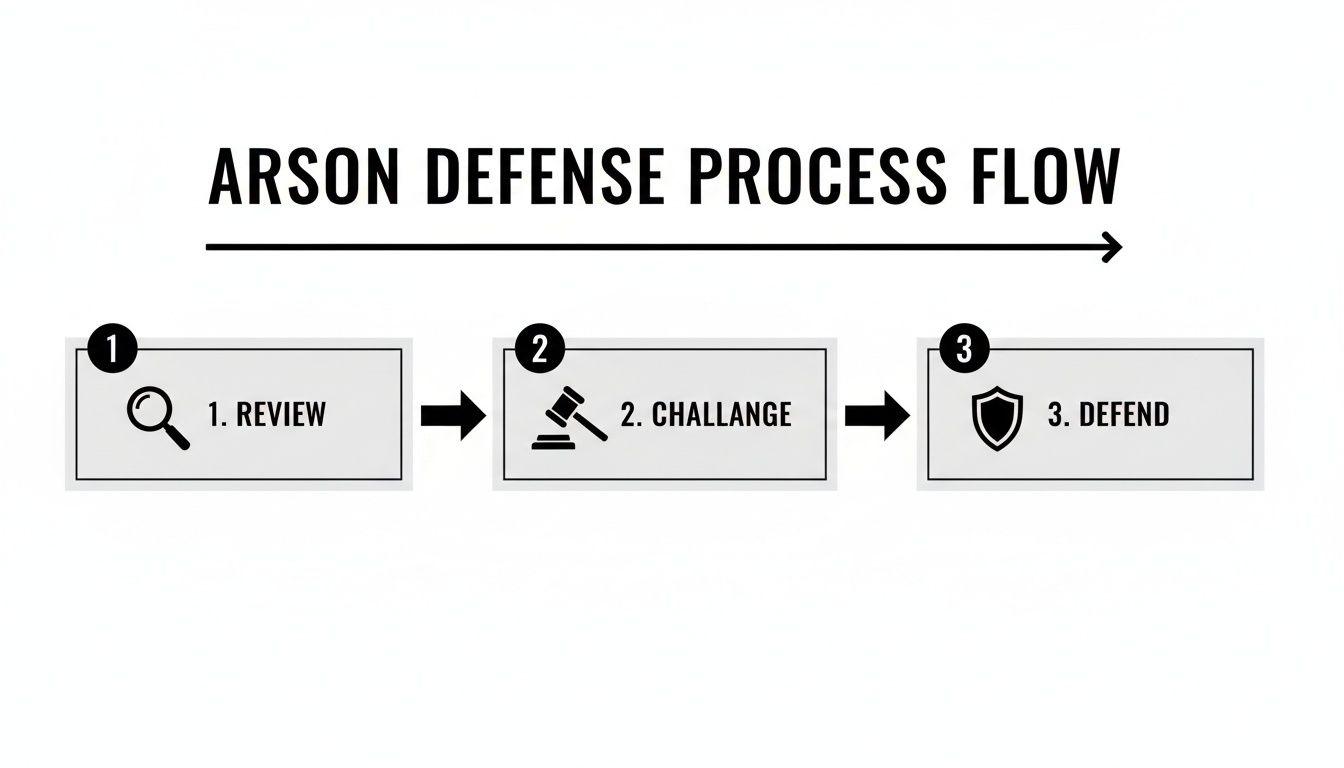
As you can see, we systematically review every piece of evidence, challenge the weaknesses we find, and build a powerful defense designed to protect you.
The pre-trial phase involves several key steps:
- Discovery: This is where we demand to see everything the state has against you. We get the police reports, witness statements, lab results, and any forensic analysis. It's our first look at their playbook, and it's where we start looking for weaknesses.
- Plea Bargaining: The truth is, most cases don't go to trial. Your attorney will negotiate with the prosecutor to see if a better outcome is possible, whether that's getting the charges reduced to something less serious or dismissed entirely. Having a strong defense gives us the leverage we need to make those conversations productive.
- Pre-Trial Motions: This is where we go on the offensive. If the police obtained evidence against you illegally, or if fire investigators relied on junk science, we file motions to suppress. This asks the judge to throw that evidence out so it can't be used against you at trial.
The stakes in any Texas arson case are sky-high, and it's not hard to see why. Between 2018 and 2022, Texas saw 43,351 wildfires burn over 1.7 million acres. A staggering 84% of those fires were human-caused, often leading to investigations under the arson Texas Penal Code. You can see the real-world impact by exploring the historical fire statistics from the Texas A&M Forest Service.
The Final Stages: Trial and Sentencing
If your case can't be resolved during the pre-trial phase, it moves on to trial. This is your chance to have your story heard by a jury of your peers. Your attorney will present evidence, cross-examine the state’s witnesses, and make the argument for your innocence. If the jury finds you not guilty (an acquittal), the case is over, and you walk free.
But if there is a conviction, the case moves to the sentencing phase. This is where the judge or jury decides the punishment. Having a strong legal team present mitigating factors—the human side of the story—can make a huge difference in the outcome. For a more detailed breakdown, take a look at our guide on the steps in the criminal justice process.
Your Questions About Texas Arson Law Answered
When you’re facing a serious charge like arson, your mind is probably racing with urgent questions. The legal system can feel confusing, and finding a straight answer can seem impossible. We’ve put together clear, practical answers to the most common questions we hear from people in your exact situation.
What Is the Difference Between Arson and Reckless Damage in Texas?
This is one of the most critical distinctions in any Texas fire-related case, and it’s often the cornerstone of a solid defense. The entire difference boils down to a single, powerful word: intent.
Arson, as laid out in Texas Penal Code § 28.02, demands that prosecutors prove you deliberately set a fire with the specific goal of destroying or damaging something. They have to convince a jury you wanted that fire to start and you wanted it to cause destruction.
On the other hand, a charge like reckless damage or criminal mischief is about a much lower state of mind. It means you were aware of a huge, unjustifiable risk that your actions could start a fire, but you ignored that risk and did it anyway.
Think of it this way: Pouring gasoline on a car and tossing a lit match on it is intentional arson. But setting off commercial-grade fireworks in a bone-dry field during a burn ban—which then sparks a wildfire—is far more likely to be seen as reckless. The first act was done for the purpose of destruction; the second was done with a dangerous disregard for a known risk.
The difference in punishment is enormous. Arson is a serious felony. Criminal mischief, depending on the dollar value of the damage, could be a lower-level felony or even a misdemeanor. A sharp defense attorney will often build a case by showing the evidence points to a tragic accident or a moment of recklessness, not the malicious intent needed to prove arson.
Can I Be Charged with Arson If No One Was Hurt and the Damage Was Minor?
Yes, you absolutely can. This is a tough pill to swallow but a crucial reality of the arson Texas penal code. Many people assume that if a fire is put out quickly and nobody is injured, the legal fallout will be minimal. That’s just not how the law works.
The Texas arson statute focuses on your intent when the fire started, not the final result. Even if the damage was tiny—a few scorch marks on a wall—you can still face a second-degree felony charge if the state believes you intended to destroy a building or a vehicle.
A second-degree felony is a life-changing event, carrying a potential prison sentence of 2 to 20 years. It gets even worse if the state claims the fire was set to collect insurance money—that bumps the charge up to a first-degree felony, no matter how little damage was actually done.
While the lack of injuries and minor damage are powerful points to argue during plea bargaining or at sentencing, they won't stop the state from filing very serious felony charges from the get-go.
What Should I Do Immediately After Being Accused or Arrested for Arson?
The first few minutes and hours after an accusation or arrest are the most important. The moves you make—and the ones you don't make—can define the rest of your case. Your only priority should be protecting your rights.
- Exercise Your Right to Remain Silent: This is non-negotiable. Do not talk to police, fire marshals, or insurance investigators about what happened without your lawyer sitting right next to you. It is shockingly easy for an innocent remark to be twisted into something that sounds like a confession. Calmly and firmly say, "I am exercising my right to remain silent, and I want to speak with my lawyer." Then stop talking.
- Do Not Consent to a Search: Don't give anyone permission to search your phone, your car, or your home. If they want to look, make them get a warrant.
- Contact a Criminal Defense Attorney Immediately: Don't wait until morning. The faster an attorney gets involved, the better. A good lawyer will immediately shield you from questioning, start preserving evidence that helps you, fight for your release at a bail hearing, and begin building the defense strategy you need to protect your future.
Getting a lawyer involved early is the single most effective thing you can do. It puts a legal barrier between you and the full weight of the prosecution from day one.
Is It Possible to Get My Record Sealed or Expunged After an Arson Case?
Yes, it’s possible, but your eligibility is tied directly to how your criminal case ends. This is exactly why fighting the charge from the very beginning is so important—the consequences of a conviction stick with you forever.
- Expunction: You can typically get an expunction if your case is dismissed, you’re found not guilty at trial (acquitted), or a grand jury no-bills you (meaning they refuse to indict). An expunction is the best possible outcome because it legally erases all records of the arrest. You can then legally deny it ever happened on job applications or anywhere else.
- Record Sealing (Nondisclosure): If you are convicted of arson, you are almost always ineligible to have your record sealed, even if you successfully complete deferred adjudication probation. Texas law blocks nondisclosure for a long list of serious felonies, and arson is on that list.
The permanence of an arson conviction creates a lifelong sentence of its own, slamming doors to jobs, housing, and professional licenses. This makes it crystal clear: the primary goal has to be avoiding a conviction at all costs. An aggressive defense aimed at getting a dismissal or an acquittal is your best—and often only—shot at a clean slate.
If you’ve been charged with a crime in Texas, call The Law Office of Bryan Fagan, PLLC for a free and confidential consultation. Our defense team is ready to protect your rights. Visit us at https://texascriminallawyer.net.