Being arrested for assault in Texas can be terrifying—but you don’t have to face it alone. One minute everything is normal, and the next, you're in the back of a police car with your head spinning. It's a confusing experience, but it’s critical to remember one thing: an arrest is not a conviction. What you do in these first few hours can set the stage for your entire defense.
What to Do After an Assault Arrest in Texas
The moments after an arrest are a blur of adrenaline and uncertainty. Your actions, however, can either help or hurt your case down the road. Knowing what to do—and just as importantly, what not to do—can give you back a sense of control.
The single most important rule is to remain silent. You must give officers your basic identifying information, like your name and address, but that's it. You are under no obligation to answer questions about what happened. Police are trained to get you talking, and anything you say can—and will—be used against you by the prosecutor.
Your Immediate Priorities After an Arrest
After you’re in custody, your mind should be focused on three things: stay calm, stay quiet, and call a lawyer. These aren't just suggestions; they're the foundation of protecting yourself.
- Exercise Your Right to Remain Silent: Politely but firmly say, "I am exercising my right to remain silent, and I would like to speak with my attorney." Repeat it as many times as you need to. Don't try to explain your side of the story to the police.
- Do Not Resist Arrest: Even if you feel the arrest is unfair, resisting will only add another criminal charge to your problems. Comply with the officers' instructions calmly and quietly.
- Contact a Criminal Defense Attorney Immediately: Don't wait. An experienced lawyer can get to work right away, protecting you from interrogation and fighting to get you out on bail as soon as possible.
This simple infographic breaks down the essential steps to take right after an assault arrest.
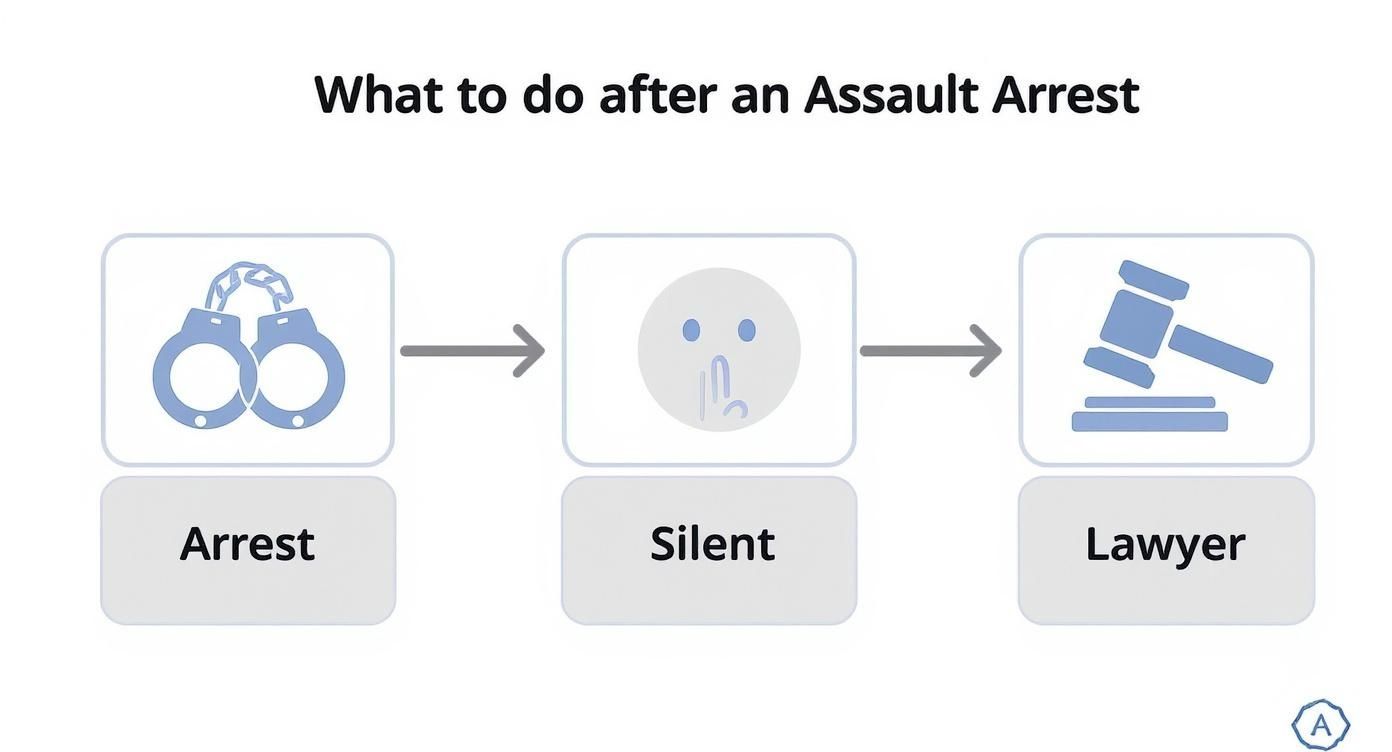
As you can see, invoking your rights and getting a lawyer on your side are the immediate pillars of a strong defense.
Once you get to the station, you will go through the booking process—fingerprints, photos, and paperwork. You can learn more in our detailed guide explaining what happens when you get arrested in Texas. After booking, a magistrate judge will set your bail amount and other conditions for release. Having an attorney at this early stage is a game-changer, as they can argue for a reasonable bail and begin investigating the allegations against you.
Understanding How Texas Defines Assault
When you’re facing an assault charge in Texas, the legal jargon can feel overwhelming. Building a strong defense starts with a simple but crucial step: understanding what the prosecutor actually has to prove. It's not as simple as "he hit me." The law has very specific definitions.
Under Texas Penal Code § 22.01, the state can charge someone with assault in three different ways. You do not have to cause a serious injury to end up in handcuffs. In fact, you don’t even have to make physical contact at all.
This broad definition is why so many situations—from a bar fight to a heated argument—can spiral into an assault arrest. Knowing which part of the law applies to your case is the first step you and your attorney will take to build your defense.
The Three Types of Simple Assault
The most common assault charge, typically a Class A Misdemeanor, boils down to one of three situations. To get a conviction, the prosecution only needs to prove one of them beyond a reasonable doubt.
- Intentionally, Knowingly, or Recklessly Causing Bodily Injury: This is the one most people think of. It’s a physical act that causes pain, sickness, or any kind of physical impairment. A punch or a hard shove that results in actual physical harm fits here.
- Intentionally or Knowingly Threatening Another with Imminent Bodily Injury: This type of assault doesn't require any physical contact. The core of it is the threat itself and the victim's reasonable fear that they are about to be hurt right now.
- Intentionally or Knowingly Causing Physical Contact That is Offensive or Provocative: This is the lowest level of assault, often a Class C Misdemeanor. Think of unwanted contact that a reasonable person would find offensive—like an aggressive finger poke in the chest, spitting on someone, or an unwanted, provocative touch.
You'll notice words like "intentionally," "knowingly," and "recklessly" appear often. These aren't just filler words; they describe your state of mind, which is a critical piece of the puzzle the prosecutor must prove.
What Do These Legal Terms Mean For Your Case?
In the eyes of the law, what you were thinking at the time of an incident is just as important as what you did. The court wants to know about your intent.
A person's intent can be the difference between a criminal charge and an unfortunate accident. Proving or disproving your state of mind is often the central battleground in an assault case, and it's where a skilled defense attorney can make a powerful impact.
Let's break these terms down into plain English:
- Intentionally: You acted because you wanted to cause a specific result. For example, your goal was to swing your fist and cause the other person pain.
- Knowingly: You were aware that your actions were practically guaranteed to cause the result. An example is throwing a heavy object into a dense crowd—you know it's almost certain to hit somebody.
- Recklessly: You saw a major, unjustifiable risk but decided to ignore it and act anyway. An example would be swinging a baseball bat around wildly in a crowded room, even if you weren't aiming at anyone in particular.
The prosecution has to prove one of these mental states. If your actions were truly accidental or you didn't have the required mindset, you have a powerful defense. This is why it’s so critical to tell your attorney every single detail of what happened.
Misdemeanor vs. Felony Assault Penalties

In Texas, "assault" isn't a one-size-fits-all term. It covers a huge range of actions, and the penalties are just as varied. Understanding the line between a misdemeanor and a felony assault charge is absolutely critical, because it directly impacts your freedom, finances, and future.
The consequences can be as minor as a fine you'd get for a traffic ticket or as severe as decades in a state penitentiary.
The specific circumstances of the incident determine how the state classifies the charge. Prosecutors look at a few key details to decide whether an allegation is a relatively minor offense or a life-altering felony. These details are the dividing line between walking away with a fine and facing years behind bars.
Factors That Elevate an Assault Charge
What turns a simple argument into a serious felony? The Texas Penal Code spells out specific "aggravating factors" that automatically ramp up the severity of an assault charge. If even one of these elements is present, the potential penalties escalate dramatically.
Key factors that can enhance an assault charge from a misdemeanor to a felony include:
- The Severity of the Injury: An act that causes "bodily injury"—which can be as simple as physical pain—is typically a misdemeanor. But if that act results in "serious bodily injury" (an injury creating a substantial risk of death, permanent disfigurement, or loss of a bodily function), the charge becomes a felony.
- The Use of a Weapon: If a "deadly weapon" is used or even just shown during the assault, the charge is immediately bumped up to aggravated assault, a second-degree felony. A deadly weapon isn't just a gun or a knife; it can be any object capable of causing serious harm.
- The Identity of the Alleged Victim: Assaulting certain people carries much heavier penalties. This protected class includes public servants like police officers and firefighters, emergency medical personnel, security guards, and even sports officials.
- A Prior Conviction: If you have a previous conviction for assault against a family member, a new allegation can be charged as a felony, even if no serious injury occurred this time.
These factors are why two situations that seem almost identical on the surface can lead to completely different legal outcomes. It all boils down to the specific details the prosecution uses to build its case.
Comparing Misdemeanor and Felony Consequences
The distinction between these two categories is stark. A misdemeanor conviction, while serious, generally involves county jail time and smaller fines. A felony conviction means potential time in a state prison, massive fines, and the loss of fundamental civil rights, like the right to vote or own a firearm.
A felony assault conviction follows you for life. It creates permanent barriers to employment, housing, and educational opportunities, making it crucial to mount an aggressive defense from the very beginning.
Aggravated assault is a significant focus for law enforcement across the state. The 2022 Crime in Texas Annual Report from the Texas Department of Public Safety showed 107,050 reported aggravated assaults, highlighting just how often these serious charges are filed.
To give you a clear picture of what's at stake, the table below breaks down the specific penalty ranges for different classifications of assault charges here in Texas.
Texas Assault Penalties Misdemeanor vs. Felony
This table provides a snapshot of the potential penalties you could face, from a low-level misdemeanor to the most serious felonies.
| Classification | Maximum Jail/Prison Time | Maximum Fine |
|---|---|---|
| Class C Misdemeanor | None | Up to $500 |
| Class A Misdemeanor | Up to 1 Year in County Jail | Up to $4,000 |
| Third-Degree Felony | 2 to 10 Years in Prison | Up to $10,000 |
| Second-Degree Felony | 2 to 20 Years in Prison | Up to $10,000 |
| First-Degree Felony | 5 to 99 Years (Life) in Prison | Up to $10,000 |
Seeing these numbers in black and white can be overwhelming. It truly underscores the importance of having a skilled Texas assault defense attorney in your corner. An experienced lawyer can challenge the prosecution's evidence, fight to get charges reduced, and work to protect your future from the devastating impact of a conviction.
What Is Aggravated Assault in Texas?
Sometimes, a set of specific circumstances can take a standard misdemeanor assault and turn it into a much more serious felony. This is what Texas law calls aggravated assault, a charge that carries penalties capable of changing your life forever. It's critical to understand what elevates an assault charge, as it explains why the prosecution pursues these cases so aggressively.
Under the Texas Penal Code, an assault charge gets "aggravated" in two primary ways: when the incident causes "serious bodily injury" or when a "deadly weapon" is used or even just displayed during the offense. If the state can prove either of these elements, the charge jumps straight to a second-degree felony, which comes with a potential prison sentence of 2 to 20 years.
The Meaning of a Deadly Weapon
When most people hear the term "deadly weapon," they immediately think of a gun or a knife. And while those certainly qualify, the legal definition in Texas is surprisingly broad. Texas Penal Code § 1.07(a)(17) defines a deadly weapon as anything that, based on how it's used or intended to be used, is capable of causing death or serious bodily injury.
This flexible definition means that almost any everyday object could be classified as a deadly weapon, depending entirely on the context.
- A baseball bat swung menacingly during an argument.
- A steel-toed boot used to kick someone who is already on the ground.
- A car used to deliberately try and run another vehicle off the road.
- Even something as seemingly harmless as a pillow could qualify if it's used in an attempt to suffocate someone.
The key takeaway here is that prosecutors don't just look at what the object is; they focus intensely on how it was used. This is a frequent battleground in aggravated assault cases and an area where a sharp defense attorney can build a strong counter-argument. You can learn more about how these charges are constructed by reading our detailed overview of Texas aggravated assault laws.
Understanding Serious Bodily Injury
The other major factor that can elevate an assault charge is the level of harm inflicted. A simple "bodily injury" might be nothing more than minor pain or a bruise, but "serious bodily injury" is a whole different legal standard. The law defines it as an injury that creates a substantial risk of death, causes permanent disfigurement, or leads to the long-term loss or impairment of a body part or organ.
The line between "bodily injury" and "serious bodily injury" isn't always crystal clear, making it a major point of contention in court. The prosecution will bring in medical records and expert witnesses to argue the injury was severe, while your defense team will work to demonstrate that the legal threshold for a felony simply wasn't met.
Examples of injuries that almost always qualify as serious bodily injury include:
- Broken bones
- Significant burns
- Loss of consciousness
- Wounds requiring surgery or extensive stitches
- Damage to an internal organ
The specific nature of the injury becomes a central piece of evidence that will be scrutinized from every possible angle as your case moves forward.
Other Enhanced Assault Charges
On top of the standard definition of aggravated assault, Texas law creates even harsher penalties for assaults that happen in specific contexts or against certain people. These enhancements show the state's priority in protecting vulnerable populations and public servants.
Assault Family Violence
An assault against a family member, someone in your household, or a person you're in a dating relationship with comes with its own set of consequences. While a first offense is typically a Class A Misdemeanor, a second offense is automatically filed as a third-degree felony. A conviction can also lead to the permanent loss of your right to own a firearm under federal law.
Assault on a Public Servant
If you intentionally, knowingly, or recklessly cause bodily injury to someone you know is a public servant performing their official duties, you'll face a third-degree felony. This protection extends to:
- Police officers
- Firefighters
- Emergency medical services (EMS) personnel
- Judges
- Process servers
Because these aggravating factors drastically increase the fines and potential prison time you're facing, it’s absolutely essential to have a defense team that knows exactly how to challenge the state's evidence at every turn.
Navigating a Sexual Assault Allegation
An allegation of sexual assault is one of the most destructive charges anyone can face. The legal penalties are life-altering, but the damage to your reputation, career, and personal life starts the second the accusation is made. These cases are incredibly emotional and legally complex, demanding a defense that is both aggressive in the courtroom and sensitive to your situation.
Under Texas Penal Code § 22.011, sexual assault is defined as intentionally or knowingly penetrating another person without their consent. Unlike other assault cases that might have clear physical evidence, these often come down to one person's word against another's. Because of this, the issue of consent nearly always becomes the central battleground.
The Critical Issue of Consent
In Texas, consent must be given freely and willingly. The prosecution's entire case will focus on proving that consent was missing—either due to force, threats, or because the accuser was unable to give it because of their age, a mental defect, or intoxication.
Sorting this out requires a meticulous and careful investigation into the facts. A skilled defense lawyer will dig into every text message, witness statement, and piece of circumstantial evidence to build a true picture of what happened and dismantle the prosecution's narrative.
The Lifelong Consequences of a Conviction
A conviction for sexual assault in Texas is devastating. It’s typically a second-degree felony, which carries a prison sentence of 2 to 20 years and a fine up to $10,000. But the punishment doesn't end when the prison sentence is over.
The most significant consequence is almost always mandatory lifetime registration as a sex offender. This isn't just a label; it's a permanent set of barriers that will impact:
- Where you can live: Texas law bars registered sex offenders from living within a certain distance of places where children gather, like schools, parks, and daycare centers.
- Your employment opportunities: A spot on the registry is a major red flag for employers, making it incredibly difficult to find and keep a job.
- Your personal relationships: The registry is public. That stigma can destroy your social and family life.
Given the profound and permanent consequences, fighting a sexual assault allegation requires immediate and strategic legal action. Your future depends on mounting the strongest defense possible from the very beginning.
It's also worth noting that these cases are notoriously difficult to prosecute. State data reflects this reality. Between 2014 and 2018, law enforcement agencies in Texas reported 71,274 incidents of sexual assault, but only 23,422 arrest charges were actually filed. You can read the full analysis from the Texas State Auditor's Office to get a better sense of the statistics.
Facing an allegation of this magnitude can feel isolating and hopeless. You do not have to go through this alone. An experienced Texas criminal defense attorney who understands the nuances of these sensitive cases can protect your rights, challenge the evidence, and fight to preserve your freedom and your future.
Common Defenses to an Assault Charge

Facing an assault charge can feel like the world is closing in, but it’s critical to remember that an arrest is not a conviction. The prosecution has the entire burden of proving its case beyond a reasonable doubt. You have an absolute right to fight back with a powerful defense.
A skilled Texas criminal defense attorney will dig into every detail of your case to find the strongest path forward. This isn’t just about telling your side of the story; it’s about questioning the evidence, challenging witness credibility, and holding law enforcement accountable for any procedural mistakes. Every angle must be explored.
Self-Defense and Defense of Others
One of the most powerful defenses against an assault charge is self-defense. Texas law is clear: you have the right to protect yourself from harm. Under the Texas Penal Code, you are justified in using force when you reasonably believe it is immediately necessary to stop someone else’s unlawful use of force against you.
To win a self-defense argument, your attorney must convince a jury that your actions were reasonable under the circumstances you faced. This means the force you used had to be proportional to the threat. Our law firm has a complete guide that goes deeper into claiming self-defense in Texas. The same principle applies to defending another person—if you reasonably believe they are in immediate danger, you can step in.
Challenging the Prosecution’s Evidence
Another highly effective strategy is to attack the evidence the prosecution is using against you. This is not a one-size-fits-all approach; it’s tailored specifically to the unique facts of your case. Your attorney’s job is to scrutinize every piece of the state's case and find the weak spots.
Here are a few common ways to challenge the evidence:
- Contradicting Witness Testimony: Pointing out inconsistencies in what the accuser or other witnesses are saying can create serious reasonable doubt. Stories change, and memories fade.
- Questioning Physical Evidence: We can challenge how physical evidence was collected, handled, or interpreted. In aggravated assault cases that tragically result in death, understanding the role of a forensic pathologist expert witness in Texas courts becomes crucial for the defense.
- Proving Mistaken Identity: Was it dark? Did things happen fast? Were the eyewitnesses unreliable? It may be possible to prove that you weren't the person who committed the alleged act.
A strong defense isn't about making excuses; it's about holding the prosecution to its high legal standard. By systematically dismantling the state's case piece by piece, an experienced attorney can create the reasonable doubt necessary for an acquittal or a favorable plea agreement.
Ultimately, being charged with assault does not seal your fate. With a strategic and aggressive defense, you can fight the allegations head-on and work toward clearing your name.
Common Questions About Texas Assault Charges
When you're suddenly thrown into the criminal justice system, your mind is probably racing with questions. The whole situation can feel overwhelming and frightening, but getting clear, straightforward answers is the first step toward regaining some control. Here are some of the most common questions we hear from people facing assault charges in Texas.
Can Assault Charges Be Dropped in Texas?
Yes, it's absolutely possible for assault charges to be dropped. A prosecutor might decide to dismiss a case if the evidence against you is weak, if a key witness stops cooperating, or if your attorney successfully shows that your constitutional rights were violated during the arrest or investigation.
But don't make the mistake of thinking charges will just disappear on their own. The decision to drop a case rests entirely with the prosecutor, not the person who made the accusation. Convincing the state to dismiss the charges almost always takes proactive, strategic work from a skilled defense lawyer.
What's the Difference Between Assault and Battery in Texas?
This is a huge point of confusion, especially for people who are familiar with laws from other states or what they've seen on TV. While many states have separate crimes for "assault" (the threat) and "battery" (the physical act), Texas law does not have a separate crime called battery.
Instead, the Texas Penal Code rolls both of those concepts into a single, broad offense simply called "assault." An assault charge can stem from causing an injury, threatening someone with imminent harm, or even just making physical contact that someone finds offensive. This means actions that other states might split into two different charges all fall under one statute here in Texas.
It's critical to understand that under Texas law, you don't have to physically touch someone to be charged with assault. A credible threat of imminent harm is enough to lead to an arrest and a conviction, highlighting the broad scope of the statute.
How Long Can You Go to Jail for Assault in Texas?
The potential jail or prison time for an assault conviction varies dramatically. The penalties are tied directly to how the offense is classified, which depends on the severity of the alleged act and other circumstances.
The range of punishment can be anywhere from:
- No jail time at all for a Class C misdemeanor, which is punishable only by a fine.
- Up to one year in county jail for a standard Class A misdemeanor assault.
- From two years to life in a state prison for a first-degree felony, like an aggravated assault that results in a serious bodily injury.
The specific facts of your case, your personal criminal history, and the strength of your defense will all play a massive role in determining what kind of penalties you might be facing.
If you’ve been charged with a crime in Texas, call The Law Office of Bryan Fagan, PLLC for a free and confidential consultation. Our defense team is ready to protect your rights. Visit us at https://texascriminallawyer.net.