Skip to content
Being arrested for assault in Texas can be terrifying — but you don’t have to face it alone. You're likely feeling overwhelmed, scared, and completely unsure of what happens next. It's a heavy situation. Most people think "assault" means a physical brawl, but under Texas law, the definition is shockingly broad. It can cover everything from an unwanted touch to a verbal threat, and every version of it carries serious consequences.
When you're facing allegations like these, you have to act fast and think clearly. Your rights and your entire future are on the line.
What an Assault Charge Really Means in Texas
Being accused of assault can feel like the walls are closing in, but you don't have to navigate this alone. The first step toward building a solid defense is to understand exactly what the state is accusing you of under the Texas Penal Code. It's not just about getting into a fight.
This is the stage where we swap anxiety for knowledge. Knowing the specific charge against you is the bedrock of your entire defense strategy. It's where we start fighting back.
The Three Ways to Commit Assault in Texas
The rulebook prosecutors must follow is Texas Penal Code § 22.01. In plain English, it lays out three specific ways a person can commit assault. This isn't just dry legal text; it’s the exact framework the state must use to prove its case against you. Understanding these rules is the first step to finding the weaknesses in their argument.
An assault happens if you:
- Intentionally, knowingly, or recklessly cause bodily injury to another. "Bodily injury" is a surprisingly low bar. The law defines it as physical pain, illness, or any impairment. Even a small bruise could be enough.
- Intentionally or knowingly threaten another with imminent bodily injury. Notice that no physical contact is needed here. If a reasonable person would take a verbal threat seriously, it can lead to an assault charge all on its own.
- Intentionally or knowingly cause physical contact with another when you know or should reasonably believe that the other person will regard the contact as offensive or provocative. This covers actions like poking, shoving, or any unwanted touching, even if it doesn't cause any pain.
The key takeaway is that an assault charge in Texas doesn't require a serious injury or even any physical contact at all. The accusation can stem from a misunderstanding, a heated argument, or an action you never intended to be harmful.
From Misdemeanor to Felony
The details surrounding the alleged incident are what determine how seriously the state will pursue the charge. A simple push might be a Class C misdemeanor (similar to a traffic ticket), but if that same push was against an elderly person, it could become a third-degree felony.
Several factors can dramatically ramp up the penalties:
- The alleged victim’s status (e.g., a public servant, elderly individual, or family member)
- Whether a weapon was used or even just displayed
- If the incident is classified as "family violence"
This is why you can't afford to underestimate any assault allegation. What feels like a minor disagreement can quickly spiral into a life-changing felony charge, complete with the threat of prison and a permanent stain on your record.
Texas Assault Charges At A Glance
To help you get a clearer picture, this table breaks down the most common assault charges in Texas, their legal classification, and the range of penalties you could be facing.
| Type of Assault | Texas Penal Code Section | Classification | Potential Penalties |
|---|---|---|---|
| Simple Assault | § 22.01(a)(1) | Class A Misdemeanor | Up to 1 year in jail and/or a fine up to $4,000. |
| Assault by Contact | § 22.01(a)(3) | Class C Misdemeanor | A fine up to $500. |
| Assault Family Violence | § 22.01(b) | Starts as Class A Misdemeanor, enhanced to Third-Degree Felony on second offense. | Penalties range from jail time to prison (2-10 years). |
| Aggravated Assault | § 22.02 | Second-Degree Felony | 2-20 years in prison and a fine up to $10,000. |
| Sexual Assault | § 22.011 | Second-Degree Felony | 2-20 years in prison and a fine up to $10,000. |
This table is just a starting point. The specific facts of your case will determine the exact charges and potential outcomes. Understanding these distinctions is the first step toward regaining control and preparing an effective defense.
Understanding The Different Levels Of Assault Offenses
When you hear the word "assault" in Texas, it’s not a one-size-fits-all term. The law treats assault charges very differently depending on the specifics of what happened. A minor argument that gets a little heated can land you with a misdemeanor, while another situation could result in a serious felony charge carrying decades in prison.
The key is understanding what factors prosecutors look at to decide how to charge your case. It’s not random. They’ll examine the level of injury, whether a weapon was involved, and the relationship between you and the other person. Think of it like a ladder—each of these elements can push a charge up to a much more serious level.
The Foundation: Simple Assault
Most assault cases start here. A Simple Assault is usually a Class A Misdemeanor under Texas Penal Code § 22.01, and it’s triggered when someone causes "bodily injury" to another person.
Now, "bodily injury" is a term that trips a lot of people up. It doesn't mean you have to cause a serious wound. The legal definition is incredibly broad—it’s just physical pain, illness, or any kind of physical impairment. A scratch, a bruise, or even the sting from a slap can be enough for the state to charge you with a Class A misdemeanor, which is punishable by up to a year in jail and a $4,000 fine.
There's an even lower level called Assault by Contact, which is a Class C Misdemeanor. This is for physical contact that’s offensive or provocative but doesn't cause any actual pain. While it only comes with a fine of up to $500, a conviction still leaves a permanent mark on your criminal record.
When Charges Escalate to a Felony
This is where the details of your case become absolutely critical. An assault can jump from a misdemeanor to a felony in the blink of an eye based on certain "aggravating factors."
A few common escalators include:
- Who the Victim Is: If the alleged assault is against a public servant (like a police officer or firefighter), a pregnant person, an elderly individual, or even a security guard, the charge is often bumped up to a felony.
- Your Criminal History: If you have a previous conviction for assault, especially one involving family violence, a new misdemeanor charge can be automatically upgraded to a third-degree felony.
- Impeding Breathing: This is a big one. If an assault involves choking or blocking the normal breathing or blood circulation of a family member, it’s an automatic third-degree felony. That carries a prison sentence of 2 to 10 years.
An allegation is not a conviction. The prosecution bears the burden of proving every single element of the offense beyond a reasonable doubt. A skilled defense attorney works to show the jury that the state's story doesn't add up.
Aggravated Assault: A Serious Felony Charge
At the top of the ladder is Aggravated Assault, which is defined in Texas Penal Code § 22.02. This is almost always a felony, and it gets filed when an assault either causes "serious bodily injury" or involves the use or exhibition of a deadly weapon.
What’s the difference between "bodily injury" and "serious bodily injury"? It’s a huge leap. The law defines serious bodily injury as something that creates a substantial risk of death, causes serious permanent disfigurement, or results in the long-term loss or impairment of a body part or organ.
The other trigger for an aggravated assault charge is a deadly weapon. And don't just think of guns and knives. A deadly weapon can be any object that is used in a way that’s capable of causing death or serious injury. A baseball bat, a steel-toed boot, or even your car can qualify, all depending on how it was used in the incident.
An aggravated assault charge is a second-degree felony, which comes with a potential prison sentence of 2 to 20 years. And if other factors are present—like if the victim was a public servant or the act was gang-related—it can be enhanced to a first-degree felony, with a punishment range of 5 to 99 years or even life in prison.
Knowing exactly where your charge falls on this spectrum is the very first step in building a powerful defense against the state’s allegations.
What To Expect After An Assault Arrest In Texas
The moments after an assault arrest in Texas are a blur of confusion and fear. It feels chaotic, like your life is spiraling out of control. But the criminal justice system, while intimidating, is really just a series of steps. Understanding that roadmap can make all the difference. An arrest isn't a conviction. It's just the starting line of a long legal race.
This infographic shows how an assault charge can escalate quickly based on the details of the situation.
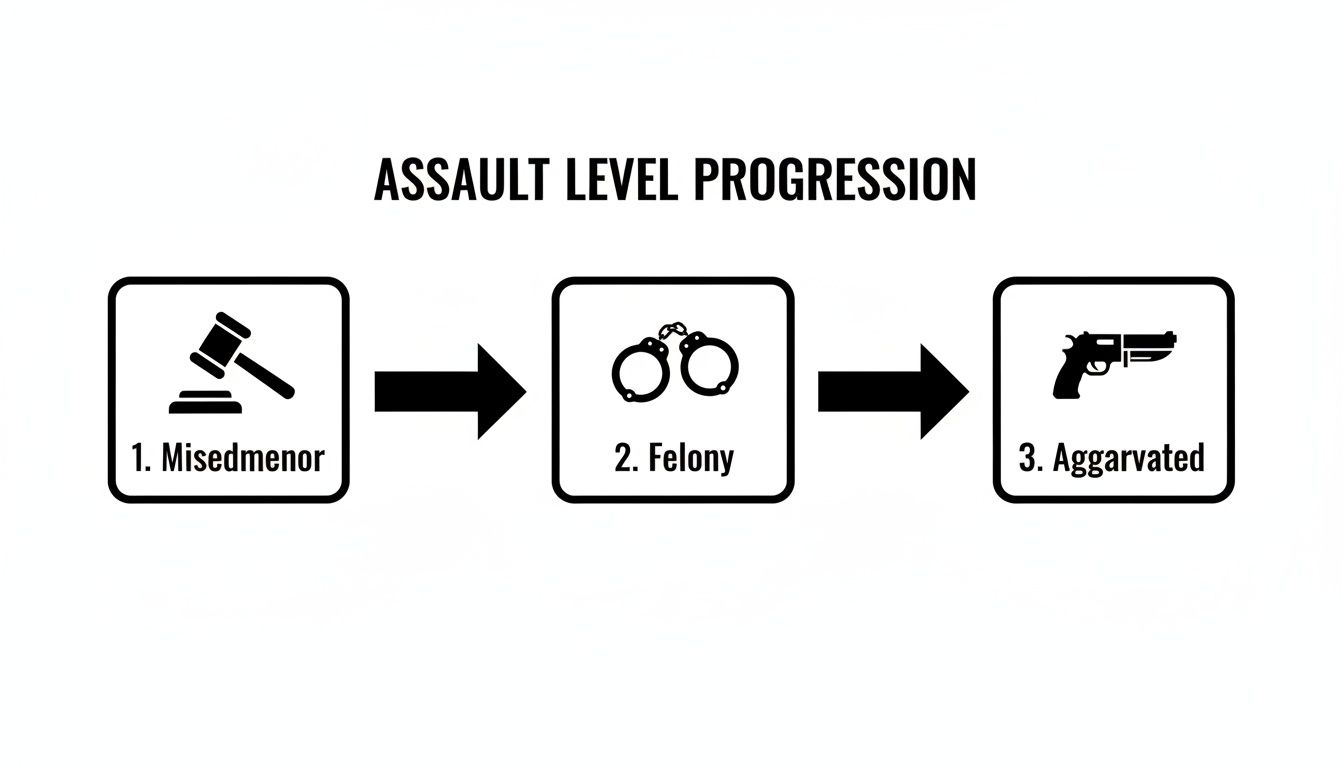
As you can see, factors like the seriousness of an injury or whether a weapon was involved can instantly turn a simple misdemeanor into a life-altering felony.
Step 1: Booking and Arraignment (The First 48 Hours)
Right after the arrest, you’ll be taken to a police station or county jail for booking. This isn't the dramatic scene from TV; it's mostly administrative paperwork. Officers will:
- Record your name, date of birth, and other personal details.
- Take your fingerprints and photograph for a mugshot.
- Search you and inventory your personal belongings for safekeeping.
By law, you must be brought before a judge for your arraignment within 48 hours of your arrest. This is your first time in court. The judge will read the formal charges against you, explain your constitutional rights (like the right to an attorney), and decide on the initial terms of your release.
Step 2: Setting Bail and Bond Conditions
During the arraignment, the judge sets your bail—the amount of money required to get you out of jail while your case moves forward. Bail isn't a fine or punishment; it's a financial promise that you'll show up for future court dates.
A judge weighs several things when setting the bail amount, including:
- The severity of the assault charge.
- Your past criminal history (or lack thereof).
- Your ties to the community, like a job or family.
- Whether they think you're a flight risk or a danger to others.
Along with bail, the judge will almost always impose bond conditions. For assault cases, a "no-contact order" is standard. This legally forbids you from communicating with or even going near the alleged victim. Breaking that order is a huge mistake—it can get your bail revoked and land you back in jail with new criminal charges.
Step 3: The Pre-Trial Phase (Discovery and Plea Bargaining)
Once you're released, your case moves into the pre-trial phase. This is where the real work for your defense attorney begins. Through a process called discovery, your lawyer demands all the evidence the prosecutor has collected against you—police reports, witness statements, photos, bodycam footage, you name it. This is where we learn what to do after an assault accusation in Texas by digging into the state's case to find its weak spots.
An arrest is just one side's accusation. The discovery process is where your attorney gets to see the whole story and starts pushing back against the prosecution’s version of events with facts.
During this time, your lawyer also starts negotiating with the prosecutor. They'll discuss the strengths and weaknesses of the case, present evidence that helps your side, and see if a plea bargain is possible. A plea bargain is an agreement to resolve the case without a trial, often for a lesser charge or a more favorable sentence.
Many assault cases are resolved here. But if a fair deal can't be reached, your case gets scheduled for trial. It's critical to remember: you are presumed innocent, and the state has the entire burden of proving you're guilty beyond a reasonable doubt.
Building Your Strategic Defense Against Assault Allegations
Being accused of assault is just that—an accusation. It’s not a conviction. It’s the very beginning of a legal fight where your side of the story must be told, defended, and proven. Building a strong defense is about more than just showing up to court; it's about meticulously picking apart the prosecution’s narrative and standing up for your rights every step of the way.
Every assault case has weak spots, and a skilled defense attorney knows exactly where to find them. From sloppy police work during the arrest to witnesses who can't keep their stories straight, our job is to expose every crack in the state's case.
Common Defenses Against Assault Charges in Texas
Texas law recognizes that not every use of force is a crime. There are specific, legally recognized justifications for actions that might otherwise land you in hot water. To use one of these defenses, you need more than a good story—you need a deep understanding of the law and the ability to apply it to the facts of your case.
Some of the most powerful defenses we see include:
- Self-Defense: This is probably the most common and effective defense. Under Texas Penal Code Chapter 9, you have the right to use force against someone when you reasonably believe it’s immediately necessary to protect yourself from their unlawful force. The key here is proportionality—your response has to match the threat you were facing.
- Defense of Others: This works just like self-defense, but you’re stepping in to protect someone else. You’re legally allowed to use force to protect a third person if you reasonably believe they are about to be unlawfully harmed.
- Lack of Intent: The prosecutor must prove you acted intentionally, knowingly, or recklessly. If your actions were a pure accident and you never intended to hurt or threaten anyone, that can be a complete defense to the charge.
- Factual Innocence or Mistaken Identity: Sometimes, the police just get it wrong. A witness might have pointed out the wrong person, or you might have been falsely accused by someone with a personal grudge. In these cases, we dig for evidence—alibis, security camera footage, other witnesses—to prove you weren't even there.
Challenging the Prosecution's Evidence
A prosecutor’s case is only as strong as the evidence they bring to court. Your defense attorney’s job is to put every single piece of that evidence under a microscope to make sure it's credible, reliable, and obtained legally. As you get ready to build your defense, one of the first things you'll do is sit down with an attorney, so it's helpful to understand lawyer consultation fees and know what to expect.
We critically analyze the state's case by asking the tough questions:
- Did the police have probable cause to arrest you in the first place?
- Were you read your Miranda rights before they started asking questions?
- Are there holes or inconsistencies in the alleged victim’s story? What about the other witnesses?
- Was evidence like photos or videos handled correctly, or was the chain of custody broken?
An assault allegation often boils down to a "he said, she said" situation. Your attorney's job is to poke holes in the accuser's story, highlight every inconsistency, and introduce that critical element: reasonable doubt.
It's also important to remember that the clock is ticking. You can check out our guide to learn more about the statute of limitations for assault charges in Texas and understand why moving quickly is so important. By systematically taking apart the prosecution’s arguments and building a compelling counter-narrative, we can put you in the best possible position for a positive outcome, whether that's a dismissal, a reduced charge, or a "not guilty" verdict from a jury.
The Hidden Consequences Of An Assault Conviction
An assault conviction in Texas isn't just about paying a fine or spending time in jail. It's the beginning of a ripple effect that sends waves through every corner of your life long after your case is closed. These hidden consequences are often the most damaging, acting as invisible barriers that can make rebuilding your future feel almost impossible.

A criminal record follows you everywhere. It complicates everyday things most people don't think twice about, like finding a job or a place to live. Grasping these high stakes is the first step in understanding why fighting the charge from day one is absolutely critical.
Your Career And Professional Life
In today's world, background checks are standard practice for most employers. An assault conviction, especially a felony, can get your application tossed in the trash before you even get a chance to explain yourself.
This is especially true for any job that requires a high degree of trust or involves working with vulnerable people. An assault conviction can slam the door on your ability to:
- Get or keep professional licenses for careers like nursing, teaching, real estate, or law.
- Work in government or law enforcement jobs.
- Hold positions that involve handling money or sensitive data.
Even a misdemeanor assault can shrink your career options and hamstring your earning potential for years to come. The opportunities just disappear.
Loss Of Fundamental Civil Rights
A conviction doesn’t just hurt your career; it can strip you of fundamental rights you might take for granted. For example, under federal law, any conviction for a crime involving family violence results in a lifetime ban on owning or possessing a firearm.
That’s right—even for a misdemeanor conviction. The permanent loss of Second Amendment rights is a serious consequence that catches many people completely off guard. The financial penalties are also a major blow, and you can learn more about how they're determined in our guide on Texas misdemeanor assault fines.
Housing, Custody, And Your Personal Life
The fallout from an assault conviction bleeds deep into your personal affairs. Landlords almost always run background checks, and seeing a violent crime on your record often leads to an automatic "no." Finding a safe, stable place to live can become a constant struggle.
For parents, the stakes couldn't be higher. A conviction for assault, particularly family violence, becomes a powerful weapon for the other side in a child custody battle. A judge might see the conviction as proof that you pose a risk to your own children, which could lead to restricted visitation or even losing custody entirely.
An assault conviction is not just a legal problem; it's a life problem. It creates a permanent record that can affect your family, your finances, and your freedom for the rest of your life.
Finding A Path Forward With Expunctions and Record Sealing
Even with these heavy consequences, a mistake doesn't have to define the rest of your life. Texas law offers pathways for people to clear their records, but only in certain situations. Depending on how your case was resolved, you might be eligible for:
- Expunction: This is the gold standard. It’s a legal process that completely destroys the records of your arrest and case. For all intents and purposes, it’s like it never happened.
- Order of Nondisclosure: This is more commonly known as record sealing. It stops private companies (like most background check services) from seeing the charge, though law enforcement and government agencies can still access it.
These options aren't available for every case, but they provide a crucial chance for a fresh start. Pursuing a nondisclosure or expunction can reopen doors to jobs and housing, finally allowing you to put the past behind you.
Frequently Asked Questions About Texas Assault Charges
When you’re facing an assault charge, your mind is probably racing. The questions come fast and furious, and the uncertainty can be paralyzing. Getting straight, practical answers is the first step toward getting your feet back on the ground.
We’ve pulled together the most common and urgent questions we hear every day to give you the clarity you need, right now.
What Is The Difference Between Assault And Aggravated Assault In Texas?
The line between a misdemeanor assault and a felony aggravated assault comes down to two things: how badly someone was hurt and whether a deadly weapon was involved. Getting this distinction right is critical because it completely changes the penalties on the table.
A simple assault, which is usually a Class A Misdemeanor, involves causing "bodily injury." In Texas, that’s a very broad term. It just means physical pain, illness, or any kind of impairment. A bruise, a scratch, or even the sting from a slap can be enough to qualify. It can also cover threats of immediate harm or making unwanted, offensive physical contact.
Aggravated assault is a whole different ballgame—it's a serious felony. An assault charge gets bumped up to "aggravated" under Texas Penal Code § 22.02 if it does one of two things:
- It causes "serious bodily injury" to someone. This isn’t just any injury; we're talking about an injury that creates a real risk of death, causes permanent disfigurement, or leads to the long-term loss or impairment of a body part or organ.
- It involves the use or exhibition of a deadly weapon while the assault is happening. And a "deadly weapon" isn't limited to a gun or a knife. It can be anything used in a way that could cause death or serious injury—think a baseball bat, a steel-toed boot, or even a car.
This means a minor scuffle can instantly become a second-degree felony, which carries up to 20 years in prison, if a weapon was so much as shown.
Can Charges Be Dropped If The Victim Doesn't Want To Prosecute?
This is probably one of the biggest myths in criminal law. The short answer is no—the alleged victim doesn't have the power to drop the charges. Once the police are called and an arrest is made, it’s no longer a personal dispute. It becomes "The State of Texas vs. You."
The prosecutor, who represents the State, has the final say on whether to move forward with a case or dismiss it. While they'll certainly listen to what the alleged victim has to say, they are not bound by their wishes.
It is the District Attorney’s Office, not the complaining witness, that prosecutes criminal cases. Even if the victim recants their statement or asks for a dismissal, the prosecutor can force them to testify and move forward with the case if they believe a crime was committed.
This happens all the time, especially in family violence cases. Prosecutors are trained to expect that a victim might change their story due to outside pressure, fear, or a change of heart. However, an uncooperative victim can throw a major wrench in the prosecution’s plans. Their refusal to testify can become a powerful bargaining chip for your defense attorney, potentially leading to a dismissal or a much better plea deal.
Why Is An Assault Family Violence Finding So Serious?
An "assault family violence" finding isn't a separate crime. Think of it as a special tag that gets attached to an assault charge when the incident involves a family member, someone you live with, or a person you’re dating (or used to date). Getting this label slapped on your record brings a set of uniquely harsh and lifelong consequences that go far beyond a regular assault conviction.
First, it sets you up for a felony enhancement down the road. A first-time conviction for assault family violence is usually a Class A Misdemeanor. But if you're ever accused a second time, no matter how minor the incident, the charge is automatically bumped up to a third-degree felony, punishable by 2 to 10 years in prison.
Second, and this is a big one, a conviction with this finding triggers a permanent federal ban on your right to own or possess a firearm. This is a lifetime prohibition. There’s no getting it back.
Finally, an assault family violence conviction can never be sealed in Texas through an order of nondisclosure. This means the charge will sit on your public criminal record forever, for any potential employer, landlord, or licensing board to see. This permanent stain is why fighting to avoid that family violence finding is absolutely critical.
Should I Talk To The Police If I Am Accused Of Assault?
The answer to this is a firm, absolute no. Your Fifth Amendment right to remain silent is the single most important protection you have when you're under investigation. You need to use it immediately and refuse to answer any questions until your lawyer is by your side.
Police officers are skilled investigators. Their job is to gather evidence that will lead to an arrest and help the prosecutor get a conviction. They are legally allowed to use misleading questions and manipulative tactics to get you to say something incriminating.
So many people make the critical mistake of thinking they can talk their way out of it or just "explain their side of the story." This almost never ends well. Even statements you think are completely innocent can be twisted, used out of context, or used to poke holes in your defense later.
There is only one safe and smart thing to say when law enforcement wants to question you:
"I am invoking my right to remain silent, and I would like to speak with my lawyer."
Say this politely but firmly, and repeat it for every question they ask. Don't offer any explanations, excuses, or details about what happened. Saying nothing is the best way to give your defense attorney a clean slate to build the strongest possible case for you.
If you’ve been charged with a crime in Texas, call The Law Office of Bryan Fagan, PLLC for a free and confidential consultation. Our defense team is ready to protect your rights. https://texascriminallawyer.net