Being arrested in Texas can feel like your whole life changed in one night.
Maybe it started with a traffic stop, a hospital visit, a welfare check, or a tense argument with someone you did not even realize counted as a public servant. Then suddenly you are in handcuffs, hearing the word “felony,” and wondering whether you are going to jail, lose your job, or see your family dragged into court too.
If that is where you are right now, take a breath. A charge is serious, but a charge is not a conviction. You still have rights, and you still have options.
An Unexpected Arrest Can Be Terrifying But You Are Not Alone
A lot of people accused of assault public servant texas charges are not hardened criminals. Many are ordinary Texans who got caught in a fast-moving, emotional situation.
You may have been confused, scared, in pain, or reacting badly to stress. You may believe the report leaves out what happened before the officer, EMT, or caseworker says you touched them. You may also be dealing with the emotional shock that follows an arrest.
That reaction is real. For some people, the event itself feels traumatic, and support outside the courtroom can matter too. If you are struggling after the incident, this resource on mental health recovery after a traumatic event may help you understand why your mind and body still feel on edge.
The legal side feels just as overwhelming. You may be asking:
- What does this charge mean
- Is this always a felony
- What if I did not know the person was a public servant
- What if I was defending myself
- What happens after booking, bond, and court
- Can this affect child custody, work, or my record later
Those are the right questions.
Key point: The most dangerous moment in a criminal case is often the beginning, when fear pushes people to guess, explain too much, or accept the State’s version before the evidence is tested.
Texas law treats alleged violence against public servants very seriously. But serious charges can still be challenged. Evidence can be incomplete. Witness accounts can conflict. Body camera footage may tell a different story than the arrest report.
You need clear information, not panic. The rest of this guide breaks the issue down in plain English so you can understand what the State must prove, how penalties work, what defenses may apply, what the court process looks like, and how to protect your future.
What Is Assault on a Public Servant in Texas
Under Texas Penal Code § 22.01(a)-(b), assault on a public servant is not just regular assault with a different name. It is a charge with extra elements the prosecution must prove.
The basic rule is this. A simple assault that might otherwise be a Class A misdemeanor can become a third-degree felony if a person intentionally, knowingly, or recklessly causes bodily injury to someone they know is a public servant who is lawfully doing official duties. A public servant can also be protected if the alleged assault was in retaliation for those duties, as described in this Texas assault on a public servant discussion.
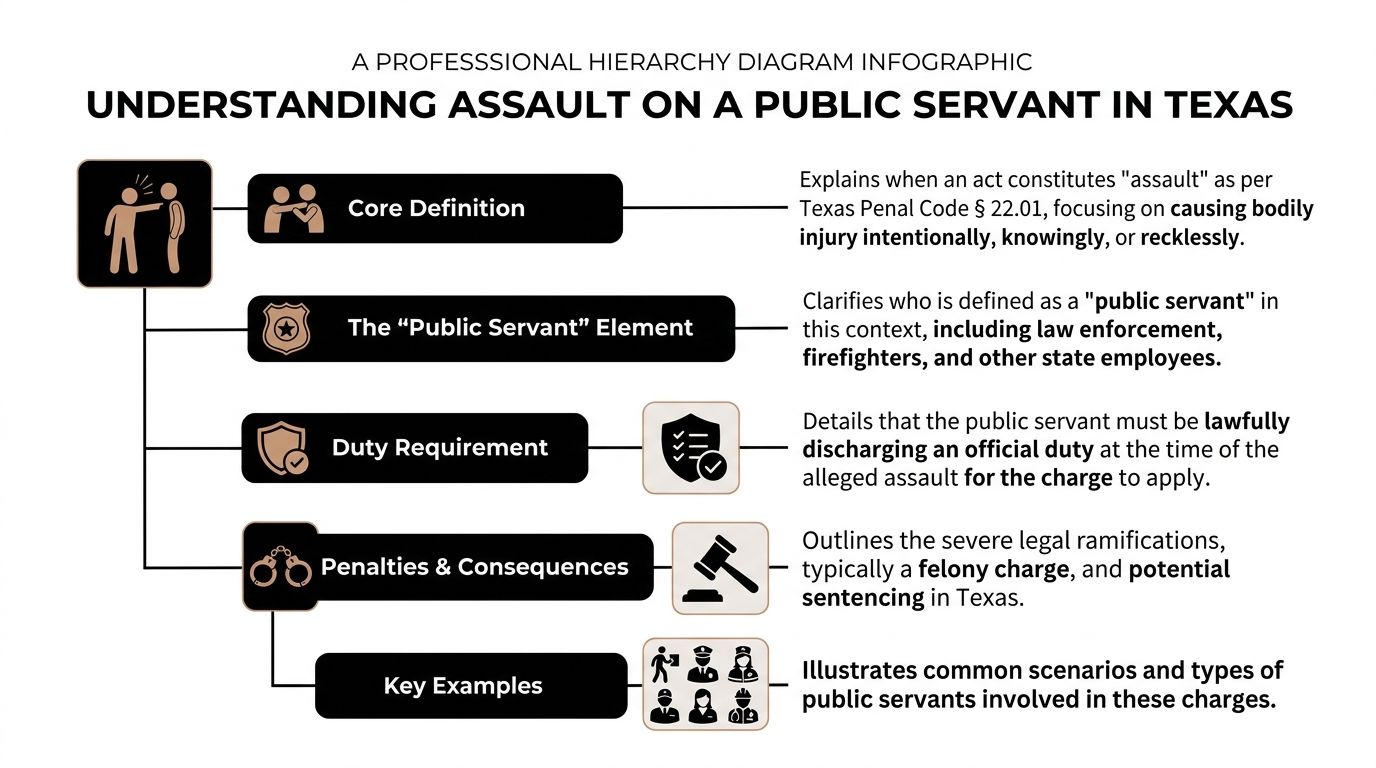
The prosecution must prove more than just contact
People often hear “assault” and think of a punch that causes a major injury. Texas law is broader than that.
For this felony charge, the State generally focuses on bodily injury. In plain language, that means the accusation is not limited to severe wounds. The prosecution will try to show that your actions caused physical pain or some physical harm.
Just as important, the State must prove two added elements:
- You knew the person was a public servant
- The person was lawfully discharging official duties, or the act was retaliation for those duties
If the State cannot prove those points, the felony enhancement can be vulnerable.
Who counts as a public servant
Many readers assume this law only applies to police officers. It does not.
Depending on the facts, protected public servants can include:
- Police officers
- Firefighters
- EMTs
- Judges
- Process servers
That broad list matters because some cases begin with confusion about who the other person was. An EMT in the back of an ambulance, a process server at your door, or a judge in a courthouse hallway may all fit into situations people do not immediately recognize as “public servant” cases.
What intentionally knowingly or recklessly means
These words sound technical, but the idea is simple.
- Intentionally means you meant to do the act.
- Knowingly means you understood what you were doing.
- Recklessly means you ignored a substantial risk your conduct could cause injury.
A reckless act is not the same as an accident. That distinction can become a major fight in court.
Lawfully discharging official duties matters
This phrase creates confusion. A person does not become protected under this felony enhancement merely because they have a government-related job. The State must show they were lawfully performing official duties at the time.
That can matter in close cases. A uniformed officer making an arrest presents a different legal picture than an off-duty officer in plain clothes during a private argument. A CPS worker making an official home visit presents a different picture than a neighbor who later says they also work for the government.
Practical takeaway: In many assault public servant texas cases, the defense begins by asking two direct questions. Did you know who this person was, and were they lawfully doing official work at that moment?
A simple example
If someone shoves a clearly identified officer during an arrest and causes bodily injury, the State will likely argue the enhancement applies.
If someone gets into a bar argument with an off-duty officer in plain clothes and never knew the person’s status, the legal analysis changes. The same physical act does not automatically create the same felony.
That is why the exact facts matter so much. Small details often decide whether the State can prove the enhanced charge at all.
Understanding the Felony Degrees and Severe Penalties
The reason people panic after this arrest is simple. The punishment range is steep.
According to Texas Criminal Defense Group’s summary of assault on a public servant penalties, assault on a public servant is a third-degree felony in Texas, punishable by 2 to 10 years in prison and a fine up to $10,000. That is a major jump from a standard Class A misdemeanor assault, which can carry up to 1 year in jail and a $4,000 fine.
The basic charge starts at felony level
That is one of the hardest parts for people to accept. In many cases, the allegation does not begin as a misdemeanor and then rise later. It starts as a felony because of who the alleged victim is and what the State says you knew.
This changes everything early in the case:
- bond arguments may be tougher
- prosecutors often approach the file more aggressively
- plea negotiations can become more complex
- the long-term consequences become much more serious
The charge can climb even higher
The same source explains that if serious bodily injury is involved, the offense can become a second-degree felony with 2 to 20 years in prison. If a deadly weapon is used, it can become a first-degree felony with 5 to 99 years or life, plus a $10,000 fine.
Those ranges are why the facts in the police report matter so much. Prosecutors often look closely at:
- the claimed injury
- whether any object is described as a weapon
- medical records
- witness statements
- body camera or dash camera footage
For a fuller discussion of related enhancement issues, this guide on Texas assault charge enhancement factors can help you see how quickly allegations can become more serious.
Penalty table
| Texas Assault on a Public Servant Penalties (2026) | |||
|---|---|---|---|
| Offense Level | Injury / Action | Potential Prison Time | Maximum Fine |
| Class A misdemeanor assault | Bodily injury assault without the public servant enhancement | Up to 1 year in jail | $4,000 |
| Third-degree felony | Assault on a public servant | 2 to 10 years | $10,000 |
| Second-degree felony | Serious bodily injury | 2 to 20 years | $10,000 |
| First-degree felony | Use of a deadly weapon | 5 to 99 years or life | $10,000 |
Why prosecutors take these cases so seriously
The same source reports 23,860 admissions for assault/terroristic threat in FY2024 in TDCJ data, which it uses to show how common and serious these charges can be in Texas. That does not tell us how every individual case ends, but it does show you are dealing with a category of offense the system treats as significant.
Important: A first-time arrest does not automatically mean leniency. Even people with no record can face real prison exposure in a felony assault case.
Penalties are only part of the risk
The sentence range is not the whole story. A felony accusation can affect release conditions, employment, firearms rights, licensing issues, and how other courts see you later.
That is why defense work in these cases is not just about avoiding the top end of punishment. It is often about challenging the enhancement itself, reducing the charge, preserving future options, and limiting damage that can follow you for years.
How These Charges Happen in Real-World Scenarios
These cases often start in ordinary places. A roadside stop. An ambulance. A courthouse hallway. Your own front porch.
The law can sound abstract until you place it inside real moments where people are frightened, embarrassed, angry, intoxicated, injured, or not thinking clearly.

A traffic stop that gets out of hand
An officer orders a driver out of the car. The driver believes the stop is unfair and pulls away when the officer reaches for an arm. In the struggle, the officer says that movement caused pain.
The driver may think, “I never attacked anyone.” The State may still file a felony and argue bodily injury to a public servant during official duty.
A medical emergency inside an ambulance
A person is hurt, panicked, or disoriented. An EMT tries to restrain or guide them during treatment. The person swings an arm, kicks, or pushes while confused.
That kind of fact pattern appears more often than many people realize. According to Kevin Bennett Law’s discussion of assaults on public servants, 63% of field medics in one Austin-Travis County survey reported being physically assaulted more than once in the prior two years, and FBI data in the same source reported over 60,000 officers assaulted nationally in one year, with most incidents involving hands, fists, or feet. That broader pattern helps explain why prosecutors may react quickly when an EMT or officer reports an injury.
A protest or crowd-control scene
Crowded scenes create confusion. People move fast. Orders are shouted. Visibility is poor. One person says you pushed an officer. You say you were shoved from behind or were trying not to fall.
These cases often turn on chaotic evidence:
- Video angles may be incomplete
- Witnesses may only see part of the event
- Identification may be disputed
- Intent may be far less clear than the report suggests
A CPS or process server encounter at home
People are often stunned to learn a charge can arise from an argument at their own door.
A CPS worker arrives during a stressful family situation. A process server tries to hand over legal papers. Voices rise. Someone reaches to block the door or remove a hand. The official later claims injury and says they were performing lawful duties.
That does not mean the State always has a clean case. But it does show how fast a private conflict can become a felony allegation.
Takeaway: Many assault public servant texas cases begin with fear, confusion, or resistance in a stressful moment, not with a plan to commit a felony.
Why these examples matter
Real-world scenarios matter because they show where defenses can develop. Maybe the person was not clearly identified. Maybe your actions were reflexive, not reckless. Maybe the official exceeded lawful authority. Maybe the claimed injury is minor and poorly documented.
Those details do not erase the charge on paper. But they can change how the case is defended and how it may ultimately be resolved.
Building a Powerful Defense Against Your Charge
A criminal accusation is the State’s version of events. It is not the final word.
In many assault public servant texas cases, the strongest defense comes from slowing the case down and examining each legal element one at a time instead of accepting the police report as complete.

Challenge the knowledge element
One of the most important issues is whether you knew the other person was a public servant.
That may seem obvious in some cases. It is not obvious in all cases. Plainclothes officers, chaotic scenes, poor lighting, unmarked vehicles, or people who never clearly identified themselves can create real doubt.
A defense lawyer may examine:
- whether a badge was visible
- whether a uniform was present
- whether commands were clear
- whether witnesses heard identification
- whether video confirms the State’s claim
If the State cannot prove knowledge, the enhancement may be challenged.
Question whether the person was lawfully doing official duties
Texas law protects public servants when they are lawfully discharging official duties. That word, lawfully, matters.
If an officer used excessive force, entered without proper authority, or acted outside lawful bounds, the defense may argue the State cannot rely on job title alone. The facts surrounding the encounter become critical.
According to Saputo Law’s discussion of defenses in assault on a public servant cases, a key but often misunderstood defense is self-defense against excessive force. The same source notes that although Texas law may presume knowledge when an officer is in uniform, that presumption can still be challenged if the officer’s actions were unlawful.
Defense focus: The law does not require you to surrender every factual dispute just because the complaining witness wears a badge or uniform.
Self-defense can matter
Self-defense is not automatic, and it depends heavily on the facts. But it can be central when a public servant allegedly used unlawful force first.
This issue often gets oversimplified. The key question is not whether the other person had official authority in general. The question is whether your response occurred during unlawful force or excessive conduct under the facts of your case.
Mistaken identity and weak proof
Not every case turns on legal theory alone. Some turn on basic proof problems.
In a crowd, hospital room, or physical struggle, identification may be shaky. The alleged injury may also be poorly documented. If the evidence of bodily injury is weak, that can change negotiations and trial strategy.
One useful area to examine is video. Body camera footage sometimes supports the State. Sometimes it undercuts the report. A closer look at how body cam footage affects Texas assault cases can help you understand why video review is often a major turning point.
A short explainer can help frame how defense themes work in practice:
Practical defense steps you can take now
Your actions early in the case matter.
- Do not contact the alleged victim. Even an apology text can be used against you.
- Write down your memory now. Include lighting, words spoken, location, who was present, and whether anyone identified themselves.
- Save evidence. Keep photos, videos, medical records, and names of witnesses.
- Follow bond conditions exactly. A new violation can damage a strong defense.
- Stay off social media. Prosecutors look for posts that sound angry, mocking, or inconsistent.
A strong defense is not built from one dramatic argument. It is built from details, timing, and evidence that challenge the State’s assumptions.
Your Legal Journey From Arrest to Resolution
After an arrest, many people fear court because they do not know what comes next. The process feels intimidating partly because it is unfamiliar.
The timeline below gives you a practical view of what usually happens in a Texas felony case.

Booking and release
Right after arrest, you are usually booked into jail. Personal information is recorded, fingerprints are taken, and the charge is entered.
Then the question becomes release. In some cases, bond is set quickly. In others, the process is slower, and conditions can be strict because the allegation involves violence.
If you want a clearer picture of how restrictions can work after release, this guide on Texas assault bond conditions can help.
Magistrate warning and early hearings
A magistrate may advise you of the accusation and certain rights. This is not your trial. It is an early appearance where the court addresses basic issues, including counsel and release matters.
At this stage, many people want to “tell their side.” That is usually a mistake. Your lawyer’s job is to protect you from turning stress into damaging statements.
Practical tip: Court is not the place to freestyle your defense. Even truthful statements can be misunderstood when made without preparation.
Arraignment and formal charging
In felony practice, the details vary by county, but the core issue is the same. The State moves from arrest paperwork toward a formal prosecution.
You may hear terms like:
- arraignment
- indictment
- pretrial setting
- discovery
- motions hearing
These are not just procedural labels. Each one affects strategy.
Discovery and investigation
Discovery is the exchange of evidence. Your defense lawyer looks for the materials needed to test the accusation, such as:
- offense reports
- witness statements
- body camera footage
- dash camera footage
- photographs
- medical records
- dispatch logs
This phase often changes the entire case. Sometimes the evidence is stronger than expected. Sometimes it exposes major weaknesses, contradictions, or missing proof.
Plea bargaining and case evaluation
Most criminal cases are resolved without a jury trial, but that does not mean you should rush into a plea. A smart plea decision comes after careful review of the evidence, your history, possible defenses, collateral consequences, and your personal goals.
Some people want the certainty of a negotiated outcome. Others need to fight the charge because of career, licensing, immigration, family, or firearm concerns.
A good lawyer helps you evaluate questions like:
- Can the enhancement be attacked
- Is a reduction possible
- Is deferred adjudication on the table
- Would a plea create long-term damage that outweighs the short-term benefit
Trial and sentencing
If the case does not resolve, it may go to trial. At trial, the State must prove the charge beyond a reasonable doubt.
That means the prosecution has to present witnesses and evidence in open court. Your defense can challenge credibility, cross-examine witnesses, object to improper evidence, and present your side of the facts.
If there is a conviction, sentencing follows. Sentencing can involve prison, community supervision, fines, conditions, and other restrictions depending on the offense level and the court’s decision.
The process is slower than expected
Many individuals find the process slower than expected. Hearings may be reset. Evidence may arrive late. Negotiations may evolve over months, not days.
That delay feels frustrating, but it also creates room for preparation. Strong defense work usually requires patience, investigation, and disciplined decision-making.
The Hidden Consequences on Your Family Life and Future
An assault public servant texas charge does not stay neatly inside criminal court. It can affect the rest of your life in ways people do not see coming.
For many clients, the deepest fear is not only jail. It is the effect on children, work, housing, professional reputation, and the future they have spent years building.
Family law problems can follow fast
A pending violent charge can appear in family court disputes, especially when custody or visitation is already contested.
The allegation may be used to argue that you are unstable, unsafe, or a risk to a child, even before the criminal case is finished. In some situations, the same incident may also lead to requests for a protective order.
That overlap matters because statements made in one case can affect the other. You need a coordinated strategy, not separate explanations that conflict.
Work and licensing issues can become immediate
A felony allegation can trigger job suspension, internal investigations, or licensing concerns long before any final outcome.
People in healthcare, education, government, security, transportation, and other regulated fields often face extra pressure because employers and boards take violent allegations seriously. Even if the criminal case is still pending, your professional life may already be under strain.
A conviction can follow you for years
The long-term effects can include barriers to employment, trouble finding housing, and loss of firearm rights. These consequences are often what make a reduction, dismissal, or other favorable outcome so important.
The case is not only about the sentence listed on paper. It is about what remains on your record and how future employers, licensing boards, and courts may read it.
Future-focused advice: When weighing any plea offer, ask not only “Can I live with this now?” Ask “How will this look to a judge, employer, or licensing board later?”
Expunctions and record sealing may matter
There is still room for hope. Some people may qualify for expunction or nondisclosure, depending on how the case ends and the specific legal history involved.
In plain English:
- Expunction can remove certain records from public view in qualifying cases
- Nondisclosure can limit who can see a record in certain situations
Not every assault-related case qualifies, and felony outcomes can limit options. Still, post-case relief should be part of the conversation from the beginning. A smart defense plan looks ahead to what can be done after dismissal, reduction, completion of community supervision, or other favorable resolution.
Rehabilitation matters too
Courts, prosecutors, and employers may all look at what you do after the arrest.
Counseling, anger management, substance abuse treatment, mental health support, steady employment, and strict compliance with court orders can all help show that the incident does not define your life. Those steps do not replace legal defenses, but they can strengthen the overall picture.
If you are facing this charge, your life is not over. But you do need to act carefully, protect your rights, and think beyond the next court date.
If you’ve been charged with a crime in Texas, call Law Office of Bryan Fagan PLLC for a free and confidential consultation. Our defense team is ready to protect your rights.