Skip to content
Being arrested in Texas can be terrifying—but you don’t have to face it alone. When the charge is assault with a deadly weapon, the stakes get much higher, much faster. This isn’t a simple misdemeanor; it’s a felony charge known legally as Aggravated Assault. A conviction doesn't just mean a slap on the wrist—it can completely upend your life with years in prison and a permanent criminal record that follows you forever.
Understanding what this charge actually means under Texas law is the absolute first step toward protecting yourself and building a strong defense. Our team is here to walk you through it, one step at a time.
What an Assault With a Deadly Weapon Charge Means in Texas

Let's cut through the legal jargon. When you hear "assault with a deadly weapon," it means the prosecutor believes they have enough evidence to prove you committed an assault and that you either used or showed a deadly weapon while doing it. It sounds straightforward, but the details are where these cases are won and lost.
In Texas, this offense falls under Texas Penal Code § 22.02 (Aggravated Assault). For the state to convict you, a prosecutor has to prove two key things beyond a reasonable doubt:
- You committed an assault. In plain English, this could mean you intentionally, knowingly, or recklessly hurt someone. It can also mean you simply threatened them with immediate harm.
- You used or exhibited a deadly weapon. This is the critical piece that turns a standard assault—often a misdemeanor—into a life-altering felony.
To give you a clearer picture, it helps to see how this charge stacks up against a standard assault charge.
Aggravated Assault vs. Simple Assault in Texas
| Element | Simple Assault (Misdemeanor) | Aggravated Assault with a Deadly Weapon (Felony) |
|---|---|---|
| Injury | Causing bodily injury (pain) is enough. | Can be just a threat of harm; serious bodily injury makes it worse. |
| Weapon | No deadly weapon is involved. | A deadly weapon is used or exhibited during the assault. |
| Severity | Typically a Class A Misdemeanor. | A Second-Degree Felony, or higher in some cases. |
| Punishment | Up to 1 year in county jail and/or a $4,000 fine. | 2 to 20 years in state prison and a fine up to $10,000. |
The table really highlights the massive difference a "deadly weapon" makes. It's the one factor that sends the potential penalties skyrocketing.
So, What Counts as a "Deadly Weapon"?
This is where things can get tricky. The term "deadly weapon" might make you think of guns and knives, and you'd be right. But the legal definition is much broader. Texas law says a deadly weapon is anything that, in the way it’s used or meant to be used, is capable of causing death or serious bodily injury.
This means ordinary, everyday objects can suddenly become a deadly weapon in the eyes of the law. For example:
- A baseball bat used to hit someone.
- A car driven aggressively toward a pedestrian.
- A heavy glass bottle or even a pair of steel-toed boots used in a fight.
Because the definition is so flexible, a key part of your defense strategy is often challenging whether the object in question truly qualifies. The context of the situation is everything.
The Critical Role of Intent
The prosecutor's job isn't just to show that something happened. They have to prove your state of mind. They must convince a jury that you acted intentionally, knowingly, or recklessly. If what happened was a genuine accident and you never intended to hurt or threaten anyone, that can be the foundation of a very powerful defense.
The crucial point to remember is that you can be charged even if no one was actually hurt. Simply exhibiting a weapon in a threatening manner is enough to lead to an aggravated assault charge. This is why understanding the specific elements of assault charges in Texas is so important for your case.
When a firearm is involved, the situation escalates dramatically. Statistics show just how dangerous these encounters can become. In 2022, Texas recorded 4,515 deaths from gun violence, which included 1,826 homicides. That means firearms were used in over 80% of all homicides that year. These numbers explain why prosecutors take any assault involving a gun so seriously—they know how quickly things can turn fatal.
Understanding the Felony Degrees and Penalties

In Texas, an assault with a deadly weapon charge isn’t a one-size-fits-all felony. The law recognizes that some situations are far more serious than others, and the penalties reflect that reality. While any charge is severe, certain circumstances can elevate the offense, dramatically increasing the potential prison time you face.
Figuring out these differences is critical. The prosecution will look for any reason to charge you with the highest possible offense. Your defense attorney’s job is to dismantle that argument and protect you from the harshest outcomes.
Most cases of assault with a deadly weapon start as a second-degree felony. This is the baseline, and it carries incredibly serious consequences right out of the gate.
A conviction for a second-degree felony in Texas can land you in prison for 2 to 20 years and hit you with a fine of up to $10,000. This isn't a charge where you can expect a simple slap on the wrist; your freedom is immediately on the line.
Even if it’s your first offense, the possibility of a lengthy prison sentence is very real. That's why it is so important to get a skilled Houston criminal lawyer and start building your defense from day one.
When the Charge Becomes a First-Degree Felony
The stakes get even higher when specific factors are part of the equation. The law includes "enhancements" that can upgrade a second-degree felony to a first-degree felony—one of the most serious classifications of crime in Texas.
A conviction for a first-degree felony carries a potential sentence of 5 to 99 years—or life—in prison, plus that fine of up to $10,000. The circumstances that can trigger this severe enhancement include:
- The Identity of the Alleged Victim: If the assault is committed against a public servant (like a police officer, firefighter, or judge) while they are on the job, the charge is automatically bumped up. The same goes for security officers, emergency medical personnel, or even witnesses and informants in a criminal case.
- Domestic Violence: Committing an aggravated assault against a family member can easily become a first-degree felony, especially if it causes serious bodily injury or if you have a prior conviction for domestic violence.
- Drive-By Shootings: If the assault involves firing a gun from a motor vehicle toward a person, house, or another vehicle, it’s automatically classified as a first-degree felony.
These enhancements show why every single detail of your case matters. A skilled attorney will pick apart the evidence to fight back against any attempt by the prosecution to apply these severe classifications. For a deeper dive into the specific consequences, you can learn more about the penalties for aggravated assault in Texas in our detailed guide.
The Focus of Texas Prosecutors
Make no mistake: Texas prosecutors are under immense pressure to crack down on violent crime, and charges involving deadly weapons are at the top of their list. Data from recent years shows an intense focus on these offenses. In Tarrant County alone, nearly 3,500 bonds were set for weapons-related charges, a category that includes assault with a deadly weapon. This reflects a trend across major Texas cities, where prosecutors are aggressively pursuing convictions in these high-stakes cases.
This prosecutorial focus means you’re up against a determined and well-resourced opponent. Having an equally determined legal team in your corner isn't a luxury—it's a necessity. The difference between a second-degree and first-degree charge can mean decades of your life. An experienced Texas assault defense lawyer will fight to ensure your case is not unfairly escalated, protecting your rights at every turn.
Powerful Defenses Against Your Charge
When you're facing an accusation of assault with a deadly weapon in Texas, it can feel like the walls are closing in. But it’s critical to remember one thing: an arrest is not a conviction. The prosecution carries the entire burden of proving their case against you beyond a reasonable doubt. A skilled defense attorney's job is to dismantle their arguments piece by piece, and there are many powerful, proven strategies to do just that.
Every case is a unique puzzle, and the right defense always depends on the specific facts of your situation. However, several powerful legal arguments can challenge these serious felony charges. Understanding these defenses is the first step toward reclaiming control and fighting for your freedom.
Justifying Your Actions Under Texas Law
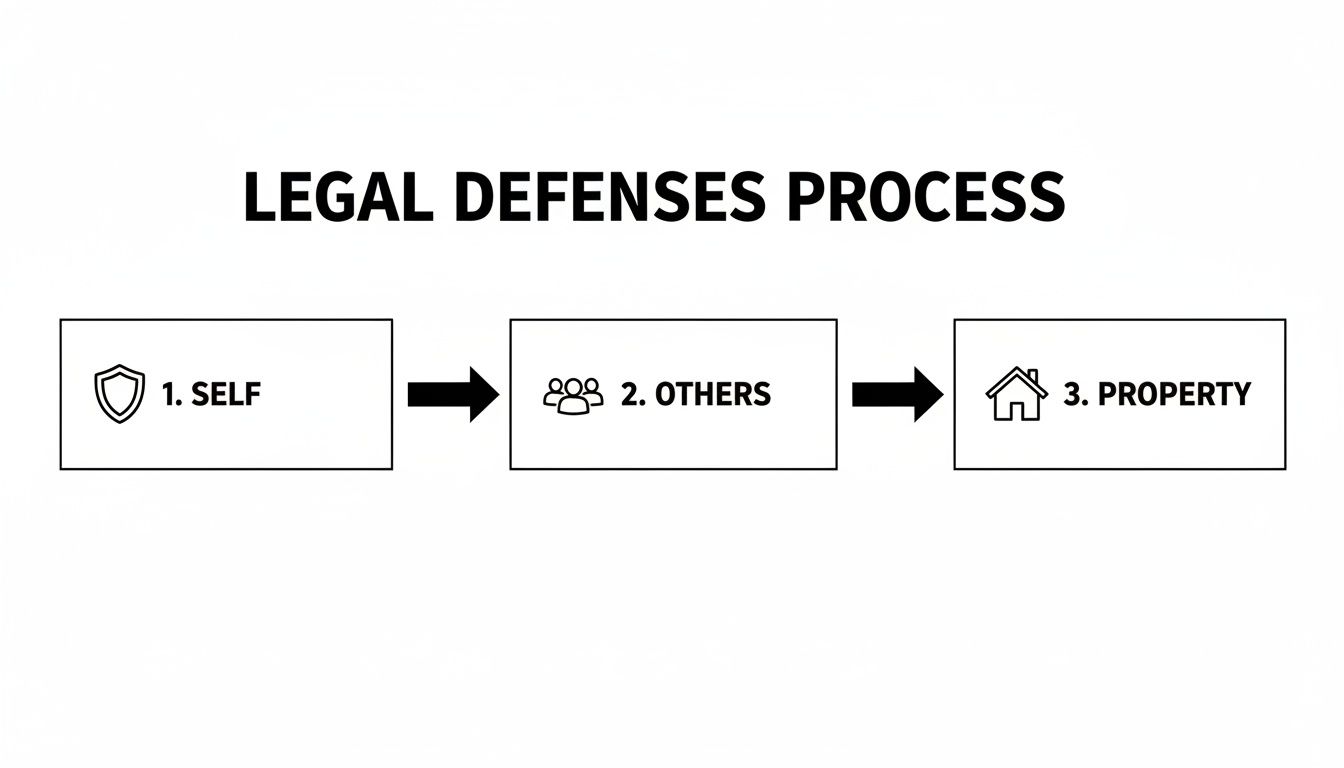
One of the strongest defenses available is arguing that your actions were legally justified. Texas law is clear: people have the right to protect themselves, their loved ones, and their property from harm. This isn't just an abstract idea; it's a right written directly into the Texas Penal Code.
Three key justification defenses include:
- Self-Defense: If you reasonably believed that using force was immediately necessary to protect yourself from someone else's unlawful force, you may have a valid self-defense claim. The key here is that the force you use must be proportional to the threat you faced.
- Defense of Others: This works a lot like self-defense. If you reasonably believed another person was in imminent danger of unlawful harm, you have the right to step in and use force to protect them.
- Defense of Property: Texas law also allows you to use force—and in some limited situations, even deadly force—to protect your land or property from crimes like theft, arson, or criminal mischief, especially at night.
Building a successful justification defense requires a deep dive into the evidence to show that your actions were a reasonable response to a direct threat. To get a better handle on how this works in practice, you can find a more detailed explanation by claiming self-defense in Texas in our guide.
Questioning the Prosecution’s Narrative
Beyond justification, many other defense strategies focus on poking holes in the prosecutor's story. Remember, they have to prove every single element of the crime. If they fail on even one point, they don't have a case.
Example Scenario: Mistaken Identity
Imagine a chaotic fight breaks out in a dimly lit bar parking lot. A witness tells police they saw a person in a red shirt threaten someone with a bottle. You were wearing a red shirt and got arrested nearby. Here's the problem for the prosecution: several other people in the area also wore red shirts, and the witness's view was partially blocked. Your attorney could argue mistaken identity, highlighting the unreliable witness testimony to create that all-important reasonable doubt.
Other crucial defenses include:
- Lack of Intent: The prosecution must prove you acted intentionally, knowingly, or recklessly. If your actions were a genuine accident and you never intended to threaten or harm anyone, this can be a complete defense. For instance, if you were cleaning a firearm and it accidentally discharged without you threatening anyone, proving a lack of intent would be the entire case.
- False Allegations: It’s an unfortunate reality, but false accusations happen, often bubbling up during heated personal disputes, divorces, or custody battles. In these cases, your attorney can investigate the accuser's motives, search for inconsistencies in their story, and expose any evidence that points to a fabricated claim.
The core of a strong defense is challenging the prosecutor’s version of events. Whether it's questioning a shaky eyewitness, proving an alibi, or demonstrating that the alleged "weapon" doesn't even meet the legal definition, your attorney will explore every possible avenue to protect you.
Ultimately, being charged with assault with a deadly weapon does not mean your story is over. It just means the fight for your future has begun. By working with an experienced criminal defense team, you can assert your rights and make sure your side of the story is heard loud and clear.
How to Navigate the Texas Criminal Justice System
If you've been arrested for assault with a deadly weapon in Texas, the road ahead probably feels like a terrifying and confusing maze. The good news is, you don't have to walk it blind. Once you understand the steps involved, the process becomes much clearer, and you can see exactly where a skilled defense attorney can step in to protect your rights.
The journey through the Texas criminal justice system isn’t random; it follows a structured sequence of events. Each stage presents critical opportunities for your defense team to challenge the state's case against you.
From Arrest to Your First Court Appearance
The process kicks off the moment you're arrested. You’ll be taken into custody, booked, and formally processed—which is when they take your fingerprints, photograph (mugshot), and personal information. Shortly after that, you'll have your first court appearance, known as an arraignment.
At the arraignment, the judge will do a few key things:
- Formally read the charges against you.
- Advise you of your constitutional rights.
- Ask you to enter an initial plea (which is almost always "not guilty").
This is also where the crucial issue of bail is decided. The judge will set a bail amount, which is the money you have to post to get out of jail while your case is pending. An experienced attorney can argue for a reasonable bail amount or even for your release on a personal recognizance bond, which requires no money upfront.
A common mistake is thinking you have to face this initial hearing alone. Having an attorney present from the very beginning is vital. They can protect you from saying anything that could be used against you and start advocating for your freedom immediately.
Gathering Evidence and Negotiating Your Case
After the arraignment, your case moves into the discovery phase. This is where your attorney formally requests every single piece of evidence the prosecutor has against you. We're talking police reports, witness statements, video footage, and any other material they plan to use.
Reviewing this evidence is how a defense team finds the weak spots in the prosecution's case. It's where we uncover inconsistencies in witness accounts or identify violations of your constitutional rights. As you start to move through the system, it's critical to understand your rights when arrested, no matter the specific circumstances.
Armed with the evidence from discovery, your attorney will start plea bargaining with the prosecutor. The vast majority of criminal cases are actually resolved at this stage. A strong defense presentation can often lead to favorable outcomes, such as:
- Case Dismissal: Convincing the prosecutor they simply don’t have enough evidence to win at trial.
- Reduced Charges: Negotiating to have the felony charge dropped to a lesser offense, like a misdemeanor simple assault.
- Favorable Sentencing: Agreeing to a plea in exchange for a lighter sentence, like probation instead of prison time.
What Happens if Your Case Goes to Trial
If a fair plea agreement can't be reached, your case will proceed to trial. This is where the prosecution has to prove your guilt "beyond a reasonable doubt" to a jury of your peers. Your attorney will present your defense, cross-examine the state's witnesses, and make a compelling argument for your acquittal.
The trial process itself is complex, involving jury selection, opening statements, the presentation of evidence, and closing arguments. If you are found not guilty, you are free to go. But if you're convicted, the case moves to the sentencing phase, where the judge or jury determines your punishment within the legal range for the offense. An experienced trial lawyer is your best defense against the lifelong consequences of a conviction.
The Lifelong Consequences of a Conviction

The penalties for an assault with a deadly weapon conviction in Texas don’t end when you walk out of prison or finish paying fines. A felony record casts a long shadow, following you for life and closing doors you might not have even considered. These consequences create real, lasting obstacles long after you’ve paid your debt to society.
This isn't about scaring you. It's about being direct and honest about what's truly at stake. Understanding these lifelong challenges is the first step in realizing just how critical it is to fight the charge and protect your future.
Permanent Loss of Firearm Rights
One of the most immediate and irreversible consequences of any felony conviction is losing your right to own a gun. Period. Under both Texas and federal law, a convicted felon is prohibited from possessing a firearm for life.
There are almost no legal pathways in Texas to get these rights back once they're gone. This isn’t just about hunting or sport—it’s the permanent removal of your Second Amendment right to protect yourself, your family, and your home.
Barriers to Your Career and Livelihood
Imagine trying to build a career with a massive roadblock in your way. That’s what a felony conviction for assault with a deadly weapon does. Nearly every employer runs background checks these days, and a violent felony is often an automatic "no."
The reality is that a permanent criminal record can make it extremely difficult to find stable employment. It can also prevent you from obtaining or keeping professional licenses needed for careers in healthcare, real estate, education, and many other fields.
The financial strain can be immense. Suddenly finding yourself in a much tougher job market can create a cascade of money problems, often requiring you to look for financial anxiety relief just to cope. The bottom line is that your ability to provide for your family could be severely compromised.
Other Hidden Penalties You Will Face
The fallout from a conviction for assault with a deadly weapon in Texas seeps into almost every corner of your life. While law enforcement agencies are constantly working to manage crime rates, a conviction places you on the wrong side of that system for good.
Just look at the numbers. In one recent month, Houston alone recorded 1,374 aggravated assaults, which contributed to a staggering 14,183 such incidents in a single year. While some regions have seen decreases, the focus on aggressively prosecuting violent crime remains intense across the state.
Here are a few other lifelong consequences you could face:
- Housing Difficulties: Many landlords and apartment complexes simply will not rent to anyone with a violent felony on their record.
- Educational Barriers: You could be denied admission to certain colleges or find yourself ineligible for federal student loans needed to get a degree.
- Immigration Consequences: If you are not a U.S. citizen, a conviction for an aggravated felony is a deportable offense. It can also permanently bar you from ever re-entering the country.
- Loss of Civil Rights: On top of losing your firearm rights, you will lose the right to vote while you're incarcerated and on parole.
Got Questions? We Have Answers.
When you’re staring down a charge as serious as assault with a deadly weapon, your mind is probably racing with a million questions. The uncertainty is overwhelming. Let’s cut through the noise and get you some straight answers to the questions we hear most often from our clients.
Can I really be charged if I only showed the weapon but never used it?
Yes, absolutely. This is a huge point of confusion for many people. Under Texas Penal Code § 22.02, the law doesn't require you to actually use the weapon; it’s enough to "use or exhibit" it.
"Exhibiting" simply means you displayed the weapon in a way that made someone else reasonably fear for their safety. You don't have to fire a gun, swing a bat, or make any physical contact at all. The act of brandishing a weapon during a heated argument is often enough for a prosecutor to bring felony charges.
What if the “deadly weapon” was just a normal, everyday object?
Here’s another area where Texas law casts a surprisingly wide net. A "deadly weapon" isn't limited to firearms or knives. The legal definition covers anything that, based on how it was used or intended to be used, is capable of causing death or serious bodily injury.
This means almost anything can qualify, depending on the circumstances. Think about it:
- A heavy glass beer bottle swung in a bar fight.
- A car driven aggressively toward a pedestrian.
- A baseball bat, a tire iron, or even steel-toed boots used to kick someone.
Because this definition is so flexible, a huge part of a strong defense is often arguing that the object in question—or how it was supposedly used—doesn't meet that high legal standard.
What’s the difference between first and second-degree aggravated assault?
The difference comes down to specific factors that can elevate the seriousness of the charge. Most cases of assault with a deadly weapon start as a second-degree felony, which is incredibly serious on its own, carrying a potential prison sentence of 2 to 20 years.
However, the charge can be bumped up to a first-degree felony—punishable by 5 to 99 years or life in prison—if certain circumstances are involved. This can happen if the assault was:
- Committed against a public servant, like a police officer or judge, while they were on duty.
- Carried out as part of a drive-by shooting.
- Directed at a family member, and the accused has a prior conviction for domestic violence.
A sharp defense attorney will scrutinize the evidence to challenge any attempt by the prosecution to tack on these severe enhancements.
Is it possible to get an assault charge sealed or expunged from my record?
Your ability to clear your record hinges entirely on the outcome of your case. This is precisely why fighting the charge from day one is so critical.
If your case is dismissed or you are found not guilty at trial, you may be eligible to have the entire arrest record destroyed through a process called expunction. An expunction essentially makes it as if the arrest never happened.
On the other hand, a final conviction for aggravated assault with a deadly weapon is a serious felony that is generally not eligible for record sealing (also known as an order of nondisclosure) in Texas. That conviction will stay on your public record forever, casting a long shadow over your future.
This reality underscores just how much is on the line. The only surefire way to protect your ability to clear your name is to avoid a conviction. The decisions you and your attorney make right now will define what your future looks like.
If you’ve been charged with a crime in Texas, call The Law Office of Bryan Fagan, PLLC for a free and confidential consultation. Our defense team is ready to protect your rights. You can reach us at https://texascriminallawyer.net.