Skip to content
Being arrested for drug possession in Austin can feel like your life just split in two. One moment you’re driving home, walking out of a friend’s apartment, or standing on a sidewalk after a traffic stop. The next, you’re in handcuffs, your phone is gone, and you’re trying to understand what happens to your job, your family, and your record.
Many in that moment don’t need a lecture. They need a clear answer to one question. What do I do now?
The first thing to know is that an arrest is not the same as a conviction. The second is that Texas drug cases often turn on details not immediately apparent, such as where the substance was found, who had access to it, whether the search was legal, and whether the state can prove you knew it was there.
If you’re searching for an austin drug possession lawyer, you’re probably anxious, embarrassed, and unsure who to trust. That’s normal. What helps is understanding the process one step at a time so you can make smart choices early, before the case gains momentum against you.
Your Guide Through the Stress of a Drug Arrest in Austin
A lot of Austin drug possession cases start in ordinary places. A taillight stop on I-35. A call about suspicious activity at an apartment complex. A search after a disagreement between people who know each other. By the time you’re released, you may have paperwork in your hand and almost no idea what any of it means.
You may also be replaying every word you said to police.
That’s common, and it’s one reason early legal guidance matters. In many cases, the strongest defense work starts before the first major court date. Your lawyer isn’t just waiting to “go to trial.” Your lawyer is checking the arrest, the search, the lab process, the paperwork, and the prosecution’s theory from the beginning.
Practical rule: If police contact you after your release, don’t try to talk your way out of the case. Stay polite, say you want a lawyer, and stop there.
Austin cases move through Travis County procedures, and that process can feel cold and fast if you don’t know what to expect. But once you understand the map, the fear usually becomes more manageable.
What helps most is focusing on three immediate priorities:
- Protect your rights: Don’t volunteer explanations, guesses, or apologies that prosecutors may later use against you.
- Preserve information: Write down where you were, who was present, what officers said, and whether anyone else had access to the location.
- Get legal advice early: Drug possession cases often involve technical defenses that are easier to spot before positions harden.
A calm, informed response now can change the entire direction of your case.
Understanding Texas Drug Possession Charges and Penalties
After an arrest, many people look at the paperwork and assume the charge should be simple. “It was only a small amount.” “It was just pills.” “It wasn’t even in my pocket.” Texas drug law is rarely that simple.
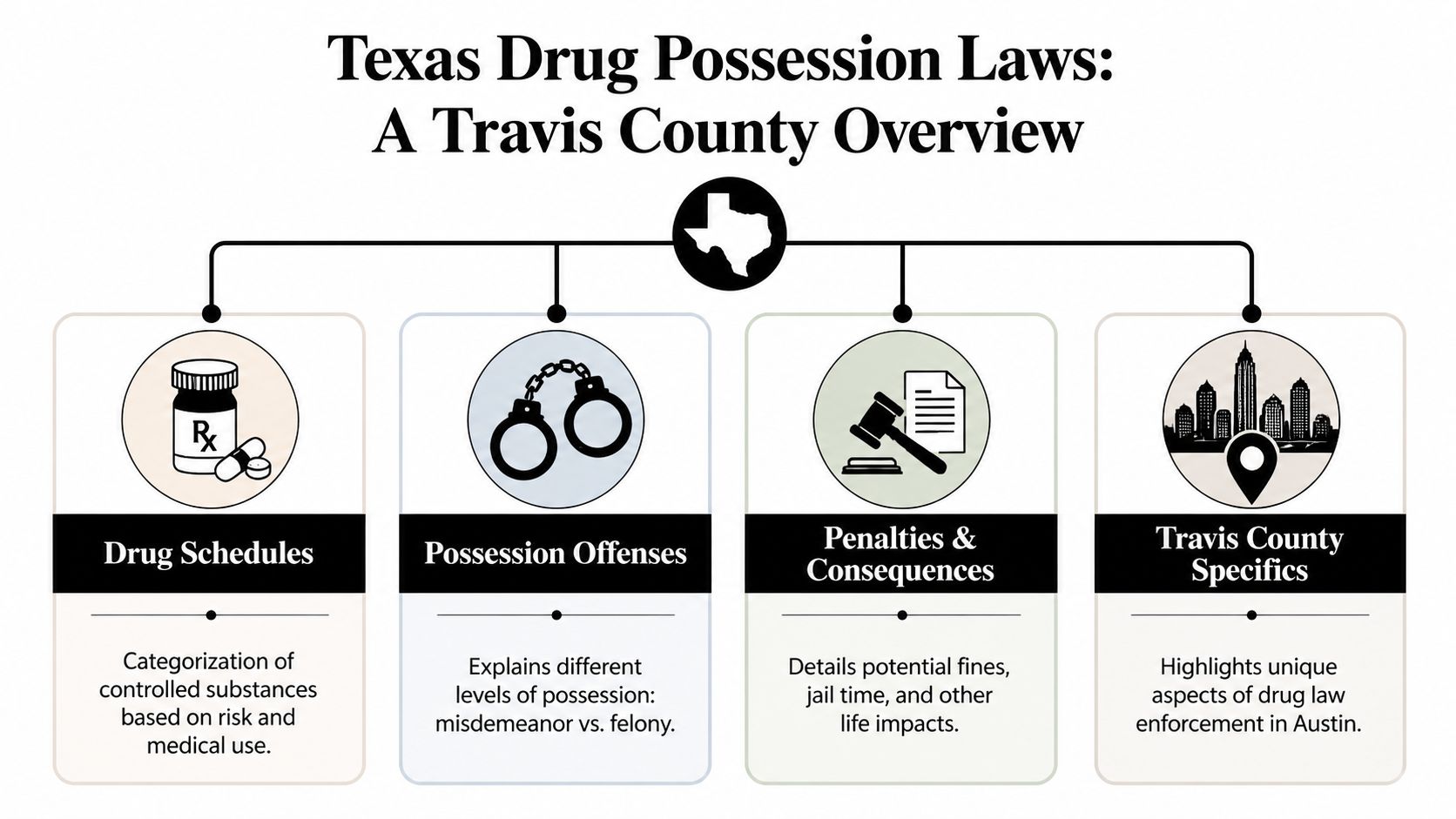
Texas prosecutes possession cases under the Texas Health and Safety Code. The law sorts substances into Penalty Groups, and the charge usually depends on two questions right away: what substance police say they found and how much they say it weighed. Marijuana sits in its own category, separate from the Penalty Group system.
That structure explains why two possession cases can look similar at first and turn out very differently in court.
How the Penalty Group system works
Texas uses four main Penalty Groups for controlled substances. As summarized in this Austin drug possession law overview, Penalty Group 1 includes substances such as cocaine, heroin, methamphetamine, and fentanyl. Penalty Group 2 includes substances such as MDMA and PCP. Penalty Group 3 includes certain prescription medications held without a valid prescription, including drugs like Xanax, Valium, and Ritalin. Penalty Group 4 includes other prescription compounds that still carry abuse potential.
A useful way to understand it is to picture the law as a sorting system first and a punishment system second. Before anyone gets to sentencing ranges, the state has to place the substance in the correct legal bucket. If that first step is wrong, the rest of the case can be wrong too.
That is one reason defense lawyers look closely at lab reports, pill identification, prescription records, and the officer’s description of what was seized.
Why the alleged weight changes the case so fast
Weight works like a series of legal thresholds. Once the allegation crosses into the next range, the charge can rise sharply.
For Penalty Group 1 substances such as heroin or cocaine, Texas law can turn a very small alleged amount into a felony case. A commonly cited example is possession of less than one gram, which can be charged as a state jail felony, while one gram or more but less than four grams can be charged as a third-degree felony.
That difference matters in tangible ways. It affects jail or prison exposure, plea negotiations, and how aggressively the case must be challenged from the start. In Travis County, a lawyer will often focus early on whether the weight includes packaging, whether the substance was properly tested, and whether the state can prove the usable amount it claims.
Marijuana follows a separate set of rules. If your case involves cannabis, this guide on possession of weed in Texas can help you understand how those rules are applied.
Prescription drugs surprise people
Pill cases often worry people for a different reason. They feel less serious because the substance has a medical use. Texas law does not treat them that way if you do not have lawful possession.
A prescription drug case can still be charged as a misdemeanor or a felony, depending on the substance and the alleged amount. The state will also look at whether you had a valid prescription, whether the pills were in the proper container, and whether they were prescribed to you rather than someone else.
Bring that paperwork to your lawyer early. A prescription defense is much easier to build with records in hand than with vague memories weeks later.
A common mistake is assuming the prosecutor will notice that a prescription exists and fix the case on their own. Defense counsel usually has to put that proof in front of the right people, in the right form, at the right time.
What “possession” means under Texas law
This part causes real confusion.
The state does not only try to prove that a substance was physically in your hand, pocket, or bag. Prosecutors may also argue that you had care, custody, control, or management over it. Lawyers often refer to that as actual possession versus constructive possession.
A car example shows how this works. If police find drugs in the center console of a vehicle with several occupants, the case is not automatically as simple as “the drugs were in the car, so everyone possessed them.” The prosecution still has to connect the substance to a specific person with facts that show knowledge and control.
That is where defense work often starts to matter. Who owned the vehicle? Who was sitting closest to the item? Were there statements from other passengers? Was the substance in plain view or hidden? Did officers find personal belongings mixed with it, or nothing tying it to you at all?
Those details often decide whether the state has a possession case or only a suspicion.
The charge on paper is only the starting point
Clients sometimes focus on the label alone. Felony. Misdemeanor. Penalty Group 1. Penalty Group 3. Those labels matter, but they are only the beginning.
A seasoned Travis County defense lawyer reads the charge like a mechanic listening to an engine. The paper says what the state is claiming. It does not tell you whether the stop was lawful, whether the search holds up, whether the lab result is reliable, whether the weight was calculated correctly, or whether the state can prove you knowingly possessed the substance at all.
That step by step review is what turns a frightening accusation into a case that can be challenged intelligently.
Navigating the Criminal Process from Arrest to Resolution
It is 10:30 at night. You are standing beside your car on a road in Austin, an officer is asking questions, and by morning you are in booking wondering what happens next. That moment feels like the floor dropped out from under you. The good news is that a Travis County drug case follows a sequence, and once you can see that sequence, the fear starts to lose some of its power.
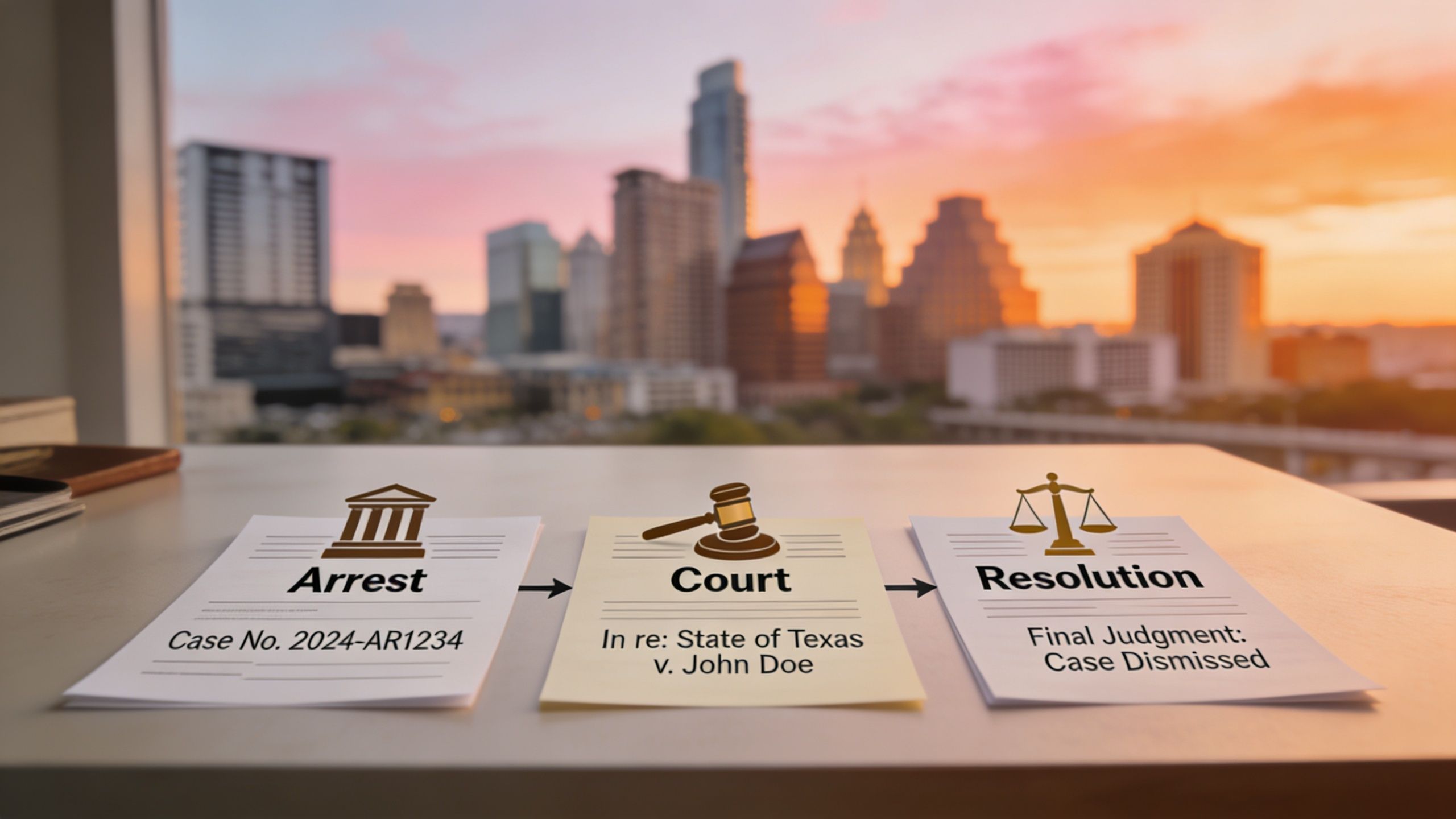
A criminal case works a lot like a chain. Each link depends on the one before it. If the stop was improper, that may affect the search. If the search was unlawful, that may affect whether the evidence can be used. If the evidence is weak, that changes plea discussions and trial risk. A good lawyer looks at the whole chain, then tests each link one by one.
Arrest and booking
The first stage usually starts with a stop, detention, or search, then arrest and booking. Police may photograph you, fingerprint you, take your property, and place you in custody until release terms are set.
Clients often ask the same question here. “Should I explain my side right away?” In almost every case, the safer answer is no. Stress makes people talk too much, guess at details, or agree with an officer’s version of events just to get out of the moment. Later, the prosecutor may treat those statements as admissions.
At this point, your lawyer starts protecting the case before a courtroom argument ever happens. That may include:
- reviewing why the officer stopped or detained you
- checking whether police had legal grounds to search
- warning you not to answer questions about ownership, knowledge, or consent
- gathering basic facts fast, before memories fade and video is lost
Magistration, bond, and release conditions
Soon after arrest, you may see a magistrate or go through the initial release process. This stage can feel routine to the court, but it matters a great deal to you. Bond is not just about getting out of jail. It often comes with rules.
Those rules may include drug testing, travel limits, reporting requirements, or orders to avoid certain people or places. A bond condition works like a temporary rulebook. If you break it, even by accident, the judge may see you as less reliable and the case becomes harder to resolve favorably.
A lawyer can push for realistic bond terms, explain each condition in plain English, and help you avoid preventable mistakes. If a condition is unclear, ask before you act.
Filing of charges and the state’s first review
After the arrest paperwork is submitted, prosecutors review the file and decide how to proceed. At this point, many people assume the state has a finished case. Usually, it has an accusation supported by reports, officer observations, and whatever evidence was collected.
That difference matters.
On paper, the state still has to prove that you knowingly possessed a controlled substance. In real life, that means prosecutors must connect the item to you with evidence that holds up under scrutiny. Shared cars, borrowed backpacks, apartments with multiple residents, and conflicting statements can make that harder than it first appears.
Your lawyer’s job at this stage is to slow the case down and examine it carefully. A rushed conclusion helps the prosecution. A careful review helps the defense.
Discovery and pretrial motions
This phase is where much of the serious defense work happens. The prosecution must turn over evidence. Your attorney studies police reports, body camera footage, dash camera video, lab records, dispatch logs, witness statements, and chain of custody documents.
A worried client sometimes expects dramatic courtroom moments right away. More often, the important work begins behind the scenes, at a desk, with a file. That file can reveal mistakes, gaps, and contradictions that change the direction of the whole case.
For example, your lawyer may compare what the officer wrote to what the video shows. Did you consent to a search, or did the officer move ahead without clear permission? Did the officer prolong the stop without legal grounds? If those issues exist, a suppression motion may follow. If you want a clearer picture of how courts examine illegal searches and seizures in Texas drug cases, that topic helps explain why these motions can be so important.
A close pretrial review often focuses on questions like these:
| Stage of review | What your lawyer is looking for |
|---|---|
| Police reports | Missing facts, vague language, or contradictions |
| Video evidence | Whether the stop, detention, and search match the written reports |
| Lab paperwork | Whether the substance was tested and documented correctly |
| Chain of custody | Whether the item was handled properly from seizure to testing |
| Witness statements | Bias, uncertainty, changing stories, or gaps in memory |
Court settings and plea discussions
Drug cases in Travis County rarely resolve in one hearing. There are usually multiple settings while the lawyers exchange evidence, file motions, and assess risk. To a client, those resets can feel like nothing is happening. In truth, that is often when the defense is doing the work that leads to a dismissal, a reduction, or a better offer.
Plea discussions also happen during this period. A plea offer is not something you accept just because it was offered. It has to be measured against the evidence, your record, your job, your immigration status if that applies, and the long term effect on your life.
A seasoned austin drug possession lawyer does more than repeat the prosecutor’s proposal. The lawyer explains what the offer means, what the state may be unable to prove, what defenses are developing, and what risks come with waiting, negotiating further, or setting the case for trial.
Trial or negotiated resolution
Some cases end through dismissal. Some end through a reduction or diversion. Some go to trial. By the time a case reaches this point, the path should feel much clearer than it did on the night of the arrest.
Trial is a structured test of the prosecution’s evidence. The state presents witnesses and exhibits. Your lawyer cross-examines those witnesses, challenges weak points, argues legal objections, and shows the jury where reasonable doubt exists. In a possession case, that may center on knowledge, control, credibility, or whether the evidence should have been excluded in the first place.
Many cases also resolve shortly before trial because sustained defense pressure exposes weaknesses that were not obvious at the beginning.
Sentencing and the next steps for your record
If the case ends in a plea or conviction, the work is not over. Sentencing is another stage where preparation matters. Your lawyer can present context about your background, treatment efforts, employment, family responsibilities, and other facts that support a more favorable outcome.
Then there is the record itself. Depending on how the case ends, you may have options such as expunction, nondisclosure, or other forms of record relief. That part matters for housing, licensing, education, and work.
The main point is simple. A drug case is not one event. It is a series of stages, and each stage gives your lawyer a new chance to protect you, limit damage, and improve the final result.
Building a Strong Defense Against Drug Charges in Austin
At this stage, many people worry the case is already decided because drugs were found and charges were filed. In reality, the defense begins by slowing the case down and testing each link in the chain. In a Travis County possession case, that usually means asking four practical questions: Did the police stop or search you lawfully? Can the state prove the substance was an illegal drug? Can the state prove it was yours? Can the prosecutor prove those points with reliable evidence?

A strong defense usually is not one dramatic courtroom speech. It is more like taking apart a machine piece by piece until you can see where it does not work.
Challenging knowledge and possession
The state does not automatically win by showing that a substance was nearby. Prosecutors still have to prove you knowingly possessed it. In plain terms, they must connect the item to you, not just to the place where police found it.
That distinction matters more than people expect.
Suppose officers find a small bag under the passenger seat of a car you borrowed from a friend. The prosecutor may point to the fact that you were driving. A defense lawyer looks closer. Who else used the car? Was the bag in plain view or hidden? Did you make any statement showing you knew it was there? Was there anything on the packaging, in your phone, or in the surrounding facts that ties that item to you personally?
Those details often decide the case. Presence is not the same as possession. Access is not the same as control. Suspicion is not proof beyond a reasonable doubt.
Search and seizure problems
Many drug cases rise or fall on how the evidence was found. If the stop, detention, frisk, vehicle search, or apartment search violated the Fourth Amendment, your lawyer can ask the court to suppress the evidence. If the judge agrees, the prosecution may lose the part of the case it needed most.
That issue comes up in everyday situations. A traffic stop gets extended without a legal basis. An officer searches a bag after consent was refused or never clearly given. A person is detained longer than the law allows while police go looking for a reason to search.
If you want a plain-English explanation of how courts examine those issues, this guide to illegal search and seizure law in Texas is a helpful starting point.
In practice, a lawyer does more than raise a general objection. The lawyer requests body camera footage, dash cam video, dispatch records, warrants, affidavits, and police reports, then compares those records line by line. If the officer’s timeline does not match the video, or the legal reason for the search is thin, that can become the center of the defense.
Shared spaces and constructive possession
Constructive possession is a legal phrase for a common accusation. It usually means police found drugs in a place you could access, and the state argues that access equals possession. Courts do not treat it that easily.
Shared-space cases are often the most stressful because the accusation can feel broad and unfair. A roommate leaves something in a living room drawer. A backpack sits on the floor during a group outing. A borrowed car contains something under a seat or in a console.
A defense lawyer looks for facts that separate you from the item, such as:
- whether the area was shared by several people
- whether the drugs were hidden or out in the open
- whether anyone else claimed ownership
- whether your fingerprints, messages, keys, or belongings connected you to the substance
- whether police relied on assumptions instead of direct proof
The closer a case gets to shared access, the more important those facts become.
Testing the substance and the paper trail
Sometimes the weak point is not possession. It is proof. The state still has to show that the substance was what police say it was, and that the item tested by the lab is the same item seized in the field.
That requires a paper trail. Officers collect evidence, package it, label it, store it, transfer it, and send it for testing. If that chain has gaps, sloppy entries, missing signatures, inconsistent weights, or unclear packaging, the defense can argue that the evidence is less reliable than the prosecutor claims.
Lab work also deserves close attention. A lawyer may examine whether the report is complete, whether the sample description matches the seized item, and whether the state can present a witness who can explain the testing if the case goes to trial.
How a lawyer builds this defense step by step
This part often helps clients the most, because it shows where the work happens.
Early in the case, your lawyer gathers records fast, before footage disappears and memories harden into a single police version of events. Next comes legal analysis. Was the stop lawful? Was consent valid? Is the warrant affidavit weak? After that, the lawyer identifies factual defenses, including who owned the space, who had access, and what proof really ties the drugs to you.
Then the defense starts applying pressure in specific ways. That may include filing motions to suppress, demanding lab records, challenging the chain of custody, interviewing witnesses, and showing the prosecutor where the proof falls short. Sometimes that pressure leads to a reduction or dismissal. Sometimes it sets up a stronger trial position. Either way, the goal is the same. Protect your rights at each stage and make the state prove every part of its case with reliable evidence.
Exploring Alternatives to a Conviction in Travis County
For many people, the deepest fear isn’t just jail. It’s the idea that one mistake will follow them forever. That’s why alternatives to a conviction matter so much in Travis County drug cases.

Why diversion matters
In the right case, a defense strategy isn’t only about fighting. It’s also about positioning you for a result that protects your future. That may mean pretrial diversion, specialty court participation, treatment-based programming, or another negotiated path that avoids a final conviction.
According to this Travis County diversion overview, Travis County Drug Court accepts low-level possession cases with completion rates around 75-80%, leading to dismissals for 65% of completers versus 20% incarceration for non-participants.
Those numbers are important because they show these programs are not symbolic. They can materially change outcomes.
Who may qualify
Eligibility usually depends on the charge, your record, the facts of the case, and your willingness to comply with program requirements. In practice, these options are most often discussed for lower-level, non-violent cases and people who show they’re taking the matter seriously.
That doesn’t mean you should assume you qualify. It also doesn’t mean you should assume you don’t. A lawyer can evaluate whether your case fits and how to present you in the strongest light.
Common issues that may affect eligibility include:
- Criminal history: Prior cases can matter.
- Case facts: The type of substance and surrounding circumstances matter.
- Personal readiness: Courts and prosecutors often want to see follow-through, honesty, and compliance.
What participation may look like
These programs aren’t a free pass. They usually require work. Depending on the program and the case, that may include treatment, counseling, testing, classes, court check-ins, or other compliance conditions.
For some clients, that sounds burdensome at first. But compared with a conviction, it may be the better path by far.
If you’re trying to understand how supervision and case management can work in Travis County, this guide to Travis County pretrial services gives useful background.
The best time to prepare for a second-chance option is before the prosecutor decides you’re not a good fit.
Failure risk and realistic expectations
Diversion works best when clients understand both the benefit and the responsibility. Missing appointments, failing testing rules, or ignoring program requirements can put the opportunity at risk. A lawyer can help you understand the expectations in plain language before you commit.
These options are often strongest for people who want to protect a career, school plans, immigration concerns, licensing, or family stability. In the right case, a second-chance route can be one of the most valuable outcomes available.
How to Choose and Hire the Right Austin Drug Possession Lawyer
Hiring a lawyer is one of the first decisions that puts you back in control. It’s also hard to do when you’re scared and under time pressure. Many people call the first name they find and hope for the best.
A better approach is to ask focused questions.
What to look for in a lawyer
Experience matters, but not in a vague way. You want someone who understands Texas criminal procedure, Travis County practice, and the technical issues that shape drug cases. According to this Austin defense market overview, firms like The Law Office of Bryan Fagan PLLC bring over 100 years of combined experience, which is the kind of depth many people look for when facing serious prosecutions.
That doesn’t mean you should hire based on one number alone. It means you should ask whether the lawyer has handled cases like yours and what they look for first in the file.
Ask questions such as:
- Case analysis: What are the first weaknesses you’d examine in my case?
- Local process: How do Travis County drug cases usually move from filing to resolution?
- Communication: Who will update me, and how often?
- Strategy choices: When do you recommend negotiation, and when do you push harder with motions or trial preparation?
Understand fees before you sign
Legal fees can be structured in different ways. Some cases are billed with a flat fee for a defined stage of representation. Others may involve hourly billing or added costs for trial work, experts, or appeals.
You don’t need to be shy about asking for clarity. Ask what is included, what triggers extra charges, and whether trial preparation is part of the quote or separate.
A useful comparison point is how professional service firms explain value and trust online. Even outside criminal defense, strong client education matters. This overview of powerful law firm marketing strategies is a good reminder that clear communication, transparency, and authority should show up before you hire a firm, not after.
Red flags to notice early
Sometimes the wrong fit is obvious.
Be cautious if a lawyer:
- Promises a guaranteed result: No honest criminal defense lawyer can promise dismissal or acquittal.
- Won’t explain the process: If they can’t make the case understandable now, communication may only get worse later.
- Pushes a plea immediately: A plea recommendation without reviewing discovery is often premature.
- Avoids your questions about records: Post-case options like expunction and sealing should be part of the conversation.
The right lawyer should help you feel more grounded, not more confused.
Frequently Asked Questions About Austin Drug Possession Cases
What is the difference between possession and possession with intent to deliver
These are different accusations, and they change the direction of a case.
A possession case focuses on whether the state can prove you knowingly had control, care, custody, or management of a controlled substance. A possession with intent to deliver case adds another layer. The prosecution is saying the facts suggest planned distribution, not personal use. That can affect charging decisions, plea discussions, and trial strategy from the start.
In plain terms, one case asks, “Did you possess it?” The other asks, “Did you possess it for sale or transfer?” A defense lawyer examines both parts separately because the evidence problems are often different.
Can I clear my record if my case is dismissed
Possibly, yes.
If your case is dismissed, you may qualify for an expunction, which is the legal process used to remove records of the arrest and case from public view. In other situations, record sealing may be the better option. The right answer depends on how the case ended, whether you completed a program, and whether any waiting period applies.
This is one reason early case planning matters. The choices made during the case can affect what cleanup options are available later.
What should I do if police want to search my car or home
Stay calm. Do not physically resist.
Say clearly, “I do not consent to any searches.” Then stop talking and ask for a lawyer. That response does two jobs at once. It reduces the chance of a roadside argument getting worse, and it gives your attorney a cleaner record to review later if the search was unlawful.
A search issue can shape the whole case. If officers found evidence after a bad stop, an improper detention, or a search without valid consent or another legal basis, your lawyer may be able to challenge that evidence in court.
Can a prescription drug case still be serious
Yes.
People often hear “prescription drug” and assume the case will be treated lightly. Texas law does not work that way. If someone has certain medications without a valid prescription, the state can file a controlled substance charge. The seriousness depends on the substance, the amount, and the surrounding facts.
These cases also create proof issues that need close attention. A lawyer may look at who the medication was prescribed to, how officers identified it, whether the pills were tested, and whether the police search was lawful.
Should I talk to police if I know the drugs were not mine
No.
That feels backwards to many people, especially if they believe a quick explanation will clear things up. In real cases, stress causes people to guess, fill in blanks, or agree with an officer’s wording without realizing it. Later, prosecutors may point to those statements as proof of knowledge or control.
Let your lawyer present the facts in a careful way. That gives you a better chance to challenge the state’s version without handing them extra evidence.
Do I need a lawyer if this is my first arrest
Yes. First-time cases often give the defense more room to protect your record, but that window can narrow fast.
A lawyer’s job is not limited to showing up in court. In Travis County, counsel can step in early to review the arrest paperwork, seek discovery, examine search and seizure problems, contact the prosecutor at the right time, and evaluate diversion or dismissal options before a case hardens into a conviction path. That step-by-step intervention is often what makes the difference between damage control and a result that protects your future.
If you’ve been charged with a crime in Texas, call Law Office of Bryan Fagan PLLC for a free and confidential consultation. Our defense team is ready to protect your rights.