Being arrested in Texas can be terrifying, but you don’t have to face it alone. A charge for Burglary of a Habitation in Texas can feel like your world is caving in. This is a serious felony charge that prosecutors pursue aggressively, and it carries the real possibility of a long prison sentence. You aren't alone, and this guide is here to explain your rights and options in plain English.
What a Burglary of a Habitation Charge Means for You

When the State of Texas accuses you of burglary of a habitation, they are saying you illegally entered someone’s home with a plan to commit another crime inside, such as theft, assault, or another felony. It’s a charge that strikes at the core of personal safety, which is why the law treats it so harshly.
Many people confuse this charge with other property crimes. But the legal distinctions are huge and have a massive impact on your case. For example, understanding the difference between robbery and burglary is a critical first step in knowing what you're facing.
The moment you are charged, the clock starts ticking. The prosecution is already building its case, gathering evidence, and preparing to secure a conviction. Your first move must be to understand your rights and get an experienced criminal defense lawyer in your corner.
Understanding the Severity of the Charge
In Texas, the law draws a thick, bold line between burglarizing a business and burglarizing a "habitation"—a place where someone lives. This distinction is the single most important factor in these cases because it dramatically increases the potential penalties. The law is designed to fiercely protect people's homes.
This is what makes a burglary of a habitation charge so serious:
- It's a Felony: A conviction means a permanent felony record, which can strip you of your right to vote, own a firearm, and make it incredibly difficult to find a job or housing.
- Serious Prison Time: The penalties are steep, often involving years—or even decades—in a state prison, depending on the specifics of your case.
- Aggressive Prosecution: District Attorney's offices in every Texas county, from Harris to Dallas and Travis to Bexar, take these cases personally and often push for the maximum punishment.
To put this in perspective, let’s look at how the Texas Penal Code categorizes different types of burglary.
Texas Burglary Charges at a Glance
The table below breaks down the different burglary offenses in Texas. Notice how the penalties jump dramatically when a "habitation" is involved.
| Offense Type | Texas Penal Code | Felony Degree | Potential Prison Time |
|---|---|---|---|
| Burglary of a Coin-Operated Machine | §30.03 | Class A Misdemeanor | Up to 1 year in county jail |
| Burglary of a Vehicle | §30.04 | Class A Misdemeanor | Up to 1 year in county jail |
| Burglary of a Building (Non-Habitation) | §30.02 | State Jail Felony | 180 days to 2 years in state jail |
| Burglary of a Habitation | §30.02 | Second-Degree Felony | 2 to 20 years in prison |
This table makes it crystal clear why prosecutors will pursue a habitation charge whenever they can—the potential punishment skyrockets.
Under Texas Penal Code §30.02, burglary of a habitation is automatically a second-degree felony, punishable by two to 20 years in prison and a fine up to $10,000. But it can get even worse. If the state alleges you entered with the intent to commit a different felony (like aggravated assault), the charge becomes a first-degree felony. The punishment range for that is a staggering five to 99 years or life in prison.
This legal framework is designed to send a message. The stakes simply couldn't be higher.
Deconstructing the Prosecution's Case Against You
To convict you for burglary of a habitation in Texas, the State carries the entire burden of proof. This isn't just a legal formality—it means a prosecutor has to prove every single element of the crime beyond a reasonable doubt. Think of their case as a chain; if your defense attorney can break just one link, the whole thing can fall apart.
Facing this legal fight starts with understanding exactly what the prosecutor must prove. Under Texas Penal Code §30.02, their job is to build a solid case around three core elements. A strong defense is built by finding the weaknesses in each one.
The Three Pillars of a Burglary Charge
The prosecution must get a jury to believe all three of these things are true. If they come up short on even one, they do not have a case.
- Unlawful Entry: They have to prove you entered a home without the owner's permission.
- A Habitation: The building you supposedly entered must legally qualify as a "habitation."
- Criminal Intent: They must prove that at the very moment you entered, you planned to commit a felony, theft, or an assault.
Let's dig into what these legal terms actually mean for you and your defense.
What Counts as an "Entry"
The idea of "entry" in Texas law is a lot broader than most people realize. It doesn’t require kicking down a door or smashing a window. Any physical intrusion into the home, no matter how small, can be enough.
For instance, just reaching an arm through an open window to grab a purse from a table could be seen as a complete entry in the eyes of the law. Even using a tool to reach inside qualifies. The key is whether any part of your body—or something connected to you—crossed the home's threshold.
But this broad definition also creates opportunities for a defense. Was the entry truly without consent? Did you mistakenly believe you had permission to be there? These are the kinds of critical questions your attorney will investigate. Evidence found during this alleged entry can also be challenged. Learning about a motion to suppress evidence can help you understand how illegally obtained evidence might be thrown out of court.
Defining a "Habitation"
Not every building is a "habitation," and this legal term is critical to the seriousness of the charge against you.
A habitation is defined as "a structure or vehicle that is adapted for the overnight accommodation of persons." This includes the main house and anything attached to it, like a garage.
This definition is vital. Breaking into a detached workshop, a storage shed, or a commercial building would likely lead to a lesser charge of Burglary of a Building, which is a state jail felony. Prosecutors often push to classify structures as habitations to secure a more serious conviction with much harsher penalties. A key part of your defense may be proving the structure in question simply does not meet the legal definition of a home.
The Crucial Element of "Intent"
Proving your state of mind—your intent—is often the prosecutor's biggest challenge and your defense's best opportunity. The state must show that you entered the home with a pre-existing plan to steal something, assault someone, or commit another felony. The crime of burglary is complete the second you enter with that intent, even if you never actually take anything or harm anyone.
Since a prosecutor cannot read your mind, they must rely on circumstantial evidence to paint a picture of what you were thinking. They might point to things like:
- Possession of Burglary Tools: Were you carrying items like crowbars, lock picks, or gloves?
- Your Actions: Did you run from the scene, try to hide, or resist arrest?
- Your Statements: Did you make any admissions to law enforcement?
This is where a sharp defense lawyer is essential. We can attack the prosecution's narrative by offering other logical explanations for your actions. Maybe you went into the wrong house by mistake, honestly believed you had permission to be there, or had no intention of committing any crime. Creating reasonable doubt about your intent can completely dismantle the state's case.
Your Journey Through the Texas Criminal Justice System
An arrest for burglary of a habitation in Texas isn’t the end of the story—it’s just the first step on a long and often confusing road. Knowing what lies ahead can reduce some of the anxiety and uncertainty that comes with facing a serious felony charge. This is your roadmap through each critical stage of the criminal justice process.
The moments right after an arrest feel chaotic, but what happens here is crucial. You will be taken to a local jail for booking, which involves fingerprints, photos, and paperwork. During all of this, you must remember your constitutional rights.
You have the right to remain silent. You absolutely should use it. Anything you say can and will be used against you, so your best move is to politely decline to answer questions until your lawyer is by your side.
Arraignment and Setting Bail
Your first court appearance is the arraignment. At this hearing, the judge will formally read the charges against you and ask how you plead—which is almost always "not guilty" at this early stage. The judge will also decide on bail.
Bail is the money you must post to get out of jail while your case moves forward. To set the amount, a judge considers several factors:
- The seriousness of the alleged crime
- Your criminal history
- Your ties to the community, like your job and family
- Whether you are considered a flight risk or a danger to others
A good criminal defense attorney can argue for a reasonable bail amount or even push for your release on a personal recognizance (PR) bond, which does not require you to post money. Getting you out of jail is a top priority, because it is much easier to help with your own defense when you are free.
The Grand Jury and Indictment Process
Because burglary of a habitation is a felony, your case must be presented to a grand jury. This is a group of citizens who meet in secret to hear the prosecutor's evidence and decide if there is enough probable cause to formally charge you with the crime.
If the grand jury finds enough evidence, they issue an indictment—the official charging document. If they don't, the case is "no-billed," and the charges are dropped. While your attorney does not present a defense at this stage, they can be building your case strategy behind the scenes.
This diagram breaks down the core elements a prosecutor must prove to get an indictment and, eventually, a conviction.
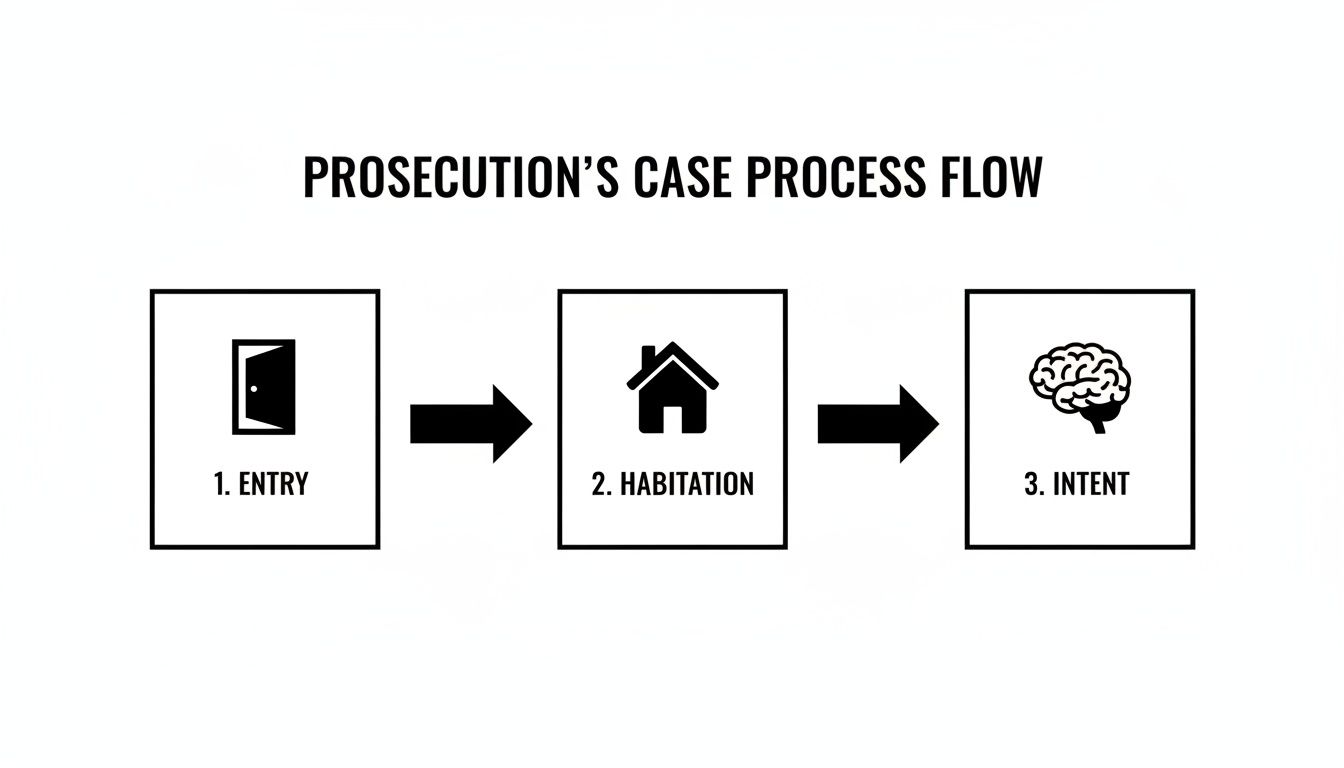
Each of these is a link in the chain of proof the state must build. If even one link is weak, their whole case can fall apart.
From Plea Bargaining to Trial
Once you are indicted, your case enters the pre-trial phase. This is where most of the legal work happens. Your defense lawyer will investigate the state's evidence, file motions to have illegally obtained evidence thrown out, and negotiate with the prosecutor.
Many criminal cases end with plea bargaining, where you might agree to plead guilty to a lesser charge in exchange for a reduced sentence. A skilled negotiator can often secure a favorable deal that avoids the risk and stress of a trial. However, if a fair agreement cannot be reached, your case will proceed to trial.
At trial, the prosecutor must prove your guilt beyond a reasonable doubt to a jury. Your attorney will cross-examine the state’s witnesses, present your side of the story, and make legal arguments on your behalf. For anyone navigating the Texas criminal justice system, especially those who aren't native English speakers, proper communication support is critical, which means understanding the role of an interpreter versus a translator.
If you are found guilty, the case moves to sentencing. If you are found not guilty, you are acquitted, and the case is over. Every stage of this journey is complex, but with the right guide, you can face it head-on.
Building a Powerful Defense Against Your Charges

Being charged with burglary of a habitation in Texas is a terrifying experience, but it’s critical to remember that a charge is not a conviction. The prosecution carries the entire burden of proof, and a skilled criminal defense attorney has many powerful strategies to challenge their case and protect your freedom.
Every case is unique, and the right defense always depends on the specific facts and evidence. The goal is simple: find the weaknesses in the prosecutor's argument and introduce reasonable doubt. An experienced lawyer will meticulously review police reports, witness statements, and physical evidence to build the strongest possible defense for your situation.
Challenging the Element of Intent
One of the most effective ways to fight a burglary charge is by attacking the element of "intent." The prosecutor must prove, beyond a reasonable doubt, that you intended to commit a felony, theft, or assault at the very moment you entered the residence. This is often the hardest thing for them to prove.
Your attorney can build a defense by showing there was no criminal intent. For example:
- Mistake of Fact: Perhaps you were intoxicated and walked into the wrong house, honestly believing it was your own or a friend's.
- Emergency Situation: You might have entered the home to get help during a medical crisis or to escape a dangerous situation.
- No Plan to Commit a Crime: You may have entered for a reason that was not criminal at all, even if it was technically trespassing.
Without clear proof of your state of mind, the state's case for burglary of a habitation can completely fall apart.
Defenses Based on Consent or Mistake
Another powerful defense strategy revolves around consent. If you had permission to be in the home, it is not a burglary. The law requires the entry to be unlawful.
This defense can apply in several scenarios. You might have had a reasonable belief you were allowed inside, perhaps because of a previous relationship with the owner or a simple misunderstanding. For instance, if a friend gave you a key in the past, you might have genuinely believed your entry was still permitted. Proving you had—or reasonably thought you had—consent to enter negates a core element of the crime.
Attacking Witness Identification and Evidence
In many cases, the prosecution's evidence depends on eyewitness testimony or physical evidence that may be flawed.
An effective defense often involves a deep investigation into how evidence was collected and how witnesses identified a suspect. Mistaken identity is a common issue, and a skilled lawyer can challenge the reliability of a lineup or an eyewitness account that was made under stressful conditions.
Furthermore, any evidence collected must have been obtained legally. If the police violated your constitutional rights through an illegal search and seizure, your attorney can file a motion to suppress that evidence. If the motion succeeds, the illegally obtained evidence is thrown out and cannot be used against you in court.
Even in areas with high crime rates, your rights are still protected. While national burglary numbers have trended downward, some Texas cities continue to report high per-capita burglary rates, which can create pressure on law enforcement to make arrests. You can discover more about how some Texas cities still face high burglary rates and see how this might influence policing priorities. A strong defense ensures this pressure doesn't lead to a violation of your constitutional rights.
The Full Impact of a Burglary of Habitation Conviction
It’s crucial to understand exactly what you’re facing with a burglary habitation texas charge. This isn't just about potential prison time and fines. A conviction sends shockwaves through every part of your life for years, long after you've paid your debt to society. It is critical to build a powerful, strategic defense right now.
A standard charge for burglary of a habitation is a second-degree felony. This carries a potential prison sentence of two to 20 years and a fine of up to $10,000. But as serious as that sounds, it can get much worse if certain aggravating factors are involved.
How a Charge Skyrockets to a First-Degree Felony
Texas law allows prosecutors to elevate the charge from a second-degree to a first-degree felony under specific circumstances. This is a game-changing move that ramps up the potential punishment to a staggering five to 99 years or even life in prison.
This enhancement is triggered if the state can prove you entered the home with the intent to commit a separate felony, other than theft.
Think of it this way: if the prosecutor can convince a jury that your plan was not just to steal something, but to commit another serious crime inside, the stakes of your case instantly go through the roof.
Examples of felonies that trigger this enhancement include:
- Aggravated Assault
- Sexual Assault
- Arson
- Murder
The Lifelong Consequences That Follow You
Even after you have served your time and paid your fines, a felony conviction follows you. These are often called "collateral consequences," and they act like invisible walls, blocking you from rebuilding your life. A conviction for burglary of a habitation can slam doors you never even knew were there.
A felony conviction is more than just a mark on your record; it's a permanent label that can strip away fundamental rights and opportunities, making it incredibly difficult to regain your footing in society.
Widespread Impact on Your Future
A conviction will fundamentally change your life in several key areas.
Employment and Professional Licenses
- Job Applications: Most employers run background checks. A felony conviction is often an automatic disqualifier, especially for any job that requires trust, security clearance, or handling money.
- Professional Licenses: If you are a nurse, a real estate agent, an accountant, or hold any other professional license, a felony conviction can lead to its suspension or even permanent revocation. Your career could be over.
Civil Rights and Personal Life
- Firearm Rights: Under both Texas and federal law, a felony conviction means you permanently lose your right to own or even possess a firearm.
- Housing: Landlords almost always run background checks. With a felony record, finding a safe, stable place to live becomes a massive challenge.
- Immigration Status: For non-citizens, a conviction for an "aggravated felony" like this can trigger mandatory deportation and a permanent ban from re-entering the United States.
These consequences are why fighting the charge from day one is so essential. A dismissal or an acquittal isn't just a legal win—it's the only way to prevent this cascade of lifelong penalties from taking over your future.
Life After a Charge: Can You Clear Your Record?

After facing a charge as serious as burglary of a habitation in Texas, the question that keeps most people up at night is simple: Can I ever move past this? A criminal record can feel like a life sentence long after the court case is over. Fortunately, Texas law provides pathways for clearing your name and giving you a chance to rebuild.
The goal for many is a true fresh start, free from the shadow of a past arrest. This is where options like expunction and nondisclosure come into play. Understanding the difference between them is the first step toward reclaiming your future.
Expunction vs. Nondisclosure: What’s the Difference?
An expunction completely destroys the record of your arrest. Once a judge grants an expunction, all government agencies must physically destroy their records of the incident. It is the legal equivalent of the event never happening, allowing you to legally deny the arrest ever occurred.
An order of nondisclosure, on the other hand, seals your record from the public. It’s like putting it in a locked file cabinet that most people cannot open. Law enforcement and certain state agencies can still see it, but employers, landlords, and the general public cannot.
An expunction provides a true clean slate by destroying the record, while an order of nondisclosure acts like a privacy shield, hiding it from public view.
These are powerful tools, but eligibility is strict—especially for a felony like burglary of a habitation. In most cases, you can only pursue an expunction if your case ended in one of these ways:
- You were acquitted (found not guilty) at trial.
- The prosecutor formally dismissed your case.
- You received a pardon from the Governor of Texas.
Gaining a second chance is a complex legal process. To fully understand your options, you can learn more about how to clear your record in Texas in our detailed guide.
While recent data shows property crimes have declined across the state, a single charge can still derail a person's life. According to the Texas Department of Public Safety, overall Index Crimes saw a decrease of roughly 23% year-over-year in early 2025. You can learn more about recent statewide crime trends from the DPS report. Even with these positive trends, securing a clean slate is essential for truly moving forward.
Common Questions About Burglary of a Habitation Charges
If you or a loved one is facing a burglary of a habitation charge in Texas, your mind is probably racing with questions. The legal system is confusing, and the stakes are incredibly high. Getting clear, honest answers is the first step toward building a defense and taking back control of your life.
Here are some of the most common questions we hear from clients every day.
What’s the Real Difference Between Burglary and Robbery in Texas?
This is one of the most frequent questions we get, and the distinction is critical. At its core, the difference comes down to whether the crime is against property or a person.
Burglary, as defined in the Texas Penal Code, is about unlawfully entering a building or home with the intent to commit another crime inside—usually theft, a felony, or assault. It is fundamentally a property crime.
Robbery, on the other hand, is a violent crime against a person. It occurs when someone commits theft while also causing injury or threatening someone with immediate harm. A burglary can instantly escalate into a much more serious robbery charge the moment a person inside the home is confronted, threatened, or hurt.
Can I Be Charged If Nothing Was Stolen?
Yes, absolutely. This is a huge misconception. In the eyes of Texas law, the crime of burglary of a habitation is complete the second you enter a home without permission, as long as you have the intent to commit a crime inside.
The illegal act is the entry itself, paired with a criminal mindset. The prosecutor does not need to prove you actually stole anything or assaulted someone. They only have to convince a jury that you intended to do so at the moment you crossed the threshold.
What If I Was Invited In, But Then Things Went Wrong?
This situation is incredibly fact-specific. If you walked through the door with the owner’s consent, you have not committed burglary because the initial entry was legal.
The trouble starts if that permission is revoked—for instance, if you were clearly and directly told to leave—and you refused to go. If you remained on the property with the intent to commit a crime after being told to leave, you could face other charges, like criminal trespass. The timeline of when consent was given and when it was withdrawn is the key here.
Is Breaking Into a Detached Garage the Same as Breaking Into the House?
It depends on how the structure is used. Under Texas law, a "habitation" isn't just the main house; it is legally defined as any structure adapted for the overnight accommodation of people. This automatically covers the main house and anything physically connected to it, like an attached garage.
A detached garage, a tool shed, or a workshop in the backyard is a different story. These are not typically considered part of the "habitation" unless someone is actually living in them, like in a converted garage apartment. If you unlawfully enter a standard detached garage, the charge would more likely be Burglary of a Building—still a felony, but a less severe state jail felony compared to the second-degree felony for a habitation.
If you’ve been charged with a crime in Texas, call The Law Office of Bryan Fagan, PLLC for a free and confidential consultation. Our defense team is ready to protect your rights.