Skip to content
Being arrested for burglary of a vehicle in Texas can be terrifying. In one moment, your world is turned upside down, and you’re left feeling overwhelmed and unsure of what happens next. While the charge is serious, you don’t have to face it alone. Understanding your rights and the law is the first step toward regaining control, and building a strong defense starts right now.
What to Do When Facing a Vehicle Burglary Charge
The minutes and hours after an arrest can be a blur of confusion and anxiety. The legal system feels like an intimidating maze, but it’s one you don’t have to navigate by yourself. The most critical thing you can do is stay calm and begin making smart, informed decisions.
This guide will break down the charge of burglary of a vehicle in plain English, explaining what prosecutors must prove to get a conviction. We'll walk you through the process step-by-step so you know what to expect. If you or someone you care about has been arrested, knowing your rights is crucial.
Understanding the Core Elements
At its heart, a vehicle burglary charge in Texas boils down to two key components: entry and intent. Getting a grip on these concepts is the foundation of any solid defense.
- Entry Isn't What Most People Think: Many assume burglary requires a smashed window or a jimmied lock. But in Texas, the definition of "entry" is much wider. Legally, it means any part of your body—even a finger—crossing the invisible plane of a car's door or window. Reaching into an open truck bed can be enough to count as entry.
- Intent is Everything: This is often the make-or-break element in a case. The prosecutor must prove that at the exact moment you allegedly entered the vehicle, you had the specific intent to commit theft or another felony. Simply being found inside someone else's car isn't a crime on its own; your state of mind is what the entire case hinges on.
An accusation is just the beginning of the story, not the end. The state carries the burden of proving every single element of the crime beyond a reasonable doubt. A skilled defense attorney's job is to challenge their narrative at every turn.
Understanding these fundamentals is vital because it immediately shows where the prosecution's case might be weak. Was there any real evidence of your intent? Was the "entry" accidental or a misunderstanding? These are the questions a dedicated defense lawyer will start asking right away. An experienced attorney can protect your rights and help you make the right choices from day one.
Breaking Down the Law: Texas Penal Code 30.04 Burglary of a Vehicle
If you're facing a burglary of a vehicle charge, the first step is to understand exactly what the law says. The state’s case is built on Texas Penal Code § 30.04. Legal statutes can feel like a foreign language, but when you break them down, the core concepts are straightforward.
The law says vehicle burglary happens when a person enters a vehicle without the owner's permission, with the intent to commit any felony or theft. To get a conviction, the prosecutor must prove two key things beyond a reasonable doubt: that you made an unlawful "entry" and that you had criminal "intent." Understanding these two pillars is how you start to see the cracks in the state's case.
What “Entry” Really Means in Texas
When people hear "entry," they usually picture someone smashing a window. But in Texas, the legal definition is much broader, and it catches many people by surprise.
To prove entry, a prosecutor just needs to show that any part of your body—or an object you were holding—crossed the "plane" of the vehicle. Think of it like an invisible force field around the car's openings.
This means these actions can legally count as an "entry":
- Reaching your hand through an open window to grab a phone.
- Leaning into an open car door to get a better look inside.
- Using a tool or a stick to move something inside the vehicle.
- Even just putting your arm over the side of a pickup truck bed.
Force is not a requirement. The car could be completely unlocked with the windows down. If you reach inside without permission and with the intent to steal, it can still be charged as a burglary.
The All-Important Element of Intent
Proving you entered a vehicle is often the easy part for the prosecution. The real fight in most vehicle burglary cases comes down to proving your intent at the moment of entry. This is a much tougher job for them.
The state has to convince a jury that you entered that car with the specific goal of committing a felony or theft. It’s not enough to show you were simply inside the vehicle; they have to prove what was going through your head at that exact second.
A prosecutor can't just guess what you were thinking. They have to present actual, concrete evidence that points to your intent to steal or commit another crime. This is often where a skilled defense lawyer can create powerful reasonable doubt.
For example, imagine you were caught sleeping in someone’s unlocked car on a freezing night. A good attorney would argue your intent was to find shelter, not to steal anything. The fact that you didn't have any stolen items on you helps strengthen that defense. Your state of mind is the whole ballgame, and it’s what separates a serious criminal charge from a simple misunderstanding.
How Vehicle Burglary Differs from Other Offenses
It's easy to confuse burglary of a vehicle with other similar crimes like theft or trespassing. The legal distinctions are huge, and they come with vastly different penalties. You can find more details in our guide to the burglary Texas penal code.
Understanding these differences is critical. Here’s a quick look at how these charges stack up.
Burglary of a Vehicle vs Related Offenses in Texas
This table clarifies the key differences between Burglary of a Vehicle and other common theft-related charges you might face.
| Offense | Key Element | Typical Scenario |
|---|---|---|
| Burglary of a Vehicle | Unlawful entry with intent to commit theft or a felony. | Reaching into an unlocked car specifically to steal a laptop. |
| Theft | Unlawfully taking property without entry being a core element. | Grabbing a bicycle from an open truck bed without reaching "inside." |
| Criminal Trespass | Entering or remaining on property without intent to commit another crime. | Sitting in someone else's unlocked car to get out of the rain. |
As you can see, the subtle difference in your alleged state of mind can be the dividing line between a Class A Misdemeanor for vehicle burglary and a much less severe Class C Misdemeanor for simple criminal trespass. An experienced criminal defense attorney knows exactly how to scrutinize the evidence—or the lack of it—to argue for a reduced charge or a complete dismissal based on these critical distinctions.
The Real-World Fallout of a Vehicle Burglary Conviction
A conviction for burglary of a vehicle in Texas is far more than just a fine. The consequences create a ripple effect, causing serious and lasting damage to your freedom, your finances, and your future. Understanding what's truly at stake is the first step toward realizing how much you need a powerful legal defense.
Most of the time, a vehicle burglary charge is a Class A Misdemeanor. While that might not sound as scary as a felony, the penalties pack a serious punch.
A conviction for a Class A Misdemeanor can mean:
- Jail Time: You could be sentenced to up to a full year in county jail.
- Heavy Fines: The court can impose a fine of up to $4,000.
- Probation: You could be placed on community supervision, forced to follow a long list of strict rules.
Those are just the immediate penalties. The real damage often goes much deeper than what happens inside the courtroom.
When a Misdemeanor Spirals into a Felony
Under certain circumstances, what starts as a misdemeanor can escalate into a life-altering felony. Prosecutors will aggressively pursue these higher charges if the facts fit.
The charge for burglary of a vehicle is enhanced to a state jail felony if:
- The vehicle was a rail car.
- The alleged intent was to steal a firearm.
- You already have two or more vehicle burglary convictions on your record.
A state jail felony conviction brings much heavier consequences, including 180 days to two years in a state jail facility and a fine of up to $10,000. That jump from a misdemeanor to a felony is a game-changer, making an experienced criminal defense lawyer absolutely essential.
The Hidden Penalties That Follow You for Life
Beyond jail time and fines, a permanent criminal record is a heavy anchor that can drag you down for the rest of your life. This is often the most devastating consequence—a barrier that feels impossible to overcome long after you’ve served your time.
A criminal record is more than a piece of paper; it’s a giant red flag that pops up every time someone runs a background check for a job, an apartment, or even a school application. The impact on your life can be overwhelming.
A conviction for burglary of a vehicle can make it incredibly difficult to:
- Find a Job: Most employers are wary of hiring someone with a theft-related conviction, especially for roles involving trust or handling money.
- Get a Place to Live: Landlords run background checks and are quick to deny applications based on a criminal history.
- Obtain Loans: Lenders might see the conviction as a sign of risk, harming your chances of getting a car loan, a mortgage, or a small business loan.
- Go Back to School: Some colleges and universities consider criminal history during admissions and it can affect your eligibility for financial aid.
- Keep a Professional License: If you’re a nurse, teacher, or real estate agent, a conviction could put your entire career in jeopardy.
This isn’t to scare you, but to give you a clear, honest picture of what's on the line. Your future is at stake, and fighting the charge is the only way to protect it.
Navigating the Texas Criminal Justice System Step by Step
Being arrested for burglary of a vehicle in Texas feels like being dropped into a legal maze blindfolded. The moment those handcuffs click, you're thrown into a complicated system with its own rules. Think of this section as your map—a step-by-step guide to help you understand what's coming and where your rights can be defended.
The journey from arrest to resolution follows a predictable path, and every stage is a critical opportunity for an experienced defense lawyer to protect you.
The First 48 Hours: Arrest and Booking
It all starts with the arrest. From there, you’ll be taken to a local jail for the booking process. This is an administrative step where an officer records your personal information, takes your fingerprints and a mug shot, and catalogs your personal items.
During this time, it is absolutely essential to remember your right to remain silent. The police will likely try to question you. You should politely but firmly decline to answer any questions until your lawyer is present. It’s far too easy to say something that could be twisted and used against you later.
Arraignment and Bail Hearing
Within 48 hours of your arrest, you must be brought before a judge or magistrate for your arraignment. This is your first official court appearance. The judge will formally read the charge—in this case, burglary of a vehicle—and ensure you understand your constitutional rights.
Right after, a bail hearing usually takes place. This is where the judge decides whether to release you from jail while your case is pending and, if so, under what conditions.
The judge will consider several factors when setting bail:
- The seriousness of the alleged crime.
- Your criminal history, if any.
- Your connections to the community, like a job or family.
- Whether you are considered a flight risk or a danger to the public.
A skilled defense attorney can make a huge difference here by arguing for a lower bail amount or even for your release on a personal recognizance (PR) bond, which costs nothing. This allows you to fight the charges from home instead of from a jail cell.
The graphic below shows just how serious the potential penalties are, from a misdemeanor to a felony conviction that leaves a permanent mark on your record.
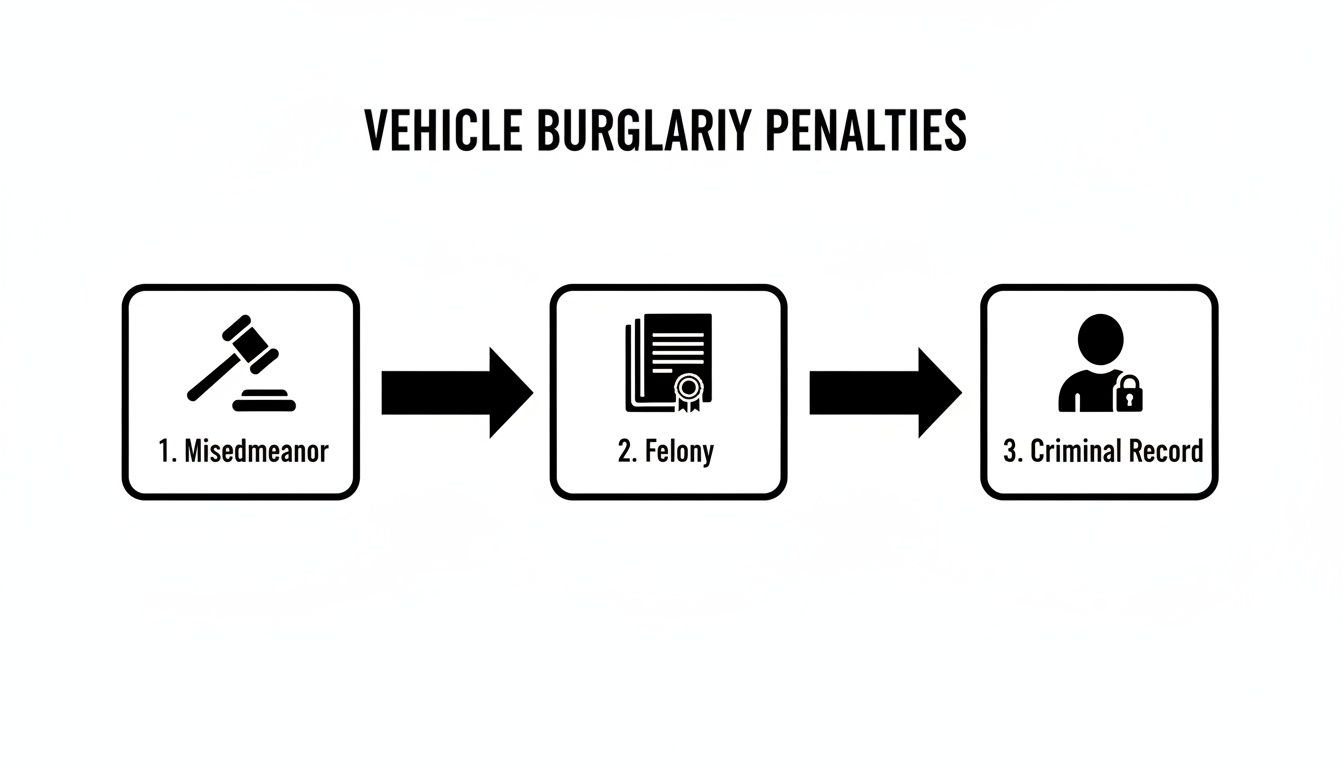
This flow chart makes it clear how quickly things can escalate, underscoring why you need a strong defense at every turn.
The Discovery and Investigation Phase
Once the initial court dates are over, your case moves into the discovery phase. This is a critical period where your defense lawyer formally requests all the evidence the prosecution has against you. It's about dissecting the state's entire case.
Your attorney will comb through every piece of evidence, which could include:
- Police reports and officer notes
- Witness statements
- Surveillance camera footage
- Scene photos
- Forensic evidence, like fingerprints
The discovery process is where we find the cracks in the prosecutor's case. An inconsistent police report, a grainy video, or a total lack of physical evidence can become the foundation of a winning defense strategy.
At the same time, your lawyer will conduct their own independent investigation. This might mean interviewing witnesses, visiting the scene of the alleged crime, or consulting with experts. The goal is simple: find the facts that support your story and create reasonable doubt.
Plea Bargaining and Your Options
The vast majority of criminal cases in Texas, including burglary of a vehicle, end with a plea bargain. This is an ongoing negotiation between your defense attorney and the prosecutor.
A plea agreement might involve pleading guilty to a less serious charge in exchange for a lighter sentence. For instance, your attorney could negotiate to have a Class A Misdemeanor burglary charge reduced to criminal trespass, which comes with much lower penalties. A good plea deal can be a strategic win, helping you avoid the risk and uncertainty of a trial. Your lawyer's reputation and negotiation skills are your biggest advantages here.
Going to Trial: Fighting for Your Freedom
If a fair plea agreement isn't possible, your case will head to trial. This is where the prosecutor must prove your guilt beyond a reasonable doubt to a jury or a judge.
The trial process includes jury selection, opening statements, presenting evidence, cross-examination, and closing arguments. In the courtroom, your attorney is your voice and your shield. They will challenge the prosecution's evidence, question the credibility of their witnesses, and present your defense in a clear, compelling way. Every step in the Texas criminal justice system matters, and having a trusted guide ensures your rights are protected from beginning to end.
How We Build Your Defense Against Vehicle Burglary Charges

Being accused of a crime is terrifying, but an accusation is not a conviction. The prosecution carries the entire burden of proving their case beyond a reasonable doubt. Our job as your defense team is to build a proactive, strategic defense that picks apart their arguments and protects your freedom.
Fighting a burglary of a vehicle in Texas charge is about systematically dismantling the state's narrative. We launch our own deep investigation into every piece of evidence, from the initial police report to witness statements. Every case is different, but a winning defense often hinges on challenging the core elements of the crime itself.
Challenging the Element of Intent
Proving what was in your mind at the exact moment of the alleged entry is often the prosecutor's biggest hurdle. This is where many cases start to fall apart. Our first step is to explore every possible explanation for your actions that doesn't involve a criminal motive.
A common and powerful defense is arguing a lack of intent. Were you just trying to get out of a sudden Texas downpour? Did you honestly mistake the car for your friend's or an Uber? These aren't just excuses; they are legitimate defenses that strike at the very heart of the state's case.
A vehicle burglary charge requires the state to prove you entered with the specific intent to commit a theft or a felony. If we can show a plausible, non-criminal reason for your presence, the prosecution's case loses all its strength.
For instance, if you were found inside a car with nothing stolen on you and no burglary tools, it becomes much harder for a prosecutor to argue you had criminal intent. We dig into the circumstances to build a compelling story that explains what really happened.
Questioning the Evidence Presented
Even when the state acts confident, the evidence they rely on is often far from perfect. Police reports can be full of inconsistencies, witness memories are notoriously flawed, and sometimes, there’s no physical evidence at all. A thorough defense means putting every piece of the state's evidence under a microscope.
We frequently challenge evidence by pointing out:
- Blurry or Unreliable Surveillance Footage: Security camera video is often grainy, shot from a bad angle, or too dark to definitively identify anyone.
- Mistaken Identity: Eyewitness testimony is one of the least reliable forms of evidence. We investigate the conditions of the identification—was it dark? How far away was the witness?
- Lack of Physical Evidence: The absence of your fingerprints, DNA, or any other physical tie to the vehicle is a huge point in your favor.
Asserting Your Constitutional Rights
Your constitutional rights are your shield. If law enforcement overstepped their authority at any point—from the initial stop to the interrogation—we can file a motion to have crucial evidence thrown out of court. Sometimes, this is enough to get the entire case dismissed.
One of the most important defenses is proving an illegal search and seizure. Police cannot search a vehicle without a warrant or probable cause. If they found evidence against you during an illegal search, we can move to suppress it, making it inadmissible in court.
Another key defense is consent. If the vehicle’s owner gave you permission to be inside, then the entry wasn't unlawful, and no burglary occurred. Misunderstandings between friends or family can easily spiral into wrongful arrests. In situations involving groups, it’s also important to understand the Law of Parties in Texas and whether the state is trying to hold you responsible for someone else's actions.
Ultimately, building a strong defense is about telling your side of the story, backed by facts, legal precedent, and a deep understanding of the Texas Penal Code. We are here to make sure that story gets told and your rights are aggressively defended.
Clearing Your Record and Reclaiming Your Future

Even after your case is over, an arrest for burglary of a vehicle in Texas can cast a long shadow. That mark on your record can create roadblocks when you’re trying to get a job, find housing, or secure a loan.
Fortunately, Texas law provides powerful tools to help you move forward. We believe in second chances, and two of the best ways to get one are through an expunction or an order of nondisclosure.
Expunction: Erasing the Record Completely
Think of an expunction as the ultimate clean slate. It doesn’t just hide your record—it legally destroys every trace of your arrest. If you’re eligible, it’s as if it never happened in the eyes of the law.
Once an expunction is granted, you can legally deny that the arrest ever occurred on applications for jobs, housing, or loans. This is the most complete form of post-case relief available.
You may qualify for an expunction if your case ended in one of these ways:
- You were found "not guilty" at trial (acquitted).
- The prosecutor formally dismissed your case.
- You were pardoned.
Nondisclosure: Sealing the Record from Public View
If an expunction isn't an option, an order of nondisclosure is your next best move. Instead of destroying the record, this court order seals it from the public. This means private employers, landlords, and others won’t see it during most background checks.
An order of nondisclosure makes your record invisible to the people who matter most—potential employers and landlords. While law enforcement can still access the record, it effectively removes the barrier for most everyday opportunities.
You may be eligible for nondisclosure if you successfully completed a deferred adjudication program for your burglary charge. After the required waiting period is over, you can petition the court to seal the records. To learn more about your options, see our guide on how to clear your record in Texas.
Got Questions About Texas Vehicle Burglary? Let's Clear Things Up.
When you're facing a charge like burglary of a vehicle, your mind is probably racing with questions. It can feel overwhelming. Let’s cut through the legal jargon and get you some straight answers to the questions we hear most often.
Do I Have to Break a Window for It to Count?
No, and this is the biggest misconception out there. Texas law defines "entry" as any intrusion into the vehicle's space. Reaching your hand through an open window or just over the side of a pickup truck bed is enough to be considered a legal entry. The use of force is not required.
What if I Didn't Actually Steal Anything?
It doesn't matter in the eyes of the law. The charge isn't about what you took; it’s about what you intended to do when you entered the vehicle. If a prosecutor can convince a jury that you entered the car with the plan to commit a theft or another felony, you can be convicted, even if you left empty-handed.
Can This Charge Mess with My Immigration Status?
Yes, absolutely. A conviction for a theft-related crime like burglary of a vehicle can be labeled a crime of moral turpitude. For non-citizens, this is a serious red flag that could lead to deportation or prevent you from getting a green card or becoming a citizen.
How Soon Should I Get a Lawyer After an Arrest?
You need to hire an experienced defense attorney immediately. The sooner you have a lawyer in your corner, the better. A good attorney gets to work right away. They can protect you from saying something that hurts your case, fight for you at your bond hearing, and start building a strong defense from day one. For those looking to prevent these situations, learning about a comprehensive car security system can offer valuable insights.
If you’ve been charged with a crime in Texas, call The Law Office of Bryan Fagan, PLLC for a free and confidential consultation. Our defense team is ready to protect your rights.