Being arrested for burglary of habitation in Texas can be terrifying, but you don’t have to face it alone. Feeling overwhelmed and scared is a completely normal reaction. The first step toward taking control of your situation is understanding exactly what you're up against. Under Texas Penal Code § 30.02, this charge is much more than simple theft; it’s about illegally entering a private home with the intent to commit another crime.
This is a serious felony, and the law treats it that way because it is designed to protect the safety and sanctity of a person’s home. A conviction can change your life forever, which is why it's so important to know your rights and options.
Understanding a Burglary of Habitation Charge
When you're staring down a charge as severe as burglary of a habitation, the legal jargon can feel impossible to untangle. But at its core, the law is built to punish the act of invading someone’s private residence with criminal intentions. It’s not just about what you may or may not have taken; it’s about the illegal entry itself and your alleged state of mind when it happened.
The prosecution has a specific job: to prove every single element of the crime beyond a reasonable doubt. Think of their case as a recipe—if even one ingredient is missing, their entire case can fall apart.
The Key Elements Prosecutors Must Prove
For the state to secure a conviction for burglary of a habitation, the prosecutor can't just show you were on someone else's property. In plain English, they have to prove that you:
- Entered a Habitation: This means any part of your body crossed the threshold of a place where people live. This could be a house, an apartment, or even an attached garage.
- Without Effective Consent: You didn't have the owner's permission to be there. Consent that was given because of a threat or deception doesn't count as valid.
- With Intent to Commit a Felony, Theft, or Assault: This is often the most critical—and most difficult—element for the state to prove. They must show that at the exact moment you entered, you already planned to commit another crime inside.
It's crucial to understand that you can be charged even if you didn't steal a thing or hurt anyone. The crime is considered complete the moment you enter with that specific intent.
Despite a statewide drop in burglary offenses, these cases remain a top priority for law enforcement. Nationally, home burglaries still make up 53% of all incidents, with average losses hitting $6,000 per break-in, which is why prosecutors pursue these cases so aggressively.
How This Charge Differs From Other Crimes
Many people mix up burglary with other property crimes like theft or trespassing, but the differences are critical for building a defense. Knowing what makes your charge unique helps clarify exactly what you're facing.
To better understand these distinctions, here is a quick comparison of Burglary of Habitation against other common property crimes in Texas.
Burglary of Habitation vs Other Texas Property Crimes
| Offense | Location Type | Required Intent | Typical Felony Level |
|---|---|---|---|
| Burglary of Habitation | A place where people live (house, apartment) | To commit a felony, theft, or assault | 2nd Degree Felony |
| Burglary of a Building | A structure not used for living (store, office) | To commit a felony, theft, or assault | State Jail Felony |
| Criminal Trespass | Any private property | To enter or remain without consent | Class B or A Misdemeanor |
| Theft | Anywhere | To unlawfully take property | Varies (Misdemeanor to Felony) |
As you can see, the "habitation" element and the "intent" requirement are what elevate this charge to a serious felony. It's not just about being somewhere you shouldn't; it's about why the prosecution claims you were there. Understanding these nuances is the foundation of a strong defense strategy. For a deeper look, check out our guide on the Texas burglary penal code. It can also be useful to see how other legal systems approach similar concepts, such as in a practical guide to house trespass.
The High Stakes of a Felony Conviction

Let’s be crystal clear about one thing: a burglary of habitation charge in Texas is always a felony. There is no misdemeanor version, no slap on the wrist. This isn't like other offenses that might get reduced. The moment a home is involved, the stakes skyrocket, and a conviction can permanently change the entire course of your life.
Facing any felony is serious, but Texas law puts a protective bubble around a person's home. The penalties are intentionally severe to send a message. Understanding just how high the stakes are is the first, most critical step in building a defense that can protect your future.
Second-Degree Felony: The Standard Charge
In most cases, burglary of a habitation is charged as a second-degree felony. Don't let the term "standard" fool you; this is a major charge with a sentencing range that reflects just how seriously the state takes it.
If you're convicted of a second-degree felony, the judge can impose:
- Prison Time: Anywhere from 2 to 20 years in a Texas state prison.
- Fines: A fine of up to $10,000.
These aren't just abstract numbers. They represent years away from your family, the loss of your freedom, and a massive financial hit. While a judge weighs many factors before deciding on a sentence, the possibility of two decades behind bars shows why you absolutely cannot afford to face this alone.
The moment a burglary charge involves a home, the legal system's approach changes dramatically. Prosecutors and judges in Texas view the invasion of a private residence as a serious violation of personal security, which is why the penalties are so harsh, even for a first-time offense.
When the Charge Escalates to a First-Degree Felony
As life-altering as a second-degree felony is, things can get even worse. Certain actions can elevate a burglary of habitation charge to a first-degree felony—the most serious level of crime in Texas short of a capital offense.
This escalation happens if, while entering, being inside, or leaving the home, you commit or even attempt to commit another specific type of felony. The most common triggers include offenses like:
- Sexual Assault or Aggravated Sexual Assault
- Injury to a Child, Elderly Individual, or Disabled Individual
- Any felony that involves using or showing a deadly weapon
A conviction for a first-degree felony carries a devastating punishment: 5 to 99 years, or life in prison, plus a potential $10,000 fine.
To put these penalties into perspective, here is a quick overview of the standard sentencing ranges for these felony levels in Texas.
Texas Felony Penalties at a Glance
| Felony Level | Prison Sentence | Maximum Fine |
|---|---|---|
| First-Degree Felony | 5 to 99 years, or life | Up to $10,000 |
| Second-Degree Felony | 2 to 20 years | Up to $10,000 |
This table clearly illustrates why the distinction between these two felony levels is so critical. The difference can be decades of your life.
A Real-World Scenario: How Things Escalate Fast
Imagine a heated argument with an ex-partner. You drive over to their apartment to get your stuff, but they refuse to open the door. In a moment of frustration, you force the door open and step inside. The argument flares up again, and you push them, causing them to stumble and fall.
What started as a personal dispute has now potentially spiraled into a first-degree felony. A prosecutor could argue that:
- You entered the home without their consent by forcing the door.
- You went inside with the intent to commit assault.
- The push itself constitutes an assault.
Suddenly, a single, regrettable chain of events could lead to a charge that carries a possible life sentence. This isn't meant to scare you, but to give you the clarity needed to understand why your very next move—contacting an experienced Houston criminal lawyer—is the most important one you can make.
How a Prosecutor Builds Their Case
To build a solid defense against a burglary of habitation charge, you first have to get inside the prosecutor’s head. They have a specific playbook they follow, and their one and only goal is to prove every single element of the crime beyond a reasonable doubt. If they come up short on even one of those elements, their whole case can fall apart.
Think of a prosecutor’s job like building a three-legged stool. Each leg represents a core element of the crime they must prove. If even one leg is weak or missing, the stool can't stand, and a jury cannot legally convict. Let’s pull back the curtain and look at how they try to build that stool.
Element 1: Proving You Entered a Habitation
First things first, the prosecutor has to show that you actually "entered" a home. Now, under Texas law, the definition of "entry" is surprisingly broad. They don’t need to prove your whole body made it inside. Just a hand, a foot, or even a tool you were holding that crossed the threshold of a door or window is enough to count.
To nail this down, they'll lean on a few key types of evidence:
- Surveillance Footage: This is the gold standard. Ring doorbells, home security systems, or a neighbor’s camera can provide undeniable visual proof of entry.
- Physical Evidence: Police are trained to look for this. Fingerprints on a windowpane, footprints near a busted door, or fibers from your clothing caught on a broken screen can all be used.
- Witness Testimony: An eyewitness—whether it's the homeowner, a neighbor, or just someone passing by—who can point you out is incredibly powerful in front of a jury.
A sharp defense attorney immediately goes on the attack here. Was that video footage grainy and unclear? Could those fingerprints belong to someone else who had been there legally? Is the witness's memory really as reliable as they claim?
Element 2: Proving Lack of Consent
Next up, the prosecution must prove you entered without the owner's effective consent. This is the bright line that separates a welcome guest from a criminal intruder. "Effective consent" means permission was given freely and willingly—not because someone was forced, threatened, or tricked.
Proving this part is usually straightforward for the State. They’ll put the homeowner on the stand to testify that they never gave you permission to be there. They might also back this up with:
- Texts or voicemails where you were explicitly told to stay away.
- A pre-existing protective order or a criminal trespass warning.
- Obvious signs of forced entry, like a shattered window or a kicked-in door, which scream "no consent."
But life and relationships get messy. A defense can emerge if you had a good reason to believe you had permission to be there, perhaps because of a past romantic relationship or a history of coming and going freely.
Element 3: Proving Criminal Intent
This is where the prosecution's case is often the shakiest—and where a good defense lawyer can do the most damage. The state has to prove that at the very moment you entered, you had the specific intent to commit a felony, theft, or an assault inside. Just being there without permission isn't enough; they have to prove what was going on in your head.
Because prosecutors can’t read minds, they are forced to use circumstantial evidence to paint a picture of your intent. Things like carrying burglary tools, wearing a mask, or making incriminating statements can be used against you. A lack of this kind of evidence makes their job much, much harder.
For example, if you're caught inside with a sack full of the homeowner's jewelry, the prosecutor has a pretty easy story to tell the jury. But what if you barged in during a nasty breakup to grab your own laptop and clothes? In that scenario, your intent wasn't to commit theft or assault, and that distinction could be enough to beat the burglary charge completely.
It’s also crucial to know that Texas law can sometimes hold you accountable for what other people do. You can get a deeper dive into this concept in our article explaining the Law of Parties in Texas. Getting a handle on these rules is a vital part of building your defense.
Crafting Your Strongest Defense Strategy
Getting arrested for burglary of habitation in Texas feels like the end of the road, but it’s not. An arrest is not a conviction. The time between being placed in handcuffs and a potential trial is a critical window—it's where a powerful defense strategy is born. A good Texas assault defense attorney doesn't just sit back and wait for the prosecutor's next move; they get aggressive, challenging the evidence, poking holes in the state's narrative, and raising strong legal arguments to protect your freedom.
Over the years, many defense strategies have proven successful in Texas courtrooms. The key is finding the right one that fits the unique facts of your case.
Challenging the Prosecution's Core Arguments
Here's a fundamental truth: the state carries the entire burden of proof. It's their job to prove every single element of the crime beyond a reasonable doubt. Your attorney's job is to dismantle that case, piece by piece, until that doubt becomes impossible for a jury to ignore. This almost always starts by attacking the two weakest links in a burglary charge: consent and intent.
Defense 1: You Had Consent to Be There
To get a conviction, the prosecutor has to prove you entered without the owner’s “effective consent.” This is a huge hurdle for them if you had permission to be on the property—or even if you had a reasonable belief that you did. It’s not burglary if you were welcome. This defense comes up frequently in complicated situations involving roommates, family members, or ex-partners.
- Real-World Example: Imagine you still have a key to the apartment you shared with your ex. You’ve gone over before to grab your mail without issue. If you do it again, even if they have since changed their mind, your entry was based on a prior understanding. That directly contradicts the state’s claim that your entry was illegal.
Defense 2: Lack of Criminal Intent
This defense is often the cornerstone of the entire case. The prosecutor must prove you entered with the specific intent to commit a felony, theft, or assault. If you entered for any other reason, the burglary charge simply can't stick. Intent is a state of mind, and it's incredibly difficult for the government to prove what was going on in your head.
- Real-World Example: You see smoke pouring from a neighbor’s window. Fearing the worst, you push open an unlocked door and go inside to check if anyone is hurt. Your intent wasn't to commit a crime; it was to help. Proving this state of mind is a complete defense to burglary.
Questioning the Evidence and Investigation
Beyond attacking the core elements, a sharp defense lawyer will put every piece of evidence and every police action under a microscope. Law enforcement isn't perfect, and procedural mistakes can get crucial evidence thrown out of court.
Defense 3: Mistaken Identity
Eyewitness testimony is notoriously unreliable. A witness might have seen someone in bad lighting, from a distance, or during a chaotic and stressful moment. If the state’s entire case hangs on one person pointing the finger at you, a defense of mistaken identity can be devastatingly effective. This often involves presenting a solid alibi, challenging the witness’s memory on the stand, or pointing out major inconsistencies in their description.
Defense 4: Insufficient Evidence
Sometimes, the state’s case is just weak. It might be built on circumstantial evidence with no direct proof linking you to the crime. For instance, maybe your fingerprints were found at the scene. But if you were a regular guest or had been there for a legitimate reason in the past, their presence is easily explained. Your lawyer's job is to show the jury that the prosecution’s story has too many holes to be believed beyond a reasonable doubt.
A critical tool in this fight is filing legal motions to exclude evidence that was obtained illegally. For example, if the police searched your home or car without a warrant or probable cause, anything they found can be suppressed. This means the jury never gets to see it. You can learn more about how this works by reading our detailed explanation of a motion to suppress evidence.
Ultimately, building the right defense requires a deep knowledge of Texas law and a relentless approach to tearing down the prosecution's narrative. An arrest is just the beginning of the story, not the final chapter. With the right strategy, you can fight for a dismissal, a reduction in charges, or a "not guilty" verdict at trial.
Navigating the Texas Criminal Court Process
If you’ve been arrested for burglary of habitation in Texas, the path forward can feel like a confusing and intimidating maze. The criminal justice system has its own language and rules that are overwhelming for anyone. But knowing what to expect can help replace fear with a sense of control. This roadmap will walk you through each critical stage, from the moment of arrest to the final resolution of your case.
From Arrest to Arraignment
The clock starts ticking the moment you are arrested. You’ll be taken to a local jail for booking—the process of taking your fingerprints, photograph (mugshot), and personal information. By law, you must be brought before a magistrate judge for an arraignment within 48 hours of your arrest.
This first court appearance is a critical step. During the arraignment, the judge will:
- Inform you of the specific charges against you (e.g., burglary of habitation, a second-degree felony).
- Advise you of your constitutional rights, including the right to remain silent and the right to an attorney.
- Set the initial amount for your bail, which is the money required to secure your release while the case is pending.
The Grand Jury and Indictment
Because burglary of a habitation is a felony, the case can't move forward on an officer's word alone. The next step is a grand jury. This is a group of citizens who listens to the prosecutor's evidence in secret and decides if there is enough probable cause to formally charge you. They are not deciding guilt or innocence; they are simply a gatekeeper, determining if the case is strong enough to proceed.
If the grand jury finds enough evidence, they issue an indictment, which is the formal charging document that officially kicks off the criminal case. If they don't, the case is "no-billed," and the charges are dropped. This is one of the first major opportunities for a skilled lawyer to intervene and potentially stop the case before it ever really begins.
This is where your defense starts to take shape by examining the core elements of the state's case.
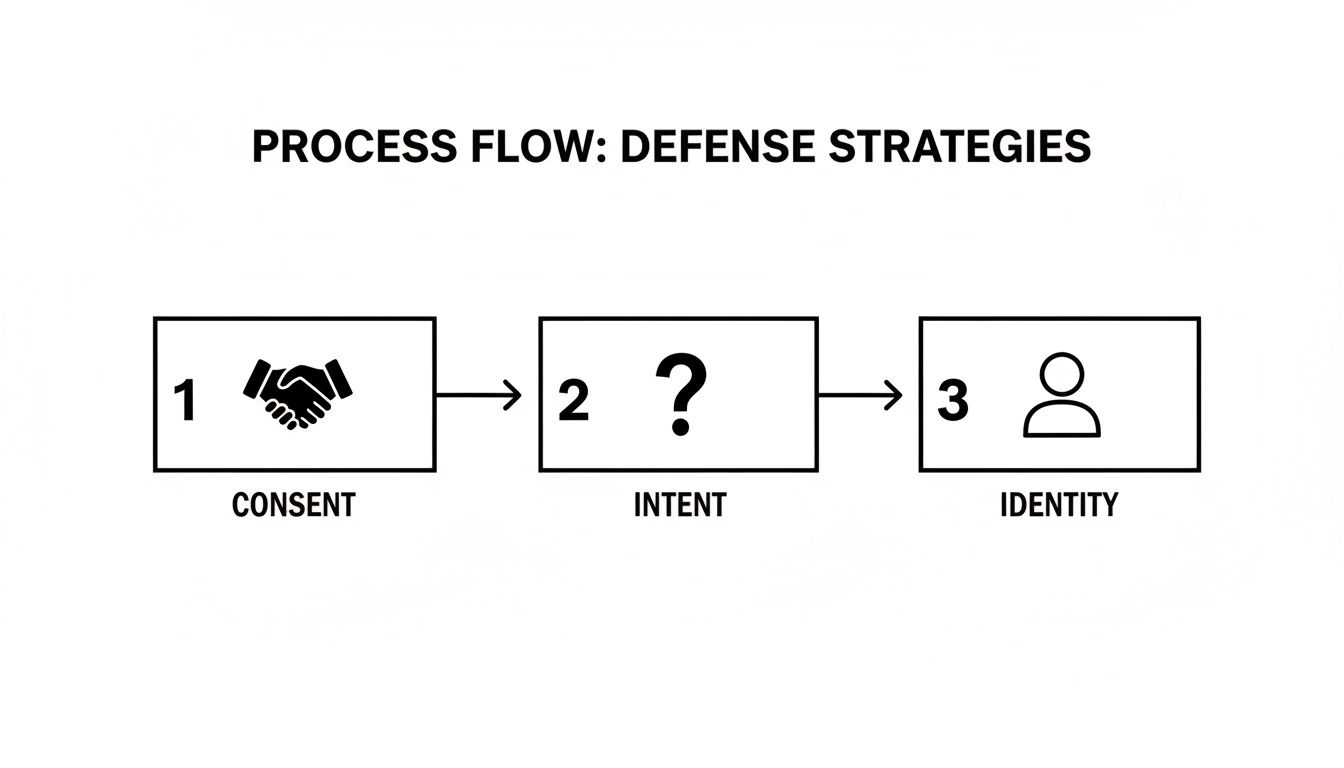
As you can see, a solid defense is built by challenging the prosecution's story on key points: Did the owner give consent? What was your actual intent? And are they sure they have the right person?
Pre-Trial Motions and Plea Bargaining
Once an indictment is issued, the case moves into the pre-trial phase. This is where your defense attorney really goes to work. They will file pre-trial motions to challenge the evidence against you. For example, they might file a motion to suppress evidence found during an illegal search or to exclude a statement taken without a proper warning of your rights.
At the same time, plea bargaining begins. The reality is that over 90% of criminal cases are resolved through plea negotiations, not a dramatic courtroom trial. Your attorney will negotiate with the prosecutor to try and secure a better outcome, which might include:
- Getting the charges reduced to a lesser offense.
- Agreeing to a sentence of probation instead of prison.
- Having the case dismissed entirely if the evidence is weak.
A strong pre-trial defense isn't just about getting ready for trial; it's about creating leverage. The more weaknesses your attorney finds in the prosecutor's case, the more likely they are to offer a favorable plea deal to avoid the risk of losing in court.
The Possibility of a Trial
If a fair plea agreement can't be reached, your case will be set for trial. A jury of your peers will hear the evidence from both the prosecution and the defense. To convict you, the prosecutor has to convince all twelve jurors beyond a reasonable doubt that you are guilty. If even one juror has a reasonable doubt, it results in a hung jury, not a conviction.
You have the right to testify in your own defense, but you are never required to. Your lawyer will present your side of the story, cross-examine the state’s witnesses, and make arguments to the jury on your behalf. If you are found not guilty, you are free to go. If you are found guilty, the case moves to the sentencing phase, where the judge or jury will decide your punishment within the legal range for a burglary of habitation conviction.
Life After a Burglary Case and Moving Forward
Just because a criminal case is over doesn't mean its impact disappears. A felony charge, especially for burglary of habitation in Texas, can cast a long shadow over your life, creating roadblocks when you apply for a job, try to rent an apartment, or seek a professional license.
The good news is that Texas law offers a way to clean up your record and reclaim your future. Depending on how your case was resolved, you might be eligible to use one of two powerful legal tools to move on.
Expunctions: Wiping the Slate Clean
An expunction is the gold standard for clearing your record. Think of it as hitting the delete button on your case—permanently. Once a judge grants an expunction, the law requires all government agencies to physically destroy every record of your arrest. Legally, it's as if it never even happened.
You are typically eligible for an expunction if your case ended in one of these ways:
- You were found not guilty after a trial (acquitted).
- The prosecutor dismissed your case.
- You were arrested but the district attorney never filed formal charges.
Orders of Nondisclosure: Sealing the Record from Public View
But what if your case wasn't dismissed? An order of nondisclosure is your next best option. Instead of destroying your criminal record, a nondisclosure seals it, effectively hiding it from the public. This means private employers, landlords, and nosy neighbors won't see it on a background check.
While an expunction completely erases the record, a nondisclosure puts it under lock and key. It’s still accessible to law enforcement and certain state agencies, but it’s hidden from almost everyone else, giving you a much-needed fresh start.
Nondisclosures are most often available for people who successfully completed a special kind of probation known as deferred adjudication. The waiting periods and eligibility rules can be tricky, which is why it’s so important to have an attorney who knows the ins and outs of Texas record-clearing laws. Both of these options can give you a real chance to put a difficult chapter behind you and build a better future.
Common Questions About Texas Burglary Charges
If you're facing a burglary of habitation charge in Texas, your mind is probably racing with urgent questions. It's a serious accusation, and getting clear, straightforward answers is the first step toward regaining some control.
What's the Difference Between Burglary and Robbery?
This is easily one of the most common points of confusion, and the media often gets it wrong. The two crimes are fundamentally different.
Burglary is an entry crime. It’s all about entering a building or home without permission with the intent to commit a felony, theft, or assault inside. The place could be completely empty when it happens.
Robbery, on the other hand, is a violent crime against a person. It involves injuring someone or threatening them with harm while you're in the process of committing a theft. The key element is the use or threat of force against a victim.
Can They Charge Me if I Didn't Actually Steal Anything?
Yes, absolutely. This surprises many people. The core of a Texas burglary charge isn't what you took—it's your intent the moment you entered unlawfully.
The crime is legally complete the second you cross that threshold with the plan to steal, assault someone, or commit another felony. It doesn't matter if you got spooked and ran or couldn't find anything valuable. The prosecutor only has to prove what was in your head when you went inside.
Is Probation a Real Possibility for This Charge?
For a first-time offender, yes, probation is sometimes an option, but it is never a guarantee. A judge will look at every single detail of your case—the specific facts, your criminal history, and any mitigating circumstances—before making a decision.
But make no mistake: burglary of habitation is a second-degree felony. Prosecutors almost always push for serious prison time, so securing a probation sentence requires a very strong and persuasive defense strategy.
What Should I Do if the Police Want to Question Me?
This is critical practical advice. You must immediately and politely tell them you are exercising your right to remain silent and that you want to speak with a lawyer. Nothing more.
Don't try to explain your side of the story. Don't offer up an alibi. Don't try to talk your way out of it. Anything and everything you say can—and will—be twisted and used against you in court. Let your attorney do all the talking.
After a burglary case, many people focus on making their homes feel safe again. Taking practical steps, like learning how to secure sliding glass doors, can be an important part of moving forward and restoring a sense of security.
If you’ve been charged with a crime in Texas, call The Law Office of Bryan Fagan, PLLC for a free and confidential consultation. Our defense team is ready to protect your rights.