Being arrested in Texas can be terrifying—but you don’t have to face it alone. When you're accused of burglary of habitation, it means the state believes you entered someone’s home without permission, intending to commit a felony, theft, or assault inside. Many people think something has to be stolen for it to count, but that's not true. The prosecutor's case often hinges on proving what you were thinking—your intent—the moment you went inside. This is one of the most serious property crimes because it violates a person's fundamental sense of safety.
What a Burglary of Habitation Charge Really Means
Facing a charge like burglary of habitation can leave you feeling lost and anxious about what comes next. You're not alone in feeling this way. The first step toward defending yourself is understanding what this accusation actually means in the eyes of the law, explained in plain English.
Texas law treats your home as your castle, giving it the highest level of legal protection. This is why the penalties for entering a home are so much more severe than for breaking into a car or a business. To get a conviction, the prosecutor has to prove several specific elements beyond a reasonable doubt.
The Key Elements of the Offense
Under Texas Penal Code § 30.02, the state’s attorney has to prove every single one of these components. If they fail to prove even one, their case falls apart.
- Entry: You "entered" a structure. This doesn't mean you had to kick down the door. Legally, even reaching your hand through an open window can be enough to count as entry.
- Without Effective Consent: You didn't have the owner's permission to be there. This is a critical point: consent can be withdrawn. If you were invited in but then told to leave and you refused, your presence could become unlawful.
- A Habitation: The building was a "habitation," which is legal term for a structure where people sleep overnight. This covers houses and apartments, but also includes RVs if someone lives in them.
- Intent to Commit a Crime: At the very moment of entry, you had the specific goal of committing a felony, theft, or an assault. This is usually the hardest part for the prosecution to prove and often becomes the central battleground for your defense attorney.
Think of these elements as the legs of a table. If your attorney can knock out even one of them, the whole case against you can collapse.
People often mix up burglary and robbery, but they're completely different crimes. Burglary is about unlawfully entering a place with criminal intent. Robbery, on the other hand, is a violent crime that involves taking something from a person using force or threats.
Why Texas Takes This Charge So Seriously
The state's tough-as-nails approach to home burglaries is a direct response to how often these crimes happen. Texas consistently has high rates of burglary, especially when it comes to homes.
FBI data shows that the South, which includes Texas, accounted for a staggering 41% of all burglary cases nationwide in 2023—more than any other region. This pressure means prosecutors and judges are often pushed to seek the harshest penalties possible.
Knowing this context is vital. You aren’t just fighting a single accusation; you’re up against a system geared to punish this specific offense severely. A skilled criminal defense attorney understands this landscape and knows how to build a defense that anticipates the prosecution's moves. Your future depends on challenging the evidence and ensuring your rights are protected every step of the way.
Understanding the Severe Penalties You Could Face

A conviction for burglary of habitation can change your life forever. It's critical to understand exactly what’s on the line. These penalties aren't a slap on the wrist; they involve serious prison time and crippling fines that can haunt you for decades. We want to give you a clear-eyed view of the fight ahead so you recognize the urgency of building a powerful legal defense.
In Texas, the law draws a thick line between breaking into a regular building and entering someone's home. Violating the sanctity of a home—the one place people are supposed to feel safest—is treated with extreme seriousness. This is why a burglary of habitation Texas charge is almost always a felony.
The specific degree of that felony, however, hinges entirely on what the prosecutor believes your intentions were.
The Standard Charge: Second-Degree Felony
The most common charge for this offense is a second-degree felony. This is what you'll likely face when the prosecution claims you unlawfully entered a home with the intent to commit theft or assault. While it's the "standard" charge, the consequences are anything but minor.
A conviction for a second-degree felony carries:
- Prison Sentence: Anywhere from 2 to 20 years in a Texas state prison.
- Maximum Fine: Up to $10,000.
Even the minimum sentence of two years means losing your freedom, your job, and precious time with your family. This is why having a strong defense from the very beginning isn't just an option—it is an absolute necessity.
When the Stakes Get Higher: First-Degree Felony
The situation becomes drastically more severe if the prosecutor accuses you of entering the home with the intent to commit a more serious felony. If they can convince a jury you intended to commit a crime like sexual assault or murder, the charge gets elevated to a first-degree felony. This is the highest level of felony in Texas, just one step below capital murder.
The potential penalties for a first-degree felony are devastating:
- Prison Sentence: From 5 to 99 years, or even life in prison.
- Maximum Fine: Up to $10,000.
The enormous jump in potential prison time—from a maximum of 20 years to a potential life sentence—shows just how much depends on the prosecutor's theory about your intent. Often, a defense attorney’s most important job is to systematically dismantle their arguments about what was going through your mind.
The table below breaks down these penalties side-by-side, making the distinction crystal clear.
Burglary of Habitation Penalties in Texas
| Degree of Felony | Basis for Charge | Prison Sentence | Maximum Fine |
|---|---|---|---|
| Second-Degree Felony | Intent to commit theft, assault, or another felony. | 2 to 20 years | Up to $10,000 |
| First-Degree Felony | Intent to commit a felony other than theft (e.g., sexual assault, murder). | 5 to 99 years, or life | Up to $10,000 |
As you can see, the penalties escalate dramatically based on the alleged intent, which is often the most subjective and contestable part of the state's case.
Under Texas Penal Code §30.02, burglary of a habitation is classified as a second-degree felony, carrying a potential prison sentence of two to 20 years and fines up to $10,000. If the intent is to commit a felony other than theft, the offense escalates to a first-degree felony, punishable by five to 99 years or even life in prison. These penalties are significantly more severe than those for burglary of a building, which is considered a state jail felony with a sentence of six months to two years. Discover more insights about these burglary statistics and their implications.
How Prior Convictions Can Make Things Much Worse
If you have prior felony convictions, prosecutors can use them to seek "enhancements," a legal tool that dramatically increases the punishment range you face.
For instance, if you are charged with a second-degree felony but have a prior felony on your record, the prosecutor can enhance the charge to a first-degree felony. Just like that, the potential prison time jumps from a 2-20 year range to a 5-99 year or life range.
These enhancements give prosecutors immense leverage in plea negotiations. It’s a powerful tactic they use to pressure defendants into accepting plea deals, even when the evidence against them is flimsy. An experienced defense lawyer knows these strategies inside and out—and knows exactly how to fight back.
Building a Strong Defense Against Your Burglary Charge
Being charged with a crime is not the same as being convicted. The clock is ticking, and the very first step toward getting your life back is understanding how to fight the allegations. When you’re facing a burglary of habitation Texas charge, a sharp defense attorney doesn’t just play defense—they go on the offense, building a strategy designed to pick apart the prosecutor's case piece by piece.
Every case is different. The unique facts, specific circumstances, and potential weaknesses in the state’s evidence all matter. A deep investigation almost always uncovers powerful ways to defend you, whether that means getting the charges reduced, dismissed entirely, or winning a "not guilty" verdict at trial.
Challenging the Element of Intent
The single most important element in any burglary case is intent. To convict you, the prosecutor must prove—beyond a reasonable doubt—that you planned to commit a felony, theft, or assault at the exact moment you entered. This is a massive challenge for them because they’re trying to prove what was going on inside your head. This is often the weakest link in their case.
- Mistake of Fact: Did you honestly believe you were in the right place? In a large apartment complex where every door looks identical, it's possible to walk into the wrong unit by accident. If you lacked criminal intent, you did not commit burglary.
- Intoxication: While intoxication isn't a get-out-of-jail-free card, extreme intoxication can sometimes be used to argue you were physically and mentally unable to form the specific intent required for a burglary conviction.
- A Different Motive: Perhaps you entered for a reason that had nothing to do with committing a crime. Were you looking for help during an emergency? Were you trying to retrieve property you genuinely believed was yours?
By building a believable, alternative story backed up by evidence, your lawyer can dismantle the prosecution's narrative about your state of mind.
Proving You Had Consent to Be There
Another pillar of the state's case is proving you entered "without the effective consent" of the owner. If you had permission to be there, the charge simply can't stick. This defense is more direct but hinges on solid documentation and credible witness testimony.
For example, maybe you were invited over, got into an argument, and the homeowner called the police claiming you were an intruder. Or perhaps you had an ongoing reason to be there, like you were a house-sitter, a friend with a key, or a contractor. Proving you had prior permission completely knocks out a key element of the charge.
A classic scenario we see involves a relationship that ends badly. One person, who used to have a key and was always welcome, returns to the house after a breakup and is suddenly accused of burglary. In these situations, proving prior consent becomes a powerful legal shield.
Fighting to Suppress Illegally Obtained Evidence
Your constitutional rights are your strongest line of defense. The Fourth Amendment protects you from unreasonable searches and seizures. If law enforcement violated your rights while collecting evidence, that evidence can be thrown out of court.
This is done by filing a legal document known as a Motion to Suppress. Common reasons for filing one include:
- Illegal Search: The police searched your home, car, or person without a valid warrant or probable cause.
- Unlawful Stop: The traffic stop or the initial reason police stopped you was not legally justified.
- Coerced Confession: You were intimidated, threatened, or tricked into making a statement, or you weren't properly read your Miranda rights.
When a judge agrees to suppress evidence, the prosecutor is forbidden from using it against you. Once their key evidence is gone, the state’s case often falls apart, leading to a dismissal of the charges.
Navigating the Texas Criminal Justice Process Step by Step
Being charged with burglary of habitation in Texas drops you into a legal system that feels confusing and overwhelming. But you don't have to walk through it blind.
Understanding the road ahead can restore a sense of control and reduce your anxiety. The process begins the moment you are arrested. From that point on, a series of critical steps will unfold, and each one is an opportunity for your defense attorney to protect your rights and fight for the best possible outcome.
The Initial Stages: Arrest and Arraignment
After an arrest, you will be taken to a local jail for booking, where they take your fingerprints, photo, and personal information.
Your first court appearance is the arraignment. Here, the judge will formally read the charges against you and ask for your plea. At this early stage, the plea is almost always "not guilty." The judge will also set your bail amount, which is the money required to secure your release from jail while your case is pending.
The Heart of the Case: Pre-Trial Proceedings
After the arraignment, your case moves into the pre-trial phase. This is where your attorney does the heavy lifting. They will receive all the state’s evidence against you through a process called discovery. This includes police reports, witness statements, photos, and any other evidence the prosecutor has.
Once your lawyer analyzes the discovery file, they can start filing crucial pre-trial motions. These are formal requests asking the court to take specific actions, such as:
- Suppress Evidence: Exclude any evidence the police obtained illegally.
- Dismiss the Case: Drop the entire case due to insufficient evidence or procedural errors.
- Compel Discovery: Force the prosecutor to hand over any evidence they may be withholding.
This is where a sharp defense strategy truly takes shape.
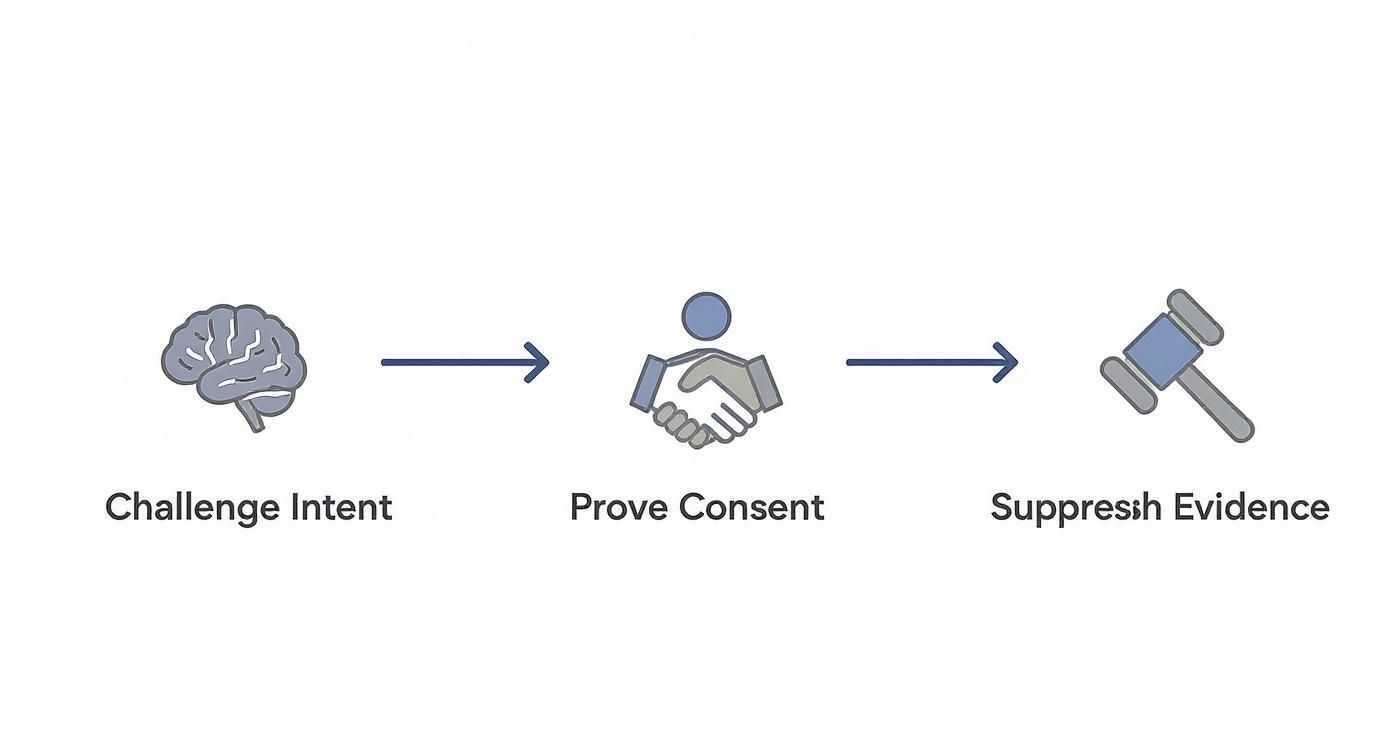
Each of these strategies—challenging the intent the DA claims you had, proving you had consent, or getting illegally obtained evidence suppressed—has the power to change the direction of your case.
Plea Bargaining Versus Going to Trial
The truth is that most criminal cases in Texas are resolved through plea bargaining. This is a negotiation between your defense lawyer and the prosecutor to reach an agreement, which might involve pleading guilty to a less serious charge or agreeing to a reduced sentence. A favorable plea bargain is a strategic victory that can protect you from the risk and severe penalties of a trial.
The decision to accept a plea deal or take your case to trial is one of the most important you will ever make. Your attorney's job is to lay out the strengths and weaknesses of your case so you can make a clear, informed choice that is right for you.
If no agreement is reached, your case will be set for trial. At trial, the prosecutor must prove your guilt "beyond a reasonable doubt" to a jury. Your lawyer will be there to cross-examine witnesses, present your side of the story, and make powerful arguments on your behalf.
This journey is complex, but it follows a predictable path. You can explore a more detailed breakdown by reading our guide on the steps in the criminal justice process.
The Hidden Consequences of a Felony Conviction

The immediate penalties for a burglary of habitation conviction—prison time and massive fines—are terrifying enough. But the punishment doesn’t end when you leave prison. A felony conviction follows you for life, creating "collateral consequences" that quietly close doors and limit your opportunities long after you've paid your debt to society. Understanding these long-term stakes is essential because it shows why you must fight the charge with everything you have from day one.
Lasting Impact on Your Career and Housing
A felony on your record makes basic needs like a job and a place to live into monumental challenges.
- Employment: Most employers run background checks. A felony conviction, especially for a crime like burglary, can be an automatic disqualifier for countless jobs.
- Housing: Landlords also run background checks, and many will deny rental applications from anyone with a felony record, making it incredibly difficult to find housing.
- Professional Licenses: If you work in a licensed field like nursing, real estate, or commercial trucking, a felony can prevent you from getting or keeping that license.
These barriers can make it feel almost impossible to get back on your feet and provide for your family.
Loss of Fundamental Civil Rights
A felony conviction also strips you of certain rights that are core to being a citizen. In Texas, a felon loses the right to own or possess a firearm, the right to vote while incarcerated or on parole/probation, and the right to serve on a jury.
Immigration Consequences for Non-Citizens
If you are not a U.S. citizen, the consequences of a burglary conviction are even more dire. Burglary is typically classified as a "crime involving moral turpitude," which can trigger devastating immigration outcomes.
A single felony conviction can be enough to start deportation proceedings, even if you have a green card and have lived in the U.S. legally for decades. It can also make you ineligible to become a citizen or re-enter the country if you leave.
The long-term impacts of a felony burglary conviction are extensive. The table below summarizes some of these potential collateral consequences.
Potential Long-Term Impacts of a Burglary Conviction
| Area of Life | Potential Impact of a Felony Record |
|---|---|
| Employment | Difficulty finding jobs, especially in licensed or government fields. |
| Housing | Denial of rental applications and ineligibility for public housing. |
| Civil Rights | Loss of the right to vote (while serving sentence), own firearms, or serve on a jury. |
| Financial | Ineligibility for certain federal loans, including student aid. |
| Family | Can be used against you in child custody or adoption proceedings. |
| Immigration | Deportation, denial of naturalization, or inability to re-enter the U.S. |
| Education | Some colleges and universities may deny admission based on a felony record. |
This makes it clear that a conviction is not just about serving time—it's about navigating a lifetime of limitations.
Is There a Path to a Clearer Future?
While the consequences are heavy, Texas law offers limited options for post-conviction relief. Eligibility for these is extremely narrow.
- Expunction: This process completely destroys the records of your arrest and charge. An expunction is typically only available if your case was dismissed, you were found not guilty at trial, or you completed a special pre-trial diversion program.
- Order of Nondisclosure: This seals your record from public view, meaning private employers and landlords can’t see it. You may be eligible for this after successfully completing deferred adjudication probation, but not all offenses qualify.
These options can offer a second chance, but they aren't available to most people convicted of a felony. This is another reason why mounting a powerful defense from the very beginning is so critical. While crime data shows residential burglaries are a serious concern, your future shouldn't be defined by a single accusation. To learn more, you can read the full report from the Texas Department of Public Safety.
Common Questions About Texas Burglary Charges
When you’re facing a serious charge like burglary of habitation, your mind is racing with questions. Getting clear answers is the first step toward calming your nerves and making a plan. Below are answers to some of the most common questions our clients ask.
What Is the Difference Between Burglary and Robbery in Texas?
This is a frequent point of confusion, and the distinction is critical. The main difference comes down to whether the crime targets a place or a person.
Burglary is a property crime. Under Texas law, it’s about unlawfully entering a building or home with the intent to commit a felony, theft, or assault. No force against a person is required.
Robbery, on the other hand, is a violent crime against a person. It involves taking property from someone by using force or making them fear for their safety. If someone breaks into an empty house to steal a TV, that's burglary. If someone shoves you and snatches your wallet, that's robbery.
Does It Matter if Nothing Was Actually Stolen?
No, it does not matter. The crime of burglary is legally complete the moment a person enters a home without permission while having the intent to commit another crime. The prosecutor doesn’t have to prove that anything was taken or that the intended crime was even attempted.
This is a crucial point. The entire case often hinges on proving what was in your mind at the moment of entry. This is why a skilled defense attorney will focus so heavily on tearing down the prosecutor's evidence of your alleged intent—it's often the shakiest part of their case.
What Should I Do if the Police Want to Question Me?
You have two powerful constitutional rights: the right to remain silent and the right to an attorney. You must use them. Anything you say can and will be used against you.
Politely and calmly tell the officers: "I am exercising my right to remain silent, and I will not answer any questions without my lawyer present." Do not try to explain your side of the story or prove your innocence. The smartest thing you can do is say nothing until you have an experienced criminal defense lawyer beside you.
Can a Burglary Charge Be Reduced to Something Less Serious?
Yes, absolutely. This is often the primary goal of a strong defense strategy. Through skilled negotiation, your attorney may be able to convince the prosecutor to reduce a serious burglary of habitation charge to a lesser offense, like criminal trespass.
A reduction is more likely when the evidence of your intent is weak. If there’s real doubt you ever planned to steal anything, your lawyer can use that as leverage to negotiate a far better outcome that might keep a felony off your record.
While dealing with the legal side of things, you may also be thinking about home security. You can look into practical security tips to prevent home break-ins to protect your property and peace of mind.
Facing a charge of burglary of habitation in Texas is an uphill battle, but it’s a fight you do not have to go through alone. Having an advocate in your corner who understands the law, knows the local courts, and is committed to protecting your future makes all the difference.
If you’ve been charged with a crime in Texas, call The Law Office of Bryan Fagan, PLLC for a free and confidential consultation. Our defense team is ready to protect your rights. https://texascriminallawyer.net