Being arrested in Texas can be terrifying—but you don’t have to face it alone. When you hear the word "burglary," you probably picture a masked figure sneaking into a home in the dead of night. While that’s one version of it, the legal definition under Texas Penal Code § 30.02 is much broader—and it catches many people by surprise.
In simple terms, burglary in Texas means entering a building or home without permission with the intent to commit a felony, theft, or assault once inside. That one word, "intent," is everything, and understanding it is the first step toward protecting your rights.
What a Texas Burglary Charge Really Means for You

Getting arrested for burglary is a jarring experience. One minute you're going about your life, and the next you're thrown into a legal maze of confusing terms and high-stakes procedures. The first step toward getting your feet back under you is understanding exactly what the state is accusing you of.
At its core, a burglary charge isn't just about what you did. It's about what the prosecutor thinks you were planning to do. This is a critical distinction, and it’s often where an entire case is won or lost. Let’s break down the components in plain English.
The Core Elements of Burglary
For a prosecutor to get a conviction, they have to prove two main things beyond a reasonable doubt:
- Unlawful Entry: This means you entered a building or "habitation" (like a house, apartment, or even an occupied RV) without the owner's "effective consent." Entry can be as minimal as reaching a hand through an open window or as obvious as walking through an unlocked door.
- Criminal Intent: At the very moment you entered, you had to have the specific intent to commit a felony, theft, or assault. It doesn't matter if you actually went through with it—the intent alone is enough to get you charged with burglary.
This "intent" element is almost always the toughest part for the prosecution to prove. How can they know what was going on in your head? This is where a skilled criminal defense attorney can poke holes in their story and create serious doubt.
What Is a 'Building' vs. a 'Habitation'?
The law draws a very bright line between different types of structures. The fear of unlawful entry is real, which is why some property owners look into effective window burglar proofing tips to feel more secure. This highlights just how seriously the law takes these violations.
The Texas Penal Code gives these terms specific definitions:
A "building" is any enclosed structure meant for people to use or occupy, like a store, an office, or a school. A "habitation" is a structure specifically adapted for people to sleep in overnight, such as a house, apartment, or condo.
Entering a habitation is treated far more seriously than entering a commercial building. Why? Because the law puts a premium on protecting people in their homes—their safe spaces. As a result, the penalties for burglary of a habitation are much, much harsher.
Facing a burglary charge means your freedom and your future are on the line. The prosecution will use these elements to build a case against you. Your best defense starts now, with understanding the law and finding an attorney who knows how to challenge the state's evidence at every turn.
How Texas Classifies Burglary Offenses and Penalties
Not all burglary charges in Texas are the same. The law makes sharp distinctions based on two critical factors: the type of structure you’re accused of entering and your alleged intent once inside.
These details can dramatically change the severity of the charge from a state jail felony to a first-degree felony, which could mean spending decades in prison. Understanding how Texas classifies these offenses is the first step in grasping just how serious your situation is. The Burglary Texas Penal Code lays out a tiered system where the stakes get higher with each level, making a strategic legal defense absolutely essential from the very beginning.
Burglary of a Building: A State Jail Felony
The least severe burglary charge you can face in Texas is Burglary of a Building. This charge applies when someone unlawfully enters a structure that isn't a private home with the intent to commit theft, assault, or a felony.
Think of places like:
- Retail stores or shopping centers
- Offices or commercial properties
- Warehouses or storage units
- Schools or detached garages
This offense is classified as a state jail felony. A conviction carries a potential sentence of 180 days to two years in a state jail facility and a fine of up to $10,000. While it’s the lowest-level felony, a conviction still results in a permanent criminal record that can haunt you for life, affecting your ability to find a job, secure housing, or even own a firearm.
Burglary of a Habitation: A Second-Degree Felony
This is where the law gets much more serious. The penalties skyrocket when the structure involved is a "habitation"—a place where people live. The law views an intrusion into someone's home not just as a property crime but as a profound violation of their personal sanctuary.
Burglary of a Habitation is charged when a person enters a home, apartment, or any other structure adapted for overnight accommodation without consent and intends to commit theft, assault, or a felony. Because this crime shatters a person's sense of security in their own home, it's elevated to a second-degree felony.
The consequences are severe:
- A prison sentence of two to 20 years.
- A maximum fine of $10,000.
This massive jump in penalty shows you exactly how seriously Texas law protects private residences. The focus isn't just on what’s inside; it's on the violation of a person's safe space, and the punishment reflects that.
Burglary with Intent to Commit Another Felony: A First-Degree Felony
The most serious burglary charge under the Texas Penal Code is when the alleged intent goes beyond simple theft. If the prosecution believes they can prove you entered a habitation with the intent to commit a felony other than theft—like sexual assault, aggravated assault, or murder—the charge becomes a first-degree felony.
This is one of the most severe charges in Texas law, and it carries life-altering consequences. A conviction can result in a prison sentence of five to 99 years, or life in prison, plus a fine of up to $10,000. The system under Texas Penal Code §30.02 clearly escalates penalties based on the building and what you intended to do inside, saving the harshest punishments for offenses that threaten someone's safety in their own home. To find out more about the different classifications of Texas penal codes, explore our comprehensive guide to the Texas Penal Code structure and offense classifications.
Here's a quick breakdown of how these charges stack up.
Texas Burglary Charges and Penalties at a Glance
| Type of Burglary | Texas Penal Code Section | Offense Level | Potential Prison Sentence | Maximum Fine |
|---|---|---|---|---|
| Burglary of a Building | §30.02 | State Jail Felony | 180 days to 2 years | $10,000 |
| Burglary of a Habitation | §30.02 | Second-Degree Felony | 2 to 20 years | $10,000 |
| Burglary with Intent to Commit Another Felony | §30.02 | First-Degree Felony | 5 to 99 years (or life) | $10,000 |
As you can see, the specific facts of a burglary allegation can change everything. That's why having a lawyer who understands these nuances is so critical to building a strong defense.
The Key Elements a Prosecutor Must Prove

When you're accused of a crime in Texas, it can feel like the entire weight of the state is on your shoulders. But it’s critical to remember that an accusation is not a conviction. The prosecution has the complete responsibility—the burden of proof—to convince a jury of your guilt.
To get a conviction for burglary, a prosecutor can't just tell a compelling story. They have to prove every single component of the crime beyond a reasonable doubt, which is the highest legal standard. This means that if there's any other reasonable explanation for what happened, the jury must find you not guilty.
Understanding these required elements is your first line of defense. It shows you exactly where the state's case might be weak and how a skilled defense attorney can start taking their arguments apart, piece by piece.
Defining Unlawful 'Entry'
The first thing a prosecutor has to establish is that an "entry" happened. Most people think this means kicking in a door or smashing a window, but the legal definition under the burglary Texas penal code is much broader and often surprises people.
In Texas, an entry legally occurs the moment any part of your body—or even an object you're holding—crosses the invisible "plane" of the building or habitation.
Think about these scenarios. They all legally count as an entry:
- Pushing a door open just a few inches.
- Reaching your hand through an open window to grab something.
- Using a tool, like a long pole or a grabber, to reach inside and move an item.
This broad definition makes it fairly easy for prosecutors to check this box. However, the entry also has to be unlawful, which brings us to the next critical element.
Proving There Was No 'Effective Consent'
An entry only becomes illegal if it's done without the owner's effective consent. This is another key legal term with a very specific meaning. It simply means you didn't have permission to be there from the owner or someone who could give permission on their behalf.
Consent isn't permanent; it can be withdrawn, and it can be limited. For example, if a store is open to the public, you have consent to enter during business hours. But that consent evaporates the second the store closes for the night. Walking in after hours, even through an unlocked door, would be without effective consent.
The prosecution must prove you knew, or should have reasonably known, that you did not have permission to be on the property at that specific time and in that manner. A simple misunderstanding or a genuine belief that you had permission can be a powerful defense.
The Most Challenging Element: The 'Intent' to Commit a Crime
This is often the weakest link in the prosecution's case and where many burglary defenses are won. A prosecutor must prove that at the very moment of entry, you had the specific intent to commit a felony, theft, or assault.
Let that sink in. The prosecutor has to get inside your head and prove what you were thinking at a specific moment in the past. It doesn't matter if you actually stole anything or hurt anyone; they only have to prove you planned to.
So how do they try to do this? They rely on circumstantial evidence, like:
- Possessing tools like crowbars, bolt cutters, or lock picks.
- Wearing gloves or a mask to hide your identity.
- Entering at an unusual time, like the middle of the night.
A good defense attorney can challenge this evidence by offering alternative, innocent explanations. Maybe you had tools in your car from your construction job. Perhaps you were just seeking shelter from a sudden storm. Creating this kind of reasonable doubt around your intent is often the key to defeating a burglary charge.
Building a Powerful Defense Against a Burglary Charge
An accusation is not a conviction. When you're facing a burglary charge in Texas, it’s easy to feel like the fight is already over, but that simply isn't true. The state carries the heavy burden of proving every single element of its case against you, and a skilled defense attorney has many proven strategies to protect your freedom.
These aren't just legal theories from a textbook. They are practical, real-world defenses that create the reasonable doubt necessary to win a case. Your defense starts with a deep dive into the specific facts of your situation and identifying the weakest points in the prosecutor's narrative.
Challenging the Element of Intent
The single most powerful defense against a burglary charge often centers on intent. As we've covered, the prosecutor must prove that at the exact moment you entered the property, you had the specific intention to commit theft, assault, or another felony.
Proving what was in your mind is an incredibly difficult task for the prosecution. They have to rely entirely on circumstantial evidence to try and build their case, which leaves a lot of room for doubt.
An experienced lawyer can dismantle their arguments by providing alternative, innocent explanations for your actions. For example, were you:
- Seeking shelter from a sudden storm or other immediate danger?
- Mistaken about the address or believed you were at a friend’s house?
- Intoxicated and not fully aware of your actions, which could negate the specific intent required for a conviction?
By presenting a plausible, non-criminal reason for your presence, we can create significant doubt about your alleged intent, making it very difficult for a jury to convict.
Arguing You Had Consent to Be There
Another common and effective defense is that you had effective consent to be in the building or habitation. If you had permission from the owner or another authorized person to enter the property, then no burglary occurred. Period.
This defense can come up in a few ways. Maybe you had a key and were a regular guest, or a friend invited you over, and the property owner later claimed you weren't welcome. In other cases, consent might have been implied by the circumstances, such as entering a business that appeared to be open to the public.
Proving you had a legitimate reason to believe you were allowed on the property completely undermines the prosecution's claim of an unlawful entry. Your attorney will gather evidence—like text messages, witness testimony, or past history with the owner—to establish that you were not trespassing.
Mistaken Identity and Insufficient Evidence
Sometimes, the police simply get it wrong. Eyewitness accounts can be notoriously unreliable, especially in low-light conditions or stressful situations. Surveillance footage may be grainy and inconclusive. In these cases, a mistaken identity defense is critical. Your attorney will scrutinize all identification procedures to see if they were suggestive or flawed.
Beyond that, the state’s entire case may be built on insufficient evidence. A strong defense involves challenging every piece of evidence they present. Are the fingerprints smudged? Is the DNA evidence contaminated? Is their key witness’s testimony inconsistent or biased?
By showing the jury that the evidence just doesn't add up, we can argue that the state has failed to meet its high burden of proof. Despite recent trends showing fewer burglary incidents, the penalties under the burglary Texas penal code have not softened. A burglary of a habitation is still a second-degree felony, punishable by two to 20 years, underscoring the state's commitment to protecting homes. For anyone accused in major Texas cities, this means prosecutors will pursue these charges aggressively, making a robust defense more critical than ever, as you can learn more in the latest crime trends report from the Texas Department of Public Safety.
Understanding Related Offenses and Recent Texas Laws
When you're facing a burglary charge, it rarely travels alone. Prosecutors often "stack" charges, meaning they pile related offenses onto the main accusation. This is a common tactic that can make your legal situation far more complex and dramatically increase the potential penalties if you're convicted.
A burglary charge can act as a magnet for other accusations like theft, assault, or criminal trespass. Each of these is a separate crime with its own set of penalties, and they can easily compound your legal troubles. Understanding how these charges connect is vital for building a complete defense that addresses every angle of the prosecutor's case.
How Burglary Connects to Other Crimes
Think of a burglary charge as the trunk of a tree, with related offenses branching out from it. Depending on what police and prosecutors believe happened, they might add charges for things like:
- Criminal Trespass: This is a lesser charge that simply involves being on someone else's property without their consent. If the prosecution’s evidence for your "intent" to commit a crime is weak, they might fall back on this to try and secure a conviction for trespass instead.
- Theft: If any property was actually taken during the alleged incident, you will almost certainly face a separate theft charge. The seriousness of this charge hinges on the value of the items stolen.
- Assault: If you are accused of causing or threatening bodily injury to someone during the entry or while on the property, an assault charge will be added. This instantly raises the stakes of your case.
It’s also crucial to understand the specific differences between burglary and other serious crimes. For instance, many people use burglary and robbery interchangeably, but they are very different offenses under Texas law. You can learn more about the critical differences between robbery and burglary in our detailed guide.
Recent Changes in Texas Property Crime Laws
The legal landscape is always shifting, and it's essential to know how new laws might affect your case. While the core definitions in the burglary Texas penal code have remained stable, lawmakers have recently focused on increasing the penalties for related property crimes, particularly those involving organized theft rings.
New Texas criminal laws set to take effect in 2025 will harden penalties for related property offenses, even as the core elements of burglary remain unchanged. For example, updates from the 89th Legislature specifically target organized retail theft by allowing prosecutors to add up the value of stolen goods, escalating a charge from a misdemeanor to a first-degree felony with a potential life sentence.
These changes make it clear that Texas is taking a tougher stance on all property crimes. That makes it more important than ever to have a defense attorney who stays current on these evolving laws and knows how to protect you from their full impact.
Navigating the Criminal Justice System After an Arrest
An arrest for burglary isn’t the end of the story—it’s just the first step in a long and often intimidating journey through the Texas criminal justice system. The moments and days that follow are a blur of confusing procedures and critical deadlines. Knowing what to expect can give you a sense of control when everything feels uncertain.
The process moves fast, and every single stage presents an opportunity for a skilled defense attorney to protect your rights and work toward a better outcome. From the moment you’re in custody, the clock is ticking.
This infographic shows how a single burglary event can spiral into a web of related charges, making the legal process far more complicated.
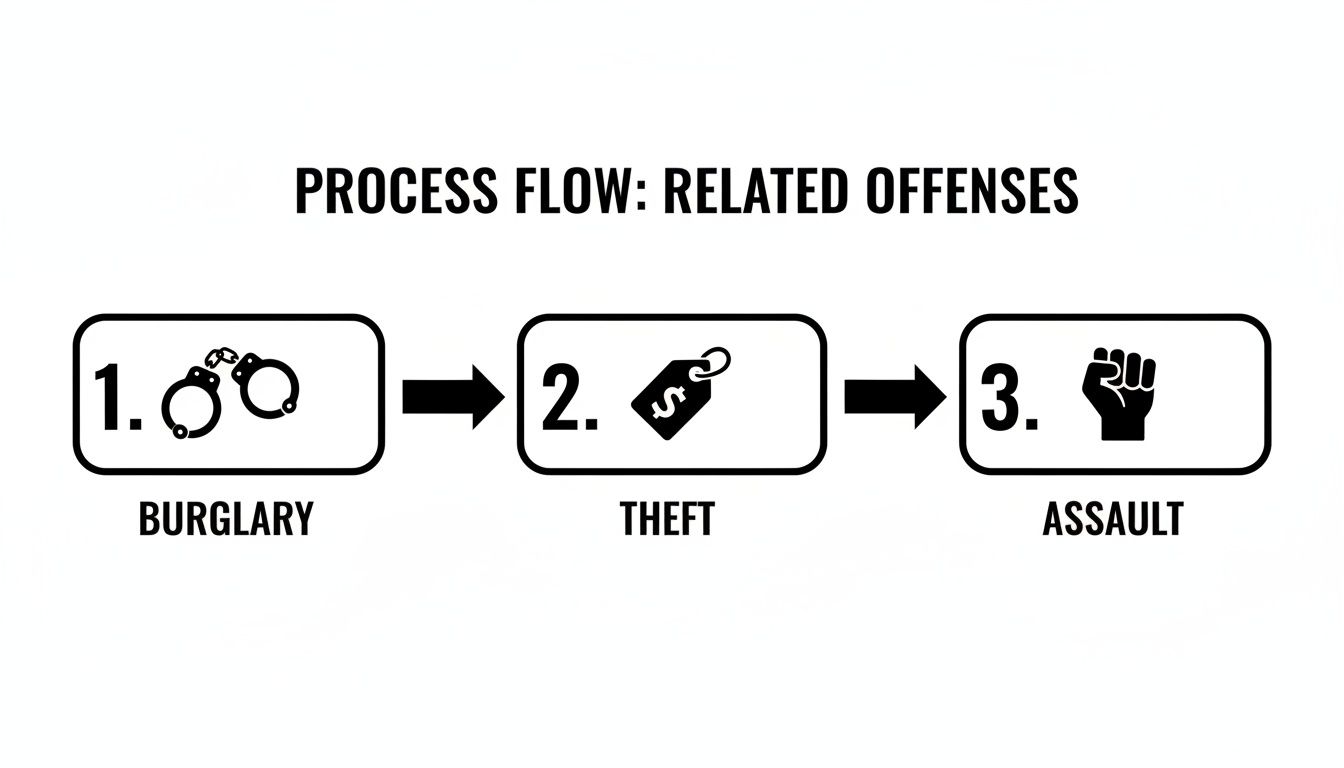
As you can see, what starts as a burglary charge can easily snowball into separate accusations for theft or assault. Each of those carries its own set of penalties, stacking the odds against you.
Step-by-Step: From Booking and Arraignment to Trial
Right after an arrest, you’ll be taken to a police station or county jail for booking. This is an administrative process where officers record your personal information, take your fingerprints and mugshot, and confiscate your belongings. It’s absolutely critical to remember your right to remain silent during this time.
Within 48 hours, you’ll have your first court appearance, called an arraignment or magistration. A judge will officially inform you of the charges, explain your rights, and set your bail amount. Bail is a financial guarantee that you’ll show up for future court dates.
The bail amount is not a punishment; it is set based on factors like the severity of the alleged crime, your criminal history, and your ties to the community. An attorney can argue for a lower, more reasonable bail amount on your behalf.
Having an experienced lawyer at this early stage is crucial. We can advocate for your release on a personal recognizance (PR) bond, which requires no money down, or fight for a bail reduction to make it affordable for you and your family. For a detailed walkthrough of the entire timeline, you can review our guide covering the steps in the criminal justice process.
From Plea Bargaining to Potential Trial
Once you are released on bond, your case moves into the pre-trial phase. This is where most of the critical legal work happens. Your attorney will receive the state’s evidence against you—a process known as discovery. We will meticulously comb through every police report, witness statement, and piece of physical evidence to find the weaknesses in the prosecution’s case.
Based on what we find, we’ll start plea bargaining negotiations with the prosecutor. This is a strategic discussion aimed at getting a favorable outcome, which could mean:
- Getting the charges reduced to a lesser offense (e.g., from a felony burglary to a misdemeanor trespass).
- Negotiating for a lighter sentence, like probation instead of jail time.
- Arguing for a complete dismissal of the charges if the evidence is too weak to stand up in court.
If a fair plea agreement isn’t on the table, we prepare to fight for you at trial. This means filing pre-trial motions to get illegally obtained evidence thrown out and building a powerful defense strategy from the ground up. At trial, the prosecutor has to prove your guilt beyond a reasonable doubt, and we will be there to challenge their case at every turn, cross-examine their witnesses, and present evidence in your favor. Whether it’s through skilled negotiation or aggressive litigation, our one and only goal is to protect your freedom and your future.
Your Top Questions About Texas Burglary Law Answered
When you’re staring down a serious charge like burglary, a million questions race through your mind. The legal system can feel like a maze, but getting clear answers is the first step toward building a defense that protects your future. Let’s tackle some of the most common concerns we hear from people in your shoes.
Can I be charged with burglary if I didn't steal anything?
Yes, absolutely. This is one of the biggest and most dangerous misconceptions about the burglary Texas penal code. The crime isn't defined by a successful theft—it's about entering a building or home without permission with the intent to commit a crime inside.
Think of it this way: the moment you cross that threshold with a plan to steal, assault someone, or commit another felony, the crime of burglary is technically complete in the eyes of the law. The prosecutor doesn't need to prove you actually took anything. If they can convince a jury you planned to, that's enough for a conviction.
What is the difference between burglary and robbery in Texas?
The line between these two crimes comes down to one thing: the use of force or threats against a person. Burglary is fundamentally a property crime. It’s about the unlawful entry into a space.
Robbery, on the other hand, is a violent crime against a person. It happens when someone takes property directly from another individual by using force, threatening them, or causing them bodily injury. While burglary isn't officially classified as a violent crime, the penalties can be just as harsh, especially when a person's home is involved.
Can a burglary charge be removed from my record?
Whether you can clear a burglary charge from your record depends entirely on how your case ends. This is why building a powerful defense from day one is so critical for protecting your name and your future opportunities.
If your case gets dismissed or you are found "not guilty" at trial, you may be eligible for an expunction. This is the best-case scenario, as it completely destroys all records of the arrest. In some other limited situations, you might qualify for an order of nondisclosure, which seals the record from public view.
But make no mistake: a felony conviction for burglary is a permanent stain. It can follow you for the rest of your life, creating massive roadblocks when you apply for a job, look for housing, or try to get a loan. Fighting the charges aggressively from the very start is your only real shot at a clean slate.
If you’ve been charged with a crime in Texas, call The Law Office of Bryan Fagan, PLLC for a free and confidential consultation. Our defense team is ready to protect your rights. Visit us at https://texascriminallawyer.net.