A felony conviction in Texas generally can't be expunged. But a felony arrest may be expunged if the case ended in an acquittal, a pardon based on actual innocence, or a dismissal without court-ordered community supervision, and for many felony dismissals or acquittals you must wait three years from the date of arrest before filing.
Being arrested in Texas can be terrifying, especially when you're trying to figure out whether one mistake, one accusation, or one dismissed case will follow you for the rest of your life. If you're searching for the answer to can a felony be expunged in Texas, you're probably worried about jobs, housing, professional licenses, and how to explain your record to people who don't know your full story.
Texas law is strict here. That's the hard truth. But strict doesn't always mean hopeless. In some cases, you may be able to clear a felony arrest. In others, you may not qualify for expunction, but you may still have another path through record sealing, also called nondisclosure. If you're facing current charges for DWI, assault, theft, or drug possession, what happens in your case now can shape what options you'll have later.
A strong defense matters long before anyone talks about expunction. From the first phone call after an arrest through arraignment, plea bargaining, trial, and sentencing, each decision affects your future. Even support staff can shape the process, which is why resources like HiredBySkill's legal intake specialist guide help people understand how law firms gather facts and respond quickly when someone needs legal help.
A Texas Felony Charge and Your Future
A felony charge can shake every part of your life. You may be wondering whether your employer will find out, whether your family will be affected, or whether a background check will keep reopening a chapter you're trying to close. Those fears are real, and they're common.
Under Texas Code of Criminal Procedure Article 55.01, a felony conviction blocks expunction. If you were found guilty, pleaded guilty, or received deferred adjudication for a felony, expunction is generally off the table under Texas law, as explained by this discussion of expunging a felony in Texas. That rule surprises many people because they assume enough time will eventually wipe the record away. It won't.
Why people get confused
The confusion usually comes from mixing up three different outcomes:
- A conviction: You were found guilty or entered a guilty plea.
- A dismissal: The charge was dropped and did not end in a final conviction.
- Deferred adjudication: You completed a form of probation, but that still isn't the same as having the arrest erased.
Texas criminal procedure makes those differences matter. A case outcome affects what happens later with your criminal record far more than the original charge label does. A felony drug possession case, felony theft case, or Texas assault defense case may all lead to very different cleanup options depending on how the case ended.
Practical rule: In Texas, the question usually isn't "Was it a felony?" The real question is "How did the case end?"
What happens before record clearing even becomes possible
If you're still in the middle of a criminal case, your focus should be on the stages ahead:
Arrest and booking
Police take you into custody, gather identifying information, and start the record that may later appear in background checks.Arraignment or first court appearance
You learn the charge and begin addressing bond conditions, counsel, and scheduling.Plea bargaining
Prosecutors and defense counsel may discuss dismissal, reduction, diversion, deferred adjudication, or trial.Trial
If your case goes to trial, an acquittal can create a path toward expunction.Sentencing
If there's a conviction or deferred adjudication, your options change sharply.
That's why a Houston criminal lawyer or Texas DWI attorney should think about both the immediate case and the long-term record impact from the start.
What Expunction Really Means in Texas
An expunction is the closest thing Texas law offers to wiping the slate clean. It's not just a dismissed case sitting in a file. It's a court-ordered process aimed at removing records of the arrest from public view under the rules in Article 55.01 of the Texas Code of Criminal Procedure.
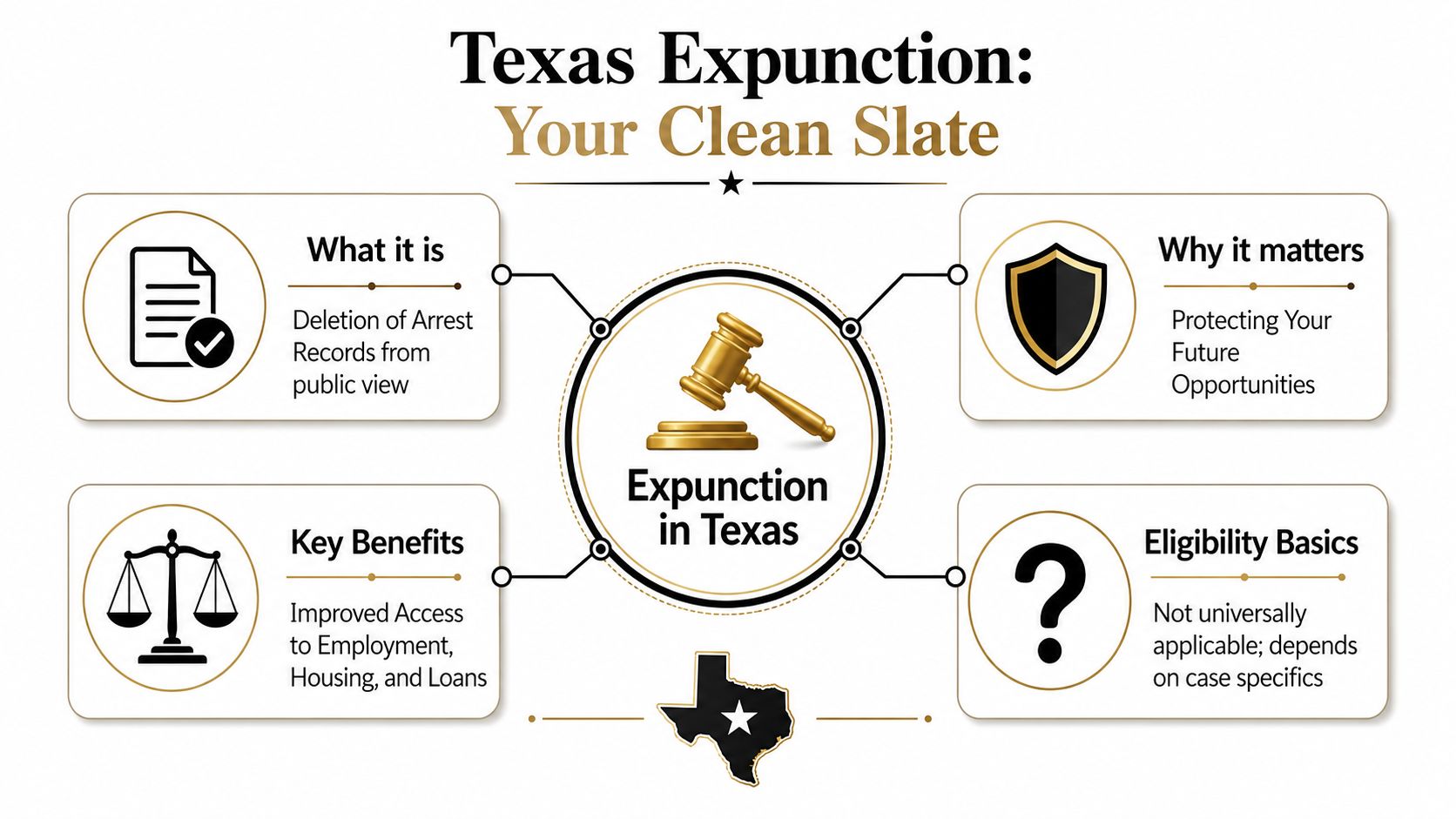
Expunction is more than a dismissal
A dismissal is a case result. Expunction is a separate legal remedy you must ask the court to grant.
That difference matters because many people assume a dropped felony charge automatically disappears. It doesn't. Arrest records can stay visible unless you take the extra legal step.
Here's the plain-English version:
| Issue | Dismissal | Expunction |
|---|---|---|
| What it means | The prosecution ended without a conviction | The court orders the arrest records removed under Texas law |
| Does it happen automatically | Usually no cleanup happens by itself | No, you must file for it |
| Why it matters | The case ended | The record may no longer follow you in the same way |
Why expunction is so valuable
When expunction is available, it's the strongest form of record relief because it addresses the arrest itself. For people applying for work, housing, or school, that can make a major difference.
If you want a broader plain-language overview, Expunction and Nondisclosure in Texas explains how to clear or seal a criminal record under Texas law.
A dismissed felony charge can still appear in the real world until you deal with the record itself.
Texas criminal law context matters
People often ask about the Texas Penal Code when they're really dealing with criminal procedure. The Penal Code defines offenses such as theft, assault, and many drug crimes. The Code of Criminal Procedure governs what happens after arrest, in court, and during remedies like expunction.
That distinction matters because your charge might come from the Penal Code, but your ability to clear the record comes from procedural law. A Texas assault defense case may turn on one set of rules at trial and a different set later when you seek record relief.
Who Is Actually Eligible to Expunge a Felony Record
Eligibility for felony expunction in Texas is narrow. That's frustrating, but knowing the exact categories can save you time and false hope.
Under Texas law, a person may have a felony record expunged only if the person was acquitted at trial, pardoned on the basis of actual innocence, or had the charge dismissed before sentencing without court-ordered community supervision. The same source also states that you're ineligible if you were convicted of another felony within the five years before the arrest you want to expunge, as explained by Clean Slate Texas on eligibility.
The three main paths
Acquittal
If a judge or jury found you not guilty, that's one of the clearest paths to expunction. In plain terms, the court determined the State did not prove the felony charge.
Pardon based on actual innocence
This is rare, but Texas law recognizes it. A pardon must be specifically tied to actual innocence, not just mercy or general forgiveness.
Dismissal without community supervision
Confusion often arises here. A dismissal can qualify, but not every dismissal does.
If your felony case was dismissed before sentencing and you were not placed on court-ordered community supervision, you may qualify. If probation or deferred adjudication was part of the outcome, that usually blocks expunction.
What usually makes a person ineligible
Many readers are looking for a checklist, so here it is in direct form:
- Final conviction: If you pleaded guilty or were found guilty, expunction is generally barred.
- Deferred adjudication: Many people think this counts as a clean ending. For expunction, it usually doesn't.
- Recent felony history: Another felony conviction within the five years before the arrest you want to clear can disqualify you.
- Same criminal episode issues: If another conviction arose from the same criminal episode, that can also create problems under Texas law.
Bottom line: The best question isn't "Was my case dismissed?" It's "Was my case dismissed in a way that still leaves me legally eligible?"
A simple self-check
Ask yourself these questions:
- Were you acquitted at trial?
- Were you pardoned based on actual innocence?
- Was the felony dismissed with no court-ordered community supervision?
- Have you had another felony conviction in the five years before that arrest?
If you can't answer those clearly, get your court paperwork before filing anything. Small wording differences in older court records can affect your eligibility.
Expunction vs Nondisclosure The Critical Difference
For many Texans, the answer to expunction is no. That's not the end of the conversation. Nondisclosure may still be available, especially if your case ended in deferred adjudication rather than a final conviction.
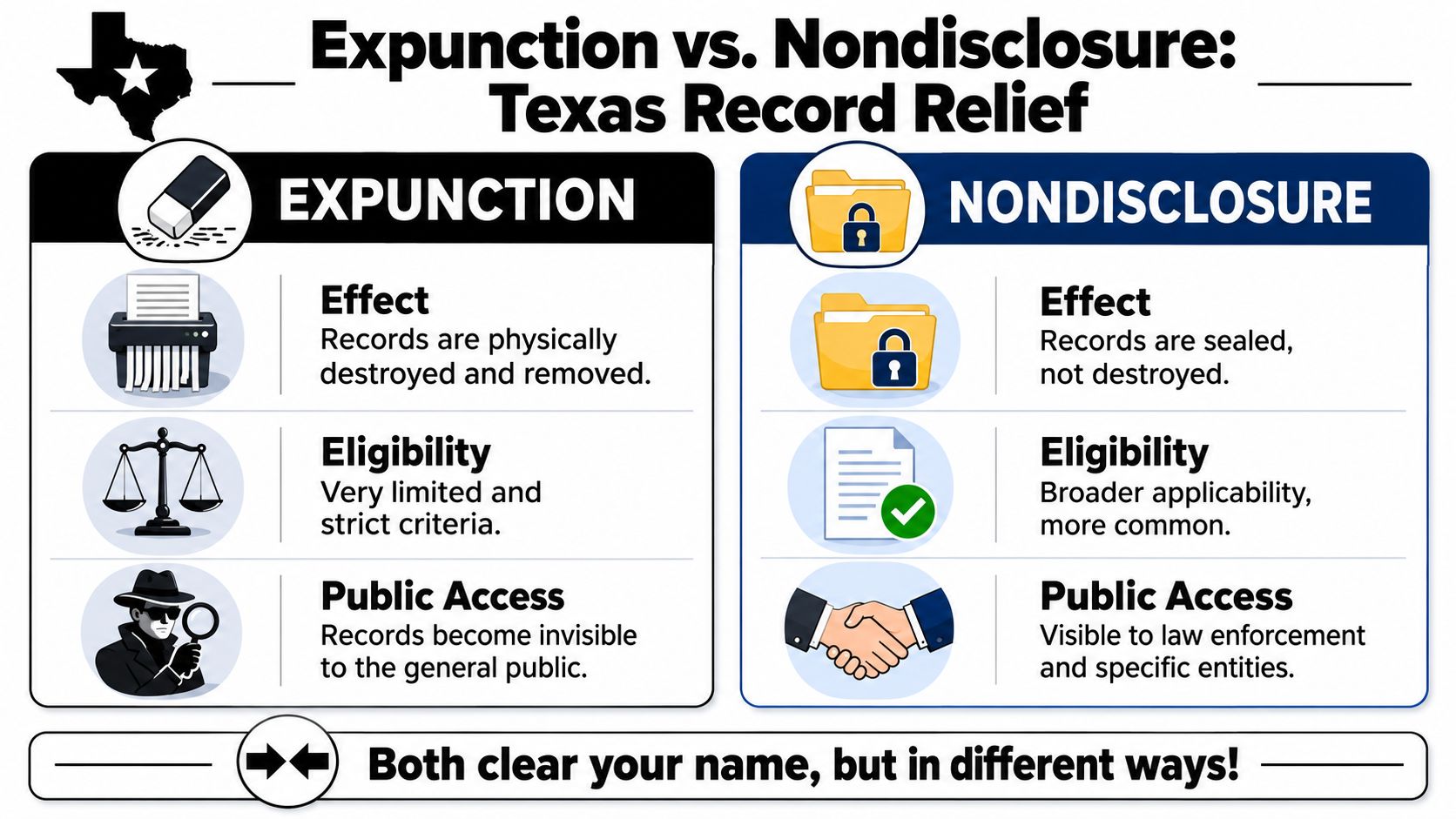
Texas law allows nondisclosure for certain felony cases after a five-year waiting period following discharge and completion of the sentence or deferred adjudication. It doesn't erase the record, but it limits public access. Individuals who received deferred adjudication may be eligible, while serious felonies such as DWI, murder, and sexual assault are excluded, as described in this explanation of Texas felony expungement and nondisclosure.
What nondisclosure actually does
Think of nondisclosure as sealing, not destroying.
The record still exists. Law enforcement and certain licensing boards may still see it. But most private employers and members of the public won't have the same access.
For many people, that's a meaningful form of relief. If your goal is to improve job and housing prospects after deferred adjudication, a nondisclosure petition may be the practical path.
For a closer look at the procedure, see this guide to an Order of Nondisclosure in Texas.
Side-by-side comparison
| Question | Expunction | Nondisclosure |
|---|---|---|
| What happens to the record | The law treats the arrest record as removable under strict standards | The record is sealed from public view, not erased |
| Who usually qualifies | People with acquittals, qualifying dismissals, or pardons based on actual innocence | Some people who completed deferred adjudication for eligible offenses |
| Can final felony convictions use it | Generally no | Not as a fix for every felony conviction |
| Who may still see it | Public access is far more limited after expunction | Law enforcement and certain agencies may still see it |
| Waiting period for eligible felonies | Depends on the expunction category | Five years for certain felonies after discharge and completion |
Why this matters for real people
A person charged with felony drug possession may not qualify for expunction after deferred adjudication, but may have a nondisclosure path later if the offense is eligible. A person convicted of a serious offense excluded by statute may have neither option. That's why legal advice has to be specific to your exact charge, outcome, and record.
If you're facing current charges, the plea decision matters. A plea bargain can avoid trial risk, but it can also affect whether later relief is available. That's true in cases involving theft, assault, and drug possession, and it's especially important in DWI-related cases because some offenses are expressly excluded from nondisclosure eligibility.
Nondisclosure is often the "yes" that people miss when they hear "no" to expunction.
Your Step-by-Step Guide to Filing for an Expunction
If you think you qualify, filing for expunction is a court process, not a formality. Timing, paperwork, and the county where you file all matter.
A key timing rule comes from Texas law: for felony cases ending in dismissal or acquittal, the waiting period is three years from the date of arrest, not the date of dismissal. If the statute of limitations for the offense has not expired, you must wait until it does, as explained by the State Bar of Texas discussion of expunction timing.
A visual overview can help if the process feels overwhelming.

Step 1 and Step 2
Confirm that you qualify
Start with the case outcome. Acquittal, qualifying dismissal, or pardon based on actual innocence are the usual starting points.Check the dates carefully
The arrest date controls an important part of the waiting period. People often look at the dismissal date and file too early.
If you want a practical time-frame discussion, this article on how long expungement takes in Texas can help you understand the process in plain language.
Step 3 and Step 4
Gather the right records
You'll usually need arrest information, the cause number, court records, dismissal paperwork, acquittal records, or pardon documents.File the petition in the correct county
Texas law generally requires the petition to be filed in the county where the arrest occurred.
At this stage, details matter. Misspelling an agency name or leaving out a records holder can create delays because the court order has to reach the agencies that maintain the record.
Later in the process, it helps to hear a lawyer explain the basics in a more conversational format.
Step 5 and Step 6
Prepare for a hearing
A prosecutor can contest your request. You must be ready to show the judge that your case fits the statute.Follow through after the order
If the judge grants expunction, agencies listed in the order are directed to handle their records accordingly.
Filing too early is one of the most common and avoidable mistakes in expunction work.
A caution about waiting periods
For many felonies, the statute of limitations can outlast the basic three-year wait. In practical terms, that means some people must wait longer even after a dismissal. This is one reason a lawyer reviews not only the dismissal order, but also the offense level, charge date, and procedural history.
Common Felonies and Their Expunction Outlook
The type of felony charge matters less than the final outcome. That surprises people, especially those charged with offenses that carry a heavy social stigma.
Drug possession
Suppose you were arrested for felony drug possession. If you were later convicted, expunction generally isn't available. If the charge was dismissed in a way that meets the legal rules discussed earlier, the outlook changes.
Drug cases often involve suppression issues, search challenges, and plea decisions. Those choices can affect whether your record may later be cleared or sealed.
Theft and property crimes
A felony theft case can also split two ways. A conviction usually closes the expunction door. A dismissal may leave room to seek relief if the statutory requirements are met.
If you're still trying to understand how Texas classifies criminal charges, Felony vs. Misdemeanor Charges in Texas gives a helpful overview.
Assault and DWI-related felonies
In a Texas assault defense case, the same pattern holds. The label "felony assault" doesn't answer the expunction question by itself. The result of the case does.
For DWI, there's an extra layer of caution. Some serious offenses are excluded from nondisclosure. So if you're facing a felony DWI accusation, your defense strategy should account for both immediate penalties and future record consequences.
What this means during the criminal case
Your lawyer should look at every stage with your long-term record in mind:
- At arraignment: preserve defenses and protect your rights early.
- During plea bargaining: compare immediate risk with future record options.
- At trial: an acquittal can change your long-term outlook.
- At sentencing: understand what a conviction or deferred adjudication will mean later.
A person charged with drug possession today may be asking about expunction next year. The answer often depends on choices made long before the case ends.
Protect Your Future with an Experienced Defense Attorney
You may be sitting at your kitchen table with two questions that sound similar but lead to very different answers. Can this felony record be erased, and if not, can it at least be sealed from public view? In Texas, that distinction matters a great deal.
Record clearing works a lot like choosing the right tool for a repair. Expunction removes an eligible record. Nondisclosure blocks public access to certain records but does not destroy them. If you start with the wrong tool, you can waste months, file the wrong petition, or make plans based on a result the law does not allow.
That is why legal advice matters early, not only after the criminal case is over. A defense attorney should evaluate the immediate case and the long-term record consequences at the same time. If the charge is still pending, decisions about plea offers, deferred adjudication, dismissal strategy, and trial can affect whether you may later qualify for expunction, whether nondisclosure is the better option, or whether neither remedy will be available.
A careful lawyer also helps answer the hard question with honesty. Some felony convictions cannot be expunged under Texas law. Some dismissed felony cases may qualify. Some people who cannot erase a record may still be able to seal it through nondisclosure. That is often the roadmap people need most. A clear explanation of what is still possible.
If you are comparing lawyers, this guide on how to choose a criminal defense attorney is a practical place to start. The Law Office of Bryan Fagan PLLC handles criminal defense matters in Texas, including cases involving felonies, misdemeanors, expunctions, nondisclosures, and related post-conviction relief.

Good legal advice does more than answer whether a record can be cleared. It helps protect the outcome that gives you the strongest chance at relief later.
If you have been charged with a crime in Texas, call Law Office of Bryan Fagan PLLC for a free and confidential consultation. Our defense team is ready to protect your rights.