Yes. In Texas, charges can be filed on probable cause, and arrested people must receive a probable cause hearing within 48 hours. But a conviction takes much more. The state must later prove guilt beyond a reasonable doubt, and weak cases often fall apart long before trial.
Being accused of a crime in Texas can feel unreal, especially when you keep asking the same question: “How can they charge me if they don't really have evidence?” That fear is common after an arrest, after a call from a detective, or after learning a grand jury may be looking at your case.
You may be dealing with a DWI, assault allegation, theft accusation, drug possession case, or even a white-collar investigation. Sometimes there's no arrest at first. Sometimes you get notice of a court date before you ever expected formal charges. In other situations, a case starts because one person made a statement and police moved quickly.
The key point is this. A charge is the start of a legal process, not the end of it. Texas law gives prosecutors room to begin a case on a lower standard than individuals often realize. That gap between a low bar to charge and a high bar to convict is often where a strong defense makes the difference.
The Scary Truth About Being Charged With a Crime in Texas
A lot of people learn about criminal charges in the worst possible way. A missed call from an investigator. A bond condition after a sudden arrest. A clerk telling you there's a case in your name. If you believe the police don't have much, or anything reliable, the whole process feels backwards.
That reaction makes sense. You expect the state to prove everything before it accuses you. In real life, the system doesn't work that way.
Why this happens
In Texas, the state doesn't need trial-level proof to start a criminal case. It needs enough to justify moving forward at the charging stage. That can come from a police report, a witness statement, officer observations, or other preliminary material that hasn't been fully tested in court.
That also means bad cases get filed. Cases built on missing facts, conflicting stories, weak identification, or shaky searches can still begin. The important question isn't only whether charges were filed. It's whether the evidence can survive legal challenge.
Practical rule: If you're charged, don't treat the filing itself as proof that the case is strong.
For people accused of online misconduct, identity-based fraud, or deceptive communications, facts can get muddled fast. If the accusation involves impersonation, fake accounts, or online deception, it can help to understand the legal risks of fake online profiles because digital behavior is often misunderstood, overstated, or taken out of context.
What the charge does and does not mean
A charge means the state believes it has enough to start the case. It does not mean a judge or jury has found you guilty. It does not mean the evidence is complete. And it does not mean your defense is limited to waiting for trial.
In practice, the early phase is often the most important. That's where an attorney can challenge the basis for the charge, identify missing proof, preserve favorable evidence, and stop you from making the case worse by trying to explain it away on your own.
Probable Cause vs Beyond a Reasonable Doubt
A lot of clients call my office after charges are filed and ask the same question: if the case is weak, how did it get this far? The answer is that Texas uses one standard to start a case and a much tougher standard to convict you.
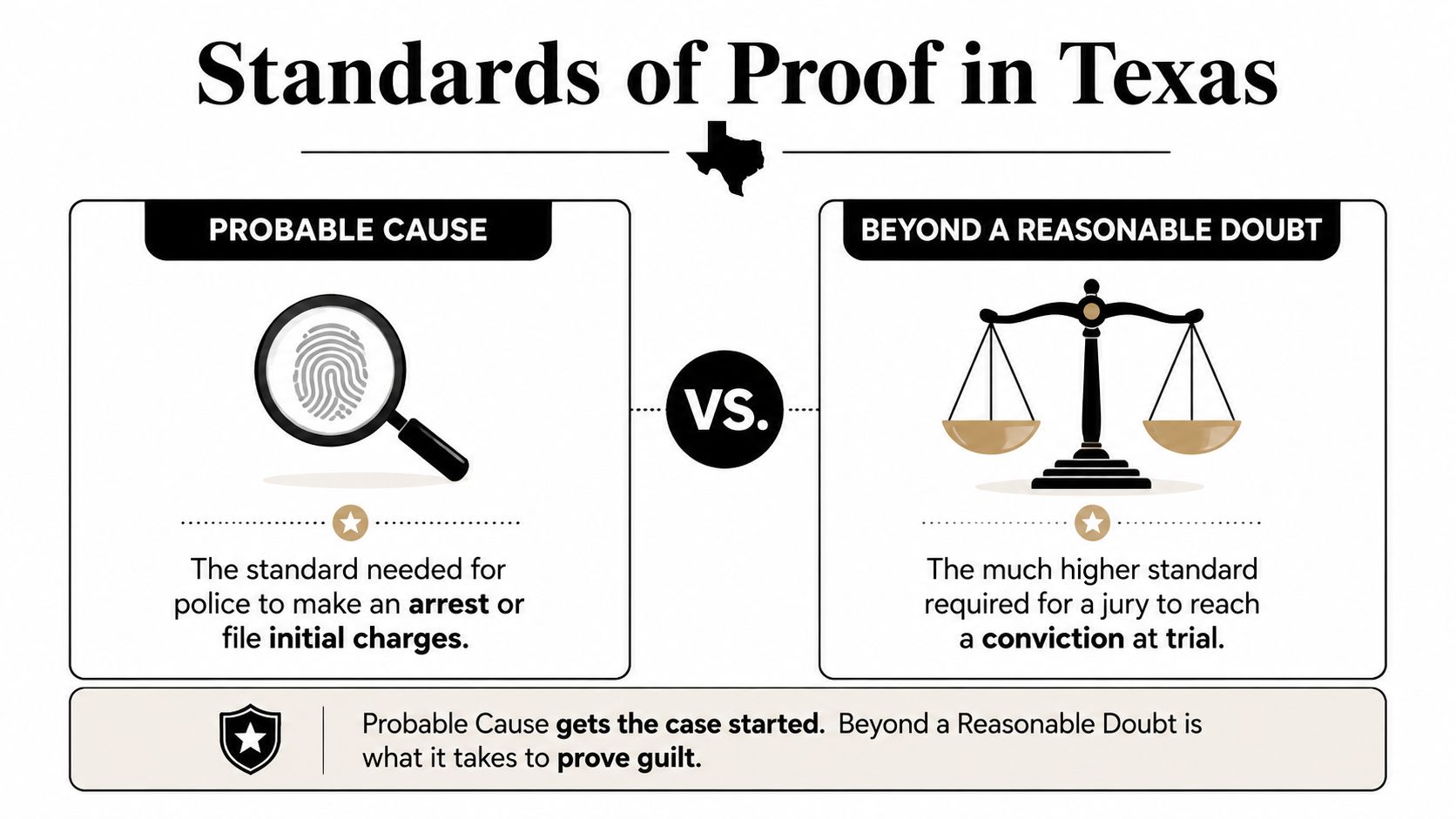
Probable cause is a low threshold. It means there is a reasonable basis to believe a crime happened and that you may be connected to it. That can come from a single witness statement, an officer's observations, a complaint, or a piece of evidence that still has not been tested in court.
Beyond a reasonable doubt is the standard for conviction at trial. The prosecutor must present proof strong enough to convince a jury of guilt after the evidence is challenged, cross-examined, and measured against the law.
That gap matters more than many people realize.
What each standard means in plain English
Here is the practical difference:
| Standard | What it means | When it matters |
|---|---|---|
| Probable cause | A reasonable basis to believe a crime may have occurred and you may be involved | Arrest, complaint, initial filing, some grand jury decisions |
| Beyond a reasonable doubt | Proof strong enough that a reasonable juror does not have a reasonable doubt about guilt | Trial and conviction |
In real cases, prosecutors often file first and sort out weaknesses later. A theft case may start with an accusation from a store employee. A DWI case may begin with an officer's opinion about intoxication. An assault case may be filed because one person called police first and gave a statement that sounds consistent on paper.
None of that settles the hard questions. Can the witness identify you? Did police follow the law during the stop, search, or arrest? Do the statements conflict? Is there proof of intent, or only suspicion?
Why the difference creates defense opportunities
The state does not win a case by filing it. The state wins by proving every required element with reliable, admissible evidence.
That is the strategic gap an experienced defense lawyer uses. Early in the case, the evidence often looks stronger in a police report than it does after body camera review, witness interviews, forensic testing, or a suppression challenge. I have seen cases that looked dangerous at filing fall apart once the timeline was tested, the identification was questioned, or the search was shown to be unlawful.
A filed charge shows the state cleared the starting line. It does not show the state can finish the race.
For a fuller plain-English explanation of the trial burden, see what beyond a reasonable doubt means in Texas.
How Texas Prosecutors Officially File Charges
You may wake up thinking the police are still “looking into it,” then learn the prosecutor has already accepted charges based on a short report, one witness statement, or an officer's version of events. That shock is common. Texas charging decisions are often made early, on an incomplete file, and long before anyone has tested whether the evidence will hold up in court.

What usually happens first
A criminal case usually starts with a police investigation and a packet sent to the prosecutor. That packet may include offense reports, witness statements, body camera clips, photographs, lab requests, and any statement you gave. For misdemeanors, the state commonly files a complaint and information. For felonies, the state generally seeks an indictment.
If there was an arrest, Article 15.17 of the Texas Code of Criminal Procedure requires a magistrate warning and an early review of probable cause. That hearing does not decide guilt. It addresses whether there was a legal basis to hold you after the arrest.
Charges can also be filed without an arrest first. If you want the timing side of that process explained in plain English, see how long it can take for charges to be filed in Texas.
What the prosecutor actually reviews
At the charging stage, the prosecutor usually sees the case in its most prosecution-friendly form. Police reports often sound cleaner and more certain than the underlying evidence really is. Important context may be missing. Video may not match the written report. Witnesses may be guessing, exaggerating, or leaving out facts that hurt their account.
A file at this stage often includes:
- Police reports written from the officer's perspective
- Witness statements that have not been tested by cross-examination
- Photos, video, or physical evidence that may later raise chain-of-custody or legality problems
- Your statements if you answered questions before speaking with a lawyer
That gap matters. A prosecutor can file a case on information that looks adequate on paper, even if the case becomes much weaker once the defense gets the full video, subpoena records, interviews witnesses, and examines how the evidence was obtained.
Where the defense gains ground
Texas prosecutors do not need trial-ready proof to start a case. They need enough to move it into the system. From a defense standpoint, that is often the opening.
I have seen assault cases filed before police interviewed neutral witnesses. I have seen drug cases charged before anyone closely examined whether the stop and search were lawful. I have seen theft allegations built around assumptions that fell apart once store video was reviewed from beginning to end.
Those are not technicalities. They are case-shaping problems. If the identification is shaky, if the timeline does not fit, if the alleged victim changes details, or if key evidence was obtained illegally, the state may have a charging document but still lack a case it can prove.
The prosecutor only has to clear the filing stage to start the case. The defense wins by forcing the state to prove it with admissible, reliable evidence.
That strategic gap is where experienced defense work matters most. Early review, fast evidence preservation, and targeted motions can change the direction of a case before the prosecution gets comfortable with its theory.
The Grand Jury A Shield Against Unjust Prosecution
You may hear that your felony case is "going to the grand jury" and assume the indictment is a formality. Clients often come in believing the decision has already been made. That is not how the process is supposed to work.
In a Texas felony case, the grand jury decides whether the prosecutor has shown probable cause to issue an indictment. If the grand jury agrees, it returns a true bill. If it does not, it returns a no bill. A no bill means the case did not clear even that early charging threshold.

What the grand jury actually does
The grand jury is one of the few checkpoints between an accusation and a formal felony prosecution. It is not a trial. It does not decide guilt. It decides whether the state has enough to keep going.
That distinction matters.
A weak case can still be presented to a grand jury because the standard is low and the proceeding is controlled by the prosecution. But weak cases can also fail there, especially when the underlying proof has obvious problems such as inconsistent witness statements, missing records, bad identification, or a search that raises legal issues.
Why the process feels one-sided
Grand jury proceedings are secret, and the defense usually is not in the room presenting the full story. That is a real disadvantage. Prosecutors choose the witnesses and evidence they want the grand jurors to hear, and the rules are looser than they are at trial.
Even so, the grand jury can still serve as a meaningful filter. I treat that stage as part of the defense strategy, not as a box the state automatically checks. In the right case, early defense work can expose enough weakness to affect how the case is presented, whether it is indicted, or how aggressively it is prosecuted afterward.
True bill versus no bill
- True bill means the grand jury approved the felony charge and the case moves forward.
- No bill means the grand jury declined to indict based on what the prosecutor presented.
- Neither result decides guilt. The state still has to prove the case later with admissible evidence.
For someone accused of felony assault, theft, drug possession, or fraud, the gap between charging and proving a case starts to matter in a concrete way. The state may be able to get in front of a grand jury with a police report and a witness statement. Winning the case is different. That stage allows the defense to test reliability, legality, and missing context.
If you are trying to decide whether early legal help is worth it, review how much lawyers charge for consultations. In felony cases, getting counsel involved before or during the grand jury stage can change the posture of the case in ways people often do not see until much later.
What To Do Immediately If You Are Charged
The first few days matter. Many people do the one thing that hurts them most. They start talking.

What helps
Follow these steps as soon as you learn you're being investigated or charged:
Use your right to remain silent. You can be polite and still say you want a lawyer before answering questions. This applies in DWI cases, assault investigations, theft accusations, drug possession arrests, and white-collar interviews.
Save documents and communications. Keep texts, emails, receipts, photos, call logs, and location data if they may help explain what happened.
Follow bond conditions exactly. If the court sets no-contact terms, travel limits, testing, or check-ins, obey them. A side issue can become the prosecutor's favorite argument against you.
Write down a timeline for your lawyer. Do it while events are fresh, but keep it private and share it only with counsel.
What can make things much worse
Some mistakes create new criminal exposure even when the original case is weak.
Under Texas law, attempting to destroy, conceal, or alter evidence is a Third Degree Felony punishable by 2 to 10 years in prison, according to this Texas evidence tampering explanation. That means deleting text messages, throwing away an item, wiping a device, or hiding records can turn a smaller case into a much more serious one. The same source notes this can happen even if the original charge is later dropped.
If you think an item, message, account, or file may matter to the case, leave it alone and get legal advice first.
Questions people often have right away
One common concern is cost. If you're trying to compare first steps before hiring counsel, this breakdown of how much lawyers charge for consultations can help you understand the basics.
Another concern is whether calling the complaining witness, “fixing” your phone, or cleaning up social media will help. Usually, it won't. In many cases, those actions create fresh problems. The best early move is controlled, careful action through counsel, not self-help.
How a Lawyer Fights a Case with Weak Evidence
Weak cases don't disappear on their own. Someone has to identify the weakness, turn it into a legal argument, and force the state to deal with it.
The work happens early
A defense lawyer starts by separating suspicion from proof. In a DWI case, that may mean examining the stop, body camera footage, field sobriety testing, and whether any blood draw followed the rules. In an assault case, it may mean comparing witness accounts, injury claims, prior communications, and self-defense issues. In a theft or fraud case, it may mean attacking intent, ownership, identification, or records interpretation.
That work often produces one of several pressure points:
- Illegal search or seizure
- Witness credibility problems
- Missing proof on an element of the offense
- Bad timeline or inconsistent reports
- Digital evidence taken out of context
The legal tools that matter
One major tool is a motion to suppress. If police obtained statements, phone contents, vehicle evidence, or home evidence unlawfully, the court may exclude it. If the state loses a key piece of its case, dismissal or a favorable reduction becomes much more realistic.
This explanation of a motion to suppress evidence in Texas gives a good overview of how that challenge works.
Other tools include motions attacking defects in the charging papers, demands for discovery, independent review of video and digital records, and strategic presentation of exculpatory material to the prosecutor before trial. That last point matters more than many people realize. A well-documented defense presentation can sometimes convince the state that the case is too weak, too risky, or too flawed to continue.
The Law Office of Bryan Fagan, PLLC handles this kind of defense work across Texas criminal matters, including DWI, assault, drug, theft, and white-collar cases, by reviewing the state's proof, challenging procedure, and building defenses around evidentiary gaps.
The best defense in a weak-evidence case isn't outrage. It's precision.
Clearing Your Name After a Dismissal
Getting a case dismissed is a major win, but it may not be the final step.
A dismissed charge can still show up in background searches, court databases, and old reporting systems. For many people, the next question is how to stop an old arrest or charge from following them into job applications, housing decisions, licensing reviews, or school opportunities.
Two common forms of relief
In Texas, the main tools are expunction and nondisclosure.
Expunction is the stronger remedy when available. It is designed to remove qualifying records so the arrest or charge no longer remains part of the ordinary public record. Eligibility depends on how the case ended and whether it meets the legal requirements.
Nondisclosure is different. It seals qualifying records from public view in many situations, but it is not the same as erasing the case entirely. Some agencies may still access sealed records.
Why outcome matters
The path to clearing your record often depends on the exact result in the criminal case. Dismissal, deferred adjudication, acquittal, or conviction can lead to very different options. That's why defense strategy should include the long view from the beginning.
If you're facing a DWI charge, assault accusation, theft allegation, or drug case, the goal isn't only to avoid the worst immediate outcome. It's also to protect your ability to work, keep professional opportunities, and move forward without an avoidable criminal record.
A careful defense can shape plea negotiations, trial decisions, sentencing arguments, and later record-clearing options. The same is true for post-conviction relief in the right case.
If you've been charged with a crime in Texas, call The Law Office of Bryan Fagan, PLLC for a free and confidential consultation. Our defense team is ready to protect your rights.
If you're facing charges in Houston, Dallas, Austin, San Antonio, or a surrounding Texas county, Law Office of Bryan Fagan PLLC can help you evaluate the evidence, protect your rights, and build a strategy early. A charge isn't a conviction, and a weak case can often be challenged. Schedule a free and confidential consultation to discuss your options.