Skip to content
Being arrested in Texas can be terrifying—but you don’t have to face it alone. If you're now on probation, you might be wondering if your life is completely on hold. So, can you travel while on probation in Texas? The short answer is yes, but it's a privilege, not a right. Think of it less like a hall pass and more like a temporary, approved leave from a very strict agreement.
Any travel—whether to the next county for a family event or across the state for work—requires getting permission first from your probation officer or the court. Trying to skip this step is a serious gamble. Unauthorized travel is a major violation of your probation rules that can land you right back in front of a judge, potentially leading to your probation being revoked and a trip to jail.
Your Guide to Traveling While on Texas Probation
Being on probation, or "community supervision" as it's officially called in Texas, can feel overwhelming. So when an opportunity or need to travel comes up—a mandatory work trip, a family emergency, or even a much-needed vacation—it’s completely normal to feel anxious and unsure about what you can and can't do. The fear of making one wrong move and facing serious consequences is real.
This guide is here to cut through the confusion and give you clear, straightforward answers. Your probation officer and the court are the gatekeepers for any travel plans you make. Their main job is to ensure you're meeting all your legal obligations, but they can also approve reasonable requests that support your rehabilitation and stability.
Understanding the Basics of Probation Travel
Whether you'll get the green light to travel depends heavily on your specific situation and, most importantly, how well you've been following the rules of your probation. Before you even think about booking a ticket, you need to understand who grants permission and what they're looking for.
Here’s a quick rundown to get you started:
- Permission Is Mandatory: You can't just tell your probation officer you're leaving. You have to formally request and receive explicit permission, usually in writing, before you go anywhere.
- Your Track Record Is Everything: Have you been showing up to all your meetings, passing your drug tests, and paying your fines on time? A solid history of compliance makes it much more likely your request will be approved.
- The Reason for Your Trip Matters: A request to attend a loved one's funeral or a required work conference will almost always be viewed more favorably than a last-minute trip for leisure. You'll need to provide a clear, legitimate reason for your travel.
- Different Rules for Different Destinations: The approval process for a quick trip to a neighboring Texas county is far simpler than leaving the state or traveling internationally. Out-of-state and international trips involve much more complex legal hurdles.
Think of your probation as a contract between you and the court. By following the correct procedure to ask for travel permission, you're showing responsibility and respect for that agreement. This strengthens your credibility and helps protect your freedom.
Navigating these rules can be tricky, and every case is unique. The conditions laid out in your probation order are the final word, so understanding them is your first and most important step. For a deeper dive into what those conditions usually entail, you can learn more about the general probation rules in Texas in our detailed guide.
In the sections that follow, we'll break down exactly what these rules mean for your ability to travel, from local trips to international journeys.
Understanding Texas Probation and Your Travel Restrictions
In Texas, what most people call "probation" is legally known as "community supervision." It’s the court’s way of giving you an alternative to jail time, allowing you to stay in your community under a specific set of rules. But this freedom comes with a catch: a strict set of court-ordered conditions you have to follow perfectly. Think of it as a contract between you and the judge—breaking any part of it puts your freedom on the line.
A standard condition in nearly every probation order deals with your movement. According to the Texas Code of Criminal Procedure, a judge can require you to remain within a specified county or area unless you get permission to leave. This isn't a friendly suggestion; it's a direct, legally binding order.
Why Do These Travel Restrictions Exist?
It’s easy to feel frustrated by these limitations, but they aren't just there to make your life difficult. From the court's perspective, these rules serve a clear purpose: keeping you accountable and available for all your probation obligations. Your probation officer needs to know where you are to supervise your progress and make sure you’re staying on track.
These rules are designed to help your probation officer do their job effectively and support your success.
The court's main goals with community supervision are rehabilitation and public safety. Travel restrictions are there to ensure you can always show up for required meetings, classes, and drug tests, which are the building blocks of a successful probation.
Ignoring these rules isn't a minor slip-up. The court sees it as a serious violation of trust, one that can bring swift and severe consequences. Before you make any travel plans, it's vital to understand the ground rules. A good first step is to learn the crucial differences between parole and probation to get a clearer picture of your legal situation.
Decoding Your Probation Order
Your probation order is the most important document you have right now. It is the rulebook for your life while on community supervision, containing a detailed list of every "Condition of Community Supervision" you must obey. Tucked away in that legal language will be the specific rules about travel.
You absolutely have to read this document from top to bottom. Some orders might keep you grounded in your home county, while others might give you more leeway to travel to neighboring counties without asking first. Never assume—always check the exact wording.
Common obligations that travel restrictions help enforce include:
- Regular Check-Ins: You must meet with your probation officer on a set schedule, often weekly or monthly.
- Mandatory Classes: This could be anything from anger management and substance abuse counseling to DWI education courses.
- Drug and Alcohol Testing: Random tests mean you need to be available at a moment's notice.
- Community Service: You can't complete your required hours if you aren't in town.
- Court Appearances: The judge may schedule review hearings that you cannot miss.
These duties are the backbone of your supervision. If you took off without permission, you’d be unable to meet these demands, putting you in immediate violation. Understanding that these rules are about supervision, not just punishment, can help you frame a travel request in a way that shows the trip won't interfere with any of these critical responsibilities.
The Different Levels of Travel Permission
When you’re on probation, a trip to see family in the next county isn't the same as a work conference in another state. The justice system sees them as entirely different, and knowing the difference is key to staying out of trouble.
Think of it this way: your probation officer has a clear line of sight on you within Texas. But the moment you cross that state line, you’re in a new jurisdiction where their authority gets complicated. That’s why the rules get much tighter the farther you want to go.
Traveling Within Texas
For trips inside the state, the leash is generally a bit longer, but it's still there. The very first thing you need to do is pull out your probation order and read the fine print. Some orders are strict, requiring you to get permission to even leave your home county. Others might let you travel to adjacent counties without asking.
But here’s the golden rule: Never assume you can leave your county without permission. Even for a quick day trip, contacting your probation officer well in advance is the smartest move you can make. It builds trust and shows you’re taking your supervision seriously. As long as your trip doesn’t clash with any of your probation duties, a reasonable in-state request usually gets a thumbs-up.
Crossing State Lines: The Interstate Compact
Leaving Texas? That's a whole different ballgame. This is where a formal, nationwide agreement called the Interstate Compact for Adult Offender Supervision (ICAOS) steps in. Think of ICAOS as a set of rules all 50 states have agreed to follow to manage probationers moving across state lines.
Because of this compact, you can't just get a quick verbal "okay" from your probation officer to visit family in another state. The process is much more formal and involves a coordinated handoff between the probation departments in Texas and your destination state. The goal is to make sure you remain supervised, even when you're outside of Texas, and to stop people from simply leaving to avoid their probation.
The ICAOS system means that when you ask to leave Texas, you are essentially asking two states for permission—the sending state (Texas) and the receiving state. Both must agree to the arrangement before you can legally travel.
This process involves significant paperwork and a solid, verifiable reason for your trip, like a documented family emergency, a mandatory work obligation, or critical medical treatment. These kinds of restrictions aren't unique to Texas. In fact, a study from the Prison Policy Initiative found that a staggering 57% of U.S. jurisdictions flat-out ban out-of-state travel for probationers without getting the green light first. You can learn more from their in-depth report on probation conditions.
What About International Travel?
If leaving the state is tough, traveling outside the United States is the final challenge. In most cases, it’s simply not an option unless you have an extraordinary and truly compelling reason. A vacation to Mexico or a backpacking trip through Europe? Those requests are almost guaranteed to be denied.
To even have a shot at getting permission for international travel, you’ll typically need:
- A Court Order: Your probation officer cannot approve this on their own. Your attorney must file a formal motion with the judge who sentenced you.
- An Exceptional Reason: We’re talking about something urgent and unavoidable, like visiting a terminally ill parent or attending a close relative's funeral abroad.
- A Persuasive Argument: You'll need to back up your request with extensive documentation to convince the judge that you aren't a flight risk.
The court's number one concern is making sure you’ll return to finish your sentence. Because of that, international travel is rarely granted. The legal bar is set incredibly high, and trying to clear it without an experienced defense attorney is next to impossible.
How to Properly Request a Probation Travel Permit
Knowing the rules is one thing, but getting a judge or probation officer to say "yes" is another challenge. The key is to be professional, organized, and completely transparent. Think of it like asking your boss for time off during a critical project—you need a solid reason, plenty of advance notice, and proof that all your responsibilities are handled.
Before you even think about booking a flight, pull out your official probation order. This document is your personalized rulebook. Don't rely on memory or what someone else told you; read the exact language yourself to understand your specific travel restrictions.
Your First Point of Contact: The Probation Officer
Your probation officer (PO) is the gatekeeper for most travel requests, especially for any trips within Texas. Building a respectful, professional relationship with them is one of the smartest things you can do while on supervision. When it’s time to ask about travel, be prepared and respect their time.
You must contact your PO well in advance of your planned trip. A last-minute request is almost guaranteed to be denied. Give them at least a few weeks' notice, if not more.
Come prepared with clear and concise answers to these questions:
- Exact Travel Dates: What is the day you plan to leave and the day you will return?
- Destination Address: You’ll need a specific physical address where you'll be staying, not just the name of a city.
- Reason for Travel: Why is this trip necessary? Be specific—a work conference, a family wedding, or a critical medical appointment are all valid reasons.
- Contact Information: How can they reach you while you're away? Provide a reliable phone number.
This chart breaks down the general process for different kinds of travel requests.
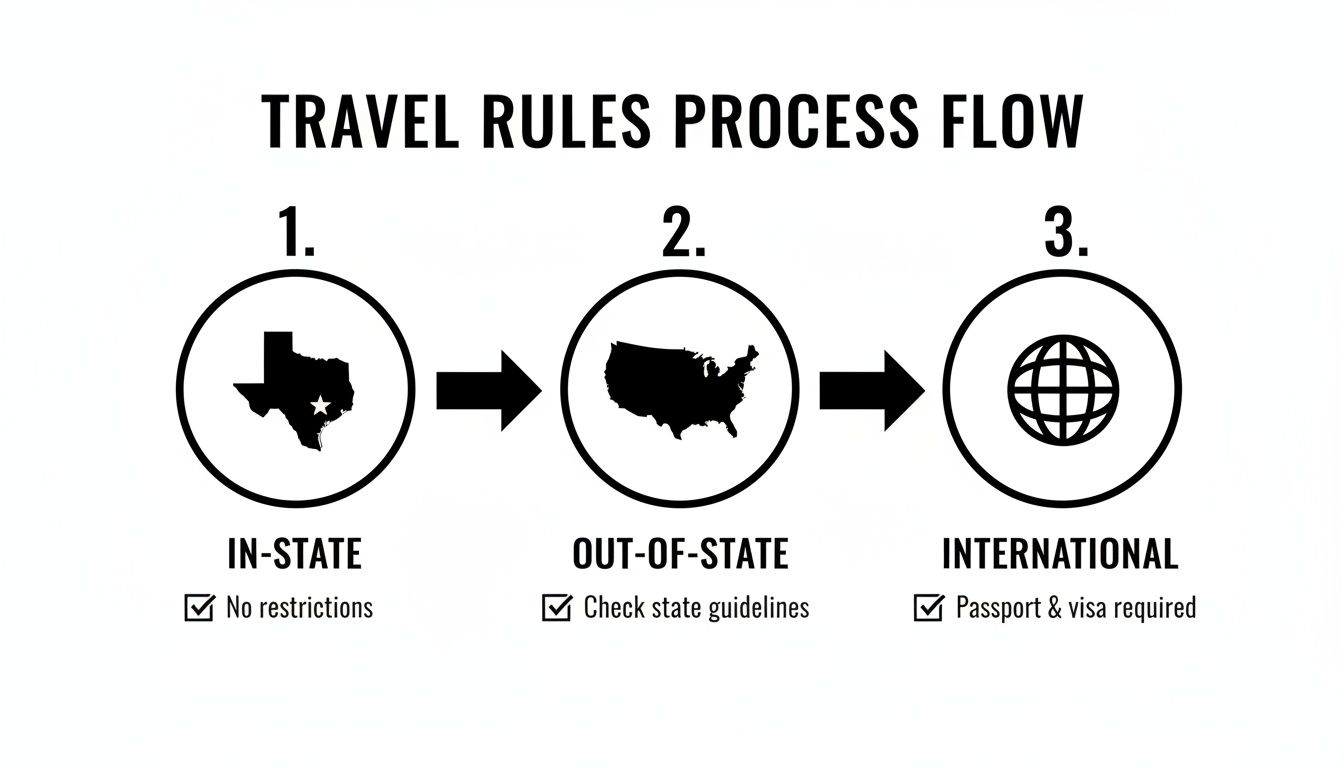
As you can see, the farther you want to go, the more formal the process becomes. The level of scrutiny ramps up significantly when you cross state lines, and even more so for international travel.
When You Need to Go to Court: The Motion to Travel
For bigger asks, like traveling out of state or internationally, a quick chat with your PO isn't going to cut it. You will need formal permission from the court that originally sentenced you. This is done by filing a legal document called a "Motion to Travel."
This isn't just a simple form. A Motion to Travel is a formal, persuasive legal document that your attorney drafts and files with the court. It lays out the details of your proposed trip and makes a strong case for why the judge should approve it, presenting you as a responsible individual who is not a flight risk.
A Motion to Travel isn't just paperwork. It's a legal argument crafted to ease the court's concerns about public safety and your commitment to probation. This is where having a skilled criminal defense attorney becomes absolutely essential.
A powerful motion will always include supporting documents to back up your request. This could be anything from a letter from your employer and conference tickets to a doctor's note or a wedding invitation. As you prepare everything, you may find that knowing how to fill out PDF forms properly helps make the process much smoother.
Increasing Your Chances of Approval
When deciding whether to grant your request, both your PO and the judge will look at your entire track record. Your past behavior is the best predictor of your future actions. If you want the best shot at getting a "yes," you need to be a model probationer.
Here are the keys to a successful travel request:
- Be in Full Compliance: Make sure you are 100% current on all your fees, fines, community service hours, and required classes. Any outstanding obligation is an easy reason for them to say no.
- Request in Advance: Never wait until the last minute. It shows a lack of planning and a lack of respect for the process.
- Have a Legitimate Reason: A trip for a family emergency or a mandatory work event is far more likely to be approved than a casual vacation.
- Provide Detailed Information: Vague plans are a major red flag. The more specific and organized your itinerary is, the more comfortable the court and your PO will feel.
Ultimately, your goal is to prove that allowing you to travel is a reasonable decision that poses no risk to the community and won't get in the way of your rehabilitation. An experienced Houston criminal lawyer knows how to frame your request in the strongest possible light.
The Consequences of Traveling Without Permission
Thinking about taking a trip without clearing it with your probation officer first? Let us be blunt: don’t do it. Traveling without proper authorization is one of the fastest ways to land yourself in serious legal trouble. This isn’t a minor slip-up or a rule you can bend—it’s a direct violation of a court order that can undo all your progress and send you right back to jail.
The consequences are swift, severe, and can put you right back where you started.
If your probation officer finds out you’ve left your designated area without approval, they won't just give you a warning. They are legally required to file a formal Motion to Revoke Probation (MTRP) with the court.
The Motion to Revoke Probation Process
An MTRP is the legal document that officially accuses you of breaking the rules of your probation. Once it’s filed, the system moves fast, and it’s not in your favor. Here is a step-by-step look at what happens:
- A Warrant Is Issued: The moment the MTRP hits the judge's desk, a warrant for your immediate arrest will almost certainly be issued.
- Arrest and Incarceration: You could be picked up at home, at work, or during a routine traffic stop. From there, you go straight to jail.
- No Bond Is Likely: For a probation violation, a judge can order you held in jail without bond until your revocation hearing. That means you could be sitting in a cell for weeks, or even months, waiting for your day in court.
This isn't a new trial where the prosecutor has to prove you’re guilty "beyond a reasonable doubt." The standard of proof is much lower. All the prosecutor needs to show is a "preponderance of the evidence"—meaning it's just more likely than not that you traveled without permission.
The Revocation Hearing
At the hearing, the judge holds all the cards. If the judge finds you violated your probation by traveling, they have the power to:
- Modify Your Probation: The judge could add stricter conditions. Think more frequent check-ins, a GPS ankle monitor, or a significant increase in community service hours.
- Extend Your Probation: Your time on supervision could be lengthened, keeping you under the court’s authority for even longer.
- Revoke Your Probation: This is the worst-case scenario. The judge can cancel your probation entirely and impose the original sentence for your crime. That means you could be sent to jail or prison to serve the full term you were facing in the first place, whether it was for a DWI, assault, or theft charge.
A probation violation puts you completely at the mercy of the court. The judge can take away your freedom over a single unauthorized trip, wiping out the second chance you were given.
These travel restrictions aren’t arbitrary; they’re a core part of community supervision. The rules are there to ensure accountability and keep you on the right path. They help probation officers monitor your progress and make sure you’re staying away from situations that could lead to trouble. In Texas, these rules are taken very seriously. The stakes are incredibly high, which is why you must never leave your approved area without explicit, written permission. If you're already facing an accusation of unauthorized travel, understanding the full scope of probation violation consequences is the critical first step in building your defense.
Frequently Asked Questions About Probation Travel
Navigating the rules of probation can bring up a lot of questions, especially when it comes to travel. Below, we’ve answered some of the most common questions our clients ask. This is general guidance, but remember, every case is different. The best way to get advice for your specific situation is to talk it over with an experienced criminal defense attorney.
Can I Travel for a Family Emergency?
Yes, travel for a true family emergency is often considered a valid reason, but you must still get permission first. No matter how urgent the situation feels, do not leave your county or state without explicit approval from your probation officer or the court.
Your first step is to contact your probation officer immediately—even if it's after hours or on a weekend. Be ready to show clear proof of the emergency, like a note from a hospital, a death certificate, or contact information for a funeral home. If you can’t reach your PO, try their supervisor.
This is exactly the kind of scenario where a lawyer can make a huge difference. We can communicate the urgency directly to the probation department or file an emergency motion with the court to help get permission quickly. This ensures you can be with your family during a difficult time without accidentally committing a probation violation.
Does My Original Charge Affect Travel Permission?
Absolutely. The type of crime you were convicted of plays a massive role in whether a travel request gets approved. Your probation officer and the court will always weigh the reason for your trip against any potential risk to public safety.
For instance, if you're on probation for a lower-level misdemeanor like a first-time DWI, your PO might be more flexible about an in-state trip. But if you're on probation for a serious felony—such as aggravated assault, a drug possession charge with intent to deliver, or any crime involving a weapon—every travel request will face intense scrutiny. For certain offenses, especially those involving violence or a high flight risk, out-of-state or international travel might be completely off the table as a condition of your supervision.
The court's primary concern is community safety. Your criminal history and the specifics of your offense are central to their assessment of whether allowing you to travel is a responsible decision.
What If My Job Requires Me to Travel?
If travel is a known requirement of your job when you’re sentenced, your attorney should bring this up with the court immediately to get it included as a condition of your probation. If you get a new job or your duties change to include travel later on, you need to tell your probation officer right away.
You’ll have to provide official paperwork from your employer. This means a formal letter on company letterhead that clearly states travel is a mandatory part of your job, along with details about how often you'll travel and where you'll be going.
- For regular, local travel (like a salesperson covering several counties), your PO might grant a standing travel permit.
- For out-of-state work trips, you will almost certainly need to submit a separate, formal request well in advance for each trip.
An attorney can help you file a motion to modify your probation conditions to officially add a provision for work-related travel. This creates a much more stable and predictable solution than having to ask for permission every single time you need to leave town for your job.
How Can a Defense Attorney Help My Travel Request?
Having a skilled Texas criminal defense lawyer in your corner is a powerful advantage when you need to travel on probation. Our job goes way beyond just filling out forms; we act as your strategic advocate to protect your rights and make your case.
First, we can review your specific probation order and give you a clear, plain-English explanation of your exact restrictions. If your probation officer denies a reasonable request, we can step in and file a formal Motion to Travel directly with the court.
When we file that motion, we don’t just ask—we build a persuasive legal argument. We’ll gather all the necessary supporting documents, like letters from your employer, medical records, or family correspondence, to present a compelling case to the judge. We’ll highlight your good behavior on probation, your stable ties to the community, and the legitimate reason for your trip. A lawyer adds credibility to your request and can effectively negotiate terms that the court and prosecutor will find acceptable.
Most importantly, if you’re ever accused of violating your travel restrictions, an attorney is your essential line of defense to fight the allegations and keep you out of jail. After successfully completing probation, we can also advise you on your options for post-conviction relief, such as expunctions or orders of non-disclosure to clear your record.
If you’ve been charged with a crime in Texas, call The Law Office of Bryan Fagan, PLLC for a free and confidential consultation. Our defense team is ready to protect your rights.