Being arrested in Texas can be terrifying—but you don’t have to face it alone. The world can feel like it’s closing in. The anxiety, the confusion, the uncertainty about what comes next—it's completely overwhelming. If you've been charged with a Class B misdemeanor, understanding what that really means is your first and most important step toward taking back control.
It’s a serious charge, more than just a slap on the wrist like a traffic ticket, but it’s not a life-altering felony either. The penalties are real: you could face up to 180 days in county jail and a fine of up to $2,000. But an arrest is not a conviction. It’s the starting line, not the finish.
What a Class B Misdemeanor Charge Actually Means for You
Hearing the word "misdemeanor" might make you breathe a little easier, but it's crucial to know that not all misdemeanors are created equal in the Texas justice system. These charges are stacked in tiers, and a Class B lands squarely in the middle. It demands your full attention from day one.
Think of it as a ladder. At the bottom, you have Class C misdemeanors, which are typically fine-only offenses like a speeding ticket. At the top are Class A misdemeanors, the most serious of the bunch, carrying up to a year in jail. Your Class B misdemeanor sits right in between—a significant jump up from a simple fine, with consequences that can follow you for years.
This classification isn't just legal jargon; it directly sets the stakes for your case. To give you a clearer picture, here’s a quick breakdown of how the different misdemeanor classes compare.
Texas Misdemeanor Classes at a Glance
| Misdemeanor Class | Maximum Fine | Maximum Jail Time | Common Examples |
|---|---|---|---|
| Class C | $500 | None | Most traffic tickets, disorderly conduct |
| Class B | $2,000 | 180 Days | First-offense DWI, possession of 2 oz. of marijuana |
| Class A | $4,000 | 1 Year | Second-offense DWI, assault with bodily injury |
This table shows exactly where your charge fits into the system. It’s not just about today’s court date; it's about understanding the long-term ripple effects a conviction could have.
Understanding the Potential Penalties
The Texas Penal Code §12.22 lays out the punishment for a Class B misdemeanor quite clearly: a fine not to exceed $2,000, confinement in jail for a term not to exceed 180 days (6 months), or both.
Some of the most common charges that fall into this category include a first-time DWI (with a BAC under 0.15), possession of up to two ounces of marijuana, or theft of property valued between $100 and $750. For more detail, you can dig into the specifics of Texas law on Class B misdemeanors.
Remember, those are the maximums. A judge has a wide range of options, from probation with zero jail time all the way up to the full 180 days. This is where a skilled criminal defense lawyer makes all the difference—they fight to keep you on the lower end of that spectrum, or better yet, get the charges dismissed entirely.
The most important thing to remember is that an arrest is just the start of the legal process, not the end. The prosecutor's charges are allegations, and you have the right to challenge them every step of the way.
Why This Charge Matters for Your Future
The immediate threat of jail and fines is scary enough, but a Class B misdemeanor conviction creates something else: a permanent criminal record. It’s the kind of thing that pops up on background checks for years, potentially slamming the door on job opportunities, apartment applications, or professional licenses.
That’s why a strong defense isn’t just about the courtroom. It’s about protecting your entire future. By understanding exactly what you’re up against, you can move past the initial shock and start making smart, informed decisions. The fear and anxiety you’re feeling right now are normal, but they can be replaced by a clear plan and the confidence that comes from having an expert in your corner.
Common Offenses That Are Class B Misdemeanors
When you get charged with a crime, the legal language can feel like a foreign language—cold, impersonal, and totally disconnected from what you actually experienced. So let's move past the abstract definition of a "Class B misdemeanor" and look at real-world examples. It might surprise you just how many common situations can lead to this serious charge.
Knowing these specific offenses does more than just satisfy your curiosity. It helps you see the pieces of your own case and understand that while your situation is unique, it fits within a legal framework our firm has successfully navigated for countless other people.
Driving While Intoxicated (First Offense)
One of the most frequent Class B misdemeanors we see in Texas is a first-offense Driving While Intoxicated (DWI). This charge applies when a driver is found to have a Blood Alcohol Concentration (BAC) of 0.08% or higher, but less than 0.15%.
Picture this: you're heading home after a couple of beers with friends. You feel perfectly fine, but a cop pulls you over for a minor traffic mistake, like not using your turn signal. The officer smells alcohol, runs you through a few field sobriety tests, and asks for a breath or blood sample. If that test comes back at 0.09%, you are now facing a Class B misdemeanor DWI.
For the state to get a conviction, the prosecutor has to prove two key things beyond a reasonable doubt:
- You were operating a motor vehicle in a public place.
- You were intoxicated at the time, which means you either had a BAC of 0.08% or more, or you had lost the normal use of your mental or physical faculties because of alcohol or drugs.
Even if you felt completely in control, that BAC number is often the single piece of evidence the state will build its entire case around.
Possession of Marijuana
Another all-too-common Class B charge is the possession of two ounces or less of marijuana. Despite changing attitudes and laws in other parts of the country, Texas law enforcement and prosecutors continue to take marijuana possession very seriously.
Think about a scenario where you're at a concert and an officer approaches your group. They find a small baggie in your pocket containing less than two ounces of marijuana. That's all it takes to be arrested and charged with a Class B misdemeanor. The prosecutor’s job is to prove you knowingly and intentionally had a usable amount of the substance.
It's helpful to see where these charges fit into the bigger picture. The Texas Department of Public Safety recently reported a statewide drop of roughly 22.64% in the overall crime volume compared to last year, which is great news for public safety. Even so, charges like DWI and marijuana possession are still incredibly common and remain a major focus for police. You can dig into the latest Texas crime trends to see the full data.
Theft of Property or Services
A theft charge lands in the Class B misdemeanor category when the value of the stolen property or services is at least $100 but less than $750. This covers a huge range of situations, from shoplifting a few items to writing a bad check for a covered amount.
For instance, if you're accused of walking out of a department store with $150 worth of merchandise you didn't pay for, you’d be facing a Class B theft charge. To convict you, the prosecution has to show that you unlawfully took property with the intent to permanently keep it from the owner.
It's critical to understand that the prosecutor's case hinges on proving your intent. Accidental actions or simple misunderstandings are not crimes, which is often a key area for building a strong defense.
Other common Class B offenses include:
- Criminal Trespass on agricultural land or inside a building.
- Harassment, like making repeated, unwanted phone calls.
- Reckless Driving, which is defined as driving in a way that endangers others.
Seeing these concrete examples helps connect the dry legal statute to a real situation you might be facing. Your case isn't just a file number; it’s a real-life event with specific facts and a story behind it. Recognizing that is the first step toward building a defense that actually tells your side.
Navigating the Legal Process After Your Arrest
The moments after an arrest are almost always a blur of confusion, anxiety, and fear. The legal system can feel like a labyrinth, deliberately complex and intimidating. But here's the truth: understanding the path ahead is the single best way to reduce that stress and start building a powerful defense.
Think of this as your roadmap for what happens after you're charged with a Class B misdemeanor in Texas. The journey through the criminal justice system follows a predictable sequence. Each stage is a critical opportunity for a skilled defense attorney to protect your rights and poke holes in the state's case against you. Knowing these steps helps you prepare for what’s coming and make smart decisions when it matters most.
The Booking Process and Your Rights
Immediately after you're taken into custody, you'll be transported to a local jail for the booking process. This is basically an administrative procedure. An officer will record your personal information, take your fingerprints and a mugshot, and confiscate your personal items for safekeeping. It's a dehumanizing experience, but it's standard procedure.
During this time, it is absolutely essential that you remember your rights. You have the right to remain silent, and you should use it. Anything you say can—and will—be used against you, so politely decline to answer any questions about the alleged crime until you've spoken with a lawyer.
Arraignment and Setting Bail
Within 48 hours of your arrest, you must be brought before a judge or magistrate for your arraignment. This is your first official court appearance. The judge will read the charges filed against you, inform you of your constitutional rights, and ask you how you plead. In almost every situation, your attorney will advise you to plead "not guilty" at this stage.
This hearing is also when the judge sets your bail. Bail is just a financial guarantee that you will show up for future court dates. The amount depends on several factors:
- The nature of the Class B misdemeanor charge itself.
- Your criminal history (or lack thereof).
- Your ties to the community, like a job or family.
- Whether the court considers you a flight risk.
The judge might set a cash bond, which requires you to pay a certain amount of money, or grant a personal recognizance (PR) bond. A PR bond allows you to be released on your written promise to appear in court without having to pay anything upfront. A good attorney can argue for a lower bail amount or a PR bond on your behalf.
The infographic below shows a few common offenses that kickstart this entire legal journey.
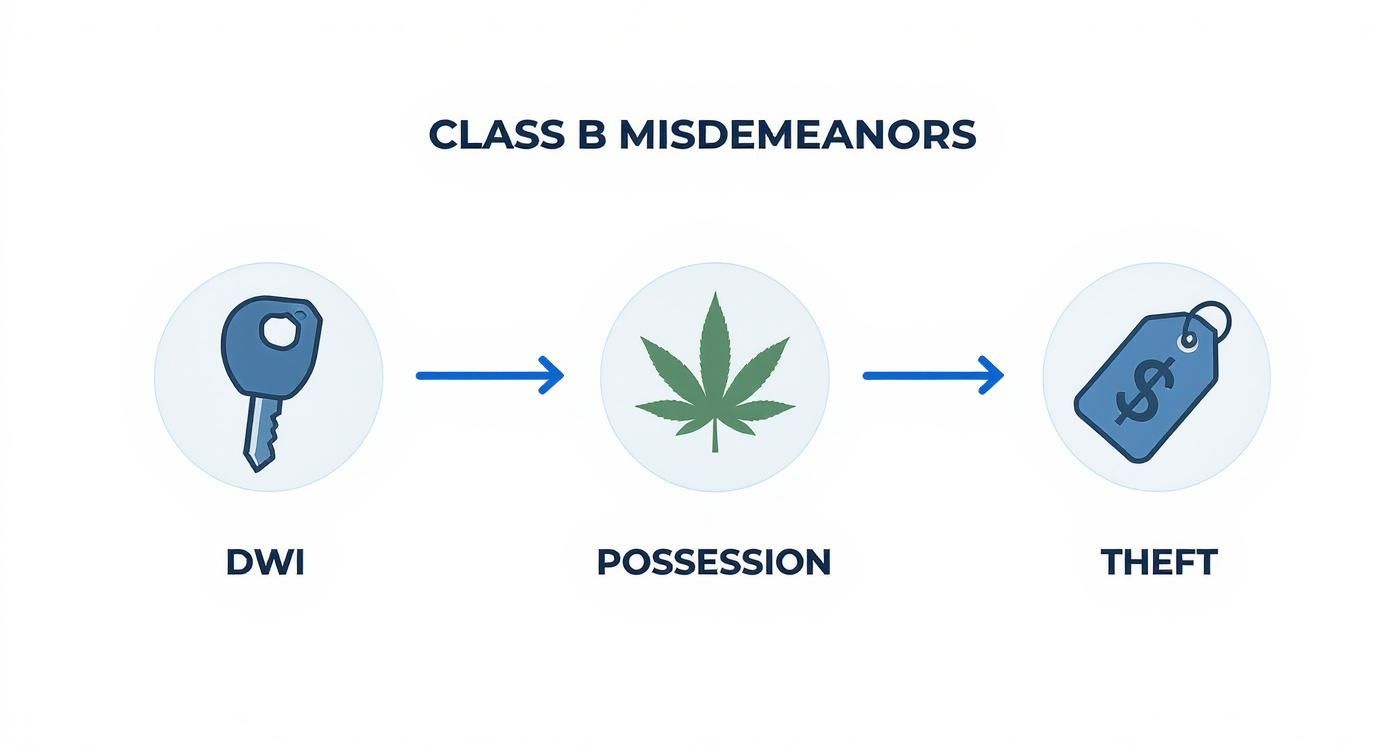
Each one of these charges, from DWI to theft, triggers the same process of booking, arraignment, and pretrial hearings. This really underscores just how important it is to get a lawyer involved early.
The Pretrial Phase: Building Your Defense
Once you're released from jail, your case moves into the pretrial phase. This is often the longest and most critical part of the whole process. During this time, your defense attorney will be hard at work building your case and fighting for the best possible outcome for you.
Here's what's happening behind the scenes during the pretrial phase:
- Discovery: Your lawyer will formally request and review all the evidence the prosecutor has against you. This includes police reports, witness statements, lab results, and any bodycam or dashcam footage.
- Filing Motions: Your attorney may file pretrial motions to challenge the state’s evidence. For example, a "motion to suppress" could be used to argue that evidence was found during an illegal search and should be thrown out of court.
- Plea Negotiations: Your attorney will negotiate with the prosecutor to see if a favorable plea agreement is possible. This could mean getting the charge reduced to a lesser offense or agreeing to a sentence like probation to avoid jail time and a final conviction on your record.
This pretrial period is where the foundation of your defense is laid. A thorough investigation by your legal team can uncover weaknesses in the prosecutor's case, creating leverage for a dismissal or a favorable plea deal.
Trying to navigate this complex process alone is a recipe for disaster. The state has a prosecutor working full-time to get a conviction. You absolutely deserve to have a dedicated, experienced defender in your corner, making sure your rights are protected at every single turn.
Building a Strong Defense for Your Case

An arrest for a Class B misdemeanor in Texas can feel overwhelming, but this is the moment to start fighting back, not giving up. An arrest is just an accusation. The prosecutor carries the entire burden of proving every single element of their case beyond a reasonable doubt—and that’s a very high bar.
Your defense begins the minute you hire an experienced attorney. We don't just take the police report at face value. Instead, we dig into every detail, hunting for weaknesses, procedural mistakes, and violations of your constitutional rights. You have powerful options, and our job is to find the best path forward for your specific situation.
Challenging the State’s Evidence
Every criminal case is built on a foundation of evidence. If that foundation is shaky, the whole case against you can fall apart. A huge part of our defense strategy involves putting the prosecution's evidence under a microscope and challenging its validity.
We start by asking critical questions that can completely change the outcome of a case:
- Was the traffic stop even legal? In a DWI case, if the officer didn't have a valid reason (reasonable suspicion) to pull you over in the first place, any evidence they found after that could be thrown out.
- Was the search constitutional? For drug possession charges, we look at whether the police had probable cause or a warrant to search your car, your pockets, or your home.
- Is the evidence reliable? We challenge the accuracy of breathalyzer machines, question the chain of custody for lab samples, and attack the credibility of witness statements.
A single mistake by law enforcement can be enough to get key evidence suppressed, which can sometimes lead to a complete dismissal of the charges.
The smallest detail can make the biggest difference in a criminal case. A thorough review of police procedures often reveals opportunities to challenge the legality of an arrest or the evidence gathered.
The Role of Plea Bargaining
While we prepare every case as if it’s headed for a full-blown trial, the reality is that many criminal cases are resolved through plea bargaining. This is simply a negotiation between your defense attorney and the prosecutor to reach an agreement that avoids the risk and expense of a trial.
A good plea deal can dramatically reduce the impact of a Class B misdemeanor charge. The goal is always to secure an outcome that protects your future and, if at all possible, keeps a conviction off your permanent record. This is where strategic, tough negotiation is absolutely vital.
Securing a Better Outcome
Through skilled negotiation, we can often achieve results that are far better than the maximum penalties on the books. These alternatives are designed to give you a second chance and prevent one mistake from defining the rest of your life.
Potential positive outcomes we fight for include:
- Reduced Charges: Negotiating to get the Class B misdemeanor knocked down to a less serious Class C offense, which is usually just a fine and doesn't create a criminal record.
- Dismissal: Convincing the prosecutor that their evidence is too weak to win at trial, leading them to drop the charges completely.
- Deferred Adjudication: This is often a fantastic option for first-time offenders. You plead "guilty" or "no contest," but the judge holds off on finding you guilty and places you on probation instead. If you successfully finish the probation, the case is dismissed, and you avoid a final conviction. You can learn more by reading our guide to what deferred adjudication in Texas is and how it might work in your case.
These options aren't just handed out—they are earned through the hard work of a defense attorney who knows how to build leverage and present your case in the most favorable light. Building a strong defense isn't just about what happens in the courtroom; it's about creating opportunities for a better future.
The Hidden Consequences of a Misdemeanor Conviction
It’s tempting to write off a Class B misdemeanor charge as “not a big deal.” A lot of people figure if they can just sidestep jail, they’ll pay a fine, put it behind them, and move on. But that’s a dangerous assumption.
A conviction isn’t just a one-day event that’s over when you walk out of the courthouse. It’s the start of a long shadow that can follow you for years, closing doors you never even knew were there. This isn’t about scaring you—it’s about giving you a clear-eyed look at what’s really at stake so you understand why fighting your charge is so critical.
How a Conviction Impacts Your Career
For most Texans, the biggest gut punch from a criminal record is its effect on their job. These days, background checks are standard practice for almost every employer. A Class B misdemeanor conviction is going to pop up on that report, and far too often, it’s an easy reason for a hiring manager to toss your application and pick someone else.
It's especially devastating for professionals who need a state license to do their job. A conviction puts those hard-earned credentials on the line:
- Nurses and Healthcare Workers: A drug or assault charge could trigger a license suspension or even revocation from the Texas Board of Nursing.
- Teachers: School districts have zero-tolerance policies. A criminal record can make it nearly impossible to get hired or keep your teaching certification.
- Commercial Drivers: A DWI conviction can mean losing your commercial driver's license (CDL), which effectively ends your career on the spot.
Barriers to Housing and Education
The fallout doesn’t end with your paycheck. Landlords and property management companies also run background checks on applicants. A misdemeanor conviction can be an immediate red flag, making it incredibly difficult to find a safe and affordable place for you and your family to live.
Thinking about going back to school? A criminal record complicates that, too. College applications often ask about your criminal history, and a conviction could hurt your chances of getting into certain programs, qualifying for scholarships, or receiving federal financial aid.
A criminal record creates a permanent paper trail that can follow you everywhere. The question is no longer just about jail time or fines; it’s about ensuring one mistake doesn’t limit your opportunities for the rest of your life.
Immigration and Other Personal Consequences
For non-U.S. citizens, the stakes are even higher. A conviction for certain Class B misdemeanors can trigger severe immigration consequences. We’re talking about the risk of deportation or making it impossible to apply for citizenship down the road.
Beyond these tangible hits, a criminal record can strain personal relationships and damage your standing in the community. The stigma is real, and it highlights just how important it is to fight the charge from day one. You can learn more by reading our article on how long a misdemeanor stays on your record in Texas.
An experienced defense attorney doesn’t just see a case number; we see your future, and our job is to protect it.
How to Clear Your Record and Move Forward

A criminal charge can feel like a permanent stain, a shadow that follows you long after the case is closed. But it doesn't have to be. Texas law provides real pathways for people to move past a mistake, clear their name, and reclaim their future. This part of the process is critical—it’s where we shift the focus from defense to recovery.
Understanding your options for clearing your record is empowering. It gives you a tangible, positive goal to work toward and proves this difficult chapter doesn't have to define your life. It’s all about taking back control of your story.
Expunction vs. Nondisclosure: What's the Difference?
In Texas, we have two primary tools for cleaning up a criminal record after a case is over: expunction and nondisclosure. They might sound similar, but they work in very different ways and have completely separate eligibility requirements.
An expunction is the gold standard—the most complete form of relief you can get. Think of it like a legal shredder. It completely destroys all records of your arrest and charge. When a court grants an expunction, government agencies are ordered to erase the incident as if it never happened. This is a powerful tool for a truly fresh start.
An order of nondisclosure, on the other hand, is more like a seal. It doesn't destroy the record, but it hides it from the public. Once an order of nondisclosure is granted, private employers, landlords, and the general public won’t see the charge on a background check. However, law enforcement and certain state agencies can still access the information if they need to.
Are You Eligible to Clear Your Record?
Eligibility for these powerful legal tools depends entirely on how your case was resolved. Not everyone qualifies, which is another reason why fighting for the best possible outcome in your criminal case is so critical from day one.
You may be eligible for an expunction if your Class B misdemeanor case resulted in one of the following outcomes:
- An acquittal (you were found "not guilty" at trial).
- A dismissal by the prosecutor.
- You were arrested but never formally charged with a crime.
Eligibility for an order of nondisclosure typically applies if you successfully completed a deferred adjudication program. This is a common path for first-time offenders where the judge agrees to dismiss the case after you complete a period of probation.
Navigating the petitioning process for either option is complex and loaded with strict deadlines and legal hurdles. Having an attorney guide you is the best way to ensure your petition is filed correctly and has the strongest possible chance of success.
The legal landscape is always shifting, which is another reason professional guidance is so important. For example, some first-time DWI charges, once a standard Class B misdemeanor, can now be upgraded to a Class A under certain circumstances due to recent legislative changes. This shows why fighting for the best outcome—and the chance to clear your record—is more important than ever.
If you're wondering about your eligibility, you can get a better sense of the rules by reading our comprehensive guide on how to clear your record in Texas.
Ultimately, the only way to know for sure is to speak with an experienced criminal defense lawyer who can review the specific details of your case and give you a straight answer.
Answering Your Questions About Class B Misdemeanors
When you’re staring down a criminal charge, the questions can feel overwhelming. You need direct, honest answers from someone who’s been in the trenches. This section tackles the most common concerns we hear from people in your exact situation, giving you the clarity you need to get a handle on what’s ahead.
Can I Go to Jail for a First Offense Class B Misdemeanor?
Yes, jail time is a very real possibility. A Class B misdemeanor in Texas comes with a potential sentence of up to 180 days in county jail. It’s not something to take lightly.
Now, that doesn't mean every first-time offender ends up behind bars. Many are good candidates for alternative outcomes like probation or deferred adjudication, which can keep you out of jail. But here’s the critical part: a judge has the final say and can absolutely impose jail time. The outcome boils down to the specific facts of your case, your background, and—most importantly—the strength of the defense your attorney puts forward. This is precisely why having skilled legal representation is non-negotiable if you want to fight for a better result and stay out of jail.
How Much Does a Defense Lawyer Cost for a Misdemeanor?
There’s no one-size-fits-all answer. The cost to hire a criminal defense lawyer depends on how complex your case is, the attorney’s level of experience, and even which court your case is in. Most reputable defense attorneys, including our firm, offer a free initial consultation to go over your case and give you a clear, transparent breakdown of the fees.
While hiring a lawyer is an investment, you have to weigh it against the staggering costs of a conviction. We're not just talking about fines. A conviction means a permanent criminal record that can slam the door on job opportunities, housing, and professional licenses for years to come.
Will This Charge Show Up on a Background Check?
Absolutely. A conviction for a Class B misdemeanor becomes a permanent part of your public record. It will pop up on nearly every standard background check run by employers, landlords, and licensing boards.
A conviction can put up serious roadblocks in your life. But it’s not always the final word. If your case is dismissed or you successfully finish a deferred adjudication program, you may be able to get the record cleared or sealed, protecting your future.
Getting an expunction or an order of nondisclosure means you can legally deny the arrest ever happened and prevent the charge from appearing on most background checks. This is the best-case scenario for moving forward, and it's a goal we always aim for.
If you’ve been charged with a crime in Texas, call The Law Office of Bryan Fagan, PLLC for a free and confidential consultation. Our defense team is ready to protect your rights. Get in touch with our Texas criminal defense lawyers today.