Getting a traffic ticket in Texas can leave you staring at the citation in your hand and wondering whether you should just pay it and move on. That reaction is common. It’s also where many drivers make a costly mistake.
A citation is an accusation, not a final judgment. With approximately 41 million people receiving driving citations annually in the U.S., and only 5% contesting their tickets in court, most drivers never explore whether they have a real defense, according to driving citation statistics collected here. If you’re thinking about contesting a traffic citation, you’re not being difficult. You’re using a legal option Texas gives you.
In major Texas cities, the court handling your case matters. So does your broader legal situation. A simple ticket in Houston, Dallas, Austin, or San Antonio may land in a municipal court or a justice court, and those practical differences affect scheduling, plea options, and how your case is presented. If you’re on probation, out on bond, applying for professional licenses, or trying to keep your insurance from climbing, the stakes are even higher.
Your First Steps After Getting a Texas Traffic Ticket
The first few hours after a stop matter more than is commonly understood. Don’t crumple the ticket into your glove box and hope you’ll deal with it later. Read it carefully while the details are still fresh in your mind.

Read the citation line by line
A Texas traffic ticket usually tells you several things at once. It identifies the alleged offense, names the court, gives you a date or appearance deadline, and often includes a charge description that may be shorter than plain English.
Pay attention to these parts first:
- Court information: This tells you where the case will be filed. That might be a city municipal court or a Justice of the Peace court.
- Appearance date or promise to appear: Signing the ticket usually means you promise to address the citation. It does not mean you admitted guilt.
- Charge description: Look for what the officer wrote, not what you assumed happened.
- Location and time: If those details are wrong, they may matter later.
Protect the facts while they are still fresh
Write down what happened as soon as you can. Include traffic conditions, weather, where the officer was positioned, what you said, and what the officer said. If there were passengers, get their contact information before memories fade.
If the stop involved an equipment issue, inspection issue, or registration-related allegation, pull your records together immediately. Drivers sometimes discover that the problem was tied to inspection or emissions compliance, and a practical review of Texas emissions testing requirements can help you sort out whether the issue was mechanical, administrative, or already corrected.
Practical rule: Don’t mail payment, click “pay now,” or enter a plea online until you understand what that choice does to your record.
Know your rights during and after the stop
You had the right to remain polite without volunteering extra facts. That still matters now. Don’t call the court and start explaining why you “sort of” did it. Don’t email a long apology. Don’t post your side of the story online.
You do have the right to review the accusation, decide how to respond, and contest the charge. In many cases, the smartest early move is simple: preserve your documents, calendar the deadline, and avoid turning a manageable ticket into an admitted violation.
Navigating the Texas Court System Your Plea and Deadlines
Once the citation is issued, your case moves into procedure. There, missed deadlines and rushed pleas create problems that had nothing to do with whether the officer was right.
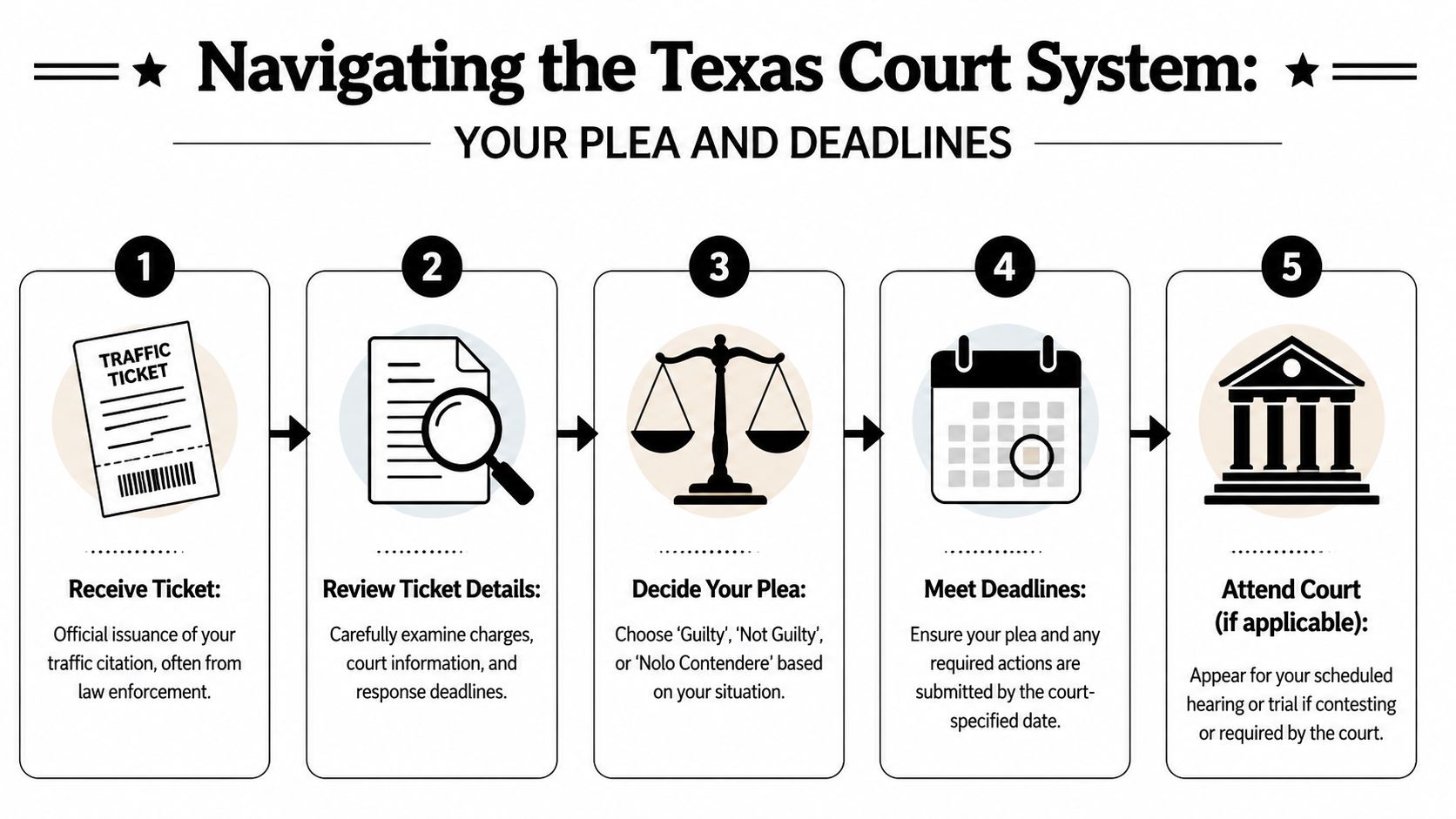
Your plea options
Most Texas traffic cases begin with one of three responses.
| Plea | What it usually means | Practical effect |
|---|---|---|
| Guilty | You admit the violation | The court can enter judgment and assess fines and costs |
| Nolo contendere | You don’t contest the charge | Often treated much like a guilty plea for the case itself |
| Not guilty | You require the state to prove the case | Opens the door to a hearing, negotiation, or trial setting |
For many drivers contesting a traffic citation, not guilty is the plea that preserves options. It doesn’t mean you’re claiming the officer lied. It means the case should be tested before you accept the consequences.
Municipal court versus Justice Court
This difference matters in Texas cities.
Municipal courts usually handle city ordinance violations and many traffic citations issued by city police officers. In a place like Houston, Dallas, Austin, or San Antonio, city tickets often land in a municipal court system with its own docket practices, online portals, compliance rules, and hearing settings.
Justice of the Peace courts usually handle Class C misdemeanor traffic matters filed in the county precincts, often after stops by county deputies or state troopers in certain areas. These courts can feel less centralized. Procedure is still formal, but scheduling and local expectations may vary more by precinct.
Here’s the practical takeaway. Two speeding tickets in the same metro area can move very differently depending on which court received the filing.
What drivers in major Texas cities should expect
- Houston: Court location matters because the city’s municipal system is different from Harris County JP courts. Don’t assume the website or appearance process is the same.
- Dallas: Tickets inside city limits may move through municipal channels, while neighboring precincts can route similar charges differently.
- Austin: Travis County and city filings often create confusion for first-time defendants because the citation may look similar even when the court procedure is not.
- San Antonio: Bexar County precinct practices can differ from municipal handling, especially on resets, appearances, and proof requirements.
Some courts are set up for fast volume processing. That doesn’t mean your case should be handled casually.
Alternatives short of trial
A contested ticket doesn’t always end in a courtroom fight. Depending on the charge, your history, and the court, you may be able to request a deferred disposition or driver safety course. Those options can sometimes help protect your record, but they are not automatic and they are not ideal in every case.
If you’ve already missed a setting or you’re worried that a warrant or default judgment may follow, review what to do if you miss a court date before the problem grows.
Deadlines are not flexible just because the charge is minor
Traffic courts process a high volume of cases. Clerks won’t usually stop the machine because you were busy at work or traveling. Put every date on your calendar. Save screenshots of any online filing confirmation. If you appear in person, keep copies of everything you submit.
Building Your Defense Evidence and Strategy
A good traffic defense usually starts long before you stand in front of a judge. In Texas city courts, the difference between a weak case and a useful one often comes down to what you gathered in the first 48 hours after the stop.

Municipal and county courts also reward different kinds of preparation. In high-volume municipal courts in Houston, Dallas, Austin, and San Antonio, judges and prosecutors often move quickly and expect concise, organized proof. In county or justice court settings, procedure can feel less rushed, but that does not mean the state’s burden gets lighter. In either forum, scattered screenshots and a vague explanation usually do not help much.
Build one file and put everything in it
Set up a single evidence folder, digital or paper, for the citation and every document tied to the stop. Keep it organized by date.
Useful items often include:
- Your copy of the citation: Check names, license plate, statute, location, and time.
- Photos of the scene: Capture signs, lane markings, construction, sight obstructions, and the officer’s likely view.
- Video footage: Dashcam, bodycam if available later, passenger recordings, or nearby business surveillance.
- Phone map history or GPS records: These can help pin down route, timing, and location.
- Witness names and contact information: Get this early, while details are still fresh.
- Repair, registration, or inspection records: Helpful in equipment or paperwork cases.
- Medical or emergency records: Important if your defense depends on necessity.
Do not assume you will remember the details later. I have seen otherwise defensible tickets become much harder to fight because the driver waited two weeks to photograph the intersection, only to find the construction barrels gone and the lane pattern changed.
Tie each piece of proof to one legal point
Evidence matters only if it answers the judge’s real question. Was the driver speeding? Was the sign visible? Was the officer in a position to see what he says he saw? Was there a documented emergency?
That is where many drivers lose focus. They bring a stack of papers but no theory.
Use a simple approach:
- Dispute the location: Use photos, maps, and timestamps.
- Dispute the timing: Use phone logs, metadata, receipts, or video.
- Dispute the equipment reading: Use maintenance, calibration, and training records.
- Explain necessity: Use records from a hospital, roadside assistance, or emergency calls.
- Challenge observation: Use lighting, distance, traffic conditions, and line-of-sight evidence.
Courts decide facts, not frustration.
Speed cases often turn on the device and the officer’s use of it
If your citation is based on radar or LIDAR, the strongest challenge is usually specific. General complaints that radar can be wrong rarely get traction. A focused request for records tied to the actual device used in your stop is more effective.
According to this guide on contesting a traffic citation, calibration, maintenance, and operator issues can affect how persuasive speed-detection evidence will be. That does not automatically defeat the ticket. It does give you a concrete area to examine.
Records worth requesting
Ask for the documents that relate to your case, such as:
- Calibration logs
- Maintenance records
- Certification for the specific device
- The officer’s training or certification to operate it
- Records showing that device was the one used during your stop
This kind of request can matter even more if the traffic case touches another criminal matter. A speeding ticket may look minor on its own, but an admission in open court, a finding of responsibility, or inconsistent testimony can create problems in a pending DWI, drug, probation, or assault case. That risk gets missed all the time by drivers who treat the ticket as separate when it is not.
Here is a useful overview of the process and the kind of preparation involved:
Strong defenses are factual and narrow
Judges hear every excuse imaginable. Being late for work, following traffic flow, or not noticing the speed limit change usually does not move the case.
What can help is proof that creates doubt about the charge or gives the prosecutor a real reason to reconsider it.
Objective contradictions
A blocked sign, a bad timestamp, or video that conflicts with the officer’s description can be persuasive. Concrete conflicts carry more weight than broad claims that the stop was unfair.
Paperwork and identification problems
Wrong vehicle details, mismatched dates, incomplete fields, or inconsistent descriptions can weaken the state’s presentation. Some errors are harmless. Some matter a great deal. The value depends on the court and how the prosecutor plans to prove the case.
Necessity supported by records
A true emergency can be relevant, but it needs documentation. Hospital discharge papers, call logs, roadside emergency records, and witness statements usually do more work than your testimony alone.
Limits on the officer’s view
Lighting conditions, traffic density, distance, weather, and angle all affect what an officer could reliably observe. In city courts handling large dockets, a clear photo or diagram can make that point faster than a long explanation.
If you already have a pending criminal case, be careful here. Statements you make while contesting a ticket may not stay confined to the ticket. Before you testify, decide whether the benefit of fighting this citation outweighs the risk of creating a record that can be used somewhere else. In practice, that trade-off is one of the biggest differences between handling a traffic ticket yourself and treating it like part of your larger defense strategy.
Inside the Courtroom What to Expect When You Fight Your Ticket
Most drivers don’t lose sleep over the fine. They lose sleep over standing in court not knowing when to speak, what to call the judge, or how formal the hearing will be.
A typical contested traffic setting in Texas begins calmly. You arrive, check in, and wait while the court handles a docket full of people with very different levels of preparation. Some came to ask for time to pay. Some plan to plead. A smaller group came ready to fight the ticket.
How the hearing usually unfolds
When your case is called, the judge or prosecutor may confirm your plea first. If the matter is going forward, the state presents its evidence. In many cases, that means the officer testifies about the stop, the alleged violation, and how the citation was issued.
Then you have your turn. If you’re representing yourself, you may question the officer, present documents, offer photos or video, and testify if needed. If you have counsel, your attorney handles that presentation and cross-examination.
Speak to the judge respectfully. “Your Honor” is the safe choice every time.
What helps and what hurts
According to this discussion of successful traffic defense preparation, effective defenses often depend on strong evidence such as video footage or GPS data, procedural challenges, or questions about speed-detection equipment. That matches what works in real courtrooms. Preparation shows.
These habits help:
- Dress neatly: You don’t need a suit, but you should look like you take the court seriously.
- Bring organized copies: One for you, one for the court, one for the prosecutor if needed.
- Answer directly: Long speeches usually weaken a point instead of strengthening it.
- Stay calm: Even if you disagree with the officer, arguing with the judge never improves your position.
These habits hurt:
- Interrupting testimony
- Turning your statement into an apology mixed with a denial
- Guessing about facts you can’t prove
- Relying on “I didn’t know” as your main defense
A realistic courtroom mindset
Think of the hearing as a credibility test. The court is looking at whether your version of events is consistent, supported, and relevant to the charge. This is not the place for sarcasm, moral arguments about ticket quotas, or anger about how the stop felt.
The drivers who do best usually present a narrow, fact-based case. They know what point they need to prove, and they don’t wander away from it.
Understanding the Outcome Dismissals and Your Driving Record
When the judge rules, the result reaches beyond that day’s docket. The question isn’t only whether you pay money now. The primary issue is what follows you after the case closes.

The outcomes drivers usually care about most
A dismissal is the cleanest result. It means the court does not enter a conviction on the citation.
Other favorable resolutions may include a reduction, deferred disposition, or a course-based outcome that avoids the same long-term damage as a straight conviction. Whether one of those options makes sense depends on the charge, your record, and the court’s practices.
If you are found guilty or you pay the ticket up front, the case can affect your driving history. To understand the type of license most everyday Texas drivers hold and why classification can matter in traffic matters, review this overview of a Texas Class C driver license.
Why the result matters outside court
Many people think of a traffic ticket as a one-time annoyance. In practice, the consequences can spread.
Here’s a simple comparison:
| Outcome | Immediate effect | Possible longer-term concern |
|---|---|---|
| Dismissal | No conviction on the citation | Less risk to your record |
| Deferred or similar resolution | You may have conditions to complete | Mistakes in compliance can still create issues |
| Reduction | A better result than the original charge | You still need to understand record impact |
| Conviction or paid ticket | Fine and court costs may apply | Record consequences and insurance concerns may follow |
Insurance impact is one of the biggest practical reasons people contest a ticket. Courts don’t control your insurer’s underwriting decisions, and insurers don’t have to treat all outcomes the same way.
Don’t evaluate a ticket only by the amount printed on it. The hidden cost often shows up later.
Learn from how other states frame point reduction
Texas handles driving records differently from other states, but it’s still useful to see how point-related consequences are explained elsewhere because the same practical concern exists. This guide for Georgia drivers on reducing points is a helpful example of how a traffic case can affect a license over time, even when the initial ticket seems minor.
The larger point is simple. A good outcome in traffic court can protect more than your wallet. It can protect your record, your insurance profile, and your ability to drive without added complications.
When a Traffic Ticket Is More Than a Ticket Why You Need an Attorney
Some traffic cases are manageable without counsel. Others are not. The hard part is knowing which kind you have before you make a decision that closes off better options.
Situations where the risk rises fast
If any of these apply, a lawyer should be part of the conversation:
- You’re on probation or deferred adjudication in another case
- You have a pending criminal charge
- You hold a CDL or drive for work
- The stop involved an accident
- The officer alleged reckless conduct or a more serious offense
- You already have a complicated driving or criminal history
For people with prior convictions or open criminal matters, a ticket may trigger much more than a fine. As explained in this discussion of fighting traffic tickets with broader criminal consequences, a traffic citation can lead to probation problems, bail-condition issues, and enhanced penalties.
Why this matters in Houston, Dallas, Austin, and San Antonio
Large urban courts process high case volume. That can make traffic matters feel routine. For a person with another case pending, routine is exactly the danger.
A guilty plea on a Class C traffic matter may look harmless in isolation. But a prosecutor in a separate assault, theft, drug possession, or DWI case may view that plea as noncompliance, poor judgment, or a violation of release conditions. A probation officer may see it the same way. If your bond says obey all laws, even a minor traffic conviction can become an unnecessary complication.
That is where criminal defense perspective matters. A lawyer looking at the whole picture can weigh the ticket against your pending case, your bond terms, plea negotiations, licensing concerns, and future record-cleanup options such as nondisclosure or other post-conviction relief where available.
Getting help before a small case turns expensive
If you’re unsure whether your ticket is minor, talk to counsel before entering a plea. A traffic lawyer can review the citation, identify defenses, request records, appear in court when permitted, and help you avoid accidental admissions. If you’re comparing representation options, this page on finding a traffic ticket lawyer in Texas can help you start that process.
A criminal defense practice is often especially useful when the traffic stop overlaps with bigger issues. That might include pending DWI allegations, an unresolved assault case, a theft charge, drug possession exposure, or concerns about how a new citation will affect your record later. In those situations, the legal analysis should not stop with the ticket itself.
If you’ve been charged with a crime in Texas, or if a traffic citation could affect your probation, bond, license, or pending case, call Law Office of Bryan Fagan PLLC for a free and confidential consultation. Our defense team is ready to protect your rights.