Being arrested in Texas can be terrifying, but the shadow it casts on your life doesn't have to be permanent. For many Texans, an expungement offers a real path to a fresh start. A common question we hear is: what’s the cost of expungement in Texas? Generally, you can expect the total investment to fall somewhere between $1,500 and $4,000, which covers everything from attorney fees to court costs.
Think of this cost not as an expense, but as an investment in reclaiming your future.
Your Financial Roadmap to a Clean Slate in Texas
Facing the future with an arrest record can feel like a heavy weight, but you don’t have to face it alone. An expungement—or expunction, as it's called under Texas law—is a powerful court order that completely erases an arrest from your record. It’s like it never happened.
When you’re ready to take that step, one of the first and most practical questions is always: what will this cost me?
The answer isn’t just a single number. The total cost is a combination of a few key parts: mandatory court filing fees, various administrative costs, and the professional fees for an experienced attorney to handle it all for you. Each piece is essential to successfully navigating the legal maze and securing the clean slate you deserve.
This guide will give you a clear, plain-English overview of the total investment required. We'll break down the main expenses you'll encounter, so you have a realistic picture of what lies ahead.
While there are costs involved, it’s critical to weigh them against the lifelong value of a clear record. An expungement can unlock new opportunities that were previously closed off.
- Better Employment: Finally pass those background checks for jobs that were once out of reach.
- Secure Housing: Greatly improve your chances of getting approved for apartment and home rentals.
- Professional Licensing: Obtain or keep the professional licenses required for so many careers, from nursing to real estate.
- Peace of Mind: Move forward without the constant anxiety of a past mistake hanging over your head.
The investment you make today in clearing your name pays dividends for years to come. To help you get a quick handle on the financial landscape, the table below offers a summary of typical cost ranges before we dive into each component in more detail.
At a Glance: Estimated Expungement Costs in Texas
This table summarizes the typical cost ranges for court-mandated fees and professional legal services for a Texas expungement. It gives you a solid starting point for budgeting.
| Cost Component | Typical Range (Misdemeanor) | Typical Range (Felony) | Notes |
|---|---|---|---|
| Court & Filing Fees | $300 – $600 | $400 – $800 | Varies widely by county. This includes the initial petition filing, clerk fees, and costs to serve notice. |
| Attorney Fees (Flat Fee) | $1,200 – $3,000 | $2,000 – $4,500+ | Depends on the complexity of your case, how many charges need to be cleared, and if a contested hearing is likely. |
| Total Estimated Cost | $1,500 – $3,600 | $2,400 – $5,300+ | This is more than just a legal fee; it’s an investment in your future earning potential and personal freedom. |
Keep in mind these are estimates. The final cost will depend on the unique facts of your case, which we'll explore next.
Deconstructing the Bill: What Are You Actually Paying For?
When you get a quote for an expungement, it’s completely normal to wonder where your money is going. The total cost isn't some arbitrary number; it’s a combination of several distinct, essential parts, each playing a critical role in the mission to clear your record. Knowing this breakdown helps you see the real value behind every dollar spent on regaining your future.
Think of it like getting a major car repair. The final bill isn't just for "fixing the car." You're paying for the new parts, the shop's overhead, and most importantly, the skilled labor of the mechanic who knows exactly how to put it all together. An expungement works much the same way—each cost is a necessary component for building your clean slate.
To give you a clearer picture, this chart breaks down the main categories that make up the total investment in your expungement.
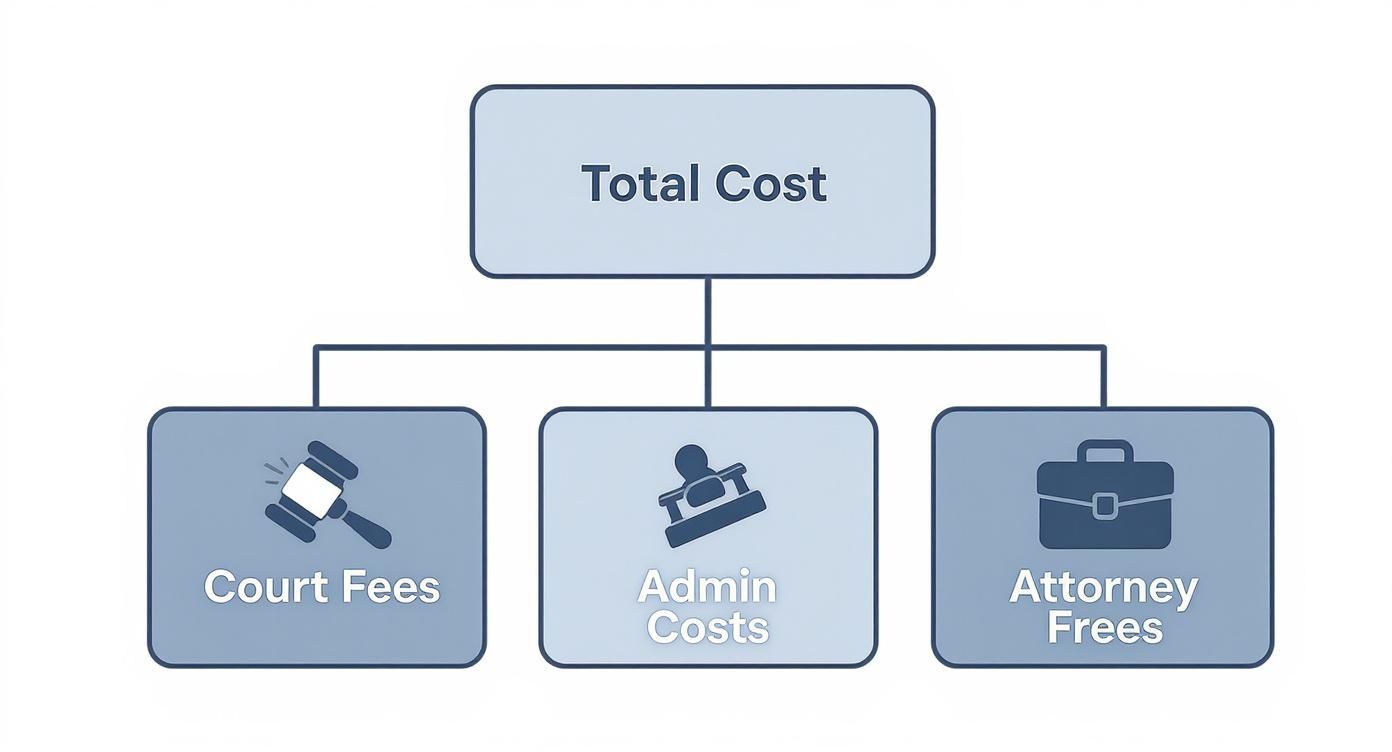
As you can see, the final price tag is a mix of non-negotiable court fees, crucial administrative expenses, and the legal fees that cover your attorney's expertise. Let's look at each piece a little closer.
Breaking Down Court Filing Fees
The first hard cost you'll encounter is the court filing fee. This is a mandatory charge paid directly to the district clerk in the county where your original criminal case was filed. This fee is what officially gets the ball rolling—it gets your Petition for Expunction on the court's docket.
There’s no statewide standard for these fees. They can vary significantly from one county to the next.
- A large urban county like Harris or Dallas will almost certainly have higher filing fees than a smaller, rural one.
- For example, you might pay around $300 to file in one county, but the courthouse down the road in the next county over could charge closer to $500 for the exact same paperwork.
This fee is set by the county government and is non-negotiable. It’s the baseline price of admission just to get your case in front of a judge.
Uncovering Administrative and Service Costs
Next up are the administrative and service costs. These are a collection of smaller but equally critical fees required to formally notify every government agency that has a record of your arrest. Under Texas Code of Criminal Procedure, Chapter 55, every single agency holding your records must be legally served with the lawsuit.
This step is what ensures that when the judge finally signs that expungement order, every agency knows they are legally obligated to track down and destroy their copy of your file.
These "behind-the-scenes" costs typically include:
- Service Fees: This is what you pay to have a constable or a private process server hand-deliver a copy of your petition to each agency you're suing. This always includes, at a minimum, the District Attorney's office and the police department that arrested you.
- Clerk Fees: The clerk’s office often tacks on small fees for issuing the official notices, called citations, that go out to each agency.
- Certified Mail Costs: For statewide bodies like the Texas Department of Public Safety (DPS), notice is usually sent via certified mail to create a paper trail proving they received it.
While these little costs might seem like minor details, they are absolutely vital. If you fail to properly notify even one agency, it can render the entire expungement void, forcing you to start the whole process over—and pay for it all again.
These fees are a necessary part of the process, ensuring your expungement is thorough and legally sound. When you partner with a firm like The Law Office of Bryan Fagan, PLLC, we handle all these moving parts so nothing gets missed. This prevents costly errors and delays. The final piece of the financial puzzle—the attorney's fee—covers the legal expertise tying it all together, which we’ll get into next.
Understanding Attorney Fees: The Core of Your Investment
When you decide to pursue an expungement, your attorney's fee is almost always the largest single part of the total cost. It's easy to be concerned about the price, but it’s critical to see this not just as an expense, but as an investment in getting the job done right the first time.
Hiring an experienced Texas criminal defense attorney is the single most important step you can take. This fee covers far more than shuffling paperwork—it’s the value of having a skilled legal guide navigate a complex system for you, avoiding costly mistakes and fighting for your future.

Flat Fees vs. Hourly Rates: What to Expect
When it comes to paying for legal services, you'll generally run into two models: hourly billing or a flat fee. While some legal matters are billed by the hour because of their unpredictable nature, expungements in Texas are almost always handled on a flat-fee basis.
This is a huge advantage for you. A flat fee means total cost certainty from day one. You’ll know the exact investment needed to take your case from start to finish, with no surprise bills or hidden charges popping up later. It covers everything, even if minor delays or administrative hurdles come up.
Think of it like hiring a contractor to build a deck. A flat fee is like getting a guaranteed price for the entire finished project. An hourly rate, on the other hand, is like paying the builder for every minute they spend, which could quickly spiral out of control.
What Does a Flat Fee Actually Cover?
Your flat fee is a comprehensive payment for your attorney's time, knowledge, and diligent work through every single stage of the process. Remember, one mistake here can get your petition denied, forcing you to start—and pay for—the entire process all over again.
Here’s a breakdown of the critical tasks your attorney's fee covers:
- In-Depth Eligibility Review: Before we file anything, we conduct a deep dive into your criminal history to confirm you are legally eligible for an expunction under the Texas Code of Criminal Procedure.
- Meticulous Petition Drafting: We prepare a precise, legally sound Petition for Expunction. This document has to be perfect, naming every single government agency that holds a record of your arrest. Miss one, and the job isn't done.
- Correct Court Filing: We make sure the petition is filed in the right court and county, paying all initial fees on your behalf to get the process started smoothly.
- Negotiation with Prosecutors: We talk directly with the District Attorney's office to see if they will agree to the expungement. An experienced attorney can often negotiate an agreement, which means you can avoid a contested court hearing.
- Representation at Hearings: If the state decides to challenge your expungement, we will vigorously represent you in court, making the legal arguments needed to get your petition granted by the judge.
- Distribution of the Final Order: Once the judge signs the order, our work isn't finished. We follow through to ensure the final order is properly sent to every agency, making sure they comply and destroy your records as required by law.
Factors That Influence Attorney Fees
While flat fees are standard, the exact amount can vary based on the specifics of your case. Just like no two criminal cases are the same, no two expungements are either. The main factors that influence the final cost are complexity and location.
For many people, the cost of an expungement has been a major roadblock to clearing their record. Typical attorney fees for an expungement in Texas can range from $1,000 to over $3,000, with court costs adding another $400 to $500. Some firms, for instance, offer a flat fee that bundles all attorney work and court expenses, covering everything from start to finish.
Key Takeaway: The attorney fee is your investment in a professional who knows the law, the local courts, and the prosecutors. It's the difference between crossing your fingers for a good outcome and having a skilled advocate work to secure it for you.
Ultimately, by hiring The Law Office of Bryan Fagan, PLLC, you are paying for the assurance that your one shot at a clean slate is handled with the highest level of professional care and legal skill.
Why Your Case Complexity and County Location Matter
When it comes to clearing your record, there’s no one-size-fits-all price tag. That’s because no two criminal cases are ever the same. The final cost of an expungement in Texas is incredibly sensitive to the specific details of your situation, and understanding these variables is the first step toward setting realistic expectations.
Two big factors drive the cost up or down: how complex your case is and which county handled the original charge. A good attorney has to dig into both before they can give you an accurate, flat-fee quote for getting the job done right.
How Case Complexity Shapes the Final Cost
Let's look at two different scenarios. Imagine a simple, single Class B misdemeanor charge for theft that the prosecutor dismissed quickly. Now, picture a felony assault arrest that a grand jury eventually "no-billed," meaning they decided not to indict. Both are eligible for expungement, but clearing the felony case will almost always cost more.
A more complicated case demands a much bigger investment of your lawyer's time and energy.
- Deeper Legal Research: A felony case, or one with several charges, often brings up tricky legal questions. Answering them requires hours of research to build the strongest possible petition for expungement.
- More Agencies to Notify: Complex cases might involve several law enforcement agencies—maybe the local police, the sheriff's office, and a special task force. Every single one has to be legally served with the lawsuit, which drives up administrative work and costs.
- Higher Likelihood of a Challenge: District Attorney’s offices tend to look much closer at expungements for serious felony arrests. They're more likely to fight it, which means your attorney has to be ready for a contested court hearing from the get-go.
All this extra legal work, paperwork, and potential for a courtroom fight gets factored directly into the final attorney fee.
The Impact of Geography on Expungement Costs
Beyond the facts of your case, where you were arrested plays a surprisingly big role in the total cost. Court procedures and filing fees aren't standardized across Texas. Each of our 254 counties has its own fee schedule and its own way of doing things.
This means wiping your record clean in a major city can be a completely different financial ballgame than in a small, rural county.
A huge urban center like Harris County, for instance, typically has higher court filing fees and more procedural hoops to jump through than a less populated county. The sheer volume of cases alone means you need an attorney who knows the local system inside and out.
On top of that, the local District Attorney's office adds another layer. Some DA's offices will sign off on expungements without much fuss, while others are notorious for fighting them. An attorney who works in that county regularly knows what to expect, which shapes their legal strategy and, you guessed it, the final cost.
A skilled attorney will consider your county's specific court costs and their own experience with the local prosecutor’s office when quoting your fee. If your arrest was in a big city, this local knowledge is non-negotiable. For example, if you were arrested in Houston, it pays to understand the specific process for an expungement in Harris County, Texas, because its unique rules can directly affect your case's timeline and budget. That kind of local expertise is invaluable for a smooth, successful outcome.
Considering Nondisclosure as a Cost-Effective Alternative
So, what happens if you find out you aren’t eligible for a full expungement? It can feel like a punch to the gut, but don’t lose hope. Texas law offers another powerful tool that can deliver serious relief: an order of nondisclosure.
Understanding the difference between these two legal remedies is the first step toward setting realistic goals and planning your finances. They both aim to clear your public record, but they get there in fundamentally different ways.
Here’s a simple, plain-English way to think about it: an expungement is like taking a chapter from your life’s book, shredding it, and burning the pieces. It’s legally destroyed, and you can deny the arrest ever happened. A nondisclosure, on the other hand, takes that same chapter and locks it away in a sealed vault. The general public can’t see it anymore, but law enforcement and certain state agencies can still get access if they have a reason.
Why Nondisclosure Can Be More Accessible
The eligibility rules for a nondisclosure are often much broader than those for an expungement. This is especially true for anyone who completed a specific type of probation called deferred adjudication. If you successfully finished a deferred adjudication sentence, an expungement is usually off the table, but you might be a perfect candidate for an order of nondisclosure.
Because the legal path is often more direct, the process for getting a nondisclosure is frequently simpler and, as a result, less expensive than a full expungement. That makes it a hugely valuable and cost-effective option for many Texans.
A first-time charge for a misdemeanor like DWI or drug possession is a classic example.
- Scenario: You were arrested for a Class B Misdemeanor DWI.
- Outcome: You took a plea for deferred adjudication, completed all the terms, and the judge dismissed your case.
- Your Remedy: In this situation, you’d petition the court for an order of nondisclosure to seal the record from public view.
Grasping this key distinction is your first move toward finding the right solution. While an expungement offers total destruction of the record, a nondisclosure provides the crucial benefit of removing it from public background checks—which can be just as life-changing for your job and housing prospects.
Comparing the Costs and Benefits
While the exact cost of a nondisclosure varies just like an expungement, the total investment is typically lower. The legal process might have fewer steps, and there may not be as many agencies to notify, which can bring down court and administrative fees.
Here’s a quick comparison to help you see the value:
| Feature | Expungement (Destruction) | Nondisclosure (Sealing) |
|---|---|---|
| Eligibility | Very strict; typically for dismissed cases, acquittals, or pardons. | Broader; often available for cases ending in deferred adjudication. |
| Public Access | Record is completely destroyed and unavailable to the public. | Record is sealed from public view, including most employers. |
| Gov't Access | Record is unavailable to nearly all government agencies. | Law enforcement and certain state licensing boards can still access it. |
| Typical Cost | Generally higher due to stricter legal requirements. | Often a more cost-effective option for those who qualify. |
Figuring out which path you qualify for is the most important first step. If you successfully completed deferred adjudication, you need to learn more about this process. You can get a detailed breakdown by reading our complete guide to nondisclosure orders in Texas, which explains eligibility and benefits in plain English. This knowledge will help you and your attorney choose the most effective and affordable strategy for your unique situation.
The True Cost of Inaction: What a Record Really Costs You
While the upfront cost of an expungement might feel like a hurdle, it's nothing compared to the lifelong price of doing nothing. An arrest record, even for a charge that was dismissed, can cast a long, expensive shadow over your future. This is the hidden price tag of inaction, and it shows up in countless ways you might not expect.
Leaving that record unaddressed can slam the door on opportunities you absolutely deserve. It’s more than just an inconvenience; it’s a constant barrier to building the life you want.

The Steep Price of a Lingering Record
The consequences of an old arrest record aren't just theoretical. They are tangible, real-world setbacks that can affect you and your family for decades.
- Lost Job Opportunities: A single flag on a background check can get your application tossed in the trash, no matter how skilled or qualified you are. This can lock you out of entire industries and significantly cap your earning potential over a lifetime.
- Housing Insecurity: Landlords and apartment complexes almost always run background checks. An arrest record can lead to an automatic denial, making it incredibly difficult to find a safe, stable place to live.
- Blocked Professional Licenses: Many careers, from nursing and teaching to real estate and cosmetology, require a state license. An uncleared record can prevent you from getting or renewing the license you need to work.
- Personal and Community Barriers: The impact goes beyond finances. You might be prevented from volunteering at your child’s school or coaching their sports team, creating a painful personal cost that’s impossible to measure.
When you look at it this way, the cost of expungement in Texas is no longer just an expense. It becomes one of the smartest investments in yourself you could ever make.
An expungement is one of the most powerful financial decisions you can make. It’s an investment that directly unlocks your earning potential and removes the invisible barriers holding you back from a better quality of life.
An Investment That Pays for Itself
The financial burden of clearing a record is a huge reason many eligible Texans don't take action. Let's be real—even when felony expungements range from $1,000 to $2,500, that’s a significant amount of money for most people. The cost is a major hurdle.
By clearing your record today, you prevent a lifetime of missed paychecks, denied applications, and personal frustration. The one-time investment you make now can easily pay for itself many times over in the years to come.
Your Top Questions About Texas Expungement Costs
When you’re thinking about clearing your record, the financial side of things can feel like another hurdle. Let's tackle some of the most common questions people have, breaking them down into straightforward answers so you know exactly what to expect.
Can I Get My Texas Expungement for Free?
It's a common question, but unfortunately, the answer is usually no. While getting a truly free expungement is rare, it’s not completely impossible. Legal aid societies or pro bono clinics at universities sometimes take on these cases at no cost, but you have to meet their very strict low-income requirements.
Even then, these programs are often swamped with requests and have long waiting lists. For most people, the most reliable and direct path to a clean slate is working with a private criminal defense attorney.
Does the Timeline Affect How Much I'll Pay?
An expungement in Texas generally takes about three to six months from the day your petition is officially filed with the court.
The good news is that if your attorney uses a flat-fee structure—which is standard for this kind of work—the timeline won't change your bill. A flat fee is designed to cover the entire process from start to finish, whether it wraps up in three months or takes a little longer. It gives you total financial predictability right from the start.
Do I Have to Pay for Everything Upfront?
Most good criminal defense firms understand that this is a big investment in your future, and coming up with the entire fee at once can be tough. That’s why many, including us at The Law Office of Bryan Fagan, PLLC, offer flexible payment plans to make it more manageable.
You should always bring this up during your first consultation. It allows you to get the experienced legal help you need without the immediate stress of a lump-sum payment. A compassionate law firm will work with you to find a solution that fits your budget.
If you’ve been charged with a crime in Texas, call The Law Office of Bryan Fagan, PLLC for a free and confidential consultation. Our defense team is ready to protect your rights.