A detective leaves you a voicemail. Your bank freezes a card. Your employer asks about transactions you don’t recognize. Or maybe you were arrested after using a card you thought you had permission to use.
That moment can turn your whole week upside down.
If you’re dealing with credit card fraud in texas, you are likely asking similar initial questions. Is this a misunderstanding? Is this really a felony? Should I talk to the investigator? What happens next?
Those questions are normal. So is the fear.
Texas treats these cases seriously. In 2025, Texas ranked #4 nationally for identity theft reports per capita, and credit card fraud made up 41.7% of all cases, according to Texas identity theft statistics compiled from FTC data. That means law enforcement and prosecutors see these allegations often, and they move quickly when they think card data, account numbers, or unauthorized purchases are involved.
Facing a Credit Card Fraud Accusation in Texas?
A lot of people picture credit card fraud as some large cybercrime ring.
Sometimes it is. Sometimes it isn’t.
Sometimes it starts with a family dispute. A shared business card. A breakup. A roommate. A company expense account. An online order traced to the wrong person. In many cases, the person charged didn’t set out thinking, “I’m committing a felony today.” But that doesn’t stop the State from filing charges.
What clients usually feel in the first few days
Clients I speak with often deal with three problems at once:
- Fear of jail because they’ve heard fraud charges can be felonies
- Confusion about the facts because they think there was consent, partial consent, or a misunderstanding
- Panic about reputation because employers, licensing boards, and family members may find out fast
If that sounds like you, slow down before you make any big decisions.
Practical rule: If an investigator wants “your side of the story,” don’t try to talk your way out of it alone. In fraud cases, even an innocent explanation can be turned into evidence about intent.
Why these cases need careful defense early
Credit card cases often depend on records, not just eyewitnesses.
Prosecutors may use transaction logs, store video, phone records, device searches, online account activity, banking records, or statements from the cardholder. Once those pieces get framed the wrong way, a simple mistake can look deliberate.
That’s why early legal help matters. A defense lawyer can step in before you hand over your version in a damaging way, before your phone gets searched without a proper challenge, and before a weak allegation hardens into a felony case.
If you’ve been researching law firms, it’s also worth noticing how legal information is presented online. Clear, ethical communication matters in criminal cases, and resources on ethical criminal defense marketing strategies can help you separate useful education from empty promises.
What you need now
You need a calm explanation of the law, the court process, the possible defenses, and whether your record can be cleaned up later.
That’s what this guide is built to do.
Defining Credit Card Fraud Under the Texas Penal Code
Texas doesn’t limit these cases to someone physically swiping a stolen card at a store.
Under Texas Penal Code §32.31, the law covers a wider range of conduct involving cards, account numbers, and stolen payment data. One important point is that the statute reaches “digital imprints,” meaning the machine-readable information on a card’s chip or magnetic stripe. A fuller breakdown of the statute appears in this guide to the Texas Penal Code fraud laws, and the statutory concept is also described in Saputo Law’s explanation of Texas credit or debit card abuse.

What the law is really looking for
In plain English, prosecutors usually need to show more than accidental contact with a card.
They try to prove that you intentionally or knowingly used, possessed, transferred, or handled card information in a way the law forbids. That’s where people often get confused. They think, “I only had the number,” or “I never even bought anything.” But possession of card data can still become a criminal issue if the State claims it was tied to fraud.
Three ideas matter most.
Intent to defraud
This means the State claims you meant to deceive someone to get money, property, services, or another benefit.
Intent is rarely proven by a confession. Prosecutors usually build it from surrounding facts. They may point to repeated transactions, altered records, multiple account numbers, fake names, or attempts to hide activity.
Effective consent
This is another phrase people misunderstand.
Permission has to be real. If a cardholder says you exceeded permission, used the card for a different purpose, or kept using it after consent ended, the case may center on that dispute.
Possession versus use
You don’t always have to complete a purchase to get charged.
If police say you possessed counterfeit cards, stored stolen card numbers, or handled digital payment data without consent, they may still file a case. That’s one reason these charges show up in both retail fraud cases and more technical white-collar investigations.
A simple example
Suppose a business owner gives an employee a company card for fuel and travel.
If the employee uses it for approved work expenses, there’s no crime. If the employee uses it for personal purchases and tries to hide them in bookkeeping, prosecutors may argue there was no effective consent and that the spending showed intent to defraud.
Same card. Very different legal outcome.
Why the language matters
Fraud statutes sound broad because they are broad.
That doesn’t mean every accusation is solid. It does mean your defense has to focus on the exact words the State must prove. If one required element falls apart, the case can weaken fast.
This short video helps explain how these kinds of allegations are analyzed in practice.
The label on the charge matters less than the evidence behind it. In many fraud cases, the fight is over consent, identity, and intent.
Common Types of Credit Card Fraud We Defend
Those charged with fraud often don’t identify with the phrase “financial crime.””
They see a messy real-life situation that got out of control.
Gas pump skimmer cases
One of the most common organized schemes in Texas involves skimmers placed inside fuel pumps. According to Estrada Law’s discussion of gas pump skimmers in Texas, criminals can buy the hardware for under $150, use a universal key to access the pump, and collect hundreds of card numbers per day from a busy location.
In those cases, police often investigate more than one person. One person may be accused of installing the device, another of collecting the data, and another of using the cloned cards.
That creates a major defense issue. Just because your name appears near one step in the chain doesn’t mean the State can prove you knowingly joined the whole operation.
Online purchase allegations
These cases often start with a flagged internet transaction.
Maybe an order was placed from your IP history, shipped near your address, or tied to a device officers later seized. But online cases can be messy. Shared Wi-Fi, reused passwords, account takeovers, and borrowed devices can all create doubt about who placed the order.
The State still has to connect the transaction to you, not just to a location or device you happened to use at some point.
Family and relationship disputes
This is one of the most misunderstood categories.
A spouse, boyfriend, girlfriend, adult child, or roommate may have used a card before without any issue. Then the relationship falls apart, money gets tight, and old spending suddenly becomes the basis for a police report.
These cases often turn on questions like:
- Was there prior permission for this type of purchase?
- Did the cardholder know about shared access to the account?
- Was the dispute really about criminal fraud, or about a broken relationship and money owed?
That’s not a small detail. It can be the difference between a criminal case and a civil disagreement.
Employee and business card cases
A worker may have access to a company card, payment portal, or saved customer information.
If the employer claims that access was abused, the case may involve accounting records, receipts, approval emails, reimbursement claims, or internal policy manuals. These cases often look stronger on paper than they really are, especially when the business had loose controls and vague spending rules.
Card data possession cases
Some defendants are accused not of spending money, but of possessing account numbers, counterfeit cards, or machine-readable card data.
That’s where the technical side of the law becomes important. A person may be charged based on what officers found on a phone, laptop, flash drive, printer, encoder, or other device. Defense work in these cases often means digging into how the evidence was found, who controlled the device, and whether the State can prove fraudulent intent instead of mere presence.
A fraud accusation often sounds simple in the police report. Once you examine the relationships, devices, permissions, and records, it usually isn’t simple at all.
Understanding the Criminal Penalties for Fraud in Texas
If you’ve been arrested, this is usually the first thing you want to know.
How bad is this?
Under Texas law, credit card fraud is typically charged as a state jail felony, with a punishment range of 180 days to 2 years in state jail and a fine up to $10,000. The charge can become more serious if the alleged victim is elderly or if the case involves a larger number of stolen card numbers. As noted in the earlier legal definition section, those penalty rules come from the same Texas statute.
The baseline penalty people need to understand
This offense is different from many theft cases because prosecutors often don’t treat it as a low-level matter just because the dollar amount seems small.
The focus is on the alleged misuse of the card, account number, or card data itself. That’s why people are often shocked to learn they’re facing a felony record even when the underlying transaction was not enormous.
Texas credit card fraud penalties by value
The chart below gives a practical way to think about exposure in fraud-related cases. Actual charging decisions can depend on the statute used, the facts alleged, and whether prosecutors combine credit card abuse with theft or related offenses.
| Value of Fraud | Charge Level | Potential Jail/Prison Time | Maximum Fine |
|---|---|---|---|
| Low-value allegations under §32.31 | Typically state jail felony | 180 days to 2 years in state jail | Up to $10,000 |
| Cases involving elderly alleged victims | Can be enhanced | Penalties increase beyond the typical state jail range | Up to $10,000 under the cited enhancement summary |
| Cases involving many stolen card numbers | Can be enhanced | Penalties can rise significantly depending on the allegations | Depends on the charged offense |
If you’re also worried about whether the State waited too long to file or investigate, this overview of the statute of limitations for fraud in Texas can help you understand one part of that timeline.
The punishment outside the courtroom
A fraud conviction can affect much more than custody time.
It can lead to trouble with:
- Employment checks when a background search shows a dishonesty-related offense
- Professional licensing for nurses, teachers, contractors, and other licensed workers
- Housing applications where landlords reject felony histories
- Immigration concerns in some situations
- Restitution demands that follow you long after sentencing ends
What this means for your strategy
Don’t judge your case only by the amount allegedly charged to the card.
Your real exposure depends on the statute, the alleged victim, the number of cards or numbers involved, your criminal history, and whether the prosecutor claims the conduct was part of a broader fraud scheme. That’s why plea decisions should be made carefully, with a clear understanding of both direct punishment and long-term consequences.
What to Expect After a Credit Card Fraud Arrest
The criminal process feels chaotic when you’re in it.
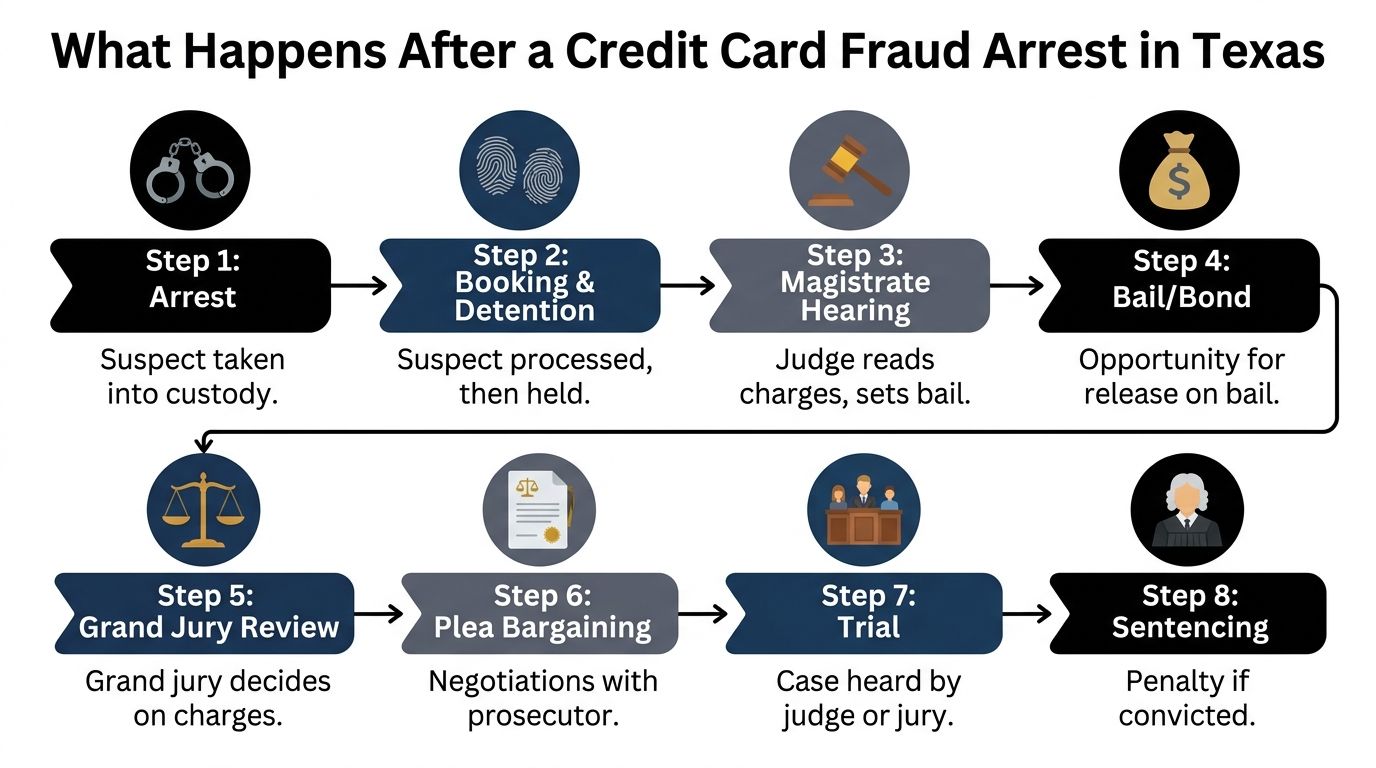
It helps to know the usual order of events so you can stop guessing what’s coming next.
The first hours after arrest
After an arrest, officers usually take you to booking.
That means fingerprints, photographs, personal information, and entry into the jail system. In some fraud cases, law enforcement may also seize a phone, wallet, computer, cards, receipts, or other items they believe connect to the allegation.
Then comes the magistrate stage. A judge or magistrate tells you the accusation and addresses bond.
Bond and release
Some people can bond out quickly. Others face delays because of the county, the charge level, warrant issues, or holds from another case.
Bond conditions matter. You may be told not to contact the alleged victim, not to access certain accounts, not to possess financial data, or not to leave the county without permission.
Follow those rules closely. A bond violation can create a second problem when you already have enough to deal with.
The charging decision
An arrest doesn’t always mean formal charges will stick as filed.
The prosecutor reviews reports, witness statements, bank materials, videos, digital evidence, and any statements you made. In felony cases, a grand jury may review the matter. Sometimes the filed case stays the same. Sometimes it gets reduced, expanded, or rejected.
This is one reason silence matters early. A rushed explanation during arrest can become part of the charging packet.
If police want a statement, the safest answer is that you want a lawyer first.
Arraignment and early court settings
At arraignment or your first significant court appearance, the court addresses the charge and your plea.
In most cases, the smart move is not to treat this hearing like your chance to explain everything. Your lawyer handles the legal posture, protects your rights, and starts shaping the case before the prosecutor locks into a theory.
Discovery and evidence review
This stage is where the essential work begins.
Your defense attorney reviews what the State has turned over. That may include:
- Transaction records from banks or merchants
- Surveillance video from stores, gas stations, or ATMs
- Search records involving phones, homes, cars, or computers
- Cardholder statements about permission and disputed charges
- Device evidence such as saved numbers, emails, messages, or spreadsheets
A strong defense often turns on details hidden inside those materials. Dates may not match. Card access may have been shared. Video may be unclear. The “owner” of a device may not be the actual user.
Plea negotiations
Not every case goes to trial.
Many fraud cases are resolved through negotiation. That can involve reduced charges, deferred adjudication, restitution plans, dismissal arguments, or other structured outcomes based on the facts and your record.
This is one place where legal counsel matters a lot. The Law Office of Bryan Fagan PLLC represents Texans through investigation, bond, negotiation, trial, and post-conviction matters, which is important in a case where one early decision can affect your record for years.
Trial and sentencing
If the case doesn’t resolve, it can go to trial before a judge or jury.
At trial, the State must prove each element beyond a reasonable doubt. Your defense may challenge consent, identity, intent, search procedures, witness credibility, or the reliability of digital evidence. If there’s a conviction, the court moves to sentencing and may consider punishment evidence, restitution, supervision options, and other factors.
The key point is this. The process has stages, and each stage gives your defense opportunities. Panic makes people miss those opportunities. Preparation helps you use them.
Common Defenses Against Credit Card Fraud Allegations
A charge isn’t the same thing as proof.
That matters in fraud cases because prosecutors often build them from records and inferences. Records can be incomplete. Inferences can be wrong.

Lack of intent
This is one of the biggest defenses.
Maybe you believed you had permission. Maybe you made a purchase by mistake on the wrong saved card. Maybe you possessed information without knowing what it was or how it got there. The State has to prove a guilty state of mind, not just contact with the card or data.
That’s a hard issue for prosecutors when the facts show confusion, mixed permissions, sloppy bookkeeping, or shared access.
Consent from the cardholder
Consent cases are common, especially in family and business disputes.
If the cardholder previously allowed use, shared the account, handed over the card, gave verbal approval, or failed to set clear limits, your attorney may be able to challenge the State’s version. The dispute then becomes less about “fraud” and more about whether consent existed and whether it later changed.
Mistaken identity
Fraud investigations often move fast once a merchant, bank, or cardholder reports suspicious activity.
But quick investigations can lead to bad assumptions. A purchase linked to your address, device, car, or workplace doesn’t always prove you were the person who made it. Shared households, borrowed cards, hacked accounts, and common devices all create room for doubt.
Weak digital evidence
Many modern cases rise or fall on electronic records.
A defense lawyer may examine how police got access to a phone, laptop, cloud account, or app data. If officers searched without proper legal authority, or if the chain of custody is weak, the defense may be able to challenge the evidence itself.
This is also where outside financial analysis can help. In document-heavy cases, professionals such as Forensic Accountants may help sort transaction patterns, reconcile business records, and identify whether the paper trail supports the accusation.
Search and seizure problems
Fraud cases often involve searches of homes, cars, wallets, computers, and phones.
If officers overstepped constitutional limits, your lawyer may file motions to suppress evidence. That can matter a lot when the prosecution’s theory depends on what police found during the search.
Defense insight: A strong fraud defense doesn’t always prove who did it. Sometimes it proves the State can’t reliably prove that you did.
Steps you should take right now
If you’re under investigation or already charged, these moves help protect you:
- Stop talking about the facts with police, coworkers, or the alleged victim
- Save records such as texts, emails, receipts, work policies, and bank notices
- Write down a timeline while the events are still fresh in your memory
- Don’t destroy devices or accounts even if you think they look bad
- Get legal advice early before giving consent to searches or interviews
People often think honesty alone will clear things up. In criminal cases, honesty without legal protection can make things worse. Your words may be quoted, shortened, or stripped of context.
Life After a Fraud Charge Expunction and Nondisclosure
A credit card fraud case doesn’t always define the rest of your life.
Texas law gives some people a way to clear or limit public access to their records. The two terms you’ll hear most are expunction and nondisclosure. They are not the same.
For a side-by-side look at how those remedies differ, this guide on expungement vs. nondisclosure in Texas is a useful starting point.
Expunction
An expunction is the stronger remedy.
In general, it applies in narrower situations, such as certain dismissals, acquittals, or cases that were not prosecuted. If you qualify, the goal is to remove the record so agencies destroy or return the relevant files.
For someone trying to apply for work, housing, or a professional license, that can make a major difference.
Nondisclosure
A nondisclosure order usually doesn’t erase the case.
Instead, it seals the record from public view. For many first-time offenders who complete deferred adjudication for a state jail felony credit card fraud charge, an order of nondisclosure may be available after a waiting period, according to this discussion of how Texas handles credit card fraud cases.
That means private employers, landlords, and much of the public may no longer see the record, though some government agencies still can.
How the process usually works
The details depend on your case outcome, but the path often looks like this:
- Confirm eligibility by reviewing the final disposition of the case
- Gather the court records that show dismissal, acquittal, or deferred adjudication completion
- File the petition or application in the correct court
- Notify the required agencies if the law requires notice
- Attend a hearing if needed and present why the relief is legally available
Where people get tripped up
The biggest mistake is assuming you qualify automatically.
Another common problem is waiting too long to ask. People finish probation, get busy rebuilding life, and only later realize a public record is blocking jobs or housing.
A post-case review can help answer practical questions like:
- Can this record be erased or only sealed?
- Do I have to wait before filing?
- Will licensing boards still see it?
- Does a dismissal mean I’m automatically clear?
Those are important questions, especially in white-collar cases where reputation matters almost as much as the sentence.
If you’ve been charged with a crime in Texas, call Law Office of Bryan Fagan PLLC for a free and confidential consultation. Our defense team is ready to protect your rights.