Facing threats or violence can be terrifying, and the thought of navigating the legal system on your own only adds to the stress. But you don't have to face it alone. In Texas, a Dallas County protective order is one of the most powerful legal tools available to you. It is a civil court order, signed by a judge, specifically designed to stop family violence, stalking, sexual assault, or harassment.
It’s not just a piece of paper. It’s a legally enforceable step toward your safety and peace of mind.
Understanding Your First Steps to Safety

When you feel threatened, dealing with courtrooms and legal jargon is the last thing you want to do. We understand. Our goal is to cut through the confusion and give you a clear, step-by-step guide so you know exactly what to expect and what your rights are.
A protective order is a legally enforceable mandate. This means if the person named in the order—the respondent—violates its terms, they can be arrested and face new criminal charges. That’s the real power behind it, and it's designed to protect you.
Who Is Involved in a Protective Order Case?
The process feels much less intimidating once you understand the key players. In a typical Dallas County protective order case, you’ll interact with a few specific people:
- The Applicant: This is you—the person seeking protection from the court.
- The Respondent: This is the person whose actions have caused harm and from whom you need protection.
- The District Attorney's Office: The Dallas County DA’s Family Violence Division is an incredible resource. They often represent the state’s interest in preventing family violence and can help victims file for protective orders.
- The Judge: This is the official who will hear the evidence from both sides and make the final decision on whether to grant the order.
Knowing who’s who helps turn a confusing situation into a structured and manageable process.
Protective Orders vs. Restraining Orders
This is a common point of confusion. While they sound similar, a protective order and a restraining order have very different purposes and, more importantly, different legal consequences.
A protective order is a specific tool designed to stop violence, threats, and harassment. As the Dallas County District Attorney's office makes clear, these are reserved for victims of family violence, dating violence, stalking, and sexual assault. Violating one carries criminal penalties.
On the other hand, a restraining order is usually a civil tool used in cases like a divorce. It's meant to prevent someone from taking actions like draining a joint bank account or selling marital property.
The most critical difference is enforcement. A violation of a protective order is a criminal offense under Texas Penal Code § 25.07, which means police can make an immediate arrest. A violation of a restraining order is a civil issue, resulting in fines or other court sanctions—but not an on-the-spot arrest.
Comparing Protective Orders in Dallas County
Not all protective orders are the same. Dallas County recognizes several types, and the right one for you depends on your specific situation. Getting this part right is the first step in building a strong case.
Here’s a clear breakdown of the most common types:
| Type of Order | Who It Protects | What Must Be Proven | Typical Duration |
|---|---|---|---|
| Family Violence | Family or household members, including dating partners. | That family violence has occurred and is likely to occur again. | Up to 2 years. |
| Stalking | Anyone who is a victim of stalking behavior. | That the respondent engaged in conduct directed at you that they knew would cause you to feel harassed, alarmed, or threatened. | Can be for life. |
| Sexual Assault | Victims of sexual assault or abuse. | That the respondent committed an act of sexual assault. | Can be for life. |
Understanding which order applies is crucial because the proof required for each is different. For a deeper look into the specifics, check out our guide on what a protective order is.
An experienced attorney can act as your trusted guide, helping you identify the best path forward, gather the necessary evidence, and ensure your application tells the judge a clear and compelling story.
Filing Your Application in Dallas County
Taking the first step to file for a Dallas County protective order can feel daunting, but it is a structured process designed to get you help as quickly as possible. The process begins when you prepare and file an "Application for Protective Order"—a formal request that explains your situation to the court.
Knowing what information you need to gather and how to present it will make you feel more in control. Your goal is to provide the judge with a clear, factual account of why you need protection.
Working with the District Attorney's Office
The good news is that in Dallas County, you don’t have to do this alone. The system offers dedicated resources for victims. The Dallas County Criminal District Attorney's Office (DCDAO) has a specialized Family Violence Division, located at the Frank Crowley Courts Building, that represents victims of family violence, dating violence, stalking, and sexual assault.
To get their help, the court must have jurisdiction, which means either you or the respondent must live in Dallas County, or the violence occurred here. This division makes the process accessible, and you can start by calling (214) 653-3605 or (214) 653-3528 to ask for their assistance. You can find more information about the support they offer by learning about the Dallas County DA's resources on their official site.
Gathering Your Essential Information
Before you file, you'll need to gather some key information for your application. This paperwork is the first thing the judge will review, so being thorough is vital.
You should be prepared to provide:
- Respondent's Information: The full legal name and current address of the person you're filing against. This is essential, as they must be legally "served" with notice of the hearing.
- Relationship Details: A brief, clear explanation of your relationship (e.g., spouse, former dating partner, family member).
- Incident Dates: The specific dates and locations where the violence or threats occurred.
- Police Reports: If you called the police, having the report numbers and the name of the responding officer is extremely helpful.
This information forms the factual foundation of your application. The more precise you can be, the stronger your case will be.
Writing a Clear and Compelling Affidavit
The single most important part of your application is the affidavit. This is your sworn statement to the judge—it’s your story, in your own words. It needs to detail the events that led you to seek protection in a clear, chronological order.
Think of your affidavit as a timeline for the judge. Start with the earliest incident you want to include and move forward to the most recent. A chronological story is the best way to show a pattern of behavior and explain why you fear future violence.
When you write, stick to the facts. Describe what happened, where it happened, when it happened, and who else was present. Use simple, direct language.
For example, instead of saying, "He was really mad," describe what he did: "He slammed his fist on the table, leaned over me, and yelled that I would be sorry if I ever left."
This kind of detail paints a clear picture for the judge. While an emergency protective order in Texas can sometimes be issued right after an arrest, your affidavit is your chance to formally request longer-term protection.
An experienced attorney can be invaluable here, helping you draft this document to ensure it's as powerful and persuasive as possible, laying the groundwork for a judge to understand the seriousness of your situation.
What to Expect in Your Dallas County Court Hearings
Walking into a courtroom can be stressful, especially when you’re already coping with fear and anxiety. Knowing what happens after an arrest or incident, however, can make a world of difference. It helps you regain a sense of control and present your case with confidence.
In Dallas County, the process typically involves two key hearings: the Temporary Ex Parte Hearing and the Final Protective Order Hearing. This is your opportunity to explain your situation clearly so the judge understands why you need protection.
The Initial Hearing: The Temporary Ex Parte Order
Your first court appearance will likely be for a Temporary Ex Parte Hearing. The term "ex parte" is a plain-English term from the law that means a hearing where only one side—you—is present. The respondent (the person you're filing against) will not be there and likely won't know about it yet.
The purpose of this hearing is to address an immediate threat. The judge will review your application and the sworn affidavit you submitted. They may then ask you questions under oath about the family violence or stalking you’ve experienced and why you believe you are in immediate danger.
If the judge finds there's a clear risk, they can issue a Temporary Ex Parte Protective Order (TPO) right away. A TPO can often be granted the same day you file, providing a crucial legal shield while you wait for the full hearing. It's a short-term solution to keep you safe.
The Full Hearing: The Final Protective Order
Once a temporary order is in place, the court sets a date for the Final Protective Order Hearing. This is the main court date where both you and the respondent have the right to be present and share your sides of the story.
Before this hearing, the respondent must be legally "served" with the lawsuit and notice of the court date. This is usually handled by a constable or a private process server who delivers the documents in person. You cannot serve the paperwork yourself.
At this final hearing, the judge will decide whether to grant a protective order that can last for up to two years, or in some severe cases involving stalking or sexual assault, even for a lifetime. Your preparation for this day is absolutely critical.

As this image shows, the path to a final hearing starts long before you step into the courthouse. It begins with gathering your evidence and preparing your story.
How to Present Your Case Effectively
At the final hearing, you must prove two things: that family violence has occurred and that it's likely to happen again. Your evidence is what will make or break your case.
Practical advice is to come prepared with organized documentation that supports everything you claimed in your affidavit. Think about anything that helps paint a clear picture for the judge, such as:
- Texts and Emails: Printouts of threatening or harassing text messages, emails, DMs, and voicemails.
- Photos and Videos: Any pictures of injuries or damaged property, or video clips of the incidents themselves.
- Police Reports: Copies of any reports you’ve filed with law enforcement about the respondent.
- Witnesses: Friends, family, or neighbors who have seen the abuse or its effects can provide powerful testimony.
Your testimony is the anchor of your case. The goal is to be clear, stick to the facts, and answer every question honestly. It's natural to feel nervous, but being prepared will help you stay focused and tell your story effectively.
This is where having an experienced attorney makes a massive difference. A lawyer can act as both a strong defender and a trusted guide, helping you organize your evidence, preparing you for questions, and making the legal arguments needed to win your case. They ensure your evidence is presented in a way the court will accept and that your voice is heard. For more on this, read our guide on securing protective order legal representation in Texas.
Responding to a Protective Order Application
Being served with papers for a Dallas County protective order can be a shocking and terrifying experience. It’s a serious legal action, and your first reaction is probably a mix of anger, confusion, and fear. It feels personal and accusatory. Right now, the most important thing is to understand what's happening and what your legal rights and options are.
The documents you received are an application for a protective order and a notice to appear in court. There might also be a Temporary Ex Parte Protective Order (TPO) included. A TPO is an emergency order a judge can grant based on the applicant's side of the story, without you being present. This temporary order is legally binding the moment you receive it.
Understanding Your Rights as the Respondent
It’s tempting to ignore the papers or hope the problem goes away. That is the single worst mistake you can make. If you don't show up for your hearing, the judge can—and almost certainly will—issue a final protective order against you by default during arraignment. You’ll lose your only chance to tell your side of the story.
You have constitutional rights. Due process means you have the right to:
- Receive formal notice of the hearing.
- Attend court and have a judge hear your side.
- Be represented by an attorney who will fight for you.
- Present your own evidence and witnesses to challenge the claims.
- Cross-examine the person who filed the order (the applicant) and their witnesses.
These rights are the bedrock of your defense. A skilled defense attorney’s job is to ensure those rights are protected from start to finish.
The Immediate Impact of a Temporary Order
If a Temporary Ex Parte Order was issued, you are legally required to follow every condition immediately. These orders are usually in place for up to 20 days, covering the time until your final hearing.
Even these temporary restrictions are severe. You might be ordered to:
- Stop all contact with the applicant—no texts, calls, emails, or social media messages.
- Stay away from the applicant's home, job, or their children's school.
- Temporarily give up your right to possess a firearm.
Violating a TPO, even accidentally, is a criminal offense under Texas Penal Code § 25.07. An arrest not only creates a separate criminal case but also severely damages your credibility in the protective order hearing.
Building Your Defense Against the Allegations
The final hearing is your opportunity to formally respond to the allegations. To win, the applicant has to prove that family violence occurred and is likely to happen again. Your goal is to build a case with evidence that casts doubt on their claims. This is a battle of facts and documentation, not just your word against theirs.
A final protective order isn't just a piece of paper. It's a public court record that can impact your job, where you can live, and your constitutional rights for years. Successfully defending yourself against a false or exaggerated claim is vital for protecting your future.
Practical advice is to start gathering any evidence that provides context or contradicts the allegations. This is a key step in what happens after an arrest or accusation. Think about anything that can help tell the full story:
- Text Messages and Emails: Look for communications that show a different narrative, like friendly conversations or messages that contradict the applicant's claim of being in fear.
- Witnesses: Are there people who can testify about your character or confirm your whereabouts during an alleged incident?
- Receipts or GPS Data: This kind of evidence can create a solid alibi, proving you were somewhere else.
- Photos and Videos: Any visual proof that backs up your version of events can be powerful.
An experienced attorney knows how to weave this evidence into a strong counter-narrative. They can challenge the applicant's testimony, question their evidence, and expose inconsistencies. Facing these allegations alone is a huge risk; having a dedicated legal advocate is your best defense.
What Happens After the Judge's Ruling?
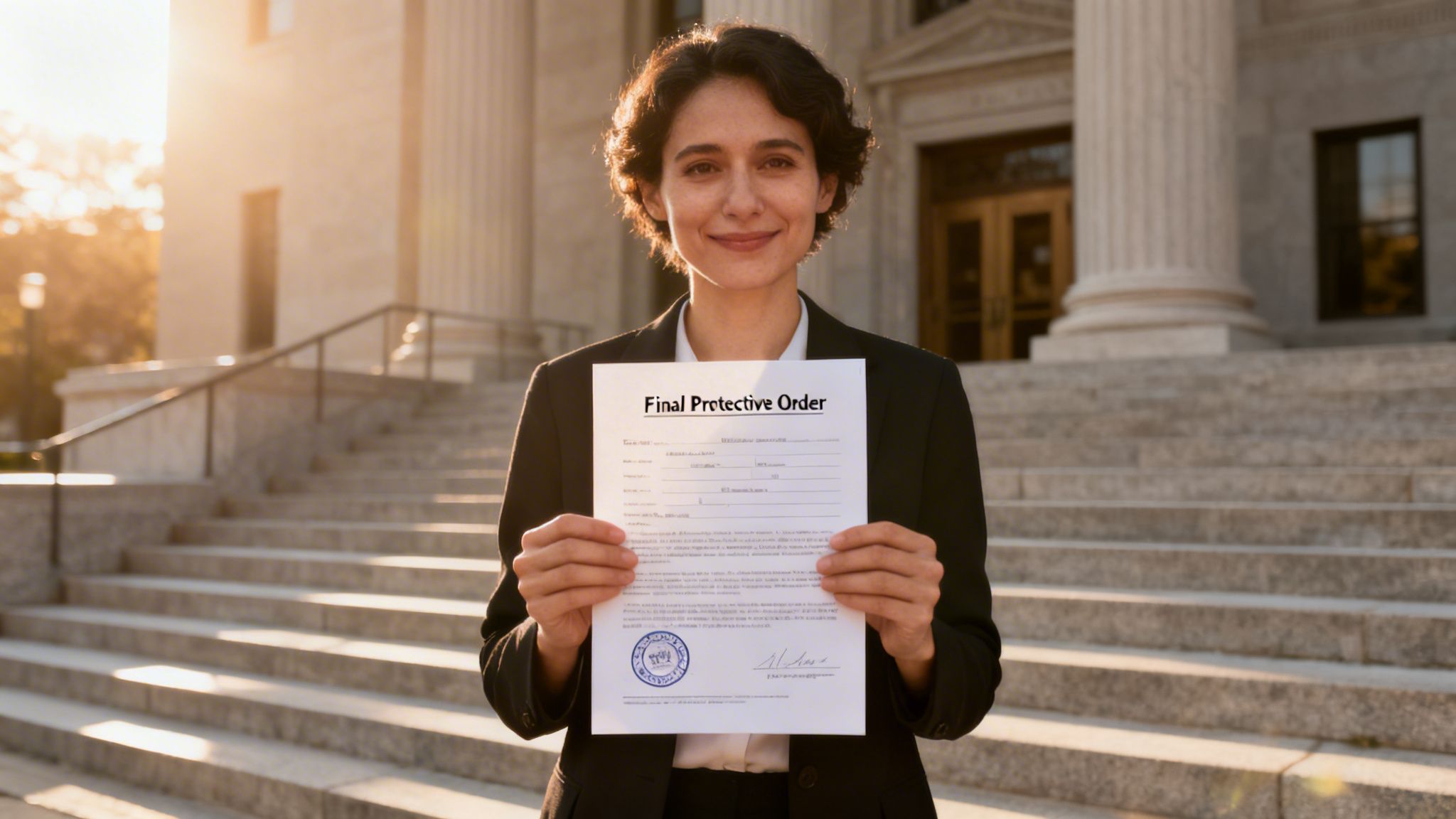
The moment the judge’s ruling is made, everything changes. Whether the protective order is granted or denied, leaving that courtroom marks the start of a new chapter with a strict set of rules. This isn't just an ending; it's a new beginning.
Understanding these rules is absolutely critical. If you’re the applicant, that court order is your shield. If you're the respondent, it’s a legal boundary you cannot cross.
If the Judge Grants a Final Protective Order
For the person who filed the application, a final protective order can bring immense relief. It’s a powerful tool, but it's only as good as your willingness to enforce it.
First, always keep a certified copy of the signed order with you. Don't just put it in a drawer. Give copies to your children's school, your HR department, and your apartment complex security—anywhere named in the order. This puts everyone on notice.
Most importantly, know what to do if the respondent violates the order. If they break the rules in any way—a text, a drive-by, a message through a friend—your only move is to call 911 immediately.
Do not engage. Don't text them back a warning. Let the police handle it. A violation of a protective order is a criminal offense under Texas Penal Code § 25.07, and law enforcement has the authority to make an immediate arrest.
Violating a final protective order is usually a Class A Misdemeanor, which can mean up to a year in jail and a $4,000 fine. If the respondent has prior convictions for the same offense, the charge can be elevated to a felony.
If You Are the Respondent Under an Order
Being on the receiving end of a protective order means you are now subject to strict, non-negotiable legal conditions. These orders often last for up to two years, and you must follow every rule to the letter. There is no grey area.
Common restrictions include:
- Total No-Contact: You cannot communicate with the protected person. Period. This means no calls, texts, emails, social media DMs, or even asking a mutual friend to "just pass along a message."
- Stay-Away Zones: You must maintain a specific distance from the person's home, job, and their children's school or daycare. This is not a suggestion.
- Firearm Surrender: Both federal and Texas law prohibit you from possessing a firearm or ammunition while under a final protective order. You will be legally required to surrender any guns you own.
Violating any of these terms will lead to your arrest and a new criminal charge. This case is completely separate from the protective order and can create more severe legal problems.
Can a Protective Order Be Changed?
Life changes, and sometimes the terms of an order need to be revisited. Both the applicant and the respondent have the right to ask the court to change or even end it before it expires. This is done by filing a Motion to Modify or Vacate.
However, a judge will not change an order casually. You must prove there has been a material and substantial change in circumstances since the order was signed. For example, if the original threat is gone and both sides agree, a judge might consider terminating the order early.
On the other hand, an applicant can file to extend an order if the threat of violence remains as the expiration date nears. Any change must be officially approved by a judge. Informal "agreements" between you and the other person are legally worthless and can land a respondent in jail. Information on post-conviction relief like this is crucial for rehabilitation-focused individuals.
Common Questions About Dallas Protective Orders
When you’re under the stress of a family violence situation, the legal system can feel confusing. It’s natural to have questions. Getting clear, plain-English answers is the first step toward taking control of your situation.
Let's address some of the most common questions we hear about protective orders in Dallas County.
How Much Does a Protective Order Cost in Dallas County?
For anyone who has experienced family violence, stalking, or sexual assault, there are no court filing fees. Texas law also ensures there are no fees for having the respondent served with the lawsuit. The goal is simple: cost should never be a barrier to seeking safety.
The Dallas County District Attorney's office may represent you at no charge. However, many people choose to hire a private attorney for dedicated, one-on-one support. While this comes with legal fees, it means you have an advocate whose only job is to fight for your case and build a personalized strategy for you.
Can I Get a Protective Order if We Weren’t Married?
Yes, absolutely. Texas law is not just for married couples. It specifically covers "dating violence," which applies to people in a romantic or intimate relationship, regardless of whether you lived together.
A judge will look at the nature of your relationship, how long it lasted, and how often you interacted to determine if it qualifies. This ensures people in all kinds of relationships have a path to legal protection from abuse.
What Happens if I Am Falsely Accused of Family Violence?
Being falsely accused is a serious and terrifying situation. You must act quickly. You have the right to hire a lawyer, appear at the hearing, and defend yourself. The biggest mistake you can make is ignoring the court notice, as it will almost certainly lead to a default order against you.
Building a defense involves bringing your own proof to the table. This practical advice includes gathering:
- Text messages or emails that tell a different side of the story or show friendly communication.
- Witnesses who can vouch for your character or what really happened.
- Receipts, GPS data, or other alibi evidence proving you were elsewhere.
A final protective order has severe, long-term consequences. It can strip you of your Second Amendment rights and creates a permanent public record. Mounting a powerful, evidence-based defense is the only way to protect your name and your future.
Will a Protective Order Show Up on a Background Check?
Yes. A final protective order is a public court record and will almost certainly appear on a thorough background check. For a respondent, this can affect applications for jobs, housing, and professional licenses. For those interested in rehabilitation, it’s important to know that while you can sometimes modify an order, information on expunctions and record sealing typically does not apply to final protective orders, making the initial defense critical.
Even a temporary ex parte order might show up in some databases, but the final order carries the most weight. This public record is also what helps enforce the order. It is another reason why it’s so critical for a respondent to fight back against false claims from day one.
If you’ve been charged with a crime in Texas, call The Law Office of Bryan Fagan, PLLC for a free and confidential consultation. Our defense team is ready to protect your rights. https://texascriminallawyer.net