Being arrested in Texas can be terrifying—but you don’t have to face it alone. When you or someone you care about is caught up in the criminal justice system, you’re suddenly forced to learn a whole new language. Terms like 'probation' and 'parole' get thrown around, and it's easy to get them confused. We know how stressful this is, so let's get right to the core distinction:
Probation is a criminal sentence served in the community instead of going to jail or prison. It's typically granted by a judge at the time of your sentencing. On the other hand, parole is a supervised, early release from prison, which is granted by a parole board after you have already served a portion of your sentence.
A Direct Comparison of Probation and Parole
While both probation and parole involve supervision within the community instead of being behind bars, they are fundamentally different legal concepts. They come from different places in the legal process, are decided by different authorities, and serve different purposes. Understanding these differences is the first step toward understanding your legal situation and what your options might be.
Probation, which Texas law officially calls "community supervision," is a form of sentencing. A judge decides to sentence you to probation as an alternative to locking you up. It’s often used for first-time offenders or less severe crimes, like a first-offense DWI or a misdemeanor theft. The idea is to focus on rehabilitation, allowing you to stay a productive member of society while following a strict set of court-ordered rules.
Parole, however, is not a sentence at all. It's a conditional release from a Texas Department of Criminal Justice (TDCJ) facility. The decision to grant parole falls to the Texas Board of Pardons and Paroles, which has to evaluate whether an inmate is ready to rejoin society before their full sentence is up. Parole is only an option for people who have already been convicted of more serious offenses and have served a portion of their prison time.
This chart gives you a quick visual breakdown of the main differences between probation, which starts in the courtroom, and parole, which begins after time has been served in prison.
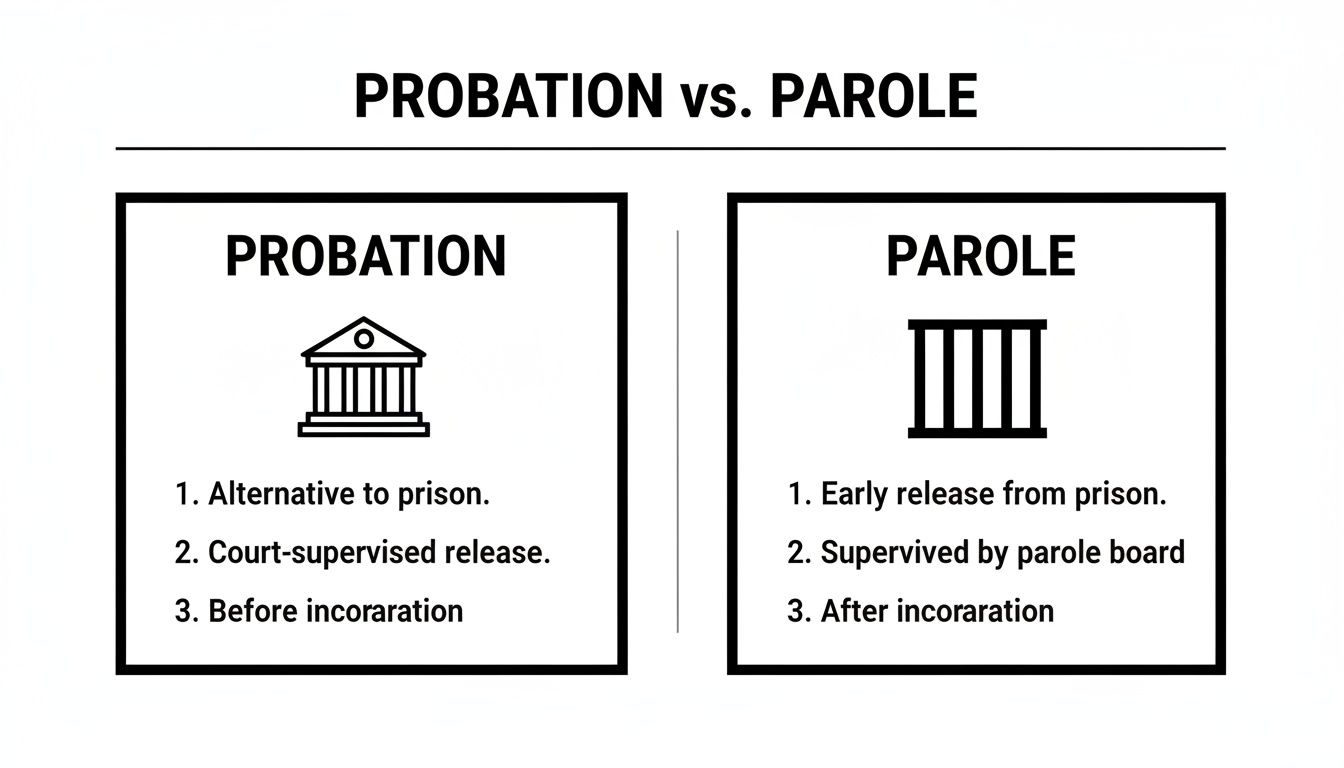
As you can see, the biggest takeaway is all about timing and authority. A judge hands down probation at sentencing, while a parole board grants parole after incarceration has already started.
To make things even clearer, the table below offers a straightforward, side-by-side comparison of these two crucial concepts in Texas criminal law.
Key Differences: Probation vs. Parole in Texas
This table offers a clear, side-by-side breakdown of the essential distinctions between community supervision (probation) and parole in Texas.
| Factor | Probation (Community Supervision) | Parole |
|---|---|---|
| When It's Granted | At the time of sentencing, as an alternative to jail or prison. | After serving a portion of a prison sentence. |
| Who Grants It | A judge. | The Texas Board of Pardons and Paroles. |
| Purpose | To provide rehabilitation and supervision instead of incarceration. | To allow for early, supervised reintegration into society. |
| Eligibility | Typically for misdemeanors or lower-level felonies, often for first-time offenders. | For inmates convicted of more serious felonies who have served the required portion of their sentence. |
| Violation Consequences | The judge can revoke probation and impose the original jail or prison sentence. | The parole board can revoke parole, and you are sent back to prison to serve the remainder of your sentence. |
Understanding whether you're dealing with probation or parole is critical because the rules, the stakes, and the legal strategies involved are completely different for each.
A Deep Dive into Texas Probation

Here in Texas, we don’t technically use the word “probation” in our legal system. The official term is "community supervision," which does a much better job of explaining what it’s really about. This is a sentence handed down by a judge that lets you stay in the community instead of going to jail or prison, but you have to follow a strict set of court-ordered rules.
A judge will typically grant community supervision if you are facing misdemeanor charges or lower-level felonies, especially if you are a first-time offender. Think of a first DWI or a simple assault charge. The goal is to balance accountability with a chance at rehabilitation. It keeps you integrated into society—working, supporting your family, and avoiding the disruptive cycle of incarceration.
This approach is far more common than most people think. For decades, the growth of community supervision in the U.S. has been almost entirely driven by probation. While parole numbers have grown, probation has exploded, jumping from about 1 million people in 1980 to a peak of roughly 4.3 million in 2007. Even after years of decline, by 2021, nearly 3.7 million adults were still on probation or parole—and the vast majority of them were on probation.
Straight Probation vs. Deferred Adjudication
When a Texas judge sentences you to community supervision, it usually comes in one of two forms. The difference between them is massive, especially for your future.
-
Straight Probation: This is what happens after you’ve been formally convicted of a crime. You either plead guilty or are found guilty at trial, and the judge sentences you to probation instead of jail. The key takeaway here is that the conviction becomes a permanent part of your criminal record.
-
Deferred Adjudication: This is a special type of probation where the judge defers finding you guilty. You’ll plead "guilty" or "no contest," but the judge holds off on entering a conviction. If you successfully complete every single term of your probation, the judge dismisses the case. You are never formally convicted of the crime.
The biggest advantage of deferred adjudication is the possibility of sealing your record later on through an order of non-disclosure. This move can prevent the public—including most employers and landlords—from ever seeing the arrest.
Common Conditions of Probation
Life on probation isn’t a free pass. It means sticking to a strict set of rules laid out by the court, designed to keep you accountable while you work toward rehabilitation. The exact conditions will vary depending on your specific case, but some of the most common requirements include:
- Reporting regularly to a community supervision officer (CSO)
- Holding down a steady job or attending school
- Paying all fines, court costs, and supervision fees
- Completing a set number of community service hours
- Staying away from alcohol and illegal drugs, often verified with random tests
- Attending mandatory counseling like anger management or substance abuse treatment
- Avoiding certain people or places tied to criminal activity
Following these conditions is non-negotiable, since any violation can land you in serious trouble. Successfully navigating these rules is your key to finishing your sentence and finally moving on with your life.
Navigating the Texas Parole System

While probation is often a sentence served instead of a jail cell, parole is something entirely different. Think of it as a conditional, early release from prison. It’s not a right—it’s a privilege granted by the Texas Board of Pardons and Paroles, giving inmates who have proven themselves ready for reintegration a path back into the community.
The journey toward parole begins long before a potential release date. For you and your family, understanding how this system works is the first step toward setting realistic expectations and building a strong case for why release is deserved.
The timing and function of parole create a completely different supervised population than probation. In fact, probationers make up about 80% of everyone under community supervision nationally, with parolees accounting for the other 20%. This gap highlights a key distinction: probation is a common alternative to jail time, while parole is reserved for those transitioning out of prison after serving time for more serious crimes.
How Parole Eligibility is Determined in Texas
In Texas, you don't just get to ask for parole whenever you want. You first have to become eligible for consideration by serving a specific portion of your sentence. The general rule under Texas Government Code § 508.145 is that an inmate must serve either one-fourth of their sentence or 15 years, whichever is less.
But for certain violent crimes—known as "3g offenses" like murder or aggravated robbery—the rules are much stricter. For these, an inmate has to serve at least half of their sentence, and they get no credit for good conduct time.
The parole review process itself is incredibly thorough. The Board of Pardons and Paroles digs into your entire file to gauge your risk to public safety and your true readiness to re-enter society.
Key factors they weigh include:
- The nature and severity of the crime: The original offense will always be a central focus.
- Your criminal history: A long track record of criminal behavior will weigh heavily against you.
- Your conduct in prison: The Board scrutinizes your disciplinary record and overall behavior behind bars.
- Participation in rehabilitation programs: Completing educational courses, vocational training, or substance abuse treatment shows a real commitment to change.
- A solid reentry plan: This is crucial. The Board wants to see stable housing, legitimate job prospects, and a strong support system from family or friends.
Life Under Parole Supervision
If the Board decides to grant parole, you are released from prison but remain in the legal custody of the state until your full sentence is up. You are required to follow a strict set of conditions monitored by a parole officer.
A common misconception is that parole is freedom. In reality, it is a highly structured and supervised extension of a prison sentence, served in the community. Violating any condition can lead you directly back to incarceration.
In Texas, the conditions of parole are not suggestions—they are mandatory. As a parolee, you are often required to:
- Report to a parole officer on a regular, set schedule.
- Maintain a job and a stable place to live.
- Submit to random drug and alcohol tests.
- Pay supervision fees and any victim restitution ordered by the court.
- Obey all laws and avoid any new arrests. Period.
- Stick to a curfew or wear an electronic monitoring device.
Successfully finishing parole is a major milestone in rebuilding a life after prison. It takes discipline, accountability, and an unwavering commitment to follow every single rule the Board sets forth.
What Happens When Probation or Parole Is Violated
Whether you’re on probation or parole, you aren’t completely free. Both types of supervision come with a long list of rules, and a single misstep can have devastating consequences—potentially sending you right back behind bars. It’s critical to understand the reality of what a violation means so you can stay on the right path.
Texas law breaks violations down into two main categories. A technical violation is when you fail to follow a specific condition of your supervision, like missing a curfew, failing a drug test, or not checking in with your officer. A new law violation, on the other hand, is far more serious. It means you’ve been arrested and charged with a new crime while still under supervision.
The Probation Revocation Process
If your community supervision officer believes you’ve broken the rules, they will file a formal document with the court called a Motion to Revoke Probation. Think of this as an official accusation that asks the judge to take away your probation. As soon as it’s filed, a warrant is almost always issued for your arrest.
What happens next is a step-by-step process:
- Arrest and Arraignment: After your arrest, you will be brought before a judge for an arraignment on the motion to revoke. Here, you will be informed of the allegations and have the opportunity to enter a plea of "true" or "not true."
- Plea Bargaining: Your Houston criminal lawyer can negotiate with the prosecutor to resolve the motion without a full hearing. This might involve agreeing to modified probation conditions in exchange for the state withdrawing the motion.
- Revocation Hearing: If no agreement is reached, you will have a revocation hearing. It’s important to understand this isn't a new criminal trial where the state has to prove guilt "beyond a reasonable doubt." The standard of proof is much lower; the prosecutor only has to show by a "preponderance of the evidence" that you likely violated a condition.
- Sentencing: If the judge agrees you violated probation, they have a few choices. They can continue your probation with tougher rules, or revoke it and sentence you to jail or prison.
A motion to revoke is a make-or-break moment. Protecting your freedom requires an immediate and smart defense. You can learn more about what's at stake by reading our guide on the consequences of a probation violation in Texas.
Parole Revocation Hearings
For those on parole, the process is handled differently. It’s the Texas Board of Pardons and Paroles that calls the shots, not a judge. If your parole officer reports a violation, a warrant will be issued, you’ll be arrested, and you’ll be entitled to a hearing to determine if you actually broke the terms of your release.
At this hearing, a hearing officer reviews the evidence and decides your fate. If they confirm a violation occurred, the Board can either continue your parole with stricter rules or revoke it completely, sending you back to prison to finish out the rest of your original sentence.
Policy shifts in just five states, including Texas, were responsible for 57% of the entire country's increase in the parole population in 2020. This shows how quickly things can change and how important it is to have an expert on your side. For specific examples, you can read more about DUI probation violation consequences.
Your Legal Options for a Fresh Start
Successfully finishing probation or parole is a huge milestone. It’s the moment you can finally start looking forward, but it often comes with a big question: "What happens now?" Getting off supervision is just the first step. Texas law actually offers some powerful tools to help you truly reclaim your future.
The path you took to get here makes all the difference. The single most important factor determining your ability to clear your name is the type of community supervision you completed—specifically, whether it was straight probation or deferred adjudication. This distinction can mean the difference between a criminal record that follows you forever and one you can legally leave behind.
Sealing Your Record with an Order of Non-Disclosure
If you successfully completed deferred adjudication, you’re in a much stronger position. Because a deferred sentence doesn't result in a final conviction, you may be eligible to petition the court for an Order of Non-Disclosure. This is a legal order that seals your criminal record from the public, hiding it from most potential employers, landlords, and schools.
An Order of Non-Disclosure doesn't destroy your record, but for all practical purposes, it makes it invisible to most people. That means when a job application asks if you’ve ever been arrested for that offense, you can legally say no. It’s an incredibly powerful tool for a true second chance.
To qualify, you’ll have to meet certain criteria, including waiting periods that change depending on the offense. Not every crime is eligible, but for thousands of Texans, this is the key that unlocks new opportunities. You can get more details on the benefits and specific requirements in our guide on what deferred adjudication is in Texas.
Erasing Your Record Through Expunction
For anyone who was arrested but never convicted—maybe your case was dismissed or you were found not guilty at trial—an expunction might be an option. An expunction is even stronger than non-disclosure; it orders all agencies to completely destroy every record of the arrest. It's as if it never happened.
The catch is that an expunction is generally not an option if you completed straight probation. That’s because straight probation requires a guilty plea and results in a formal conviction. This is exactly why fighting for deferred adjudication at the very beginning of a case is so critical for your long-term future.
When you're mapping out your fresh start, especially if you're transitioning out of the system, it helps to know all your residential support options. It’s worth taking the time to learn the difference between sober living and a halfway house to make sure you have the right support system in place.
How a Texas Criminal Defense Attorney Can Help You
Navigating the Texas criminal justice system feels like trying to find your way through a maze blindfolded. It’s overwhelming, but you absolutely don’t have to face it alone. Having a skilled Texas assault defense attorney in your corner isn't just helpful—it can be the single most important factor in the outcome of your case. We’re here to make sense of the chaos and fight for the best possible path forward for you.
An attorney’s real work starts long before a judge ever bangs a gavel. We get involved early, negotiating directly with prosecutors to argue for probation instead of a jail cell. Our job is to build a compelling story about you—one that highlights your potential for rehabilitation and your ties to the community. We'll dig into the evidence, protect your constitutional rights at every turn, and push for outcomes like deferred adjudication that can keep a conviction off your record.
Protecting Your Freedom
If you or a loved one is already incarcerated and hoping for parole, our role shifts. We meticulously build a persuasive parole packet for the Board of Pardons and Paroles, showcasing every bit of progress made and painting a clear picture of a person ready to successfully rejoin society. And if you’re already on supervision and are accused of a violation, we will aggressively defend you against any motion to revoke your freedom.
An experienced lawyer brings more than just legal knowledge to the table; they provide a steady hand to guide you through a confusing and often scary process. We’re here to fight for your freedom, protect your future, and give you a voice when it matters most. Expert legal help is just one phone call away.
Answers to Your Top Questions About Probation and Parole in Texas
When you're navigating the rules of community supervision, it’s natural to have questions about how it all works in the real world. We hear a lot of the same concerns from clients, so let's clear up some of the most common ones.
Can I Finish Probation or Parole Early in Texas?
Yes, it's possible to get off probation or parole early in Texas, but it's never a guarantee. Think of it as a privilege you have to earn, not a right.
For probation, the decision is up to a judge. You generally need to have completed at least one-third of your term without a single misstep. For parole, the Texas Board of Pardons and Paroles makes the call. In both cases, perfect compliance is the bare minimum. Filing a formal motion with the help of an attorney shows the court you're serious and can dramatically increase your odds of success.
What Is the Difference Between Felony and Misdemeanor Probation?
The biggest differences come down to two things: how long you're supervised and how strict the rules are.
- Misdemeanor probation is shorter, usually lasting up to two years under the Texas Code of Criminal Procedure. The conditions are typically less intense, focusing on basic compliance like reporting and staying out of trouble.
- Felony probation is a much bigger deal. It can last for up to ten years and involves far more demanding supervision. Expect stricter reporting schedules, more required classes or treatment, and much harsher penalties for any slip-ups. The seriousness of the original crime dictates just how tight the leash will be.
Can I Travel if I Am on Probation or Parole?
Travel is a restriction, not a right, when you're under supervision. You can't just pack a bag and go; you need explicit permission from your supervising officer for any trip.
You'll have to submit a formal travel request far in advance, explaining where you're going and why. Approval isn't automatic—it depends on your destination, your reason for the trip, and your track record of following the rules. Getting permission to travel out of state is tough, and international travel is almost always off the table.
If you’ve been charged with a crime in Texas, call The Law Office of Bryan Fagan, PLLC for a free and confidential consultation. Our defense team is ready to protect your rights. https://texascriminallawyer.net