Being arrested in Texas can be terrifying—but you don’t have to face it alone. When you're trying to figure out what's happening, understanding the exact charges against you is the first, most critical step toward building a defense. People often use "robbery" and "burglary" interchangeably in everyday conversation, but in the eyes of Texas law, they are completely different crimes with very different consequences.
The core difference is simple: robbery involves force or fear against a person, while burglary is all about unlawfully entering a place. One is a crime against a person; the other is a crime against property. Knowing which one you're facing is essential, as it dictates the entire legal strategy for your defense.
Robbery vs. Burglary: The Key Distinctions
When you’re facing a theft-related charge, the specific details of what allegedly happened are everything. The prosecution has to prove a completely different set of facts for a robbery charge than for a burglary charge, and a skilled defense attorney knows exactly where to challenge their story.
Robbery always involves taking property directly from someone by using force, intimidation, or threats of harm. Think of a carjacking or a convenience store holdup where a weapon is shown. Burglary, on the other hand, means entering a building or home without permission with the intent to commit another crime inside—usually theft, but it could also be assault or another felony. For a burglary to occur, a victim doesn't even have to be present.
The single biggest factor separating these two crimes is the presence of a victim and the use of force. If someone used force or fear to take property from you, it's likely robbery. If someone broke into your home, car, or office to commit a crime, it's likely burglary.
This infographic gives you a quick visual summary of how force, entry, and the nature of the crime separate the two.
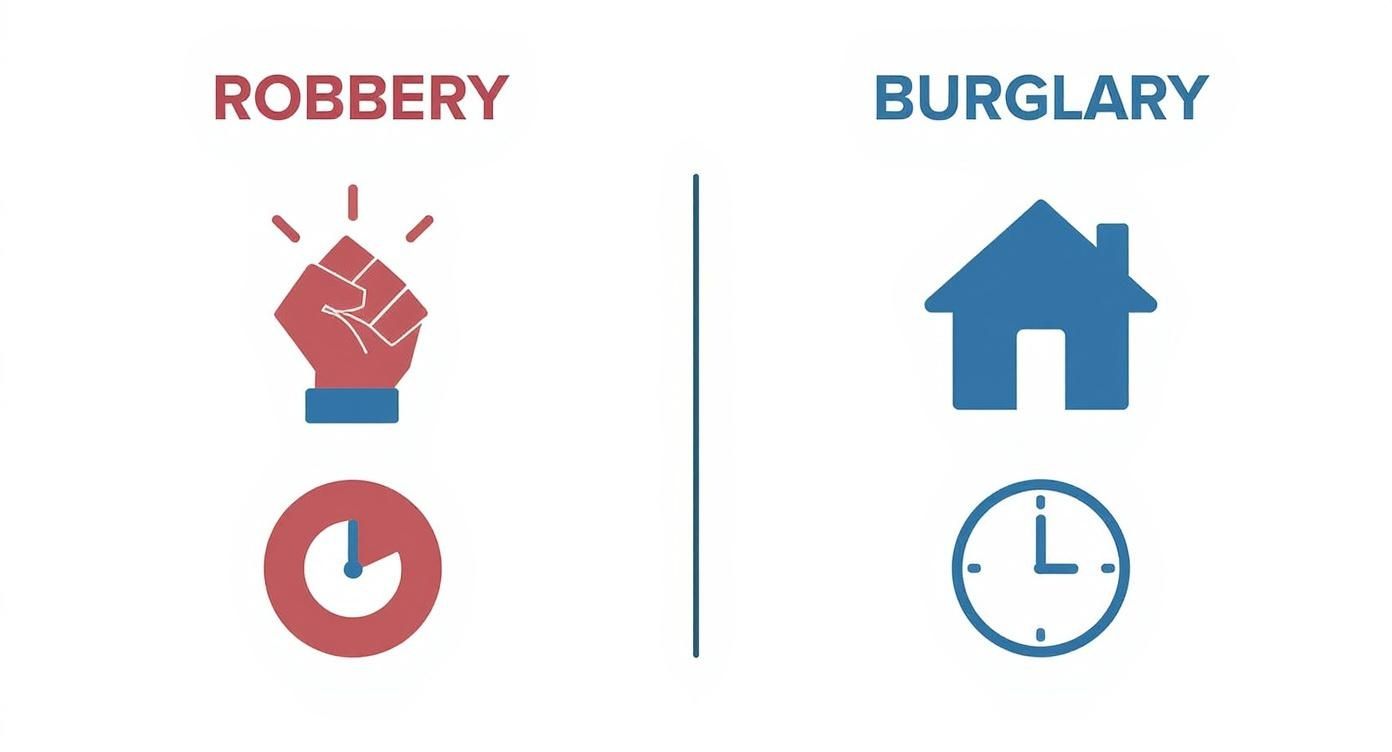
As you can see, that element of force is what truly defines robbery, while unlawful entry is the foundation of any burglary charge.
Robbery vs Burglary At a Glance
To make these differences even clearer, here’s a quick side-by-side comparison of what a prosecutor needs to prove for each charge under Texas law. If you want to dig deeper into how Texas law handles different types of theft, you can also check out our guide on the difference between theft and robbery.
| Element | Robbery | Burglary |
|---|---|---|
| Primary Focus | Crime against a person | Crime against property/structure |
| Key Action | Taking property using force or fear | Entering a structure unlawfully |
| Victim Presence | Victim must be present | Victim is not required to be present |
| Required Intent | Intent to obtain or maintain control of property | Intent to commit a felony, theft, or assault inside |
This table boils it down, but the real-world application of these laws can get complicated fast. The nuances—like whether you were simply in the commission of theft when force occurred—can change everything.
Robbery Under Texas Law

When you hear "robbery," you probably picture a mugging or a store holdup. Those are classic examples, but the legal definition here in Texas is extremely specific. Getting a handle on these details is the first step toward building a strong defense if you're facing this serious charge.
Under Texas Penal Code § 29.02, a person commits robbery if, in the course of committing theft and with the intent to keep the property, they either:
- Intentionally, knowingly, or recklessly cause bodily injury to another person; or
- Intentionally or knowingly threaten or place another in fear of imminent bodily injury or death.
This definition boils down to three core parts a prosecutor has to prove beyond a reasonable doubt: you were stealing something, you meant to keep it, and you used force or fear to do it.
The Elements a Prosecutor Must Prove
For a robbery conviction, the State of Texas carries the full burden of proof. It's your criminal defense lawyer’s job to poke holes in their story, scrutinizing every piece of evidence and challenging the prosecution at each turn.
Here are the key elements they have to prove:
- In the Course of Committing Theft: This means the forceful act happened during the theft, in the immediate escape after the theft, or even in an attempt to commit theft.
- Intent: The prosecutor must show you specifically intended to take and keep someone else's property without their permission.
- Force or Fear: This is the make-or-break element. The state must prove you either caused actual bodily injury—even something as minor as pain—or made a threat that would put any reasonable person in fear for their safety.
A practical example is snatching a purse from someone's shoulder. If the victim is jostled and feels pain, the "bodily injury" element is met. On the other hand, if you tell a convenience store clerk, "Give me the money or you'll get hurt," that's a direct threat, and it fulfills that element just the same.
Aggravated Robbery: A More Serious Charge
The stakes get much higher if the charge is elevated to aggravated robbery. This is one of the most serious felony offenses in Texas, carrying incredibly severe penalties.
A robbery becomes aggravated robbery under Texas Penal Code § 29.03 if the person uses or exhibits a deadly weapon, causes serious bodily injury to another, or commits the crime against someone who is 65 years of age or older or disabled.
This means that just showing a knife or a firearm during a theft can launch a second-degree felony into a first-degree felony. A skilled defense team will focus on challenging whether a weapon was truly "used or exhibited" or if an injury actually meets the high legal standard of "serious bodily injury." The difference between these two charges can mean decades in prison, making an aggressive and detailed defense absolutely essential.
Understanding Burglary in Texas

While robbery is a crime against a person, burglary is all about the place. It’s a crime of unlawful entry, and that distinction is the key to understanding how these charges differ. In Texas, the crime of burglary is complete the second you cross a threshold without permission, as long as you intended to commit another crime once inside.
Under Texas Penal Code § 30.02, you commit burglary if you enter a habitation or building without the owner’s consent and either:
- Enter with the intent to commit a felony, theft, or an assault; or
- Remain concealed with the intent to commit a felony, theft, or an assault; or
- Enter and actually commit or attempt to commit a felony, theft, or an assault.
Notice that you don't actually have to steal a single thing to be charged with burglary. If a prosecutor can convince a jury you entered with the intent to steal, that's often enough for the charge to stick.
The Critical Role of Intent and Location
In almost every Texas burglary case, two factors matter more than anything else: your alleged intent and the type of structure you entered. The prosecution’s entire case is built on proving what was going through your mind at the exact moment of entry. This is a notoriously difficult thing to prove and creates a critical opening for a skilled Houston criminal lawyer.
Texas law also draws a very sharp line between two kinds of structures: habitations and buildings.
- Burglary of a Habitation: This is a second-degree felony. It’s treated so seriously because it involves a home—a place where people live and have the highest expectation of safety. A "habitation" is legally defined as any structure adapted for the overnight accommodation of people.
- Burglary of a Building: This is a state jail felony. While less severe than a second-degree felony, it still carries life-altering consequences. This charge applies to places like businesses, offices, or detached garages not used as living quarters.
Think of it this way: sneaking into an empty office building after hours to steal computers is burglary of a building. But breaking into an apartment, even when nobody is home, is burglary of a habitation—a far more serious offense in the eyes of the law.
The core of a burglary charge is the unlawful entry combined with criminal intent. The prosecutor must prove beyond a reasonable doubt that you did not have permission to be there and that you entered for the specific purpose of committing theft, assault, or another felony.
What This Means for Your Defense
Because intent is so central to the charge, a strong Texas assault defense often focuses on challenging the prosecutor’s evidence of what you were allegedly planning to do. Without clear, undeniable proof of your intentions, the state’s case can quickly fall apart.
An experienced attorney will dig into every detail—from how entry was supposedly made to your actions once inside—to build a defense that protects your rights. If you are facing these charges, it is vital to understand the specifics of your case. You can find more detailed information in our comprehensive guide to defending against burglary charges in Texas.
Comparing Penalties for Robbery and Burglary
When you're facing serious criminal charges, you have to understand the potential consequences. In Texas, the penalties for robbery and burglary are miles apart, and it all boils down to one fundamental difference: robbery is a crime against a person, while burglary is a crime against property.
Because robbery always involves force, violence, or the threat of harm, the penalties are consistently severe. Burglary penalties, on the other hand, hinge heavily on where the crime occurred. Breaking into a home is punished far more harshly than breaking into a commercial building, and for good reason—the law takes the sanctity of a person's home very seriously.
Felony Levels and Sentencing Ranges
The specific felony classification is what dictates the punishment range you could face if convicted. The stakes are incredibly high, and a single element of the crime can add decades to a potential prison sentence.
Here’s a side-by-side look at what you could be up against under the Texas Penal Code:
| Offense | Felony Level | Prison Time | Fine |
|---|---|---|---|
| Robbery | Second-Degree Felony | 2 to 20 years | Up to $10,000 |
| Aggravated Robbery | First-Degree Felony | 5 to 99 years or life | Up to $10,000 |
| Burglary of a Habitation | Second-Degree Felony | 2 to 20 years | Up to $10,000 |
| Burglary of a Building | State Jail Felony | 180 days to 2 years | Up to $10,000 |
Take a close look at that table. You'll notice that burglary of a habitation carries the exact same potential prison sentence as a standard robbery. That's no accident; it shows just how seriously the law protects people inside their homes. Still, aggravated robbery remains one of the most severely punished crimes on the books. Our firm has a detailed guide that further breaks down the punishments for robbery in Texas and the factors that can swing a sentence one way or the other.
Long-Term Consequences Beyond Prison
The immediate penalties are just the start. A felony conviction for robbery or burglary is a shadow that follows you for life, creating massive barriers long after you've served your time. These "collateral consequences" are real, and they can include:
- Loss of Firearm Rights: Convicted felons are prohibited from owning or possessing firearms under both state and federal law.
- Employment Difficulties: Many employers will not consider hiring someone with a felony conviction, especially for violent or theft-related offenses.
- Housing and Loan Ineligibility: Landlords and lenders run background checks. A criminal record often means instant denial for apartment or loan applications.
- Immigration Status: For non-citizens, a conviction can trigger deportation or make it impossible to get legal residency or citizenship.
A felony conviction isn’t just about prison and fines; it’s a permanent mark on your record that slams doors to future opportunities shut. This is why fighting the charge from day one with an experienced defense team is absolutely critical.
Facing these outcomes is overwhelming, but remember this: an arrest is not a conviction. A strategic legal defense—whether it’s negotiating a plea bargain to reduce a charge or fighting for a full dismissal—can completely change the course of your future.
Defense Strategies for Robbery and Burglary

Being arrested for any crime in Texas feels like the walls are closing in. It’s a frightening experience, but it’s critical to remember that an arrest is not a conviction. The prosecution carries the entire burden of proving every single element of the charge against you, and a skilled defense attorney’s job is to dismantle their case piece by piece. Effective defense strategies are built around the unique facts of your situation.
For both robbery and burglary, common defenses often revolve around mistaken identity, a lack of criminal intent, or challenging the evidence itself. For example, a solid alibi, clear surveillance footage, or credible witness testimony can prove you were somewhere else entirely. In other cases, if law enforcement conducted an unlawful search to find evidence, that evidence may be suppressed—meaning the prosecutor can’t use it against you in court.
Defending Against Burglary Charges
Because a burglary charge hinges on intent and unlawful entry, a strong defense will zero in on these two potential weak points in the prosecution's case.
- Lack of Intent: The state must prove you entered a building with the specific intent to commit a felony, theft, or assault. If you went inside for a non-criminal reason—maybe you genuinely thought you had permission or were just seeking shelter—the burglary charge may not hold up.
- Consent to Enter: If you had the owner’s consent to be in the building, the "unlawful entry" element simply disappears. This happens more often than you might think. Misunderstandings about who is allowed on a property can create a powerful defense.
Imagine a scenario where you were invited into a home by one roommate, but another roommate later called the police. In that situation, the element of unlawful entry becomes very questionable.
A strong defense often exposes the prosecution's inability to prove what was in your mind at the moment of entry. Without concrete evidence of criminal intent, a burglary charge can be successfully challenged.
Defending Against Robbery Charges
Robbery cases are all about the alleged use of force or fear. The entire case can fall apart if your attorney can successfully dispute these critical elements.
- Disputing Force or Fear: A key defense is arguing that no force was actually used, or that any interaction didn't rise to the level of a credible threat. An accidental bump while committing a simple shoplifting, for instance, does not automatically transform a theft into a violent robbery. The prosecution has to prove that element beyond a reasonable doubt.
- Challenging Identity: Eyewitness misidentification is one of the leading causes of wrongful convictions. Your attorney can challenge the reliability of witness testimony, especially if the encounter was brief, stressful, or happened in poor lighting. Memories are faulty, and juries know this.
An experienced defense team will scrutinize every detail of the accusation to protect your rights and fight for the best possible outcome.
Steps to Take After a Theft Arrest
Getting arrested for robbery or burglary in Texas can make your world feel like it’s spinning out of control. The moments after an arrest are confusing and terrifying, but the decisions you make right then can drastically change what happens next. Knowing your rights and what to expect helps you regain a little of that control.
The first and most important thing to do is exercise your right to remain silent. You are not required to answer any questions from law enforcement about what happened. Politely tell them you want to speak with an attorney, and then stop talking. Anything and everything you say can be used against you later.
What Happens at the Police Station
After an arrest, you’ll be taken to a local jail for booking. During this process, officers will take your fingerprints and photograph (your mugshot) and record your personal information. You’ll then be held until your arraignment, which is your first time appearing in front of a judge. This hearing usually happens within 48 hours of your arrest. At the arraignment, the judge will:
- Inform you of the specific charges you’re facing
- Advise you of your constitutional rights
- Set your bail amount
Bail is the money you must pay to get out of jail while your case is moving forward. The arraignment is a critical step, and you can get a deeper look at it in our post on what to expect at your first court date.
Having an experienced criminal defense attorney involved as early as possible—even before your arraignment—is the single most effective step you can take to protect your rights. An attorney can argue for a lower bail and start building your defense from day one.
Navigating the Legal Process
Once you're released on bail, the real legal work begins. This phase involves your attorney demanding evidence from the prosecution (a process called "discovery"), filing motions to challenge improper police conduct, and possibly negotiating a plea bargain. A plea bargain is an agreement where you might plead guilty to a lesser charge in exchange for a lighter sentence. If no deal is reached, your case will head toward trial. Throughout this entire journey—from booking and bail to plea deals and a potential trial—having a trusted legal guide is absolutely essential. You don't have to face this alone.
Frequently Asked Questions About Robbery and Burglary Laws in Texas
When you’re staring down a serious criminal charge, a flood of urgent questions is completely normal. If you're trying to figure out the difference between robbery and burglary, you need clear, direct answers to protect your rights. Here are a few of the most common questions our clients bring to us.
Can I Be Charged With Burglary if I Didn’t Steal Anything?
Yes, absolutely. This is one of the biggest misconceptions about burglary in Texas. The crime is defined by the unlawful entry with the intent to commit another crime—not by actually stealing anything.
The prosecutor’s entire job is to prove you entered a building or home without consent and that you planned to commit theft, assault, or another felony once you were inside. The alleged theft never has to happen for the charge to stick. This focus on intent is almost always the most critical battleground in a burglary defense.
What Makes a Robbery an Aggravated Robbery?
A robbery charge gets kicked up to aggravated robbery—a much more serious first-degree felony—under a few specific circumstances. According to the Texas Penal Code, this happens if the person allegedly:
- Causes serious bodily injury to another person.
- Uses or exhibits a deadly weapon during the crime.
- Commits the robbery against someone who is 65 years of age or older or is disabled.
The presence of any one of these factors will dramatically increase the potential penalties. We’re talking about adding decades to a possible prison sentence.
An experienced attorney is crucial for challenging the details here. Was the injury legally "serious"? Does an object truly meet the definition of a "deadly weapon"? These distinctions can be the difference between a first-degree and second-degree felony charge.
Can a Robbery or Burglary Conviction Be Sealed or Expunged?
Getting a conviction off your record in Texas is tough. Felony convictions for crimes like robbery and most burglaries generally cannot be expunged if you were found guilty. An expunction completely destroys the record of an arrest, but it's really only an option if your case was dismissed or you were found not guilty at trial.
However, some convictions might be eligible for an order of nondisclosure, which essentially seals the record from the public. Your eligibility depends on many different factors, including the specific offense and whether you successfully completed probation. A knowledgeable defense attorney can review your case to see if you qualify for any kind of post-conviction relief.
If you’ve been charged with a crime in Texas, call The Law Office of Bryan Fagan, PLLC for a free and confidential consultation. Our defense team is ready to protect your rights. Visit us at https://texascriminallawyer.net.