Skip to content
Being arrested in Texas can be terrifying—but you don’t have to face it alone. While people often use the terms “robbery” and “stealing” interchangeably in conversation, the legal system sees them as worlds apart. The line between them is drawn with one powerful element: violence or the threat of it.
Understanding this distinction is the first step toward building a strong defense. Think of it this way: robbery is essentially theft plus an assault. That key difference turns a property crime into a serious violent crime with life-altering felony consequences. If you are facing charges, knowing exactly what the prosecutor must prove is critical to protecting your future.
The Core Difference: Force and Fear
When you're facing criminal charges, the specific words used by prosecutors matter immensely. The Texas Penal Code treats robbery and stealing (legally known as theft) as completely separate offenses. Explaining why in clear, plain-English is the first step toward fighting for your rights.
At its heart, theft is a property crime. The focus is on the unlawful taking of property without the owner's consent, often done secretly or without the victim even noticing.
Robbery, on the other hand, is a crime against a person. It happens when someone uses force, causes injury, or puts a person in fear of bodily harm while in the process of committing a theft. That single element—the presence of force or fear—is what elevates a simple theft into a serious felony.
To make this crystal clear, let’s break down the key legal distinctions a Texas prosecutor has to prove.
At a Glance: Robbery vs. Stealing (Theft) Under Texas Law
This table highlights the fundamental differences between the two charges.
| Legal Element | Stealing (Theft) | Robbery |
|---|---|---|
| Primary Focus | Unlawful taking of property. | Taking property through violence or intimidation. |
| Use of Force/Fear | Not required. The act is typically secretive or unnoticed. | Required element. Must cause or threaten bodily injury. |
| Crime Classification | A crime against property. | A crime against a person (violent crime). |
| Penal Code Section | Texas Penal Code § 31.03 | Texas Penal Code § 29.02 |
| Typical Severity | Varies from Class C Misdemeanor to First-Degree Felony, based on property value. | Always a felony, starting as a Second-Degree Felony. |
As you can see, the game changes entirely once violence enters the picture. Navigating these charges can feel overwhelming, but a knowledgeable Texas criminal defense attorney can challenge the prosecution's claims and fight to protect your rights.
Understanding a Texas Theft Charge
In everyday conversation, you just call it "stealing." But in the Texas legal system, the official term is theft. Under Texas Penal Code § 31.03, the law defines theft as unlawfully taking someone's property with the specific intent to keep it from them for good. This is a classic property crime, which means the law’s focus is squarely on the property itself, not on any force or fear used against a person.
For a prosecutor to get a theft conviction that sticks, they have to prove two things beyond a reasonable doubt:
- Unlawful Appropriation: This is the physical act. It means you took or exercised control over property without the owner's permission.
- Intent to Deprive: This is the mental part. The prosecutor has to show that at the moment you took the property, your goal was to keep it permanently or for so long that the owner would lose a huge chunk of its value.
This "intent" piece is everything. Taking something by accident isn't theft. For instance, if you grab someone else’s identical black suitcase from the airport carousel thinking it's yours, you haven’t committed a crime. But the moment you get home, realize the mistake, and decide to keep the fancy new luggage and everything inside—that's when your intent shifts, and your actions cross the line into theft.
How Property Value Determines the Charge
In Texas, the seriousness of a theft charge is almost entirely based on the value of the property stolen. This is a critical point because the dollar amount is what separates a small fine from years behind bars. It's vital to understand the difference between felony and misdemeanor charges, because the long-term consequences are worlds apart.
Here’s a quick look at how theft charges are tiered based on value:
- Less than $100: Class C Misdemeanor (fine up to $500)
- $100 to $750: Class B Misdemeanor (up to 180 days in jail, $2,000 fine)
- $750 to $2,500: Class A Misdemeanor (up to 1 year in jail, $4,000 fine)
- $2,500 to $30,000: State Jail Felony (180 days to 2 years in state jail, $10,000 fine)
From there, the charges escalate quickly through third, second, and first-degree felonies. For property valued at $300,000 or more, you could be looking at up to 99 years or life in prison.
A theft case lives or dies on the prosecutor’s ability to prove your intent. If they can't show you meant to permanently keep the property, their case falls apart. An experienced Houston criminal lawyer knows exactly how to attack the state's evidence—or lack thereof—on this crucial point.
From a simple shoplifting case to a complex embezzlement scheme, the legal foundation is the same. The State of Texas has the burden of proof, and a sharp defense team can pick their case apart, defend your rights, and fight for the best possible outcome.
How Theft Becomes Robbery: The Use of Force or Fear
The line between a simple theft case and a much more serious robbery charge is drawn with one critical element: the use of force or fear. This single factor is what transforms a property crime into a violent crime in the eyes of the law. While theft is all about the property taken, robbery is about the harm—or threat of harm—done to a person during the act.
Under Texas Penal Code § 29.02, someone commits robbery if, while in the process of committing theft, they either:
- Intentionally, knowingly, or recklessly cause bodily injury to another; or
- Intentionally or knowingly threaten or place another in fear of imminent bodily injury or death.
This definition is what kicks the crime out of the realm of property value and squarely into the territory of violence, triggering severe felony penalties.
The Meaning of "In the Course of Committing Theft"
The law is very specific about the timing. The phrase "in the course of committing theft" means the violence has to happen either during the initial taking of the property or during the immediate escape right after.
This timing often becomes a major point of contention in court. For instance, imagine someone shoplifts a small item and then shoves a security guard while running out the door. That single push can instantly elevate a misdemeanor shoplifting charge into a second-degree felony robbery. The force was directly tied to the theft. You can learn more about the specific elements of robbery in Texas and how prosecutors have to prove each one.
From Robbery to Aggravated Robbery
The charges can get even more serious, escalating to Aggravated Robbery under Texas Penal Code § 29.03. This is a first-degree felony that occurs if, during the robbery, the person:
- Causes serious bodily injury;
- Uses or exhibits a deadly weapon; or
- Causes bodily injury to or threatens a person who is 65 years or older or disabled.
Key Insight: A "deadly weapon" isn't just a gun or a knife. Any object used in a way that could cause serious injury or death—like a baseball bat or even a car—can qualify and push the charge up to a first-degree felony.
At its core, the legal difference between robbery and stealing is this direct, often violent, confrontation. Robbery is always considered a violent crime because it involves taking property directly from a person's presence through force or intimidation. This distinction underscores why facing a robbery charge requires a defense attorney who is prepared to fight aggressively on your behalf.
Comparing the Penalties for Robbery and Theft
When you look at the potential consequences, the gap between robbery and stealing becomes a chasm. Texas law sees robbery as a violent crime against a person, so the penalties are intentionally severe and life-altering. Theft, while still a serious offense, is treated as a property crime, with punishments that scale up with the value of what was taken.
A conviction for robbery under Texas Penal Code § 29.02 is a second-degree felony. That charge alone carries 2 to 20 years in state prison and a fine of up to $10,000. If the situation escalates to aggravated robbery—meaning a deadly weapon was used or someone was seriously hurt—it becomes a first-degree felony. The penalties then skyrocket to 5 to 99 years, or even life, in prison.
Theft Penalties: A Different Framework
The penalty system for theft works on a completely different logic. Instead of violence, the law focuses entirely on the dollar value of the property stolen. This creates a tiered system that can range from a minor slap on the wrist to a major felony.
- Misdemeanor Theft: When the property value is low (generally under $2,500), theft is a misdemeanor. This could mean anything from a small fine for a Class C ticket to a year in county jail for a Class A charge.
- State Jail Felony Theft: Once the value crosses the $2,500 threshold, the charge bumps up to a state jail felony, which comes with 180 days to 2 years in a state jail facility.
This flowchart boils down the simple but critical element that separates these two crimes.
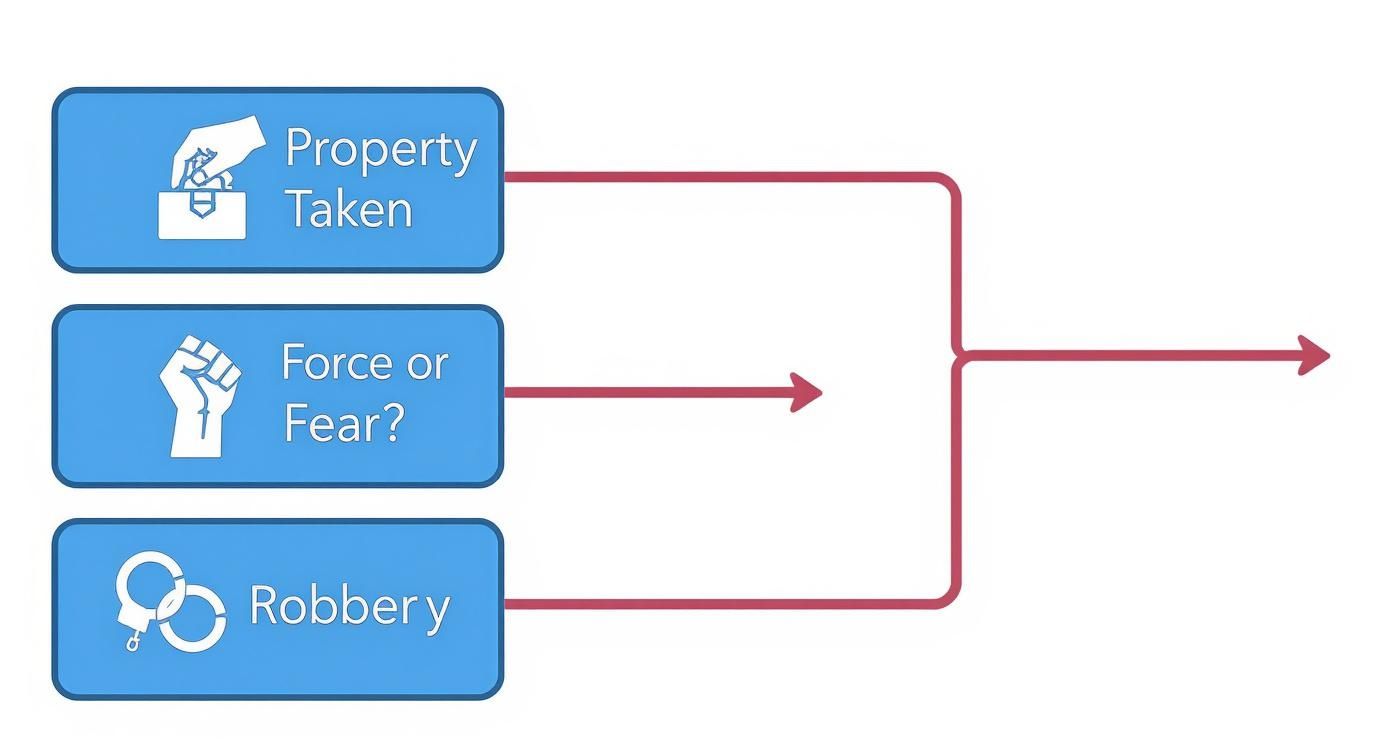
As the visual makes clear, the presence of force or fear is the definitive trigger. It’s what transforms a simple property crime into a violent felony charge with devastating consequences.
The penalties for robbery are so harsh because the crime isn't about property—it's about violating a person's safety. A robbery conviction is always a felony, no matter how little was actually stolen.
Long-Term Collateral Consequences
Beyond the prison time and fines, a felony robbery conviction leaves a permanent stain on your record. It creates lifelong obstacles that are far harder to navigate than those from a typical theft charge. A felony conviction can permanently strip you of your right to own a firearm, vote (while serving your sentence and on parole/probation), and hold many professional licenses.
Perhaps most damaging of all, it makes finding a decent job and stable housing incredibly difficult. Many employers and landlords simply won't consider applicants with a violent felony on their record. Exploring the full legal ramifications of a robbery charge in Texas is crucial to understanding what’s truly at stake. These consequences underscore just how important it is to mount a powerful defense from day one.
Building a Strong Defense Against Your Charges
Getting charged with a crime in Texas can feel like the walls are closing in, but an arrest is not a conviction. The prosecution has the tough job of proving every single element of their case beyond a reasonable doubt. A skilled defense attorney knows exactly where to find the cracks in their story.
For both theft and robbery, the prosecutor’s case is often not as solid as it first appears. There are powerful legal strategies your defense team can use to challenge the evidence and fight for your freedom.
Challenging a Theft Charge
When it comes to theft, the entire case often balances on one critical point: intent. The state has to prove you intended to permanently take that property from its owner. If they can’t prove what was in your head, their case crumbles.
Common defenses against theft include:
- Lack of Intent: Maybe you took an item by mistake, thinking it was yours. Grabbing the wrong iPhone off a coffee shop table because it looks just like yours isn't a crime—it’s a simple mistake.
- Belief of Ownership: You might have had a genuine, good-faith belief that you had a right to the property. If we can show your belief was reasonable, it completely undermines the criminal intent needed for a conviction.
- Consent: If the owner let you take the property, it’s not theft. The prosecutor must prove the taking was unlawful and that you didn't have permission.
Defending Against a Robbery Accusation
Because robbery is a violent crime, the defense strategy shifts. Here, we focus on challenging the elements of force or fear. A strong defense will put the alleged victim’s claims and the entire situation under a microscope.
Crucial Point: For a robbery conviction, the prosecution must prove you used force or fear in the course of committing a theft. If we can break that link, the robbery charge can't stand. It might get reduced to a much lesser offense like simple theft or assault.
Key defense strategies for robbery often involve:
- Challenging the Use of Force: Did what happened truly count as "force" under the law? Was someone actually injured, or was it just minor, incidental contact? The details matter.
- Questioning the Element of Fear: Was the alleged victim's fear reasonable under the circumstances? An overreaction or an unreasonable interpretation of your actions isn't enough to make it a robbery.
- Mistaken Identity: Eyewitness testimony is notoriously unreliable, especially during a high-stress event. An alibi, cell phone data, or surveillance footage could prove you were somewhere else entirely when it all went down.
Whether you're facing a misdemeanor theft or a felony robbery charge, the key is to move fast. An experienced attorney can start investigating your case right away, preserving evidence and building the strongest defense possible from day one.
What to Do After an Arrest for Robbery or Theft

Whether it’s for robbery or theft, getting arrested in Texas is a terrifying experience. The hours and days that follow are absolutely critical. Every decision you make from this point forward can have a lasting impact on your case, so understanding your rights is the best way to regain some control.
Your first move—and the most important one—is to exercise your right to remain silent. You are not obligated to answer any questions from law enforcement about what happened. You should politely but firmly say, “I am exercising my right to remain silent, and I would like to speak with my attorney.” That’s it.
Practical Advice: Anything you say can and will be used against you. Police are trained to ask questions that sound harmless but are designed to get you to admit to key elements of a crime. Don't try to explain your side of the story or prove your innocence to them. That’s your lawyer’s job.
After the arrest, you’ll be taken to a local jail for booking. This is just an administrative process where they take your fingerprints, photo, and personal information. Soon after, you will have your first court appearance, known as an arraignment.
Navigating the Legal Process
Here is a step-by-step guide on what you can generally expect after an arrest:
- Arraignment: At this first court appearance, the judge will formally read the charges against you, and you'll enter a plea. At this early stage, that plea is almost always "not guilty." The judge will also set your bail amount—the money needed to get you out of jail while the case moves forward.
- Plea Bargaining: Your attorney will negotiate with the prosecutor. The goal might be to get the charges reduced—for example, from a felony robbery down to a misdemeanor theft—or to agree on a more lenient sentence.
- Investigation: We conduct our own investigation. We’ll dig into police reports, interview witnesses, and search for weaknesses in the prosecutor’s case against you.
- Trial and Sentencing: If a fair plea deal can't be reached, your case will head to trial, where your defense attorney will stand up and defend your rights in court. If a conviction occurs, the sentencing phase follows.
This is where having a skilled attorney becomes vital. We can get to work right away, advocating for a reasonable bail amount and starting to build your defense strategy.
Even after a case is over, there may be options for your future. While violent felonies like robbery come with strict limitations, some theft convictions may be eligible for expunction or record sealing, which can clear your public record. We can advise you on your eligibility and guide you through that process to help you move on with your life.
Common Questions About Texas Robbery and Theft Laws
When you're caught in the crosshairs of the criminal justice system, the questions come fast and furious. Below are some clear, no-nonsense answers to the most pressing concerns people have when trying to understand the difference between robbery and stealing charges in Texas.
Can a Theft Charge Be Upgraded to Robbery After an Arrest?
Yes, and it’s a scenario that plays out more often than you might think. A prosecutor has the power to amend charges as new evidence comes to light.
Picture this: you’re initially arrested for shoplifting—a simple theft. But if the investigation uncovers that you pushed a security guard on your way out the door, that single act of force could be all a prosecutor needs to elevate the charge to felony robbery. This is exactly why your actions during and immediately after an alleged incident are so critical. Escalating a situation can have devastating consequences, turning a misdemeanor case into one that carries the threat of serious prison time.
Does a Toy Gun Count as a Deadly Weapon?
It absolutely can. Under Texas law, a “deadly weapon” isn’t defined just by what it is, but by how it’s used or intended to be used. The key is whether it's capable of causing serious bodily injury or death.
In an aggravated robbery case, what truly matters is whether the victim reasonably believed the weapon was real and feared for their life. A realistic-looking toy gun that creates genuine fear can be treated as a deadly weapon under the law, rocketing the charge up to a first-degree felony.
Can a Robbery Charge Be Reduced to Theft?
Yes, and getting a robbery charge reduced is often the primary goal for any skilled defense attorney. This is typically done by poking holes in the prosecution's evidence regarding the elements of force, injury, or fear.
For instance, your lawyer might argue that the supposed “threat” wasn’t credible enough to instill genuine fear. Or they could show that any physical contact was accidental and didn't meet the legal standard of "force" required for a robbery conviction. By chipping away at these crucial elements and creating reasonable doubt, it's often possible to negotiate with the prosecutor to get the charge knocked down to theft—a move that results in dramatically less severe penalties.
If you’ve been charged with a crime in Texas, call The Law Office of Bryan Fagan, PLLC for a free and confidential consultation. Our defense team is ready to protect your rights. Visit us at https://texascriminallawyer.net.