Being arrested in Texas can be terrifying—but you don’t have to face it alone. When you’re staring down a criminal accusation, the specific words on the legal paperwork can feel confusing, almost designed to overwhelm you. Many people throw around the terms “theft” and “robbery” like they mean the same thing. Under the Texas Penal Code, however, they are worlds apart, with vastly different consequences for your future.
Understanding this distinction is the first critical step in building a defense that protects your rights and your freedom.
Understanding Theft vs. Robbery in Texas
The entire matter boils down to a single question: Was there a direct, physical confrontation or threat of harm? If the answer is yes, you’re likely facing a robbery charge.
- Theft is about taking someone’s property without their permission, usually through stealth or deception. Think of shoplifting, grabbing a package off a porch, or swiping something from an unlocked car. No force is used against a person.
- Robbery happens when someone uses force, causes an injury, or threatens a person with immediate harm while they are in the process of committing a theft. Snatching a purse directly off someone's shoulder or demanding their wallet at gunpoint are classic examples of robbery.
At its core, the presence of violence or the fear of it elevates what would have been a property crime into a violent crime against a person. That’s the game-changer in the eyes of Texas law.
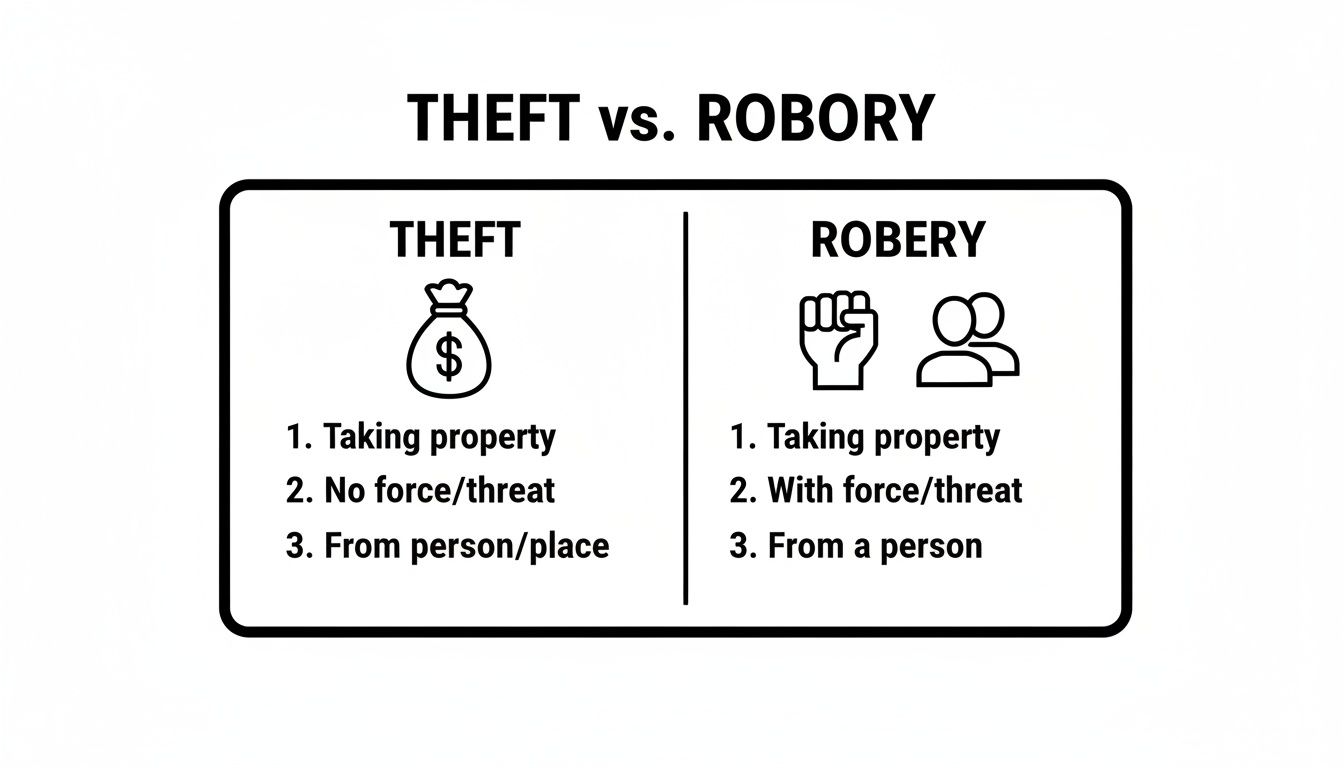
This distinction isn't just a legal technicality; it has real-world implications for how your case is prosecuted and the penalties you face. To get a better sense of how property crimes are viewed from the other side, it can be helpful to look into common strategies to prevent retail theft that businesses use.
For those facing charges, a quick side-by-side comparison can make the legal definitions much clearer.
Theft vs. Robbery At a Glance
The table below breaks down the core elements of each offense as defined by Texas law. You'll notice immediately that the key difference is the presence—or absence—of force or threat against a person.
| Legal Element | Theft (Texas Penal Code § 31.03) | Robbery (Texas Penal Code § 29.02) |
|---|---|---|
| Core Action | Unlawfully taking property. | Taking property while using force or threats. |
| Intent | Intent to permanently deprive the owner of their property. | Intent to obtain or maintain control of property. |
| Force/Threat | No force, violence, or direct threat against a person is involved. | Yes—causes bodily injury or threatens imminent bodily injury or death. |
| Crime Type | Crime against property. | Crime against a person (a violent crime). |
| Typical Offense Level | Misdemeanor or felony, depending on property value. | Always a felony (second-degree). |
Understanding these statutory elements is crucial because the prosecution must prove every single one beyond a reasonable doubt to secure a conviction.
How Texas Law Defines Each Crime
The Texas Penal Code doesn't leave room for ambiguity. Each offense is laid out in a separate statute with its own specific elements.
- Theft is defined under Texas Penal Code § 31.03. The law centers on the "unlawful appropriation of property with intent to deprive the owner of property."
- Robbery, detailed in Texas Penal Code § 29.02, involves committing a theft and, in the course of doing so, intentionally, knowingly, or recklessly causing bodily injury or placing another person in fear of imminent bodily injury or death.
This legal separation is why a robbery charge will always be prosecuted as a felony in Texas. The element of violence or threat automatically triggers much harsher penalties, including the potential for serious prison time. It’s treated not as a simple property crime, but as a direct assault on a person's safety and well-being.
How Texas Law Defines a Theft Charge
To really grasp the massive difference between theft and robbery, we have to start with the basics: how Texas law looks at the lesser charge. Getting a theft conviction isn't as simple as proving someone took something. The prosecution has a specific checklist they must satisfy, all laid out in Texas Penal Code § 31.03.

The core of the law says a person commits theft if they "unlawfully appropriate property with intent to deprive the owner of property." That might sound like dense legal speak, but it breaks down into simple ideas that can make or break your case. Let's pull back the curtain on what each part actually means.
Breaking Down the Elements of Theft
For the State of Texas to convict you of theft, the prosecutor has to prove two key things beyond a reasonable doubt. Not one, but both.
- Unlawful Appropriation: This just means you took control of property without the owner's permission. It could be as straightforward as shoplifting a shirt or as complex as taking payment for a contracting job you never planned to start.
- Intent to Deprive: This element is all about what was going on in your head. The prosecution must show you intended to keep the property for good, or at least for so long that the owner would lose a huge chunk of its value or use. Accidentally walking out of a store with an item in your cart isn't theft, precisely because that critical intent is missing.
These two pillars—appropriation and intent—form the foundation of every single theft case in Texas, from a minor shoplifting ticket to a major felony charge.
A Critical Point on Intent: The prosecution's entire case often hinges on proving what you were thinking at the exact moment of the alleged offense. Your state of mind is the central battleground in a theft case, and it's frequently where a skilled Texas criminal lawyer can build the strongest argument to protect your freedom.
How Property Value Determines the Penalties
Here’s a crucial distinction: robbery is always a felony. Theft, on the other hand, is graded almost entirely on the value of the property or services involved. Texas uses a ladder system, where the penalties get steeper as the value climbs. This is why a theft accusation can be anything from a simple fine to a first-degree felony that carries a potential life sentence.
- Class C Misdemeanor: For property valued at less than $100. This is the lowest level, often handled with a fine no worse than a traffic ticket.
- Class B Misdemeanor: Property valued between $100 and $750. Here, you're looking at potential jail time of up to 180 days and a fine up to $2,000.
- Class A Misdemeanor: Property valued between $750 and $2,500. The stakes get higher, with penalties of up to one year in jail and a $4,000 fine.
- State Jail Felony: Property valued between $2,500 and $30,000. This is a major leap. A conviction means potential prison time of 180 days to two years.
From there, the charges continue to escalate through third, second, and first-degree felonies for higher values, with the most serious cases involving property worth $300,000 or more. This value-based system is exactly why a key defense strategy is often challenging the prosecutor's math on the alleged stolen items. What might seem like a minor issue can quickly spiral into a life-changing felony, making experienced legal help non-negotiable from day one.
How Texas Law Defines Robbery and Aggravated Robbery
People often use “theft” and “robbery” interchangeably, but in a Texas courtroom, they are worlds apart. Theft is a crime against property. Robbery is a crime against a person. That's the single most important distinction, and it’s why robbery charges are always treated with far greater severity.
When prosecutors charge someone with robbery, they’re not just saying property was taken. They’re saying your safety was directly attacked.
Under Texas Penal Code § 29.02, robbery is defined as committing a theft while also intentionally, knowingly, or recklessly causing bodily injury or putting someone in fear of imminent harm or death. The key legal phrase is "in the course of committing theft." This means the violence or threat has to happen right before, during, or in the immediate escape after the theft.
Think of it this way: quietly lifting a wallet from a purse left on a restaurant table is theft. But yanking that same purse off the owner’s shoulder, causing her to stumble and fall? That's robbery. Force was used.
The Elements That Define Robbery
To get a robbery conviction, a prosecutor can't just show that a theft and an assault happened on the same day. They have to prove the two acts were directly connected.
Here are the critical components that elevate a simple theft into the felony offense of robbery:
- A Theft Occurs: There has to be an underlying attempt to unlawfully take someone else's property.
- Force or Threat: The accused must either cause actual bodily injury—even a minor one—or make a credible threat that puts the victim in fear of immediate harm or death.
- Intent: The action must be intentional, knowing, or reckless. This means the person acted with awareness or simply didn't care about the risk of injuring or terrifying someone.
It’s this focus on violence and fear that makes robbery a serious charge right out of the gate.
The Fear Factor is Enough: It’s critical to understand that no one actually has to be physically hurt for a robbery charge to stick. If you threaten someone in a way that makes them reasonably fear for their safety and they hand over their property, that is robbery under Texas law. The emotional and psychological harm is legally recognized as part of the crime.
When Robbery Becomes Aggravated Robbery
Texas law draws an even harder line when certain dangerous factors enter the picture. A robbery charge can be elevated to Aggravated Robbery under Texas Penal Code § 29.03, one of the most serious felony charges you can face. A conviction carries life-altering consequences.
An offense becomes aggravated robbery if, during the robbery, the person:
- Causes serious bodily injury to another.
- Uses or exhibits a deadly weapon.
- Injures or threatens someone who is 65 years or older or a disabled person.
The mere presence of a deadly weapon—whether it's a gun, a knife, or even a heavy object brandished in a threatening way—instantly raises the stakes to a first-degree felony. You can learn more about how prosecutors approach these cases by reading our guide on aggravated robbery Texas law.
The penalties for aggravated robbery are severe, reflecting the grave danger the crime poses to the community. Facing a robbery or aggravated robbery charge means you are up against the full force of the Texas justice system, and getting an expert Houston criminal lawyer on your side right away is absolutely essential.
Comparing Penalties and Long-Term Consequences
Knowing the legal definition of your charge is one thing, but what really matters is how a conviction will actually impact your life. The penalties for theft and robbery in Texas are worlds apart, and that difference shows you just how seriously the law views a crime against property versus a crime against a person. The consequences for robbery are severe right out of the gate, while theft penalties scale up dramatically based on the value of what was taken.

It’s about more than just fines and potential jail time. A conviction leaves a permanent mark on your record that can slam doors shut for years to come. That’s why understanding exactly what’s at stake is so critical for building a defense that truly protects your future.
Texas Penalties for Theft vs. Robbery
To give you a clear, side-by-side look at the potential punishments, we've broken them down in the table below. You'll notice right away that while some theft charges are minor misdemeanors, robbery starts as a serious second-degree felony. If it's aggravated robbery, you're looking at a first-degree felony—one of the most severe charges in Texas law.
Texas Penalties for Theft vs. Robbery
| Offense | Classification | Potential Jail/Prison Time | Maximum Fine |
|---|---|---|---|
| Theft < $100 | Class C Misdemeanor | None | $500 |
| Theft $100 – $750 | Class B Misdemeanor | Up to 180 days | $2,000 |
| Theft $750 – $2,500 | Class A Misdemeanor | Up to 1 year | $4,000 |
| Theft $2,500 – $30,000 | State Jail Felony | 180 days to 2 years | $10,000 |
| Robbery | Second-Degree Felony | 2 to 20 years | $10,000 |
| Aggravated Robbery | First-Degree Felony | 5 to 99 years (or life) | $10,000 |
This stark contrast really drives home why the presence of force or fear is the single most critical factor in how these crimes are prosecuted and punished.
Beyond Jail: The Collateral Consequences
The official penalties are only part of the story. A criminal conviction, especially for a felony, brings a wave of long-term consequences that can disrupt every corner of your life. People in the legal field often call these "collateral consequences" because they aren't part of the court's sentence, but they feel like punishments all the same.
- Employment: Most employers run background checks. A theft conviction is often seen as a crime of dishonesty, making it incredibly difficult to find a job in any field that requires trust. A robbery conviction, being a violent felony, is a massive barrier to almost any kind of employment.
- Housing: Landlords frequently deny rental applications from people with criminal records, particularly when felonies are involved.
- Professional Licenses: A conviction can stop you from getting or keeping professional licenses for careers in nursing, teaching, real estate, or even law.
- Firearm Rights: In Texas, a felony conviction means you permanently lose your right to own a firearm.
- Immigration Status: For non-citizens, a conviction for either theft or robbery can trigger deportation proceedings, no matter how long you've lived in the United States.
A conviction is more than just a legal outcome; it's a label that can follow you for the rest of your life. The long-term consequences often create more hardship than the initial court-ordered punishment, making a proactive defense absolutely essential.
For a deeper dive into the specific punishments and how they are applied in court, you can learn more about the robbery vs theft penalties Texas enforces. The difference in these long-term impacts underscores why fighting the charge against you isn't just about avoiding jail—it's about preserving your ability to work, live, and provide for your family down the road.
Building a Defense Against Theft and Robbery Charges
Getting arrested can make you feel like the walls are closing in. But it’s critical to remember one thing: an arrest is not a conviction. The State has the heavy burden of proving every single element of the crime against you beyond a reasonable doubt. A skilled criminal defense attorney’s job is to dismantle their case, piece by piece, and there are many effective ways to do just that.
Every case is unique, and the right defense always depends on the specific facts. A proactive and strategic legal partner will dig into every detail, hunting for weaknesses in the prosecution's story to build the strongest possible defense for you. The line between a theft and a robbery charge often comes down to very specific actions and intentions, which creates multiple avenues for a powerful defense.
Common Defenses Against a Theft Accusation
In Texas, a theft charge lives or dies based on your state of mind—what you were thinking at the exact moment of the alleged crime. This is often the most fertile ground for building a defense.
- Lack of Intent: The prosecutor has to prove you intended to permanently take the property from its owner. If you accidentally walked out of a store with something still in your cart or simply forgot to return a borrowed tool, you didn't have the criminal intent required for a conviction.
- Belief of Ownership: If you honestly and reasonably believed the property was yours to take, you can't be found guilty of theft. This is known as a "claim of right" defense, and it can be a game-changer in disputes over who owns what.
- Challenging Property Value: The seriousness of a theft charge in Texas is tied directly to the property's value. Your attorney can challenge the prosecution’s valuation, showing the item was worth less than they claim. This can potentially knock a felony charge down to a misdemeanor.
Challenging a Robbery Charge
Robbery is a different beast because it involves the added element of force or fear. As a result, the defense strategies shift away from just your intent and focus more on the actions that took place during the incident.
A sharp attorney will scrutinize the evidence for cracks in the story and challenge the prosecution's version of events. There are several key defenses that can be explored, which you can learn more about by reviewing common robbery defenses in Texas law.
Key strategies often include:
- Mistaken Identity: Eyewitness testimony is notoriously unreliable, especially in high-stress situations. A defense can be built by challenging shaky identification procedures, presenting a solid alibi, or using surveillance footage to prove you weren't the person who committed the crime.
- No Force or Threat Used: If no credible threat was made and no actual force was used, the charge might be theft, but it isn't robbery. An attorney can argue that what happened simply doesn't meet the legal standard for a violent crime.
- Self-Defense: If you were defending yourself or your property during a confrontation and property happened to be taken in the chaos, that may not be robbery at all.
The Power of Investigation: A strong defense is built long before anyone steps into a courtroom. It starts with an independent investigation—interviewing witnesses, analyzing police reports for errors, and examining every piece of evidence. This thorough preparation is often what makes the difference between a conviction and a dismissal.
What to Do If You Are Arrested
Hearing the click of handcuffs is a terrifying moment. Your mind starts racing, you feel a complete loss of control, and it's easy to panic. But this is precisely when you need to be the most strategic. The choices you make in the minutes and hours after an arrest can drastically shape how your case unfolds.
The single most important thing you can do is stay silent. You have the right to refuse to answer questions from the police, and you absolutely should. Calmly and clearly say, “I am exercising my right to remain silent, and I want a lawyer.” That's it. Say nothing else. Law enforcement officers are trained to get you to talk, and anything you say—even if you think it proves your innocence—can and will be used against you.
Navigating the Initial Steps
Once you're arrested for an alleged theft or robbery, you’ll be taken to a police station for booking. This is the administrative part where they take your mugshot, collect your fingerprints, and record your personal details. It’s a formal process, but it’s what officially puts you into the criminal justice system.
After booking, you will be brought before a judge for your arraignment. This is your first official court appearance. The judge will read the formal charges against you and ask you to enter a plea. Having an attorney with you at this stage is critical; they will advise you on the best way to proceed.
Understanding Bail and Getting Released
During the arraignment, the judge will also set your bail. Bail is essentially a financial promise that you’ll show up for future court dates if you are released from jail. The amount is determined by the severity of the charge and whether the judge sees you as a flight risk.
For theft or robbery charges, you'll be dealing with criminal bail bonds. It's useful to understand the key differences between criminal bail bonds and immigration bonds, as this can shed light on the legal hurdles you might face, particularly if your immigration status is a factor. The immediate goal is always to secure your release so you can participate more effectively in your own defense.
Hiring a lawyer right after an arrest isn't an admission of guilt—it’s a smart, protective move. An experienced attorney can immediately start fighting for a reasonable bail amount and begin building your defense from day one.
Protecting Your Future After a Case
Even when a case is over, the fight isn’t. A criminal record can follow you for the rest of your life, creating roadblocks to getting a job or finding housing. Thankfully, Texas law provides ways to clear your name.
Options like expunctions and orders of nondisclosure can help remove an arrest or seal a conviction from the public's view. An expunction effectively destroys the records of an arrest, while an order of nondisclosure hides a past conviction from most private entities. Pursuing this kind of post-conviction relief is a vital step toward reclaiming your future and moving on with a clean slate.
Answering Your Questions About Theft and Robbery
When you're hit with a serious criminal accusation, it’s completely natural for your mind to race with questions. The legal system is a confusing place, and just getting a handle on the specifics is the first step toward feeling a little less powerless. We’ve put together answers to some of the most common questions we hear from people facing theft and robbery charges in Texas.

While these answers are a great starting point, nothing beats a confidential conversation with an experienced criminal defense attorney about the unique facts of your case.
Can I Still Be Charged with Robbery If No One Was Actually Hurt?
Yes, absolutely. Under Texas Penal Code § 29.02, the prosecutor does not need to prove anyone was physically injured to get a robbery conviction. This is a common misconception that gets people into trouble.
The law is clear: simply putting someone in fear of imminent bodily injury or death is enough. If you made a credible threat to get someone to hand over their property, that act meets the legal definition of robbery—even if you never laid a hand on them.
I Returned the Stolen Property—Will They Drop the Charges?
Returning what was taken, while often a smart move, won't automatically make the charges disappear. In the eyes of the law, the crime of theft was complete the moment the property was unlawfully taken with the intent to keep it from the owner. Giving it back later doesn't rewind the clock.
That said, returning the items can be a powerful mitigating factor. It's something your attorney can point to as a sign of remorse. This can be used to argue for a better outcome, like getting the charges reduced or negotiating a plea for a lighter penalty. It shows good faith, but it is not a get-out-of-jail-free card.
Why Do I Need a Lawyer for a Misdemeanor Theft Charge?
It’s a huge mistake to underestimate a misdemeanor theft charge. While it may not come with the heavy prison sentences of a felony, a conviction still creates a permanent criminal record.
That mark on your record can follow you for the rest of your life, popping up on background checks when you try to get a job, rent an apartment, or even apply for a professional license. An experienced lawyer can fight to protect your future by seeking a dismissal, negotiating for a diversion program, or eventually pursuing an expunction to wipe your slate clean.
If you’ve been charged with a crime in Texas, call The Law Office of Bryan Fagan, PLLC for a free and confidential consultation. Our defense team is ready to protect your rights.