Being arrested in Texas can be terrifying — but you don’t have to face it alone. When you're facing criminal charges, the words on the paperwork can feel like a foreign language. But understanding the difference between theft and robbery is the first, most critical step in building your defense. The core distinction isn't about what was taken—it's about how it was taken.
In the simplest terms, theft is about unlawfully taking property. Robbery, on the other hand, is theft supercharged with violence or the threat of it. Think of it this way: one is a property crime, while the other is a violent crime against a person. That single distinction changes everything, from the severity of the charges to the lifelong consequences you could face.
Understanding the Charges You Face in Texas
Being arrested is a terrifying experience, but you don't have to navigate the legal system alone. The specific charge filed against you carries immense weight, as theft and robbery have entirely different elements a prosecutor must prove beyond a reasonable doubt.
This simple decision tree gets right to the heart of what separates these two offenses under Texas law.
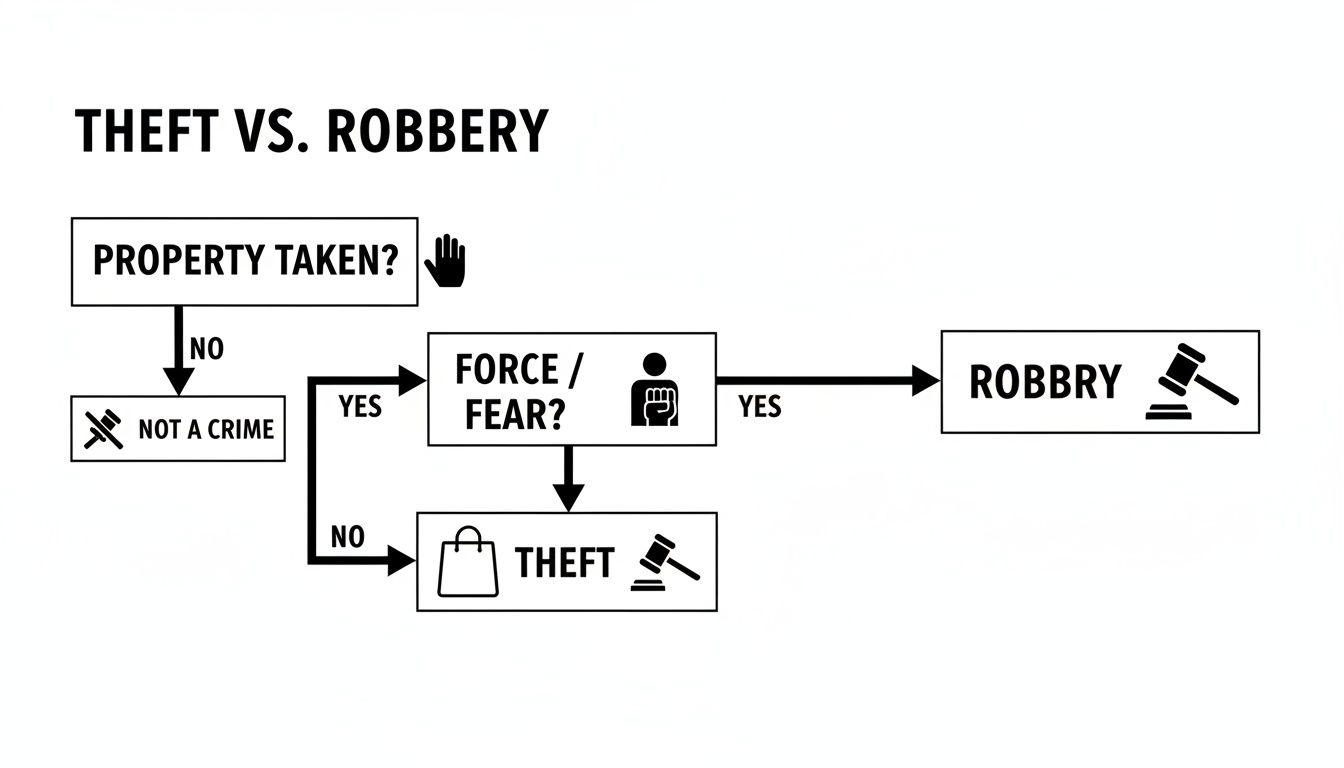
As the flowchart shows, the legal pivot point is the presence of force, the threat of harm, or putting someone in fear. This one factor is what escalates a property crime into a violent felony, turning a misdemeanor theft case into a serious robbery charge.
Key Legal Distinctions
The Texas Penal Code lays out these offenses in separate chapters for a reason. Knowing the fundamental differences helps you grasp the seriousness of your situation right away.
Here’s what sets them apart:
- Nature of the Crime: Theft is a property crime. The law’s focus is on the value of what was taken. Robbery, however, is classified as a violent crime against a person, even if no one was physically touched.
- Presence of a Victim: You can commit theft without the owner ever knowing you were there—think shoplifting or swiping a package from a porch. Robbery requires a direct confrontation where the victim is aware of what's happening because of force, threats, or intimidation.
- Core Elements: To convict you of theft, a prosecutor must prove you intentionally took property without permission. For robbery, they must prove all the elements of theft plus the fact that you caused bodily injury, threatened someone, or placed them in fear of imminent harm.
The most significant takeaway is this: robbery isn’t just about the stolen property; it’s about the violent or threatening way it was taken. This is why the penalties for robbery are exponentially more severe than for most theft offenses.
For a glimpse into how these situations unfold from the other side, you can read a real-world account of being robbed and facing a legal process to understand the victim's perspective.
Theft vs. Robbery At a Glance
To make the differences even clearer, here's a quick side-by-side comparison of the key legal elements.
| Legal Element | Theft | Robbery |
|---|---|---|
| Primary Focus | Unlawful taking of property | Taking property through force or fear |
| Crime Classification | Property Crime | Violent Crime |
| Force or Fear | Not an element of the crime | A required element of the crime |
| Typical Penalties | Range from Class C Misdemeanor to First-Degree Felony | Second-Degree or First-Degree Felony |
| Statutory Reference | Texas Penal Code Chapter 31 | Texas Penal Code Chapter 29 |
While both charges are serious, robbery is treated with far greater severity by prosecutors and judges. Knowing which one you're up against is the first step toward protecting your rights and your future.
What Legally Constitutes Theft in Texas
When most people hear the word "theft," they usually picture something like shoplifting or swiping a wallet. While those are definitely examples, Texas law casts a much wider net. Understanding exactly what the state considers theft is the first step in building a solid defense if you're ever charged with it.

Under Texas Penal Code Chapter 31, the legal definition is straightforward: unlawfully appropriating property with the intent to deprive the owner of it. It sounds simple, but this definition contains two critical parts that a prosecutor must prove beyond a reasonable doubt: the act of taking and the mental state behind it.
The Two Core Elements of a Theft Charge
To get a conviction, the state has to prove both of these elements were present. A good defense attorney is going to pick apart the prosecution's case, looking for weaknesses in one or both of these areas.
- Unlawful Appropriation of Property: This just means you took control of property that wasn't yours without the owner's permission. "Property" isn't limited to physical items; it can be anything of value, like services or even financial documents.
- Intent to Deprive the Owner: This is the real kicker—the mental state. It's not enough to have simply taken something. The prosecutor has to prove you meant to keep it from the owner permanently or for so long that they lost a major part of its value or enjoyment.
Think about it this way: accidentally walking out of a store with an item still in your cart might not be theft if you never had the intent to steal it. Your state of mind at that moment is a central piece of the legal puzzle.
Common Examples of Theft in Texas
Theft charges cover a huge range of actions, many of which you might not realize fall under the same legal umbrella. What really separates them is the value of the property or service that was taken—that's what determines how serious the charge is.
Common theft offenses include:
- Shoplifting: Taking items from a retail store without paying.
- Theft of Services: Getting a taxi ride or eating at a restaurant and then leaving without paying the bill.
- Embezzlement: Taking money or assets that you were entrusted with, which often happens in a work setting.
- Receiving Stolen Property: Having property that you know for a fact was stolen by someone else.
It's also important for businesses to understand the difference between theft and robbery when managing losses. Most retail loss comes from non-violent acts like shoplifting. But the value of what's being taken is climbing; retail studies found the average reported value per shoplifting incident jumped to around $462 in 2020. You can learn more about recent shoplifting trends and see how it's impacting the economy.
The key takeaway is that theft in Texas is a property crime. The core of the offense is the unlawful taking, not the use of force or fear, which is what elevates a crime to robbery.
Because theft penalties are tied directly to the value of the property, the stakes can range from a small fine for a Class C misdemeanor all the way up to years in prison for a first-degree felony. A Houston criminal defense attorney can help you understand the specific charge you’re up against and start building a strategy to protect your rights.
How Texas Law Defines a Robbery
While theft is about taking property, robbery is a completely different animal in the eyes of Texas law. What separates them isn't the value of what was stolen, but the presence of violence or fear. The Texas Penal Code draws a firm line in the sand: robbery is theft supercharged with violence or intimidation. This single element transforms a property crime into a violent crime, which is exactly why Texas prosecutors go after these cases so aggressively.

The official definition lives in Texas Penal Code Chapter 29. It says a person commits robbery if, in the course of committing theft, they intentionally, knowingly, or recklessly cause bodily injury to another person or put them in fear of imminent bodily injury or death.
This distinction isn't just legal jargon; it has massive real-world consequences. A robbery conviction comes with far harsher penalties than a simple theft—even if the stolen property was worth next to nothing—because the law’s main concern is the harm done to the victim.
The Critical Phrase "In the Course of Committing Theft"
One of the most powerful parts of the statute is the phrase "in the course of committing theft." You might think this means only the exact moment the property is taken, but Texas law sees it differently.
This phrase is legally defined to include:
- Conduct that happens during an attempt to commit theft.
- Actions that occur during the immediate flight after the theft or attempted theft.
This broad definition is a game-changer. Let's say you shoplift an item. That's theft. But if you shove a security guard on your way out the door to escape, the entire incident can escalate to robbery. The focus instantly shifts from the stolen merchandise to your physical act against another person. For a deeper dive, you can learn more about the specific elements of robbery in Texas in our detailed guide.
Actions That Elevate Theft to Robbery
A theft charge becomes a robbery charge the moment one of two things happens. The prosecutor only needs to prove one.
- Causing Bodily Injury: This doesn't mean a severe injury. The law defines it as physical pain, illness, or any impairment of physical condition. Pushing someone to the ground and causing them pain is enough.
- Threatening or Placing in Fear: This one is more subjective but just as serious. It covers any action or words that would make a reasonable person afraid of being harmed right then and there. You don’t even have to touch the victim; a threatening gesture or a menacing demand is enough to cross the line into robbery.
For example, just saying, "Give me your wallet or I'll hurt you," turns a theft into a robbery. It doesn't matter if you never showed a weapon or laid a hand on the person. The fear you created is the key element.
Understanding Aggravated Robbery
Texas law doesn't stop there. The charge can become even more severe: Aggravated Robbery, a first-degree felony. A robbery gets "aggravated" if the person:
- Causes serious bodily injury to another.
- Uses or exhibits a deadly weapon.
- Causes bodily injury to or threatens someone who is 65 years or older or disabled.
A deadly weapon can be obvious, like a gun or a knife. But it can also be anything capable of causing death or serious injury when used that way—even a baseball bat or a brick. The penalties for aggravated robbery are incredibly steep, reflecting the extreme danger posed to the victim. If you're facing a robbery or aggravated robbery charge, you're in for a serious legal fight. Your first and most critical step is to contact a skilled Texas criminal defense lawyer immediately.
Comparing Penalties for Theft and Robbery
The single biggest difference between a theft charge and a robbery charge comes down to the penalties. It’s a night-and-day distinction. Because Texas law sees robbery as a violent crime against a person, the consequences are drastically more severe, even if the value of what was taken is tiny. Grasping this gap is the first step in understanding the gravity of the charges you might be facing.
A theft conviction can be as minor as a ticket or as serious as years in prison—it all hinges on the value of the property. Robbery, on the other hand, starts as a serious felony right out of the gate, with penalties that can permanently alter the course of your life.
Punishment Ranges for Texas Theft Charges
In Texas, theft penalties are tied directly to the value of the property or services stolen. The law creates a ladder of offenses, and with each step up, the potential jail time and fines get steeper.
Here’s a general breakdown of how theft is classified under Texas Penal Code § 31.03:
- Less than $100: This is a Class C Misdemeanor, punishable by a fine of up to $500.
- $100 to $750: Now it's a Class B Misdemeanor, carrying up to 180 days in county jail and a fine of up to $2,000.
- $750 to $2,500: You're looking at a Class A Misdemeanor, punishable by up to one year in county jail and a fine of up to $4,000.
- $2,500 to $30,000: This crosses the line into a State Jail Felony, with 180 days to two years in a state jail facility and a fine up to $10,000.
- $30,000 to $150,000: This is a Third-Degree Felony, punishable by two to 10 years in prison and a fine of up to $10,000.
As you can see, the penalties escalate quickly. What might seem like a small mistake can easily become a felony charge with serious prison time on the table.
Punishment Ranges for Texas Robbery Charges
Unlike theft, robbery penalties have nothing to do with the value of what was taken. It doesn't matter if you steal a dollar or a diamond necklace; the charge is determined by the level of violence or threat used.
- Robbery: This is a Second-Degree Felony. A conviction brings a prison sentence of two to 20 years and a potential fine of up to $10,000.
- Aggravated Robbery: If a deadly weapon is used, someone suffers serious bodily injury, or the victim is elderly or disabled, the charge jumps to a First-Degree Felony. This is one of the most serious offenses in Texas law, carrying a prison sentence of five to 99 years or life, plus a fine of up to $10,000.
To get a clearer picture of how these penalties stack up, you can explore our detailed breakdown of robbery versus theft penalties in Texas.
The critical point is this: the moment force or fear enters the equation, the potential consequences skyrocket. A simple theft that could result in probation can become a robbery charge that demands years, or even decades, in a Texas prison.
Here's a side-by-side look at how these penalties compare.
Texas Theft and Robbery Penalties Comparison
This table provides a detailed breakdown of criminal classifications and potential punishments for various theft and robbery offenses in Texas.
| Offense | Classification | Potential Jail/Prison Time | Maximum Fine |
|---|---|---|---|
| Theft < $100 | Class C Misdemeanor | None | Up to $500 |
| Theft $100 – $750 | Class B Misdemeanor | Up to 180 Days | Up to $2,000 |
| Theft $750 – $2,500 | Class A Misdemeanor | Up to 1 Year | Up to $4,000 |
| Theft $2,500 – $30,000 | State Jail Felony | 180 Days to 2 Years | Up to $10,000 |
| Robbery | Second-Degree Felony | 2 to 20 Years | Up to $10,000 |
| Aggravated Robbery | First-Degree Felony | 5 to 99 Years (or Life) | Up to $10,000 |
As the table shows, there is no overlap. The lowest-level robbery charge carries a minimum sentence equal to the maximum for a state jail felony theft. This stark contrast highlights just how seriously the state of Texas treats crimes involving violence or the threat of violence.
Long-Term Consequences Beyond Jail and Fines
The punishment doesn't stop when you walk out of jail or pay the final fine. Far from it. The collateral consequences of having a theft or robbery conviction on your permanent record can follow you for the rest of your life. For many people, these are the most damaging penalties of all.
A felony conviction, especially for a violent crime like robbery, creates huge barriers to rebuilding your life. It can shut doors and make it nearly impossible to:
- Find a good job: Many employers are hesitant to hire someone with a criminal record, particularly for crimes involving dishonesty or violence.
- Secure stable housing: Landlords often run background checks and can legally deny rental applications based on a criminal history.
- Own a firearm: In Texas, convicted felons lose their right to possess a firearm.
- Obtain professional licenses: A conviction can make it impossible to get or keep licenses for careers in nursing, real estate, law, and other regulated fields.
- Avoid immigration issues: For non-citizens, a conviction for a crime of "moral turpitude"—which includes most theft and all robbery offenses—can trigger deportation.
These long-term impacts show exactly why fighting the charges against you is so critical. A good criminal defense attorney will not only defend you in court but also advise you on how to protect your future, like seeking an expunction or an order of nondisclosure if you're eligible.
How to Build a Defense Strategy
Getting charged with theft or robbery in Texas can feel like the walls are closing in. It's easy to feel cornered, but it’s critical to remember that an arrest is not a conviction. The prosecution carries the entire burden of proving its case beyond a reasonable doubt, and a skilled defense attorney’s job is to dismantle that case, piece by piece. Building a powerful defense strategy starts the moment you decide to fight back.
Every case is different. The right approach depends entirely on the specific facts and evidence at play. Your attorney will kick things off with a thorough investigation—scrutinizing police reports, tracking down and interviewing witnesses, and analyzing the prosecution's evidence for any and all weaknesses. This process is all about finding every possible angle to challenge the charges against you.
Common Defenses Against a Theft Charge
Because a theft conviction hinges on the prosecutor proving you intended to steal, many defense strategies zero in on your state of mind when the alleged offense happened. A successful defense often involves showing that one of the key elements of the crime simply wasn't there.
Some common defenses for theft include:
- Lack of Intent: This is one of the most powerful defenses you can raise. Maybe you took the property by mistake, honestly believing it was yours. Or maybe you just forgot you even had it. If the prosecution can't prove you intended to permanently deprive the owner of their property, they don't have a case.
- Consent from the Owner: If you had a reasonable belief that the owner gave you permission to take or use the property, you can't be found guilty of theft. In Texas, this is often called the "effective consent" defense.
- Mistake of Fact: This defense applies if you genuinely believed the property belonged to you. For example, if you grabbed a suitcase at the airport that looked identical to yours, you lacked the criminal intent required for a theft conviction.
A key takeaway for theft defense is that the prosecution must prove what you were thinking. An experienced attorney can effectively argue that a simple misunderstanding or mistake does not amount to a criminal act.
Challenging the value of the allegedly stolen property is another crucial strategy. Since theft penalties in Texas are tiered based on value, proving the property was worth less than the prosecution claims can lead to a huge reduction in charges—sometimes dropping a felony all the way down to a misdemeanor.
Challenging a Robbery Accusation
Defending against a robbery charge is a different beast altogether because it involves allegations of violence. The strategy has to address not only the theft but also the elements of force or fear that elevate the crime to a violent felony. A thorough defense questions every single part of the prosecution's story.
Here are some effective approaches:
- Questioning the Use of Force or Fear: A skilled defense lawyer will dig into whether the alleged actions legally count as "force" or would actually cause a reasonable person to feel fear. If the interaction wasn't truly threatening, the charge could potentially be knocked down to simple theft.
- Challenging Witness Identification: Eyewitness testimony can be notoriously unreliable, especially in high-stress situations like a robbery. Your attorney can file motions to challenge identifications made from photo lineups or show-ups that were improperly conducted by police.
- Arguing Self-Defense: In some cases, force might have been used not to commit a theft, but to defend yourself during a confrontation that was already happening.
Building a solid defense against a serious charge like robbery requires a deep understanding of legal procedures and rules of evidence. You can explore more about what it takes to fight these charges by reading our in-depth guide to robbery defenses under Texas law. Remember, the goal is to protect your rights and your future at every stage. An aggressive, proactive defense is your best tool.
What to Do Immediately After an Arrest
Getting arrested for any crime, whether it's misdemeanor theft or felony robbery, is a scary and confusing experience. In those first few hours, every move you make—and every word you say—can dramatically shape the outcome of your case. Knowing your rights isn't just a good idea; it's your most powerful tool.

The single most important thing you can do is exercise your right to remain silent. Police are trained to ask questions that sound casual but are specifically designed to get you to admit to key elements of an offense. You need to politely but firmly state, "I am exercising my right to remain silent, and I would like to speak with my attorney." After that, stop talking.
The First Steps to Take
After an arrest, you’ll be taken to a police station for booking. This is where they take your mugshot, record your personal details, and take your fingerprints. It’s crucial to stay calm and cooperative during this administrative part, but remember that you don't have to answer any questions about the alleged crime.
Here are the critical first moves you should make:
- Invoke Your Rights: Clearly state that you are invoking your right to remain silent and your right to an attorney. Don't answer any questions about what happened without your lawyer there.
- Do Not Resist: Resisting arrest, even if you feel it's unfair or unlawful, will only lead to more criminal charges. Comply with commands peacefully.
- Contact an Attorney Immediately: Your first call should be to a criminal defense lawyer you trust. The sooner your attorney gets involved, the better they can protect you during police questioning and fight for you at your bail hearing.
Being charged with theft is far more common than robbery. The key difference is the use of force. Because most property crimes don't involve violence, theft cases significantly outnumber robbery cases in Texas and across the country.
What Happens After Booking
Once booking is done, you'll be held until you can see a magistrate judge for your arraignment, which usually happens within 48 hours of your arrest.
At the arraignment, the judge will:
- Tell you the official charges you're facing.
- Advise you of your constitutional rights.
- Set your bail amount.
Bail is a financial promise that you'll show up for future court dates. Having an attorney with you at this hearing is vital. They can argue for a lower, more reasonable bail amount or even push for your release on a personal recognizance bond, which doesn't require you to pay anything upfront.
Your silence is your shield. Anything you say can and will be used against you by the prosecution. Let your attorney do the talking from the very beginning.
Beyond the immediate legal fight, you might also worry about your digital footprint. Public records like mugshots can follow you for years. If you're concerned about this, you can find resources that explain how to get mugshot removed online. Taking control of your situation starts with knowing your rights and getting an experienced legal team in your corner.
Frequently Asked Questions
When you're caught in the Texas legal system, questions pop up fast. Below, we've tackled some of the most common ones we hear from clients trying to understand the line between theft and robbery. Hopefully, this brings some clarity to your situation.
Can I Be Charged with Robbery If I Didn't Use a Weapon?
Yes, absolutely. This is a huge misconception. Under the Texas Penal Code, a robbery charge doesn't hinge on a weapon. All it takes is causing any bodily injury or putting someone in fear of imminent harm or death while you're committing a theft.
Think about it this way: a simple verbal threat of violence can be enough for prosecutors to bump a theft charge up to robbery. The focus is on the fear and force, not the hardware.
What if I Intended to Return the Property?
This can be a tricky defense, but it’s a valid one. A theft conviction requires the state to prove your "intent to deprive the owner of the property." Now, that doesn't just mean forever. If your plan was to keep the item for so long that a major part of its value or usefulness was gone, the prosecutor will argue it’s still theft.
An experienced criminal defense attorney knows how to attack this element, arguing you never had the criminal intent the law requires for a conviction.
Key Insight: Your state of mind at the moment of the alleged crime is everything. Prosecutors have to prove what you were thinking, and a lack of criminal intent is often one of the strongest defenses we can build.
Does Shoplifting Count as Robbery or Theft?
Shoplifting almost always starts as a theft charge. But things can go from bad to worse in a heartbeat. If you try to run and use force against a store employee or security guard—even something as simple as a shove—that theft charge can instantly escalate to robbery.
The law is crystal clear on this: the moment force or fear enters the picture, you've crossed the line from theft into much more serious territory.
Can a Conviction Be Removed from My Record in Texas?
In some cases, yes. Depending on how your case ends, you might be eligible for an expunction, which completely wipes the slate clean, or an order of nondisclosure, which seals the record from the public.
Eligibility is complicated, though. It usually depends on whether your case was dismissed, you were acquitted, or you successfully finished deferred adjudication probation. It is absolutely critical to talk to an attorney about your options for cleaning up your record. A clean record can protect your future job prospects, housing, and reputation.
If you’ve been charged with a crime in Texas, call The Law Office of Bryan Fagan, PLLC for a free and confidential consultation. Our defense team is ready to protect your rights.