Being arrested in Houston for a drug offense can turn a normal day into a crisis. One moment you're driving home, leaving work, or answering a knock at the door. The next, you're in handcuffs, your phone is in police custody, and you're wondering whether you're about to lose your job, your license, or your future.
If that's where you are right now, take a breath. A drug charge is serious, but it isn't the same thing as a conviction. You still have rights, you still have options, and the steps you take early can shape the outcome of your case.
Facing a Drug Charge in Houston? You Are Not Alone
A lot of good people end up facing drug allegations. Some are first-time offenders. Some are professionals with careers to protect. Some are parents worried about what this could mean for custody, immigration status, housing, or a security clearance.
Texas law takes controlled substances seriously. Prosecutors can file charges for possession, delivery, manufacturing, or possession with intent to deliver. Depending on the substance, the amount, and your record, a case can range from a misdemeanor to a felony with life-changing consequences.
What often shocks people first is how common these cases are. Texas averages over 100,000 drug arrests annually in recent years, according to a discussion of state and federal drug charge thresholds. That doesn't make your situation less stressful. It does mean you're not alone, and it means the court system deals with these cases every day.
What a Houston drug case usually feels like at first
Clients often come in with the same fears:
- Will I go to jail
- Should I explain my side to police
- Can this be dismissed
- What happens at court
- Will this stay on my record forever
Those are the right questions. The hard part is that the internet often gives half-answers. You need a full roadmap, from the first phone call after arrest to the possibility of clearing your record later.
Practical rule: Your case is about more than the drugs police say they found. It's about how officers stopped you, searched you, tested the evidence, wrote the report, and handled everything after the arrest.
Why early legal help matters
A strong defense starts long before trial. It starts with protecting your rights, stopping damaging statements, reviewing the basis for the stop or search, and preserving evidence before it disappears. That's where a drug crimes attorney houston residents can trust becomes important. The right lawyer isn't just there to stand beside you in court. That lawyer should guide you through every stage, explain what matters, and help you avoid mistakes that make the case harder to fight.
The First 48 Hours After a Houston Drug Arrest
The first two days matter more than is often realized. Police are gathering statements, jail staff are processing paperwork, prosecutors are reviewing preliminary information, and bail decisions may happen quickly. Panic can make people talk too much. That's one of the most common mistakes.

What to do immediately
Start with a short list and stick to it.
- Stay silent about the facts of the case. You can give basic identifying information. You do not need to explain where you were, who the drugs belonged to, or why something was in your car or home.
- Ask for a lawyer clearly. Say, "I want to speak with an attorney, and I'm not answering questions without my attorney."
- Don't consent to searches if officers ask again. If a search already happened, don't argue. Just don't give new consent.
- Call a family member who can help with logistics. You may need help locating paperwork, arranging bond, or finding medications and work contact information.
- Write down what you remember as soon as you can. Time, place, officers, witnesses, what police said, whether they had a warrant, and what was searched.
Why silence helps your defense
People often think, "If I explain this, they'll understand." That's rarely how it works. Officers are trained to collect statements that support probable cause and prosecution. Even a partly innocent explanation can lock you into details that later conflict with body camera footage, police notes, or witness accounts.
If drugs were found in a shared car, shared apartment, borrowed jacket, or someone else's bag, your words can accidentally fill in gaps the prosecution couldn't otherwise prove. Under Texas law, possession generally means actual care, custody, control, or management. The government still has to connect you to the substance. You don't have to help them do that.
Tell police you want a lawyer. Then stop talking about the case. Silence can't be cross-examined later.
What happens after booking
After arrest, you're usually booked into jail, photographed, fingerprinted, and entered into the system. Then the case moves into the early court process. In plain English, here are the main stages:
- Magistration or first appearance: A judge reviews basic information, advises you of rights, and addresses bond.
- Bail or bond decision: The court decides whether you'll be released and under what conditions.
- Charging review: Prosecutors review reports and decide how to proceed.
- Future court settings: These may include arraignment, status settings, motion hearings, plea discussions, and possibly trial.
What arraignment means in plain English
At arraignment, the court formally tells you the charge and asks for a plea. In many cases, your lawyer handles much of this process and advises you on whether entering a plea right away makes sense. A vital takeaway is straightforward: Arraignment isn't the time to tell your story in open court. It's a procedural step, not your chance to argue the case.
Why timing changes strategy
Houston drug cases don't all move at the same speed. Misdemeanor drug cases often resolve within several months, while felony cases can take from six months to over a year, according to guidance on Houston drug possession case timelines. That means the earliest decisions often have the longest impact.
If your lawyer can quickly request reports, preserve video, evaluate the stop, and begin negotiations, you may be in a stronger position. Delay can make witness memory weaker and evidence harder to challenge.
How to Choose Your Houston Drug Crimes Attorney
Hiring counsel isn't just about finding any Houston criminal lawyer. Drug cases have technical issues that can decide whether a case gets reduced, dismissed, or pushed toward trial. Search and seizure law, lab testing, chain of custody, plea bargaining, and local court practice all matter.

What to look for first
A good consultation should leave you calmer and better informed, not more confused. You want a lawyer who can explain the process in plain language and talk specifically about drug charges in Houston courts.
Ask about these points:
- Local court experience: Has the attorney handled cases in Harris County and the surrounding courts where your case will be heard?
- Drug-case focus: Does the lawyer regularly defend possession, delivery, trafficking, and related search issues?
- Early-case strategy: What happens in the first week after hiring them?
- Communication: Will you speak with the attorney directly, or mostly with staff?
- Collateral consequences: Can the lawyer discuss effects on jobs, licenses, immigration, family law, or firearms rights?
Questions that tell you a lot
During a consultation, don't just ask, "Can you help me?" Ask questions that show how the lawyer thinks.
Here are useful examples:
- How would you evaluate whether the stop or search was legal
- What evidence do you usually request first in a Houston drug case
- Do you look for diversion, dismissal, suppression, or trial first
- How do you handle cases involving shared vehicles or shared homes
- What happens if lab results don't match the arrest allegation
Those questions matter because a strong defense begins with details. A lawyer who speaks only in general promises may not be looking closely enough.
Fee structures in plain English
Legal fees often confuse people when they're already under stress. Most criminal defense fee arrangements fall into a few categories:
| Fee type | What it usually means | What to ask |
|---|---|---|
| Flat fee | One set amount for a defined part of the case | Does it include motions, hearings, and trial prep |
| Retainer | Upfront deposit billed against work performed | How often will I receive billing updates |
| Hourly | You pay for time spent | Who works on the case and at what rate |
The most important question isn't just cost. It's scope. Make sure you know what the fee covers, what triggers added cost, and whether trial is included.
Red flags that deserve caution
Some warning signs are easy to miss when you're desperate for help.
- Guaranteed results: No ethical lawyer can promise a dismissal or no-jail outcome.
- No discussion of evidence: If the lawyer doesn't ask how the stop happened or where the drugs were found, that should concern you.
- Pressure to plead quickly: Fast resolutions can sometimes help, but rushed pleas can also close off defenses.
- Vague answers about post-case relief: A complete defense plan should include discussion of record consequences too.
A lot of clients also want to hear how the defense process works before they commit. This video gives a useful overview of criminal defense issues to think about as you evaluate counsel.
One practical way to compare lawyers
Meet with more than one attorney if you can. Then compare them on substance, not style alone. Did they ask real questions? Did they explain risk clearly? Did they discuss both courtroom defense and record-cleanup options later?
The Law Office of Bryan Fagan PLLC represents clients in drug possession and related criminal cases across Texas, including Houston, and also handles expunctions, nondisclosures, and criminal matters that overlap with family law. Whether you choose that firm or another, the key is to hire counsel who treats your case like a legal problem to solve, not just a file to process.
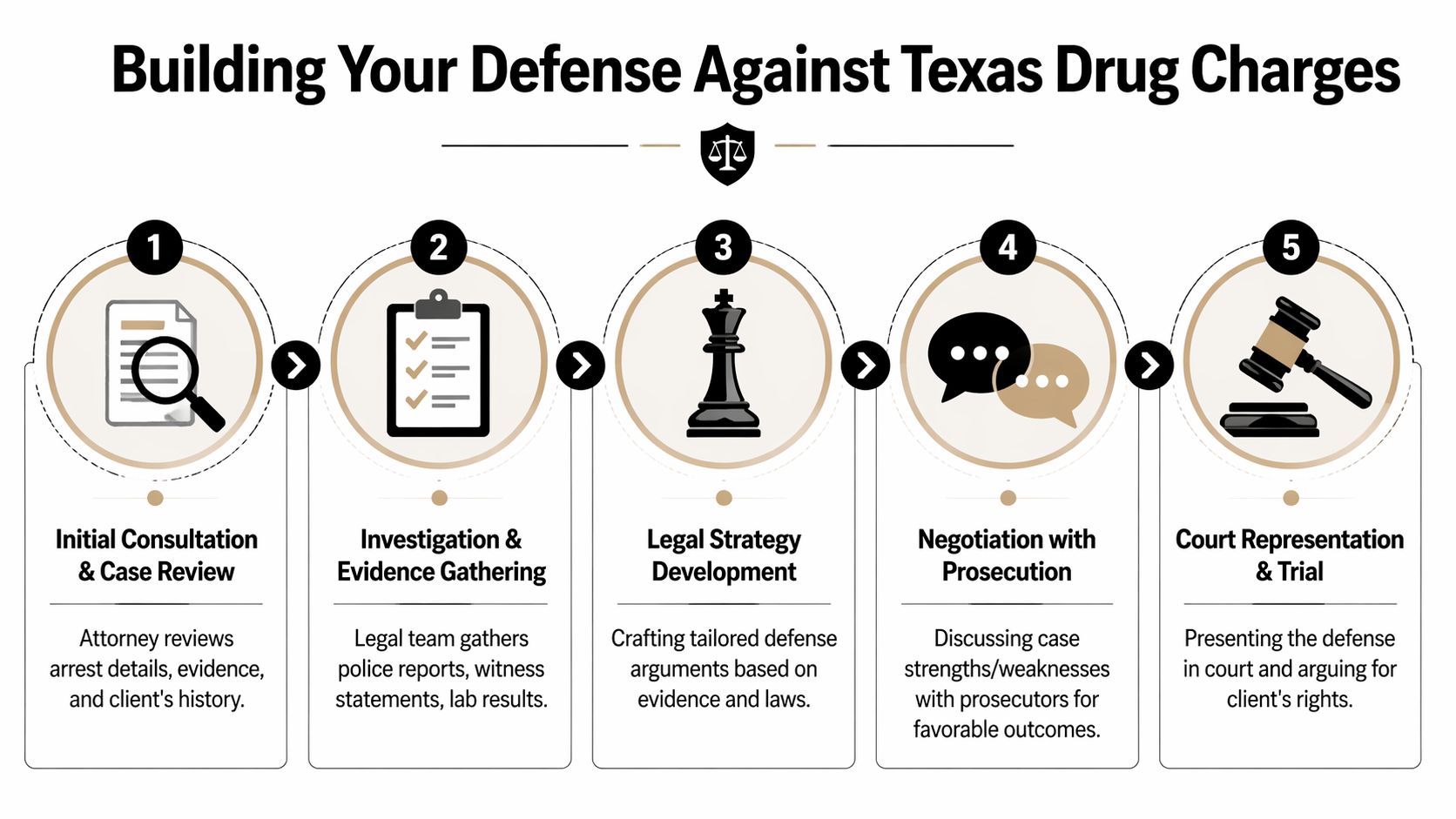
Building Your Defense Against Texas Drug Charges
A drug arrest creates one story. Your defense attorney's job is to test whether that story holds up under the law. That's where many cases turn. Police may believe they found drugs. Prosecutors may file charges. But the Constitution, the Texas Health and Safety Code, and the rules of evidence still control what the government has to prove.
Why many cases are still defensible
Houston drug defense often comes down to targeted legal challenges. In fact, approximately 80% of Houston drug possession cases are dismissed when defendants use strategies such as challenging illegal searches, showing lack of knowledge, or exposing chain-of-custody errors, according to a Houston drug possession defense analysis.
That doesn't mean every case will be dismissed. It does mean an arrest report is only the beginning, not the end.
Defense angle one and illegal search issues
The Fourth Amendment protects you from unreasonable searches and seizures. In plain language, police usually need legal grounds to stop you, detain you, search you, search your car, or search your home.
Examples that often deserve close review include:
- Traffic stops without a valid reason: If the stop itself wasn't lawful, the evidence found afterward may be challenged.
- Car searches based on shaky consent: If consent wasn't voluntary or clearly given, the search may be contestable.
- Home searches with weak warrants: A warrant must be legally sufficient and properly executed.
If a judge suppresses the evidence, the prosecution may lose the core of its case.
A lot of drug cases are really search cases in disguise. If the search fails, the case can fail with it.
Defense angle two and whether you legally possessed the substance
Texas possession law is broader than many people expect. The state doesn't always have to show drugs were in your pocket. Prosecutors may argue you had care, custody, control, or management over the substance.
That sounds simple until you apply it to real life.
If officers find drugs in a center console of a borrowed car, who possessed them? If drugs are inside a kitchen drawer in a house with several adults, who had control? If pills are in a backpack at a party, who knew they were there?
A lawyer may challenge:
- Knowledge: Did you know the substance was there at all?
- Control: Could the government prove it was yours or under your control?
- Connection: Were there enough links between you and the alleged contraband?
For a plain-English look at how attorneys challenge evidence and strategy issues in these cases, see defense strategies in Texas drug cases.
Defense angle three and chain of custody
Chain of custody means the documented path of the evidence from seizure to storage to testing to court. It can be compared to a relay race. If police collect an item, store it, send it to a lab, and later present it in court, each handoff should be tracked.
Problems can include:
| Issue | Why it matters |
|---|---|
| Unclear labeling | The state must show the tested item is the same one taken from the scene |
| Gaps in handling records | Missing steps raise questions about tampering or confusion |
| Storage problems | Poor storage can affect contamination arguments |
| Lab mismatches | The reported substance must match the item tied to your case |
A broken chain doesn't automatically end a case, but it can create reasonable doubt or support suppression and negotiation.
Defense angle four and lab testing problems
Police suspicion isn't enough. The state must prove the substance falls within the charged penalty group. That often requires lab evidence. A defense lawyer may review whether the item was tested correctly, whether the report matches the allegation, and whether contamination or poor documentation is an issue.
This matters in residue cases, prescription-related cases, and situations where appearance alone can be misleading.
Defense angle five and negotiation before trial
Most cases don't end with a jury verdict. They end through motion practice, strategic advantage, and negotiation. A defense attorney may push for reduction, diversion, dismissal, or a plea that avoids the worst consequences.
That work happens behind the scenes. It includes reviewing reports, filing motions, exposing weaknesses, and making prosecutors confront the risks in their case.
Penalties for Drug Convictions in Texas
Texas drug penalties depend on several moving parts. The substance matters. The amount matters. Your criminal history matters. Whether the case stays in state court or goes federal matters too.
The main state law for many possession cases is Texas Health and Safety Code §481.115, which covers possession of certain controlled substances in Penalty Group 1. Texas also uses different penalty groups for different substances. Marijuana is treated separately under Texas law, and prescription-related cases can raise their own issues.
State charges and federal charges are not the same
One of the most important distinctions is whether your case remains in state court or escalates to federal court. A 2025 source reports a 22% surge in Houston federal indictments for fentanyl-related crimes, with federal penalties averaging 5 to 40 years, according to Houston federal drug crimes reporting. Federal cases often involve trafficking allegations, interstate activity, larger quantities, wiretap evidence, or multi-agency investigations.
At the state level, penalties can still be severe. The highest felony drug charges can carry very long prison exposure and substantial fines. That is one reason early case analysis is so important.
Texas Drug Penalties at a Glance Example
The table below is only a simplified example. The exact charge depends on the specific substance, amount, prior history, and facts of the case.
| Amount | Charge Level | Potential Jail/Prison Time | Potential Fine |
|---|---|---|---|
| Small amount of a lower-level offense | Misdemeanor or felony, depending on substance | Can range from county jail exposure to prison exposure | Fine amount depends on charge level |
| Larger amount of a controlled substance | Felony | Can involve multi-year prison range | Fine amount can be significant |
| Highest-level felony range | First-degree felony | 5 to 99 years in prison | Up to $10,000 |
Those highest-level penalties come into play in serious felony situations. In some cases involving prior records, minimum sentencing rules can make the outlook even harsher.
Penalty groups in plain language
Texas places controlled substances into Penalty Groups. These groups help determine punishment ranges. You don't need to memorize every category right now. What you need to know is this:
- Penalty Group 1 cases often carry the heaviest possession consequences.
- Prescription drugs can still lead to criminal charges if possessed unlawfully.
- Marijuana cases follow a different statutory framework from many controlled substances.
- Amount drives risk. A small amount may be treated very differently than a larger one.
If your case involves marijuana, this overview of possession of weed in Texas can help you understand how those charges differ from other drug allegations.
Collateral consequences people often overlook
A conviction can affect more than jail or prison time. Depending on the case, you may also face:
- Professional licensing trouble
- Employment problems from a public record
- Housing barriers
- Student aid or school discipline issues
- Firearm rights concerns
- Immigration consequences for non-citizens
- Family law fallout, including custody concerns
Those consequences are one reason a plea offer should never be judged by jail time alone. Sometimes the most important question is what the outcome leaves on your record.
Life After a Drug Case Your Path to a Clean Record
A lot of articles stop at conviction and sentencing. Real life doesn't. After the court date ends, you still have to apply for jobs, renew licenses, pass background checks, and move forward. That's why post-case relief matters so much.
Texas offers several tools that may help, depending on the result of your case and your eligibility. The right option depends on whether your case was dismissed, whether you completed deferred adjudication or probation, and what statute applies to the offense.

Expunction and nondisclosure are not the same
People often use these terms as if they mean one thing. They don't.
- Expunction: This is the stronger remedy. It can remove qualifying records so the arrest or case is no longer publicly visible in the usual way.
- Order of nondisclosure: This seals qualifying records from public view, but it is not the same as destruction of the record.
- Record sealing: This phrase is often used informally to describe nondisclosure.
When these options may matter in a drug case
Texas law does allow some post-conviction or post-case relief in drug matters. For example, discussion of Texas drug crime relief options notes that under Texas Health & Safety Code §481.115, certain low-level possession cases may qualify for nondisclosure, but many people miss the opportunity because the filing process is technical.
That missed chance is common. People think finishing probation ends the problem. Often it doesn't. The record can still follow you unless someone takes the next legal step.
Common paths to a better long-term outcome
Your route depends on how the case ended.
Case dismissed
You may be eligible to seek expunction, depending on the circumstances.Deferred adjudication completed
In some cases, nondisclosure may become available after the waiting period and statutory requirements are met.Pretrial diversion completed
Some diversion outcomes can support a cleaner record result than a conviction.Conviction entered
Options may be narrower, but it's still worth reviewing the case for any available relief.
Finishing court requirements doesn't always clear your record. You often need a separate legal filing to protect your future.
Why legal help still matters after the case ends
Post-case relief has deadlines, eligibility rules, filing requirements, and notice procedures. A mistake can delay the process or lead to denial. If you're trying to move past a drug case, this guide on how to get a record expunged is a useful starting point.
A complete defense strategy should always ask two questions. How do we fight the charge now? And how do we protect your future later?
Frequently Asked Questions About Houston Drug Cases
Can I be charged if the drugs weren't on me
Yes. Texas law doesn't limit possession to something found in your hand or pocket. Prosecutors may argue you had control over drugs found in a car, apartment, locker, or bag. In such cases, constructive possession becomes an issue.
The state still has to prove more than proximity. If several people had access to the place where officers found the substance, your lawyer may challenge whether the evidence links it to you.
Will a first offense automatically mean jail
Not always. Outcome depends on the substance, amount, your history, the facts of the arrest, and how the evidence holds up. Some first-time cases are resolved without jail. Others carry much higher risk.
What matters most is avoiding assumptions. A first arrest can still have serious record consequences, so it should be defended carefully from day one.
What if the drugs belonged to someone else
That can be a valid defense issue, but you need to handle it carefully. Telling police on the scene usually creates new problems and rarely ends the arrest. Your lawyer will need to evaluate whether the facts support a lack-of-knowledge defense, a lack-of-control defense, or both.
This often comes up in shared homes, borrowed vehicles, or situations involving friends or partners.
Can police use residue or a tiny amount
They may try. Texas drug cases can be filed even when the alleged substance is a very small amount or residue on an object. Those cases are often heavily dependent on lab testing, police interpretation, and proof that you knowingly possessed the substance.
Small quantity does not mean small consequences. It also doesn't mean the case is strong.
Should I take the first plea offer
Not automatically. A plea offer has to be measured against the evidence, suppression issues, collateral consequences, and any chance at dismissal or diversion. Some offers improve after your attorney files motions or exposes weaknesses.
The right question isn't "Is this the fastest way out?" It's "What does this do to my record, my freedom, and my future?"
What if my case might go federal
You need counsel to evaluate that risk quickly. Cases may move toward federal attention when law enforcement alleges trafficking, interstate activity, larger quantities, or organized investigation. Federal procedure, sentencing exposure, and evidence issues can look very different from a state possession case.
How long will this stay on my record
That depends on how the case ends and whether you later qualify for expunction or nondisclosure. Some people are eligible to clean up their record, but they never file. Others assume they qualify when they don't. The answer requires a close review of the final disposition and the governing statute.
Do I need a lawyer if I plan to plead guilty
Yes, because even a guilty plea involves strategy. A lawyer may still negotiate the charge level, the language in the judgment, probation terms, treatment conditions, reporting requirements, and later record options. In criminal court, the details matter.
If you’ve been charged with a crime in Texas, call Law Office of Bryan Fagan PLLC for a free and confidential consultation. Our defense team is ready to protect your rights.