Being arrested for a drunk driving offense in Texas can be terrifying—but you don’t have to face it alone. The terms flying around can be confusing. DUI, DWI—what's the difference? While many states use them interchangeably, Texas law draws a sharp, clear line. Understanding this distinction is the first step toward building a strong defense and protecting your future.
At its core, the difference comes down to one simple factor: your age.
The Critical Distinction Between DUI and DWI in Texas
Let's cut through the legal jargon. If you’re an adult 21 or over and accused of operating a vehicle while impaired, you will face a Driving While Intoxicated (DWI) charge. However, if you are a minor under 21, you will face a Driving Under the Influence (DUI) charge for having any detectable amount of alcohol in your system.
This isn't just a matter of semantics. The legal standards, potential penalties, and the entire approach to your case are fundamentally different for each charge.
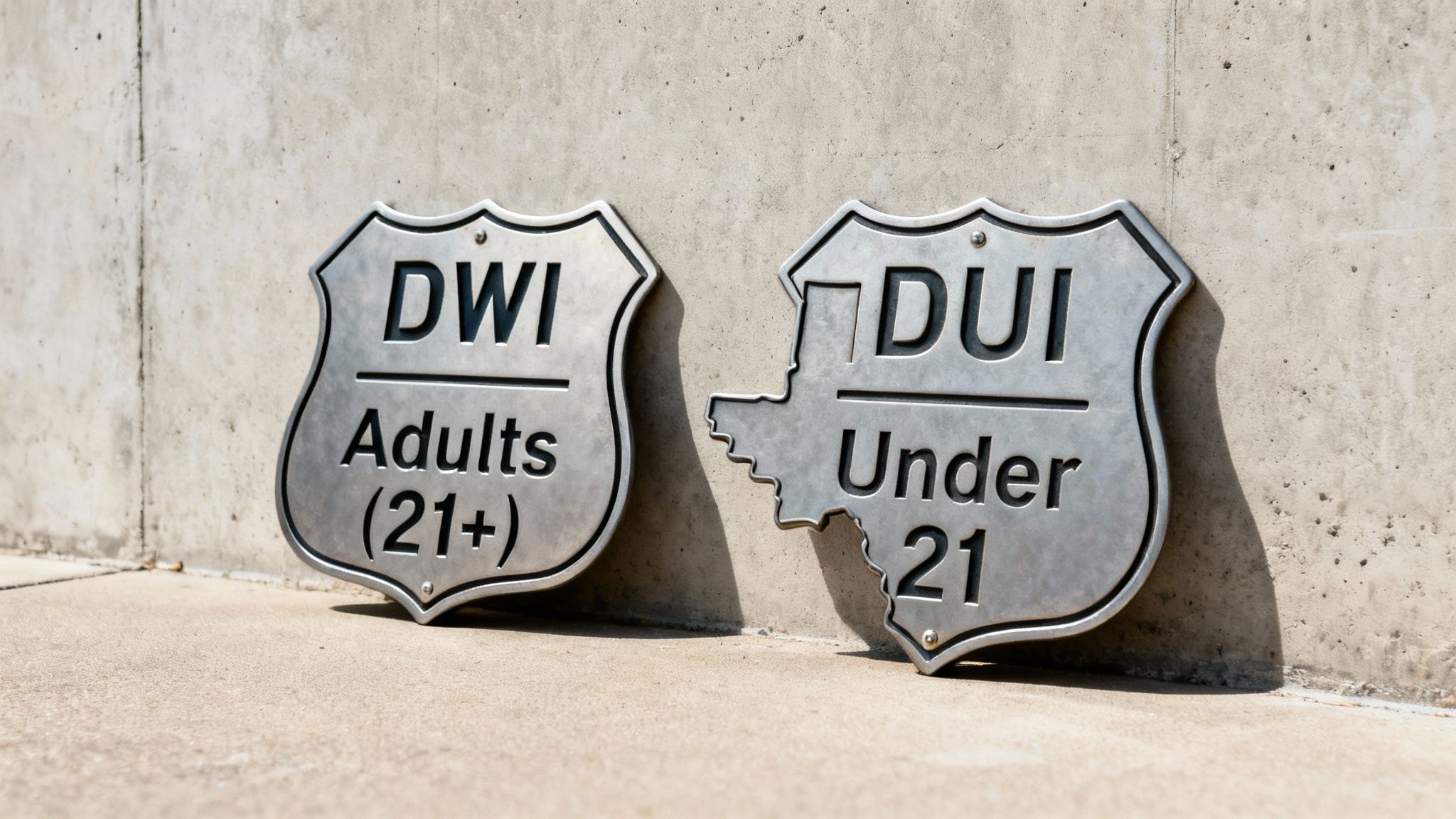
Defining the Charges Under Texas Law
The primary intoxicated driving offense in Texas is DWI. To address underage drinking and driving, the state created the separate DUI offense for minors under a strict "zero-tolerance" policy. It was designed to send a clear message and prevent tragic accidents.
Confusion often arises because people use "DUI" and "DWI" interchangeably in conversation. But in a Texas courtroom, they mean very different things. For a deeper dive, you can explore some of the official Texas DWI and DUI statistics on zealousadvocate.com.
To make it crystal clear, let's break down the key legal differences side-by-side.
Core Legal Differences: DUI vs. DWI in Texas
This table highlights the key legal distinctions between a DUI and a DWI charge in Texas, which is the foundation of any defense strategy.
| Legal Factor | Driving Under the Influence (DUI) | Driving While Intoxicated (DWI) |
|---|---|---|
| Applicable Age | Drivers under 21 years old | Primarily drivers 21 and older |
| Legal Authority | Texas Alcoholic Beverage Code | Texas Penal Code § 49.04 |
| Required Proof | Any detectable amount of alcohol | Proof of intoxication (BAC ≥ 0.08% or loss of faculties) |
| Typical Charge | Class C Misdemeanor (first offense) | Class B Misdemeanor (first offense) |
As you can see, your age is the trigger, but the legal authority and the evidence required to prove the case are where they truly diverge.
Why This Difference Matters for Your Case
So, why does this matter so much? Because the evidence needed to convict you, the potential jail time, the fines, and the long-term impact on your criminal record all hinge on whether you're facing a DUI or a DWI.
A DWI charge, governed by Texas Penal Code § 49.04, requires prosecutors to prove you were legally intoxicated. They must show either a Blood Alcohol Concentration (BAC) of 0.08% or higher, or that you lost the normal use of your mental or physical faculties because of alcohol or drugs.
A DUI charge for a minor has a much lower bar. The prosecutor only needs to prove that you had any detectable amount of alcohol in your system while driving. One beer could be enough.
Grasping this fundamental difference is absolutely essential as you and your attorney begin to navigate the Texas criminal justice system and map out a defense.
Understanding the Texas DWI Charge for Adults
If you're over 21 and find yourself arrested for drunk driving in Texas, the charge you're up against is Driving While Intoxicated, or DWI. This offense is defined in Texas Penal Code § 49.04, and it’s the foundation for how the state prosecutes adult drivers. Understanding what this law actually says is the first critical step for anyone facing this serious situation.
Unlike a DUI charge for a minor, which only requires any detectable amount of alcohol, a DWI charge puts a much heavier burden on the prosecution. They have to prove you were legally intoxicated while operating a motor vehicle in a public place. This is a much higher legal standard to meet.

How the State Proves Intoxication
Texas law gives prosecutors three different ways to prove you were intoxicated at the time of your arrest. They only need to convince a jury of one of them to get a conviction.
Blood Alcohol Concentration (BAC) of 0.08% or Higher: This is the most straightforward method. If a chemical test—like a breathalyzer or a blood draw—shows your BAC was 0.08% or higher while you were driving, you are considered "per se" intoxicated. This means you are intoxicated under the law, no matter how sober you felt.
Loss of Normal Mental Faculties: The State can also argue that because you consumed alcohol, drugs, or a combination of substances, you lost the normal use of your mental faculties. The evidence they might use for this includes things like slurred speech, confusion about your location, or an inability to follow an officer's instructions.
Loss of Normal Physical Faculties: This approach focuses on physical impairment. Prosecutors often build their case around an officer’s testimony about your driving—such as weaving or swerving—your performance on Standardized Field Sobriety Tests (SFSTs), or physical clues like stumbling or fumbling to find your license.
A key takeaway: you can be charged and even convicted of DWI with a BAC under 0.08%. If the prosecutor can build a compelling case that you lost your normal mental or physical abilities due to alcohol, that BAC number suddenly becomes less important.
Penalties for a First-Time DWI Offense
For most people, a first-time DWI with no aggravating factors is charged as a Class B Misdemeanor. Don't let the word "misdemeanor" fool you; the consequences are severe and can throw your life into chaos.
If you’re facing a charge like this, it's vital to know what you might be up against. You can get a deeper look at what to expect in our detailed guide on a 1st DWI offense in Texas.
A conviction for a Class B Misdemeanor DWI can bring:
- Fines: Up to $2,000.
- Jail Time: A minimum of 72 hours and up to 180 days behind bars.
- License Suspension: Your driver's license can be suspended for up to a full year.
On top of these penalties, a judge can also order probation, require you to attend DWI education classes, and mandate the installation of an ignition interlock device on your vehicle.
When a DWI Becomes a Felony
Certain situations, known as aggravating factors, can instantly escalate a DWI charge from a misdemeanor to a much more serious felony. When that happens, the potential penalties skyrocket, including the real possibility of significant prison time.
Common aggravating factors that raise the stakes include:
- High BAC: If your BAC is 0.15% or higher, the charge is enhanced to a Class A Misdemeanor. This doubles the potential fines to $4,000 and jail time to one year.
- Child Passenger: Driving while intoxicated with a passenger under the age of 15 is an automatic State Jail Felony.
- Prior Convictions: A second DWI is a Class A Misdemeanor, and a third DWI is a third-degree felony, which carries a prison sentence of two to ten years.
Knowing exactly what you're charged with—and why—is the first step toward building a defense that works. An experienced Texas DWI attorney can dig into the evidence, challenge the prosecutor's story, and fight to protect your rights and your future.
Navigating a Texas DUI Charge as a Minor
For drivers under 21 in Texas, the rules for drinking and driving are unforgiving. The state’s “zero tolerance” policy means there’s a completely different set of laws for minors compared to adults. If you or your child is facing an underage drinking and driving charge, you’re not dealing with a DWI—you’re up against a Driving Under the Influence (DUI) charge, an offense designed to penalize any detectable alcohol consumption by a young driver.
This isn’t about being intoxicated in the traditional sense. Under the Texas Alcoholic Beverage Code, a minor can be charged with DUI for having any detectable amount of alcohol in their system. That’s the core of the zero-tolerance law. A single drink can be enough to kickstart a legal process with life-altering consequences.
Understanding Zero Tolerance
The legal standard for a minor is dramatically lower than for an adult facing a DWI. While an adult needs a BAC of 0.08% or evidence of lost faculties, a minor simply has to have a trace of alcohol present. This makes a DUI charge far easier for a prosecutor to prove in court.
The penalties are aimed at minors, focusing on education and deterrence, but don't mistake that for leniency. They are severe enough to create long-term roadblocks for a young person’s future.
A DUI charge isn't a simple traffic ticket; it’s a Class C Misdemeanor that creates a permanent criminal record. This record will show up on background checks for college applications, scholarships, and future jobs, making a proactive legal defense absolutely critical from day one.
Penalties for an Underage DUI
While a first-offense DUI for a minor typically doesn't involve jail time like an adult DWI, the consequences are still significant and designed to leave a lasting mark. A conviction brings a range of court-ordered penalties.
For a first offense, a minor can expect:
- Fines: Up to $500.
- License Suspension: A driver's license suspension of at least 60 days.
- Community Service: Between 20 and 40 hours of alcohol-related community service.
- Alcohol Awareness Course: Mandatory completion of an approved alcohol education program.
These penalties get steeper with each subsequent offense. A second DUI can lead to a license suspension of 120 days, and a third can mean a 180-day suspension, on top of higher fines and more community service. You can learn more about the specific steps involved by reading our guide on the juvenile DUI legal process.
The Broader Impact of a DUI Conviction
The reality is that court-ordered penalties are often just the beginning. A DUI conviction follows a young person, creating hidden consequences that can affect their opportunities for years. It's a heavy burden to carry at the start of your adult life.
The issue of drunk driving, particularly among young people, is a serious concern in our state. Tragically, Texas has one of the highest rates of fatal crashes involving underage drivers. This statistic highlights why law enforcement and prosecutors take these charges so seriously.
A DUI record can impact:
- College and University Admissions: Many applications ask about criminal history, and a conviction is a major red flag for admissions officers.
- Scholarship Opportunities: Financial aid and scholarship committees may deny applicants who have a criminal record.
- Employment: Future employers will see the DUI on background checks, potentially limiting job prospects, especially for positions that require driving.
- Insurance Rates: Car insurance premiums for the entire family can skyrocket after a DUI conviction.
Because the stakes are so high, it's essential to fight a DUI charge with a strong and immediate defense. An experienced attorney can scrutinize the evidence, challenge the legality of the traffic stop, and work to protect your child’s future from the lasting shadow of a single mistake.
Comparing Penalties and Long-Term Consequences
When you are charged with an intoxicated driving offense in Texas, the immediate penalties are only the beginning. A conviction for either a DWI or a DUI creates a ripple effect that can touch every part of your life for years. Understanding the full scope of these consequences is the first step in recognizing why a strategic legal defense is so important.
While both charges are serious, the penalties for an adult DWI are designed to be much more punitive than those for a minor’s first-offense DUI. That’s because a DWI is a significant criminal offense, often starting as a Class B Misdemeanor with the potential for jail time. A DUI, while still a Class C Misdemeanor, focuses more on education and deterrence for young drivers.
The Direct Costs: Fines, Jail, and License Suspension
The most immediate penalties handed down by a court are fines, potential jail time, and the suspension of your driving privileges. For a first-offense adult DWI, you could face fines up to $2,000, a jail sentence ranging from 72 hours to 180 days, and a driver's license suspension for up to one year.
In contrast, a first-offense DUI for a minor typically involves a fine up to $500, no initial jail time, and a license suspension of at least 60 days. The focus is on mandatory community service and alcohol awareness education.
Here's a quick look at how the penalties stack up side-by-side for a first offense.
First-Offense Penalty Comparison for DWI and DUI
| Penalty | DWI (Adult) | DUI (Minor) |
|---|---|---|
| Criminal Classification | Class B Misdemeanor (or higher) | Class C Misdemeanor |
| Fine | Up to $2,000 | Up to $500 |
| Jail Time | 3 to 180 days | Not typically ordered |
| License Suspension | 90 days to 1 year | 60 to 180 days |
| Alcohol Education | Required | Required |
| Community Service | 24 to 100 hours | 20 to 40 hours |
| Ignition Interlock | Possible | Possible |
As you can see, the court takes a much heavier hand with adult DWI charges, even for a first-time mistake.
The infographic below summarizes the key penalties a minor faces under Texas's zero-tolerance DUI laws.
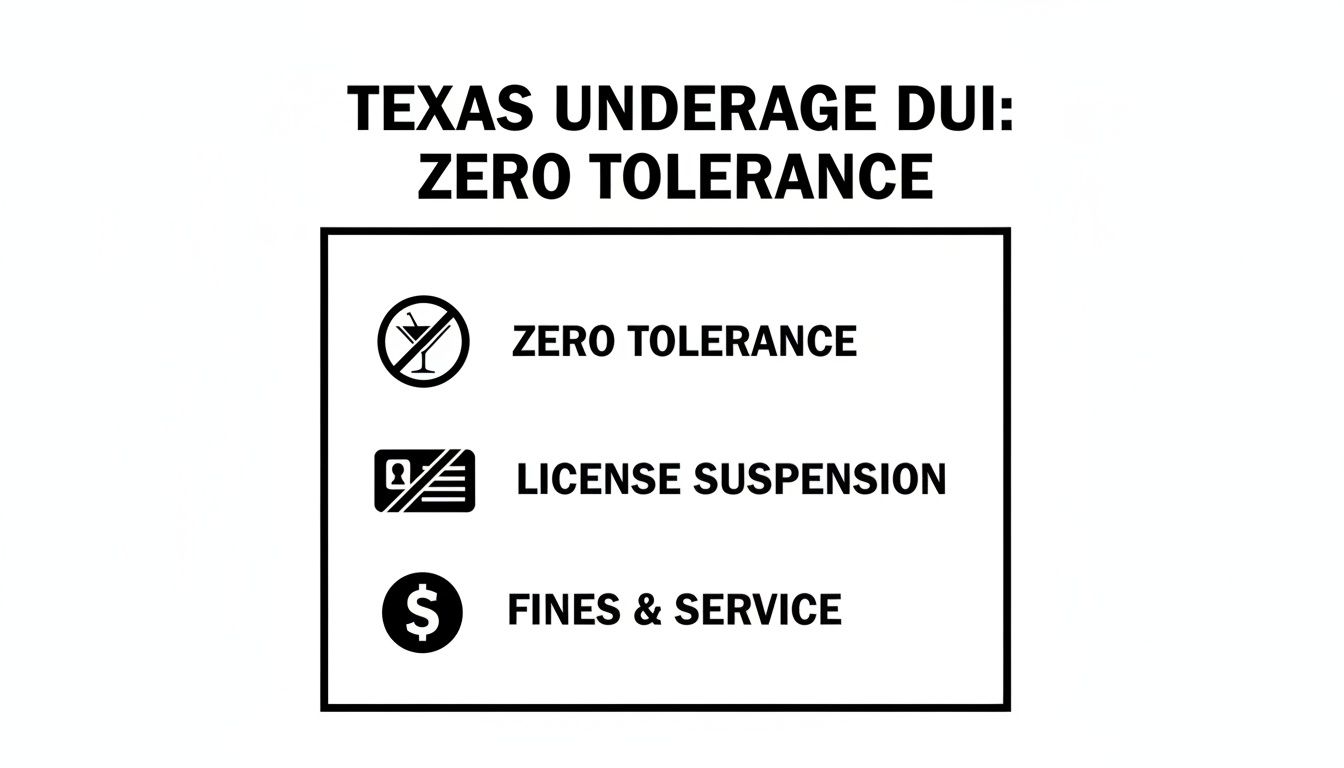
This visual really highlights how Texas law targets underage drinking and driving with specific, non-negotiable consequences aimed at preventing future offenses.
The Administrative License Revocation Process
One of the most confusing parts of any DWI or DUI arrest is the Administrative License Revocation (ALR) process. This is a civil proceeding that is completely separate from your criminal case. If you fail or refuse a chemical test (breath or blood), the Texas Department of Public Safety (DPS) will automatically move to suspend your license.
You have only 15 days from the date of your arrest to request an ALR hearing to fight this automatic suspension. Missing this deadline means your license will be suspended, regardless of what happens in your criminal court case.
This is a critical deadline that many people miss, which is why it's so important to contact a Texas DWI attorney immediately after an arrest.
Hidden Costs and Lasting Consequences
The penalties listed on paper don't tell the whole story. The "hidden costs" of a conviction can often be more damaging than the initial fines.
These long-term consequences include:
- Drastic Insurance Increases: Your car insurance premiums will skyrocket, often costing you thousands of extra dollars over several years.
- Permanent Criminal Record: A conviction for either offense creates a criminal record that is visible on background checks for employment, housing, and professional licenses.
- Employment Difficulties: Many employers are hesitant to hire individuals with a DWI or DUI on their record, especially for jobs that require driving or a high level of trust.
- Professional Licensing Issues: A conviction can jeopardize professional licenses for nurses, pilots, real estate agents, and other licensed professionals.
Understanding the stark conviction trends in Texas shows just how much is at stake. Outcomes often hinge on your Blood Alcohol Concentration (BAC) and even the county where you were arrested. For cases with a BAC of 0.15% or higher, conviction rates can spike to between 70-85%, which comes with enhanced penalties. These statistics can vary significantly between major counties like Travis, Bexar, and Tarrant. You can find more insights on these drunk driving statistics on abc13.com.
Whether you are an adult facing a DWI or a minor navigating a DUI, the potential damage to your future is immense. The fines, court costs, and increased insurance are just the financial side. The harm to your reputation and career opportunities can be even more severe. This is why you cannot afford to face these charges alone.
What Happens After a DWI or DUI Arrest in Texas
The sound of handcuffs is jarring. In the moments after a DWI or DUI arrest, everything moves fast, and the fear of the unknown can be overwhelming. But knowing what’s coming next can give you back a sense of control. This guide walks you through the entire process, from the back of the patrol car to your first day in court.
Getting arrested is disorienting, but it’s not the end of the road. It’s the start of a legal journey where you have rights that need to be protected every step of the way.
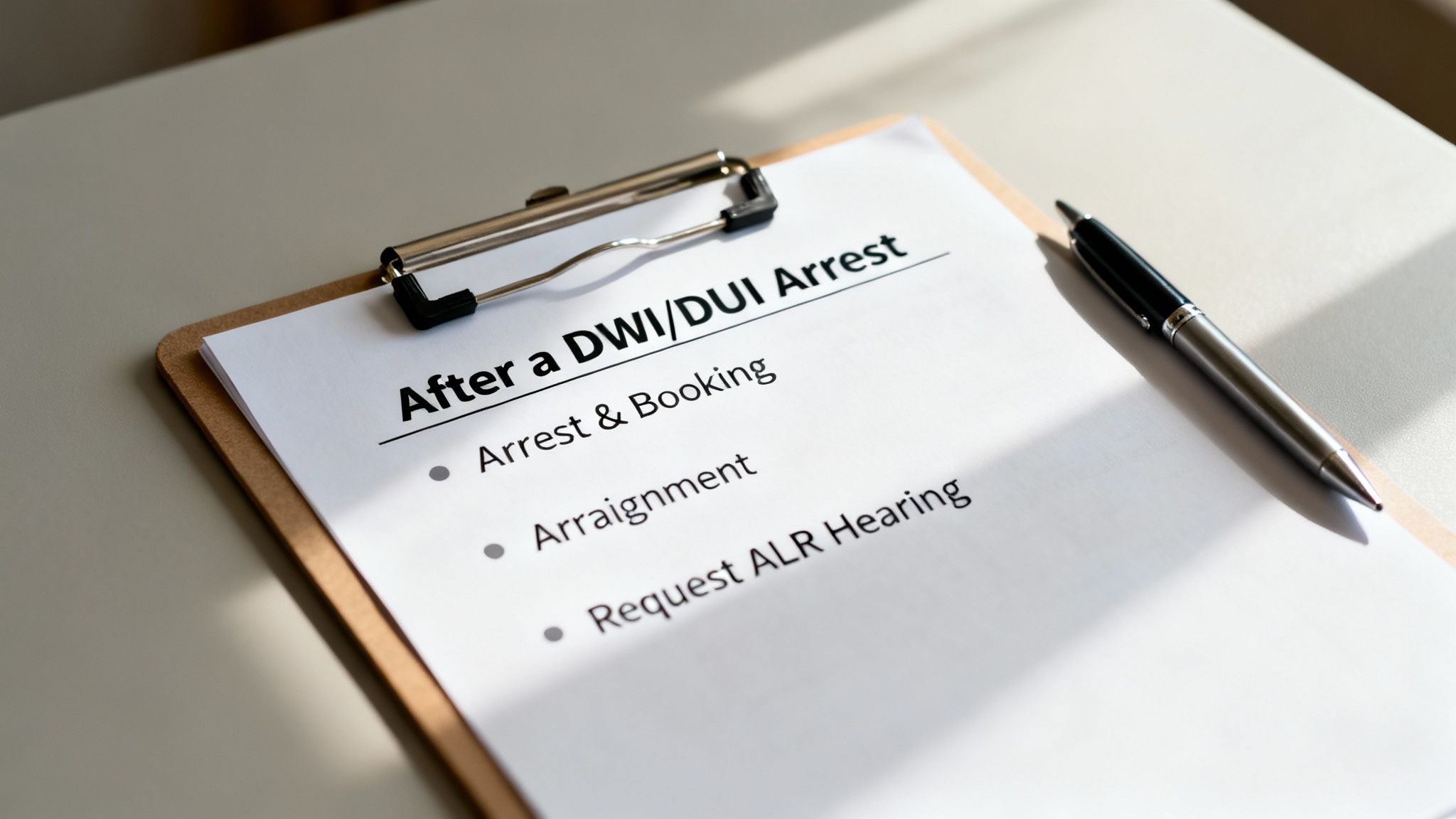
The First 24 Hours: The Arrest and Booking Process
Once an officer arrests you for a suspected DWI or DUI, you’ll be taken to a local police station or county jail for booking. This isn't an interrogation; it's an administrative process that includes:
- Information Gathering: The police will take down your personal details, like your name, date of birth, and address.
- Mugshot and Fingerprints: They will take your photograph (the mugshot) and record your fingerprints.
- Property Collection: Any personal belongings you have will be collected, cataloged, and stored for you until your release.
During booking, you'll be formally told what charges you are facing. It is absolutely critical to remember that you have the right to remain silent and the right to an attorney. You should exercise both.
The Critical 15-Day ALR Deadline
One of the most urgent deadlines you'll face after a DWI arrest in Texas has nothing to do with the criminal court. It's a civil process called the Administrative License Revocation (ALR) hearing.
If you refused a breath or blood test, or if you took one and your BAC was 0.08% or higher (or any detectable amount for a minor), the Texas Department of Public Safety (DPS) will automatically move to suspend your driver's license.
You have exactly 15 days from the date of your arrest to request an ALR hearing and fight this automatic suspension. If you miss this deadline, your license will be suspended—no matter what happens with your criminal case.
This is a make-or-break first step. An experienced Houston criminal lawyer can file the request for you and represent you at the hearing, fighting to keep you on the road while the criminal case unfolds.
The Arraignment: Your First Court Appearance
After you are released from jail, either on bail or personal recognizance, you'll get a date for your first court appearance, called an arraignment. It’s a brief but formal hearing where a few key things happen.
At the arraignment, the judge will:
- Formally read the charges against you.
- Ask you to enter a plea. Your attorney will almost always advise you to plead "not guilty." This isn't a claim of innocence; it's a procedural step that forces the prosecutor to prove their case and preserves all of your legal rights.
- Set your bond conditions. This might include things like not drinking alcohol, installing an ignition interlock device in your car, or checking in with a probation officer while the case is ongoing.
This hearing officially kicks off your criminal case. From this point, the case moves into the pretrial phase.
Pretrial and Discovery: The Heart of Your Defense
The pretrial phase is where the real work on your defense gets done. During this time, your lawyer will engage in a process called discovery, where they formally demand that the prosecutor turn over all the evidence they have against you. This includes everything:
- Police reports
- Dashcam and bodycam video footage
- Results from any breath or blood tests
- Statements from witnesses
- Maintenance and calibration logs for the breathalyzer machine
Your defense attorney will comb through every piece of evidence, looking for holes in the State's case. Was there a legal reason to pull you over in the first place? Were the field sobriety tests administered correctly? Was the breathalyzer machine working properly? The answers to these questions are often the keys to getting a case dismissed or negotiating a much better outcome.
Clearing Your Record with Expunctions and Nondisclosures
Even after a DWI case is over, the arrest stays on your record. It’s a shadow that can follow you long after you’ve paid your dues, creating real-world problems when you're trying to get a job, find housing, or even apply for a loan.
But in Texas, an arrest doesn't have to be a life sentence. The law provides powerful ways to move forward with a clean slate. This isn't just about shuffling legal paperwork; it’s about taking back your reputation and reclaiming your future. Understanding your options is the first step to putting this chapter behind you for good.
Can Your DWI or DUI Record Be Destroyed?
The absolute best way to clear your name is with an expunction. Think of it as a legal process that completely destroys every single record of your arrest. Once a judge grants an expunction, it’s like it never happened. You can legally deny you were ever arrested for that offense.
However, getting an expunction is tough, as the eligibility requirements are very strict. Generally, you only qualify if:
- Your case was dismissed by the prosecutor.
- A jury found you "not guilty" at trial (an acquittal).
- You successfully completed a pretrial diversion program.
An expunction is a true fresh start, but it's available only for cases that did not end in a conviction or any kind of probation.
Sealing Your Record with an Order of Nondisclosure
What if your case ended with deferred adjudication probation? You might be eligible for an order of nondisclosure. This legal tool doesn't destroy your arrest record, but it does seal it from the public's view. In practice, this means private employers, landlords, and others won't see it on a typical background check.
While an expunction erases the past, a nondisclosure hides it. Government agencies and law enforcement can still access a sealed record, but for most practical purposes in your daily life, the record is invisible.
Whether you can get a nondisclosure depends on the specific offense, your criminal history, and completing a mandatory waiting period after your probation is over. To get a better handle on how these two options stack up, you can learn more about expungement vs. nondisclosure in Texas in our detailed article.
Petitioning for either an expunction or a nondisclosure is a complex legal process. The deadlines are strict and the procedural rules are unforgiving. A small mistake on the paperwork can get your petition denied, closing the door on your chance to clear your name. An experienced criminal defense attorney can determine your eligibility, handle all the complex filings, and argue your case in court to give you the best shot at success.
Common Questions About Texas DUI and DWI Charges
When you're facing a drunk driving charge, the questions can feel overwhelming. Here are some straightforward answers to the most common concerns we hear from clients, cutting through the legal jargon to give you a clear picture of what's at stake.
Should I Refuse a Breathalyzer Test in Texas?
This is one of the toughest decisions you can make during a traffic stop. On one hand, refusing a breath or blood test means the state won't have a clear-cut BAC number to use against you. On the other hand, Texas has "implied consent" laws, which means you've already agreed to these tests just by having a driver's license.
Refusing triggers an immediate and automatic driver's license suspension—typically for 180 days for a first offense. Prosecutors can still move forward with a DWI charge using other evidence, like the officer’s testimony about your driving, your appearance, and how you performed on any field sobriety tests. It's a complex decision with immediate consequences for your freedom to drive, and you should discuss your options with a Texas DWI attorney.
Can I Get a DWI for Using Prescription Medication?
Yes, you can. Many people are surprised by this, but a DWI in Texas isn't just about alcohol. The law defines intoxication as being impaired by alcohol, a controlled substance, a drug, or any combination of them.
This includes legally prescribed medications if they compromise your ability to drive safely. Having a valid prescription is not a defense. The only question that matters in court is whether that substance impaired your normal mental or physical faculties while you were behind the wheel.
How Long Does a DWI Stay on My Record in Texas?
Forever. A DWI conviction in Texas becomes a permanent part of your criminal record and does not simply disappear after a few years. The only way to remove it from your record is through an expunction or an order of nondisclosure.
An expunction, which completely erases the record, is only an option if your case was ultimately dismissed or if you were found not guilty at trial. For some first-time offenders who successfully complete a specific type of probation, an order of nondisclosure might be possible after a waiting period. This doesn't destroy the record, but it does seal it from public view.
If you’ve been charged with a crime in Texas, call The Law Office of Bryan Fagan, PLLC for a free and confidential consultation. Our defense team is ready to protect your rights. https://texascriminallawyer.net