Being arrested in Texas can be terrifying—but you don’t have to face it alone. If you've been charged with driving while intoxicated, you might hear the terms DUI and DWI used, but it's crucial to understand they are not the same. In Texas, DUI and DWI are not interchangeable. They are two completely different offenses, and the one you could face comes down to a single factor: your age.
If you’re 21 or older and accused of driving while impaired, you’ll be charged with Driving While Intoxicated (DWI). But if you’re a minor under 21 with any detectable amount of alcohol in your system, you’ll face a Driving Under the Influence (DUI) charge. Knowing the difference is the first step toward building a solid defense.
Understanding the Legal Distinction in Texas
When you're dealing with the stress of an arrest, the last thing you need is more confusion. Many people use DUI and DWI interchangeably, but in the eyes of Texas law, they are worlds apart. The core distinction boils down to your age and what a prosecutor must prove to secure a conviction.

A DWI charge, defined in the Texas Penal Code, is for adults. To convict you, prosecutors must prove you were legally intoxicated in one of two ways:
- Your Blood Alcohol Concentration (BAC) was 0.08% or higher.
- You lost the normal use of your mental or physical faculties because of alcohol or drugs.
A DUI, on the other hand, is governed by the Texas Alcoholic Beverage Code. It’s a direct result of the state’s zero-tolerance policy for underage drinking and driving. For a DUI conviction, the prosecutor doesn’t have to prove you were impaired at all. They only need to show that you, as a driver under 21, had any detectable amount of alcohol in your system.
How Age Determines the Charge
This age-based split creates two entirely separate legal paths with different penalties and lifelong consequences. An adult cannot be charged with a DUI. And to make matters more complex, a minor caught driving with a BAC over 0.08% could face an adult DWI charge in addition to a DUI.
The most critical factor in a Texas drunk driving case is often your age. It dictates not just the name of the charge but the entire legal framework, from the evidence required to the potential penalties you face.
To put it simply, the state has a much lower bar to clear when prosecuting a minor. Let’s break down the key differences.
Quick Comparison: DUI vs DWI Charges in Texas
This table gives you a clear, high-level summary of these fundamental distinctions.
| Factor | DWI (Driving While Intoxicated) | DUI (Driving Under the Influence) |
|---|---|---|
| Applicable Age Group | 21 years and older | Under 21 years |
| Legal Standard | Impairment or BAC of 0.08% or more | Any detectable amount of alcohol |
| Governing Law | Texas Penal Code § 49.04 | Texas Alcoholic Beverage Code |
| Typical Offense Level | Class B Misdemeanor (for a first offense) | Class C Misdemeanor (for a first offense) |
As you can see, while both are serious, the legal requirements and the laws that govern them are completely different. Understanding which charge you’re up against is the first and most important step in preparing your defense.
What It Means to Be Charged with DWI in Texas
If you're an adult aged 21 or over in Texas, an intoxicated driving charge means one thing: Driving While Intoxicated, or DWI. This is the standard charge for adults, and it comes with serious penalties that can affect your freedom, your finances, and your future.
To really understand what a DWI charge means, you have to understand how the state defines "intoxicated" in plain English. It’s not as straightforward as most people think.
The Two Ways Texas Defines Intoxication
Under Texas Penal Code § 49.04, the state has two different angles it can use to prove you were intoxicated. This is a critical point because a DWI conviction isn't always about the number on a breathalyzer. The prosecution just needs to prove one of the following beyond a reasonable doubt:
- Per Se Intoxication: This is the one everyone knows. If a chemical test—breath, blood, or urine—shows you had a Blood Alcohol Concentration (BAC) of 0.08% or higher, you are considered intoxicated under the law. It doesn’t matter if you felt fine to drive; the number itself is enough.
- Impairment Theory: Here’s where things get subjective. You can be convicted of DWI even if your BAC is below 0.08% or if there’s no chemical test at all. If the state can prove you lost the "normal use of mental or physical faculties" because of alcohol, drugs, or a mix of both, that’s legally intoxication.
That second definition is where a prosecutor’s case often relies on observation and opinion, which is exactly why having a skilled Texas DWI attorney is so important. They’ll build their argument using the officer’s notes and your performance on field sobriety tests.
A huge misconception is that if you pass a breathalyzer, you’re in the clear. Not in Texas. The State can still pursue a DWI charge by arguing that your driving, coordination, or speech showed you'd lost your normal abilities.
How Prosecutors Build a DWI Case
A prosecutor’s job is to present evidence that convinces a jury you were intoxicated. This evidence collection starts the second an officer decides to pull you over. They're trained to look for specific signs they believe point to impairment.
Practical advice: Remember that every interaction is being recorded and noted. Key evidence in a typical DWI case includes:
- The Traffic Stop: The initial reason for the stop, whether it was weaving, speeding, or a broken taillight.
- Officer Observations: The officer's notes about your appearance (like bloodshot eyes), your speech (slurring), or any smell of alcohol.
- Field Sobriety Tests (FSTs): These are the physical and mental exercises like the walk-and-turn, one-leg stand, and the horizontal gaze nystagmus (eye) test. These tests are notoriously hard to pass perfectly even when sober and can be challenged by a sharp Houston criminal lawyer.
- Chemical Test Results: The numbers from a breathalyzer or blood test are powerful, but they aren't foolproof. Machines can be calibrated incorrectly, samples can be contaminated or mishandled, and the results can be flat-out wrong.
In Texas, the line between DUI and DWI is clear: a DUI is for minors with any detectable amount of alcohol. A DWI is the charge for adults operating a vehicle with a BAC of 0.08% or higher or who are impaired by any substance. This distinction is massive because a first-time DWI is a Class B misdemeanor that can land you in jail for up to 180 days with huge fines—and the penalties get much worse from there. Explore more details about Texas DWI charges and trends.
Understanding how the state puts its case together is the first step toward taking it apart. Every piece of their evidence is an opportunity for a strong defense.
Texas's Zero Tolerance Law for Minors
When it comes to drivers under 21, Texas law is incredibly strict. The state enforces a zero-tolerance policy, and this is where the specific charge of Driving Under the Influence (DUI) comes into play. If your child is facing this charge, it’s critical to understand that it operates under a completely different set of rules than an adult DWI.
Unlike a DWI, a DUI charge doesn’t require any proof of impairment. The prosecutor doesn't need to show that your child was swerving, slurring their speech, or acting "drunk." The legal standard is much, much lower.
What Is a Minor DUI in Texas?
Under the Texas Alcoholic Beverage Code, a minor commits a DUI if they operate a motor vehicle in a public place with any detectable amount of alcohol in their system. That means a BAC of 0.01% is just as illegal as a 0.07%. Any trace is enough to trigger an arrest and a formal charge.
This zero-tolerance approach is designed to stamp out underage drinking and driving entirely. The logic is simple: younger drivers are less experienced, and alcohol affects them more significantly, creating a dangerous combination on the road.
The legal landscape is especially tough for minors. Things can get even more complicated if other factors are involved, like using fake identification to get alcohol. It's smart for parents and young adults to know how to spot fake IDs to understand the full scope of risks.
The Consequences of a DUI Conviction
While a first-offense DUI is usually a Class C Misdemeanor—less severe than a Class B Misdemeanor DWI—the penalties can still create massive, long-term obstacles for a young person just starting their life. A conviction isn't just a ticket; it's a criminal record that follows them for years.
The immediate penalties for a first-time DUI often include:
- A fine of up to $500.
- A driver's license suspension of at least 60 days.
- Between 20 and 40 hours of mandatory community service.
- Required attendance in an Alcohol Awareness Education Program.
But the hidden consequences are often far more damaging.
A DUI conviction on a young person's record can be a major roadblock. It can jeopardize college admissions, disqualify them from certain scholarships, and raise red flags for future employers during background checks.
These collateral consequences are exactly why a DUI charge must be taken seriously from day one. An experienced attorney can cut through the noise and explain the various DUI myths and the real consequences for those under 21 to help your family make the right moves.
It's also crucial to know that if a minor is caught driving with a BAC of 0.08% or higher, they can be charged with an adult DWI on top of the DUI. This scenario dramatically raises the stakes, exposing them to the much harsher penalties of a DWI, including potential jail time.
Facing a DUI charge is overwhelming for any family. But with a compassionate and skilled legal team on your side, you can fight to protect your child’s future and minimize the impact of a single mistake.
Comparing The Penalties For A DWI And DUI Conviction
When you’re facing an intoxicated driving charge, your first thought is probably about the consequences. It's a natural and immediate worry. Understanding the potential penalties is the first step in grasping what’s at stake, because in Texas, the punishments for a DWI and a DUI are worlds apart.
A standard first-offense DWI for an adult is a Class B Misdemeanor, which comes with serious criminal penalties. A first-offense DUI for a minor, on the other hand, is a Class C Misdemeanor. While still serious, its initial consequences are generally less severe. The key thing to remember is that both criminal and administrative penalties apply, hitting your freedom, your finances, and your ability to drive.
Criminal Penalties Explained
Criminal penalties are what the court hands down after a conviction—the fines and jail time most people think of. This is where the difference between a first-offense DWI and DUI becomes incredibly stark.
For an adult DWI, you’re looking at:
- Jail Time: A mandatory minimum of 72 hours and up to 180 days in county jail.
- Fines: A fine of up to $2,000.
- Court Costs: Additional fees that can tack on hundreds, if not thousands, to your total bill.
For a minor’s first DUI, the criminal penalties are more focused on education and community service:
- Fines: A fine of up to $500.
- Community Service: Usually between 20 and 40 hours of court-ordered service.
- Alcohol Awareness: Mandatory completion of an alcohol education program.
This infographic breaks down Texas's zero-tolerance DUI law for minors, covering who it applies to, the operation of a vehicle, and the simple presence of alcohol.
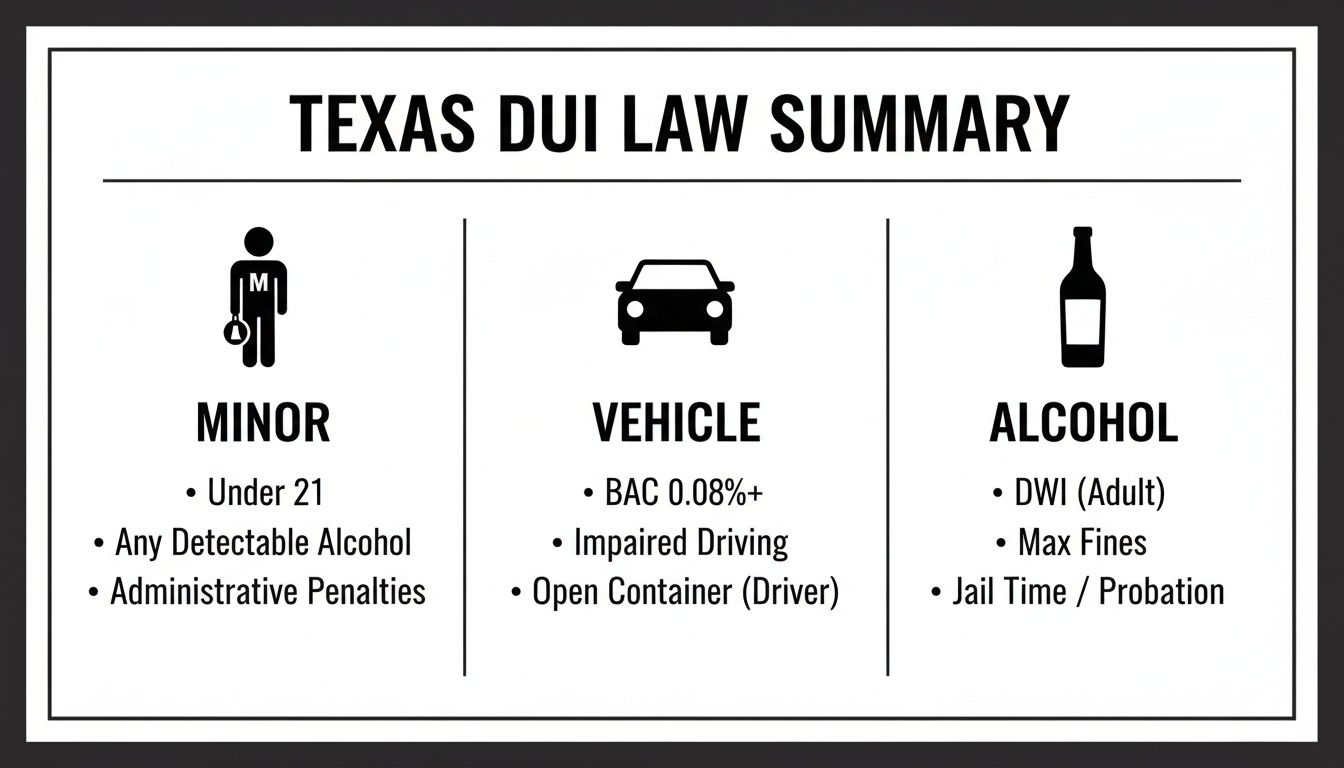
As you can see, for a DUI, the law isn't concerned with impairment—it's strictly about the driver's age and whether there was any detectable alcohol in their system.
Penalty Breakdown: DWI vs. DUI First Offense
This table details the potential criminal and administrative penalties for a standard first-offense DWI versus a first-offense DUI in Texas, helping you understand the stakes involved with each charge.
| Penalty Type | DWI (First Offense – Class B Misdemeanor) | DUI (First Offense – Class C Misdemeanor) |
|---|---|---|
| Criminal Fine | Up to $2,000 | Up to $500 |
| Jail Time | 72 hours to 180 days | No jail time |
| License Suspension | 90 days to 1 year (ALR) | 60 days (ALR) |
| Community Service | 24 to 100 hours | 20 to 40 hours |
| Mandatory Program | DWI Education Program | Alcohol Awareness Course |
| Ignition Interlock | Possible, often as a condition of bond or probation | Possible, often as a condition of probation |
Looking at the two side-by-side, it's clear that while both are serious, a DWI conviction carries the immediate threat of jail time and much steeper financial penalties right out of the gate.
Administrative Penalties: License Suspension
Completely separate from your criminal case, the Texas Department of Public Safety (DPS) will try to suspend your driver's license. This is a civil process called an Administrative License Revocation (ALR), and it’s triggered automatically if you fail a chemical test (BAC of 0.08% or higher) or refuse to take one.
For a DWI, a failed test can mean a 90-day suspension. For a minor’s DUI, a failed test results in a 60-day suspension for a first offense. Refuse the test, and those suspension periods can get much longer. You have a very small window of time to request an ALR hearing to fight this. You can learn more by reading our guide to Texas DUI penalties.
It's a common mistake to think the criminal case is the only battle. The fight to save your driver's license starts immediately after your arrest and happens in a completely different proceeding from your criminal charges.
When Penalties Get Worse: Enhanced DWI Charges
It's critical to know that certain factors can elevate a standard DWI into a much more serious offense with far harsher penalties. These are known as enhancements.
Common DWI enhancements in Texas include:
- High BAC: If your blood alcohol concentration was 0.15% or higher, a first-offense DWI gets bumped from a Class B to a Class A Misdemeanor. This doubles the potential jail time to one year and raises the maximum fine to $4,000.
- Child Passenger: Driving with a passenger under the age of 15 automatically turns the charge into a State Jail Felony. You could face 180 days to two years in a state jail and a fine up to $10,000.
- Repeat Offenses: A second DWI is a Class A Misdemeanor. A third DWI becomes a Third-Degree Felony, punishable by two to 10 years in prison.
These enhancements show why every DWI or DUI charge demands a strong, immediate defense. What seems like a straightforward misdemeanor can quickly spiral into a life-altering felony conviction without the right legal guidance.
What to Expect After a DWI or DUI Arrest in Texas
Being put in handcuffs and taken to jail is a disorienting, frightening experience. The arrest, though, is just the start of a complicated legal journey. You're not just dealing with a criminal case; there's also a separate civil process to save your driver's license. Understanding the road ahead can help reduce your anxiety and show you where a strong defense can make a critical difference.
The process kicks off the second you're arrested. You'll be transported to a local jail for booking—fingerprints, a mugshot, and logging your personal information. This is when the clock starts ticking on several deadlines that can impact your freedom and your future.
The Two Battles You Must Fight
After a DWI or DUI arrest in Texas, you are immediately facing two separate legal fights on two different fronts. It's a common and costly mistake to focus only on the criminal charges while ignoring the administrative one.
The Criminal Case: This is the court process where a prosecutor tries to prove you are guilty of DWI or DUI beyond a reasonable doubt. It involves court dates, potential plea negotiations, and possibly a trial. The outcome can lead to fines, jail time, and a permanent criminal record.
The Administrative License Revocation (ALR) Hearing: This is a separate civil process started by the Texas Department of Public Safety (DPS) to suspend your driver's license. You have only 15 days from the date of your arrest to request a hearing to challenge this automatic suspension. If you miss this deadline, you forfeit your right to fight, and your license will be suspended.
The ALR hearing is your first and often best opportunity to challenge the evidence against you. An experienced Texas DWI attorney can use this hearing to question the arresting officer under oath, which can reveal weaknesses in the state's case that can be used to your advantage in the criminal proceedings.
Key Stages in the Texas Criminal Court Process
Navigating the court system can feel overwhelming if you don't know what to expect. While every case is unique, the general timeline follows a predictable path. A skilled defense attorney guides you through each step and protects your rights along the way.
Here is a step-by-step guide on what happens after an arrest:
Arraignment: This is your first official court appearance. The judge will read the charges against you, and you'll enter a plea—almost always "not guilty" at this stage to preserve all your legal options. Bail or bond conditions will also be set.
Pre-Trial Phase: This is the longest phase, where your attorney digs into the evidence, reviewing police reports and videos. They'll also file legal challenges called pre-trial motions, which can be used to suppress evidence that was obtained illegally, like challenging the legality of the traffic stop or the accuracy of a breathalyzer test.
Plea Bargaining: During the pre-trial phase, your attorney will negotiate with the prosecutor. Depending on the strength of the evidence, the prosecutor might offer a plea agreement to a lesser charge or a more lenient sentence to avoid going to trial.
Trial and Sentencing: If a plea deal can't be reached, your case proceeds to trial. You have the right to have your case heard by a jury of your peers or, in some situations, a judge (known as a "bench trial"). The prosecution has the burden of proving its case beyond a reasonable doubt. If convicted, the judge or jury will then determine your sentence.
The outcome of DWI cases can vary dramatically depending on where you were arrested. Local court procedures and prosecutorial tendencies play a huge role. For instance, dismissal rates for first-time DWIs range from about 18-25% in Dallas County to only 8-12% in Bexar County, showing just how important local expertise really is.
No matter what, knowing what to do immediately after a DUI arrest can significantly impact your case's outcome. The steps you take in those first few hours and days are critical for building a strong defense.
Clearing Your Record with Expunctions and Nondisclosures
Even when a DWI or DUI case ends in your favor, the arrest itself can cast a long shadow over your life. A publicly accessible arrest record can create significant hurdles when you’re applying for jobs, seeking housing, or pursuing a professional license. Fortunately, Texas law provides powerful legal tools to help you clear your name and move forward.
The two primary methods for post-conviction relief are expunctions and orders of nondisclosure. While both offer a fresh start, they work in fundamentally different ways. Understanding which one you might qualify for is the final, crucial step in putting this difficult chapter behind you for good.
Expunction: The Power to Erase an Arrest
An expunction is the most complete form of record clearing available. When a judge grants an expunction, it’s as if the arrest never happened. All government agencies are ordered to physically destroy every record related to the arrest, including police reports, fingerprints, and court filings.
You may be eligible for an expunction if your case resulted in one of the following outcomes:
- You were found not guilty at trial (acquitted).
- Your case was dismissed by the prosecutor.
- You successfully completed a pre-trial diversion program.
- You were arrested but never formally charged with a crime.
Once an expunction is granted, you can legally deny the arrest ever occurred on applications for jobs or housing, with very few exceptions.
Orders of Nondisclosure: Sealing a Record from Public View
An order of nondisclosure works a bit differently. Instead of destroying the record, it seals it, preventing private entities and the general public from viewing it. Government agencies and law enforcement can still see the record, but it’s hidden from background checks run by most employers. This is also known as record sealing.
Eligibility for nondisclosure often applies to individuals who successfully completed a deferred adjudication program. This is a type of probation where you plead guilty or no contest, but the judge defers a finding of guilt. If you complete the probation terms successfully, the case is dismissed, and you can petition to have the record sealed.
"Beyond understanding the legal process, it's crucial to consider the long-term implications of a conviction, such as how it might appear on criminal record checks for employers."
The path to clearing your record involves specific eligibility requirements and strict timelines. Navigating the petition process requires careful attention to legal detail. An experienced criminal defense attorney can determine if you qualify for an expunction or nondisclosure and guide you through every step, ensuring you have the best possible chance to truly leave the past behind.
Common Questions About Texas DWI & DUI Laws
When you're facing an intoxicated driving charge, your mind is flooded with urgent questions. The legal system can feel overwhelming and confusing, but getting clear, straightforward answers is the first step to taking back control. Here are some of the most common questions our clients ask about the difference between a DWI and a DUI in Texas.
Can I Refuse a Breathalyzer Test in Texas?
Yes, you have the right to refuse a breathalyzer or blood test in Texas. However, that refusal comes with immediate consequences. This is because of the state's "implied consent" law, which means that by accepting a driver's license, you've already agreed to submit to these tests if lawfully asked.
Refusing the test triggers an automatic driver's license suspension through a civil process called an Administrative License Revocation (ALR). Here is some practical advice on what that means for you:
- First-Time Refusal: Your license will be suspended for 180 days.
- Second or Subsequent Refusal: The suspension jumps to two years.
While refusing means the prosecutor won’t have your BAC level as hard evidence, they can still use the fact that you refused against you in court. They'll argue it's evidence you knew you were guilty. An experienced attorney can fight for you at the ALR hearing to try and save your license and start building a strong defense for your criminal case.
What Makes a DWI a Felony?
Most first-time DWI charges are filed as misdemeanors, but certain factors can escalate the charge to a much more serious felony. A DWI in Texas becomes a felony under these circumstances:
- Third or Subsequent DWI: Any third DWI arrest is automatically a third-degree felony. This isn't just a slap on the wrist; it carries a potential prison sentence of two to 10 years.
- DWI with a Child Passenger: If you are arrested for DWI and have a passenger under 15 years old in the vehicle, the charge is elevated to a state jail felony.
- Intoxication Assault: If an accident caused by your intoxication results in serious bodily injury to another person, you're looking at a third-degree felony charge.
- Intoxication Manslaughter: This is the most severe. If an intoxicated driving accident results in a fatality, it becomes a second-degree felony, which carries a prison sentence of two to 20 years.
How Long Will a DWI Stay on My Record?
This is a critical point: a DWI conviction in Texas stays on your criminal record forever. It is permanent. It cannot be sealed or removed later on, which is why fighting the charge from day one is so important.
However, if your case ends without a conviction, you might be able to clear your record entirely. Information on expunctions and record sealing is key for anyone focused on rehabilitation. You could be eligible for legal relief if:
- Your case was dismissed.
- You were found "not guilty" at trial.
An expunction is a legal tool that can permanently destroy all records of the arrest, as if it never happened. An order of nondisclosure, on the other hand, seals the record from public view. A skilled defense attorney can evaluate your case to see if you qualify for one of these life-changing options.
If you’ve been charged with a crime in Texas, call The Law Office of Bryan Fagan, PLLC for a free and confidential consultation. Our defense team is ready to protect your rights.