Skip to content
Being arrested for a DWI in Texas can be terrifying, leaving you to wonder if one mistake will haunt you forever. The good news? It doesn’t have to. A true DWI expungement in Texas is possible, but it comes with a major catch: your case cannot have ended in a conviction. If you were found not guilty, your case was dismissed, or charges were never formally filed, you might be able to wipe the slate clean.
Can You Truly Erase a DWI Arrest in Texas?
When you’re facing the fallout of a Driving While Intoxicated (DWI) arrest, it feels like a permanent black mark on your record, threatening everything from job prospects to apartment applications. The first question we always get is, "Can I get this thing off my record for good?" The answer hinges entirely on how your case was resolved. In Texas, the only way to completely destroy the record of an arrest is through a legal process called an expunction.

Think of an expunction as a legal time machine. It effectively treats the arrest as if it never happened. Once a judge signs the order, all government agencies—from the police department that arrested you to the prosecutor’s office—are legally required to find and physically destroy their records of the incident. It’s the gold standard for clearing your name, but Texas law reserves this powerful tool for specific outcomes where the system ultimately determined you were not guilty of the offense.
Understanding Your Case Outcome
The final result of your DWI case is the single most important factor determining whether you can get an expunction. Let's walk through the scenarios that open the door to a fresh start.
- Acquittal: If you went to trial and the judge or jury returned a "not guilty" verdict, you’re in the clear. You can file for an expunction immediately. This is the most straightforward path to clearing your record.
- Dismissal: Maybe the prosecutor dropped the charges. This could happen for a number of reasons—not enough evidence, a violation of your rights during the traffic stop, or your successful completion of a program like Pre-Trial Intervention (PTI). A dismissal makes you eligible for expunction.
- No Charges Filed: In some cases, you get arrested, but the District Attorney's office decides not to formally press charges. Once the legal deadline for filing those charges (the statute of limitations) runs out, you can petition the court for an expunction.
There's a common myth that any DWI arrest can eventually be wiped away with enough time. With tens of thousands of DWI arrests happening across Texas every year, only a small fraction ever become eligible for a true expunction. It's strictly limited to cases that don't end in a conviction. You can learn more about Texas DWI statistics and see just how narrow this path can be.
Crucial Distinction: If you were convicted of the DWI—even a first offense—or you received deferred adjudication, you are not eligible for an expunction. A conviction slams that door shut, though you might have other options, like sealing the record from public view.
To give you a clearer picture, let's break down the remedies available based on how a DWI case concludes.
Texas DWI Record Clearing Options at a Glance
| Case Outcome | Available Remedy | Record Status After Remedy |
|---|---|---|
| Acquittal (Not Guilty) | Expunction | All records are destroyed. You can legally deny the arrest. |
| Case Dismissed | Expunction | All records are destroyed. You can legally deny the arrest. |
| Charges Never Filed | Expunction | All records are destroyed. You can legally deny the arrest. |
| Completed Deferred Adjudication | Order of Nondisclosure | Record is sealed from public view but still visible to law enforcement and some agencies. |
| Conviction (Jail/Probation) | No Remedy (Generally) | The conviction remains on your permanent criminal record. |
As you can see, the path to a truly clean slate is very specific. Facing the aftermath of an arrest is overwhelming, but you don't have to figure it all out by yourself. The first step is understanding exactly where your case stands. From there, you can start taking back control of your future.
If you’ve been charged with a crime in Texas, call The Law Office of Bryan Fagan, PLLC for a free and confidential consultation. Our defense team is ready to protect your rights.
Understanding Expunction vs. Nondisclosure
When you're trying to put a DWI arrest behind you, Texas law can feel like a maze of unfamiliar terms. You’ll hear two words tossed around a lot: expunction and nondisclosure. They both promise a clean slate, but they get you there in completely different ways. Getting this distinction right is one of the most important first steps you can take.
Think of it this way: an expunction is like finding every single document related to your arrest—digital and physical—and permanently destroying them. It’s the legal equivalent of making the arrest vanish as if it never happened.
A nondisclosure, however, is more like taking that same file, placing it in a high-security safe, and locking it away from public view. The file still exists, but only a very limited group of people have the key. This is what people often mean when they talk about "sealing" a record.

What Expunction Truly Means For You
An expunction is the most powerful tool Texas law offers for clearing your name. It’s a total and complete erasure. When a judge grants your Petition for Expunction, they are ordering every government agency to destroy their records of your arrest.
This isn’t just a suggestion; it's a command sent to everyone who has a copy, including:
- The police department or sheriff’s office that arrested you
- The District Attorney’s office that handled the case
- The Texas Department of Public Safety (DPS)
- Any other state agency with a file on the incident
Once the process is complete, it's gone. For good. It won't show up on background checks, and you can legally deny the arrest ever took place on job applications or housing forms. This is the absolute gold standard for a DWI expungement in Texas.
How Nondisclosure Differs In Practice
An Order of Nondisclosure is still a fantastic outcome, but it doesn't go as far as total destruction. When your record is sealed, it's made confidential and hidden from the public. This means your landlord, a private employer, or a nosy neighbor won’t find it when they run a background check.
The crucial difference? The record is still there. It remains accessible to law enforcement, government agencies, and certain state licensing boards (think nursing, teaching, or the State Bar). If you ever find yourself in trouble again, the prosecutor can pull up that sealed DWI record and use it against you.
Here’s the bottom line: An expunction gives you the legal right to say the arrest never happened. With a nondisclosure, you don’t have to tell most people about it, but the government hasn't forgotten.
This is a critical fork in the road, as eligibility for one doesn't mean you're eligible for the other. For a more detailed breakdown, check out our guide on the differences between expungement vs. nondisclosure in Texas.
To really see how these two legal paths diverge, let’s put them side-by-side.
Expunction vs. Nondisclosure: What's the Difference?
| Feature | Expunction (Record Destruction) | Nondisclosure (Record Sealing) |
|---|---|---|
| Eligibility | Only for arrests that did not result in a conviction (e.g., acquittal, dismissal). | For certain offenses where you successfully completed deferred adjudication or, in some DWI cases, probation. |
| Record Status | All records are physically destroyed. | Records are sealed from public view but not destroyed. |
| Who Can See It | No one. The records cease to exist. | Law enforcement, government agencies, and some licensing boards. |
| Legal Denial | You can legally deny the arrest and charge ever occurred. | You do not have to disclose it on most applications, but you cannot deny it to law enforcement. |
Ultimately, the best path for you is determined by the specific outcome of your DWI case. While everyone hopes for an expunction, an Order of Nondisclosure is a powerful and life-changing tool that gives countless Texans a second chance.
Figuring Out if You Qualify for a DWI Expunction
Not everyone arrested for a DWI in Texas gets to wipe the slate clean. The law is incredibly specific about who gets this powerful second chance. In short, getting a DWI expungement in Texas is reserved for those situations where the legal system never actually found you guilty of a crime.
To even be in the running, your DWI case must have ended in your favor. You cannot have been convicted of the DWI or any other offense that came from that same arrest—not even if the charge was knocked down to something less serious, like reckless driving. A conviction of any kind slams the door shut on expunction.
So, how do you know if you're on the right track? Let's walk through the exact scenarios that make you eligible to file a Petition for Expunction.
The Four Paths to Expunction Eligibility
Texas law lays out four main routes to get your DWI arrest record cleared. If your situation fits one of these descriptions, you may be able to permanently erase that arrest as if it never happened.
-
You Were Found “Not Guilty” at Trial: This is the cleanest and most direct path. If you fought your case in court and a judge or jury acquitted you, you’re immediately eligible to file for an expunction. A "not guilty" verdict is a definitive statement that the prosecution simply couldn’t prove its case.
-
Your DWI Case Was Dismissed: A prosecutor might drop the charges against you for all sorts of reasons—not enough evidence, an illegal traffic stop, or maybe a faulty breathalyzer. If your case was formally dismissed by the court, you become eligible for expunction once a mandatory waiting period has passed.
-
You Were Arrested, but No Charges Were Ever Filed: It happens. You get arrested and released, but the District Attorney’s office decides not to move forward with the case. Once the statute of limitations—the state’s legal deadline to file charges—runs out, you can then petition to have the arrest record destroyed.
-
You Completed a Pre-Trial Intervention Program: Some Texas counties offer programs like Pre-Trial Intervention (PTI) or Pre-Trial Diversion. These are deals where you complete certain requirements (like classes or community service), and in return, the prosecutor agrees to dismiss your case. A dismissal from a PTI program makes you eligible for expunction.
It's critical to understand that eligibility is just the first hurdle. To get a deeper look at the specific requirements, check out this overview of Texas expungement law and eligibility.
Understanding the Mandatory Waiting Periods
Even if your case was dismissed, you can't just run down to the courthouse the next day and file. Texas law, specifically the Texas Code of Criminal Procedure Chapter 55, forces you to wait for the statute of limitations on your alleged offense to expire. This waiting period is there to make sure the prosecutor can’t just refile the charges against you later.
Here are the standard waiting periods you have to follow before you can file your petition:
- Class C Misdemeanor: 180 days from the date of the arrest.
- Class A & B Misdemeanors: One year from the date of the arrest.
- Most Felonies: Three years from the date of the arrest.
A standard first-offense DWI is a Class B Misdemeanor. That means you’ll typically need to wait one year from your arrest date before you can file for an expunction after a dismissal.
Important Exception: The waiting period does not apply if you were acquitted at trial. A "not guilty" verdict gives you the green light to start the expunction process right away.
Navigating these rules and timelines is tricky. One small mistake in your timing or paperwork can get your petition denied, forcing you to start all over again. Confirming your eligibility and getting the timing right is a crucial first step where the guidance of an experienced criminal defense attorney is invaluable. They can pull your case records, calculate the exact filing date, and make sure your petition meets every single legal standard.
Your Step-by-Step Guide to the Expunction Process
The Texas legal system can feel like a maze, especially when you're trying to navigate it on your own. But clearing your name through a DWI expungement in Texas isn't magic—it's a formal legal process with a clear path. Once you understand the map, the journey becomes much less intimidating.
This guide breaks down that journey into four distinct steps. From filing the first piece of paper to making sure every last trace of your arrest is gone, here’s how the process works.
Step 1: Drafting and Filing the Petition for Expunction
Everything kicks off with a critical legal document: the Petition for Expunction. This is far more than just a form you fill out. It’s a formal, persuasive request to the court that lays out the legal argument for why you are entitled to have your arrest record completely wiped clean.
This petition has to be perfect. It must include specific details like:
- Your personal information (full name, DOB, driver's license number).
- The exact date of the arrest and the charge.
- The name of the police department or agency that arrested you.
- The case number and the court that handled it.
- A clear statement explaining why you qualify (for example, that your case was dismissed).
Once drafted, the petition is filed in the district court of the county where the arrest happened. This first step is absolutely crucial. A single mistake here can get your case thrown out before it even gets started.
Step 2: Notifying All Relevant Government Agencies
After your petition is filed, you can't just sit back and wait for a court date. The law requires you to formally notify every single government agency that might have a record of your arrest. This is where many people trying to handle this alone run into serious trouble.
You have to properly serve a long list of agencies, which almost always includes:
- The District Attorney’s office that handled your case.
- The law enforcement agency that arrested you (like the Houston Police Department or Dallas County Sheriff).
- The Texas Department of Public Safety (DPS).
- The county or district clerk’s office.
Each of these agencies has the right to show up and contest your expunction. If they think you aren't eligible, they can argue against you in court. Proper notification is a non-negotiable step that makes the whole process legally sound. To see how these steps fit into the bigger picture, you can check out the complete Texas expungement process timeline.
Step 3: Attending the Expunction Hearing
With all the agencies notified, the court will schedule a hearing. The good news? If your petition is drafted correctly and no one objects, this hearing is often just a quick formality. Your attorney can usually attend for you, so you may not even have to show up.
However, if an agency decides to object, this hearing becomes a mini-trial. The agency will explain why they think you don’t qualify, and your attorney will have to argue why the Texas Code of Criminal Procedure says you do. This is a moment where having a sharp, experienced lawyer on your side is absolutely vital.
An experienced attorney knows how to see potential objections coming from a mile away and builds a strong case to shut them down. They'll use evidence and legal precedent to show the judge that granting your expunction isn't just the fair thing to do—it's legally required.
Step 4: Obtaining and Distributing the Signed Order
If the judge agrees with your petition, they will sign an Order of Expunction. This is the golden ticket—the official court order telling all government agencies to destroy every record of your DWI arrest. But the job isn't quite finished yet.
That signed order has to be sent to every single agency you notified back in Step 2. They are legally required to comply, but you can’t just assume they will. A good attorney will stay on top of this, tracking each agency to get confirmation that your records have been found and permanently destroyed. This final follow-through ensures your fresh start is truly complete.
This flowchart shows the three outcomes that can make you eligible to start the expunction journey.
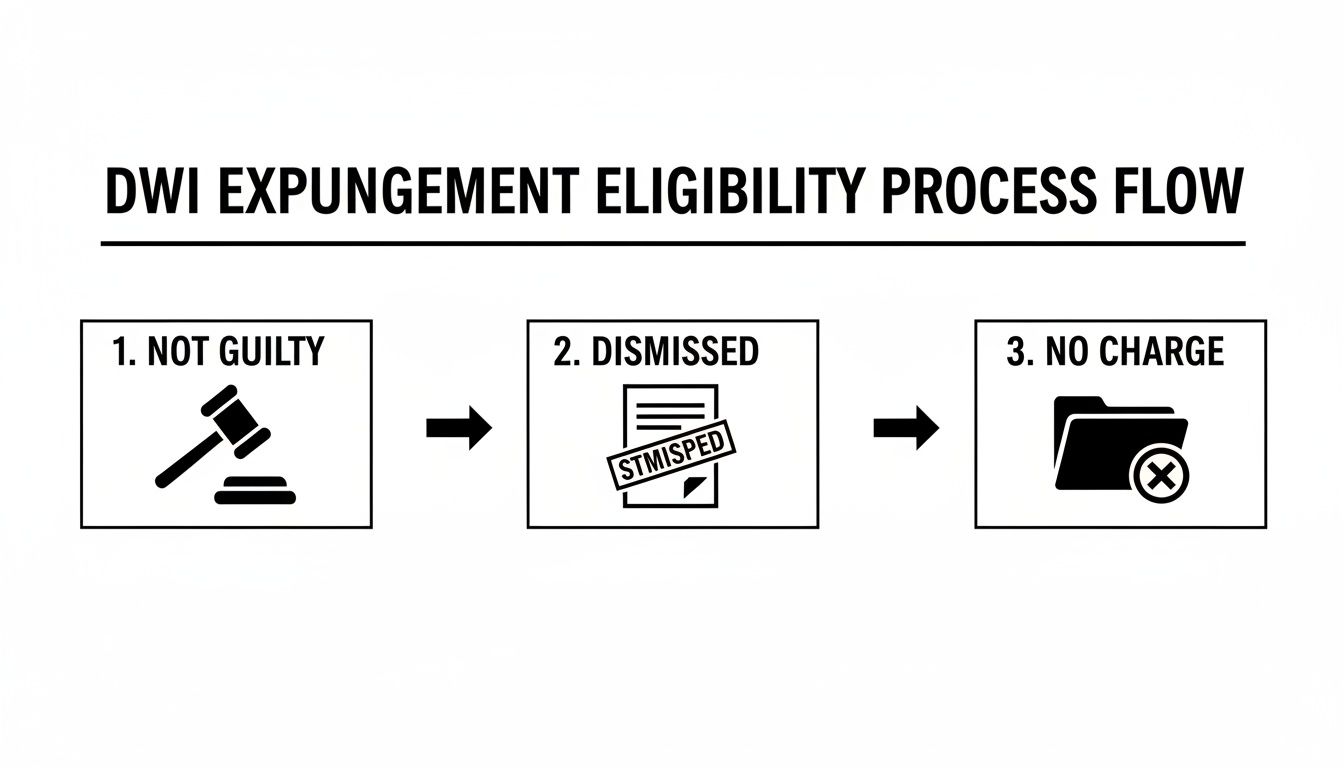
As you can see, the path to clearing your record only opens up if your case ended with a "not guilty" verdict, a dismissal, or if the prosecutor never even filed charges against you.
What to Do If You Don't Qualify for Expunction
Getting the news that you don’t qualify for an expunction can feel like a gut punch. It’s tough to hear. When a DWI case results in a conviction, the door to completely destroying that record slams shut. But that doesn't mean you're out of options. Texas law offers another powerful tool that can give you a real second chance: an Order of Nondisclosure.
Think of it this way: if an expunction is like shredding a document, a nondisclosure is like locking it away in a secure vault. The record still exists, but it’s sealed from public view, giving you a fresh start in many of the ways that matter most.
Shifting Focus to Sealing Your Record
For many Texans, especially those with a first-time DWI conviction, an Order of Nondisclosure is often the best and only path forward. This legal remedy essentially puts a "Do Not Disturb" sign on your criminal history, telling government agencies they can't release that information to the public.
So, what does that mean in the real world? It means the record becomes invisible where it counts. It won't pop up on background checks run by:
- Most private employers
- Landlords and apartment complexes
- Colleges and universities
- Loan and credit agencies
Now, it’s not a total wipe. Law enforcement and certain state licensing boards can still access the sealed information if they have a legitimate reason. But for all practical purposes, sealing your record removes the biggest obstacle standing between you and rebuilding your life and career. It allows you to move on without a past mistake casting a shadow over your future.
Who Qualifies for a DWI Nondisclosure?
In recent years, Texas lawmakers have opened up more pathways for first-time DWI offenders to clean up their records. But the rules are very specific. You have to check all the boxes to be eligible to seal a DWI conviction.
Here’s what the court will look for:
- A First-Time DWI Offense: This has to be your one and only criminal conviction. Minor traffic tickets that didn’t lead to an arrest are usually fine, but anything more serious will disqualify you.
- Completed Your Sentence: You must have successfully finished everything the judge ordered—probation, all fines paid, and any required classes or community service completed.
- No Accident Involved: The DWI incident can't have involved a car crash with another person.
- A BAC Below 0.15: Your blood alcohol concentration (BAC) at the time of the arrest had to be under 0.15. If it was 0.15 or higher, that's considered an enhanced DWI, which automatically disqualifies you from nondisclosure.
These requirements are strict, but they provide a clear route forward for those who have learned from their mistake and paid their debt to society.
Navigating the Mandatory Waiting Periods
Just like with expunctions, you can't file for a nondisclosure the day after your case is over. There's a mandatory waiting period that you must complete after you’ve finished your sentence. How long you have to wait depends on the specifics of your sentence.
The waiting period for a DWI nondisclosure starts after you complete your sentence, not from the date you were arrested.
There are two main timelines to be aware of:
- Two Years: This shorter waiting period applies if you had an ignition interlock device (IID) on your vehicle for at least six months as part of your sentence.
- Five Years: If you were not required to have an ignition interlock, you’ll have to wait the full five years.
Getting this timing right is critical. If you file your petition even one day too early, the court will automatically deny it. You'll lose your filing fees and have to start the whole process over again. An attorney can help you verify the exact end date of your sentence to make sure you file at the right time.
The good news is that Texas laws around clearing records are slowly evolving. Legislative updates have reshaped eligibility for both expunctions and sealing, often creating new opportunities for people whose cases ended favorably. These changes show a positive trend toward giving more people a chance to move past old mistakes. You can read more about evolving Texas expunction laws to see how these updates might affect different situations.
If you’ve been charged with a crime in Texas, call The Law Office of Bryan Fagan, PLLC for a free and confidential consultation. Our defense team is ready to protect your rights.
How a Defense Attorney Makes a Critical Difference
Trying to navigate the maze of a DWI expungement in Texas by yourself is a huge risk. The legal system is built on a foundation of strict rules and unforgiving deadlines. One tiny mistake on a form or a missed deadline can get your petition thrown out, forcing you right back to square one. This is where having a seasoned legal professional on your side becomes your single greatest asset.
An experienced criminal defense attorney isn't just a guide; they're your champion, making sure every single step is handled with absolute precision. We don't just hope you're eligible—we verify it. Our team digs into the details of your arrest and court records to confirm you meet every strict requirement laid out in Texas law.
From Paperwork to the Courtroom
We take the entire administrative burden off your plate. That means drafting and filing an error-free Petition for Expunction designed not just to be filed, but to withstand a judge's scrutiny. This isn't about filling in blanks on a form; it's about building a compelling legal argument for why you've earned a clean slate.
From there, we manage all the complex communications and legal notices required for every state agency involved, from the arresting police department to the district attorney's office. This proactive approach prevents the common administrative slip-ups that can completely derail an otherwise strong case.
We stand for you in court, ready to counter any objections and argue persuasively on your behalf. Having a skilled advocate in your corner can make all the difference, especially if a prosecutor tries to challenge your petition.
To get a better sense of the different roles in the justice system, you can explore the difference between an attorney and a lawyer. With our deep experience in courtrooms across Houston, Dallas, and the rest of Texas, we know the local procedures, the court staff, and what judges expect to see. Let our team handle the legal heavy lifting so you can focus on what really matters: moving forward with your life.
If you’ve been charged with a crime in Texas, call The Law Office of Bryan Fagan, PLLC for a free and confidential consultation. Our defense team is ready to protect your rights.
Frequently Asked Questions About DWI Expungement
Even after digging into the details, you probably still have some specific questions about what a DWI expungement in Texas really means for your future. Below are the straightforward, plain-English answers to the most common concerns we hear from clients every single day. Think of it as your practical guide to clearing your record.
How Much Does a DWI Expungement Cost?
The total cost of an expungement is really broken down into two parts: attorney fees and court filing costs. The filing fees are set by the county and usually land somewhere between $300 and $500. Attorney fees will depend on how complex your specific situation is.
While it's an investment, it’s one of the most important ones you can make in yourself. A clean record opens doors to better jobs, housing, and professional licenses that might otherwise be completely off-limits. The long-term financial and personal benefits almost always outweigh the upfront cost.
Can I Expunge a DWI If I Received Deferred Adjudication?
This is a very common and completely understandable point of confusion. Unfortunately, the answer is a hard no. Under Texas law, deferred adjudication is not an option for DWI charges, period. So, it's impossible to complete deferred adjudication for a DWI and then turn around and ask for an expungement.
If your case ended with probation for a first-time DWI, your best path forward is likely an Order of Nondisclosure. This seals your record from public view and provides many of the same practical benefits as a full expunction.
How Long Does the Expungement Process Take?
Once your petition is filed with the court, the process isn't instant. It’s important to prepare for it to take some time as it works its way through the legal system.
A realistic timeline for a Texas expungement is typically between three to six months. This clock starts the day the petition is officially filed and stops the moment the judge signs the final Order of Expunction.
This timeframe gives us enough room to file the petition, properly notify all the state agencies involved, and allow them the time they need to respond before we get to the court hearing. We'll keep you in the loop at every single stage so you always know exactly where your case stands. Having clear expectations from the start makes the whole journey much less stressful.
If you’ve been charged with a crime in Texas, call The Law Office of Bryan Fagan, PLLC for a free and confidential consultation. Our defense team is ready to protect your rights. Get Help Now.