Flashing lights in your rearview mirror can turn an ordinary drive home into one of the worst nights of your life. A few minutes later, you may be standing on the roadside, answering questions you’re not sure how to answer, worrying about jail, your job, your license, and what your family will say in the morning.
That panic is real. So is the confusion that follows a Texas DWI arrest.
When people search dwi lawyer near me, they usually aren’t shopping casually. They’re trying to regain control fast. They want to know what happens next, whether they’ll lose their license, whether court is coming soon, and whether this charge is about to follow them for years.
Texas treats DWI seriously. A first-offense DWI is commonly charged under Texas Penal Code § 49.04, which makes it a crime to operate a motor vehicle in a public place while intoxicated. “Intoxicated” can mean either you did not have the normal use of your mental or physical faculties because of alcohol, drugs, or a combination, or your alcohol concentration was at or above the legal limit. That sounds simple on paper. In practice, these cases often turn on traffic stop facts, officer judgment, testing procedures, and timing.
You don’t have to sort that out alone. The first days matter, and the decisions you make now can protect your license, your record, and your future options.
Being Arrested for DWI in Texas Can Be Terrifying But You Don’t Have to Face It Alone
A Texas DWI arrest usually begins in a blur. You’re handcuffed, booked, fingerprinted, and then released hours later with paperwork you barely remember receiving. By sunrise, your phone may already be full of messages from family, coworkers, or a spouse asking what happened.
That’s when many people make their first serious mistake. They treat the arrest like a bad night that will sort itself out. It usually won’t.
The first morning matters
If you were released from jail, you may still be dealing with bond conditions, a court date, and questions about transportation. If a family member is trying to help, practical support matters. For basic guidance on release issues and what families often need to handle right away, this resource on Express Bail Bonds help for arrests gives a useful overview.
The emotional side matters too. Shame makes people freeze. Fear makes people talk too much. Neither helps your defense.
Practical rule: Treat the first 24 hours after a DWI arrest like the beginning of a legal case, not the end of a bad evening.
What you’re actually facing
A DWI case can affect more than one part of your life at once:
- Your criminal case in court
- Your driver’s license and ability to get to work
- Your employment, especially if you drive for work or hold a professional license
- Your family situation, including parenting schedules or pending custody issues
- Your record, which may affect housing and future opportunities
That’s why calm, early action matters more than panic. The right lawyer doesn’t just appear in court and say a few words. Good defense work starts by protecting deadlines, preserving evidence, and identifying weaknesses in the State’s case before those opportunities disappear.
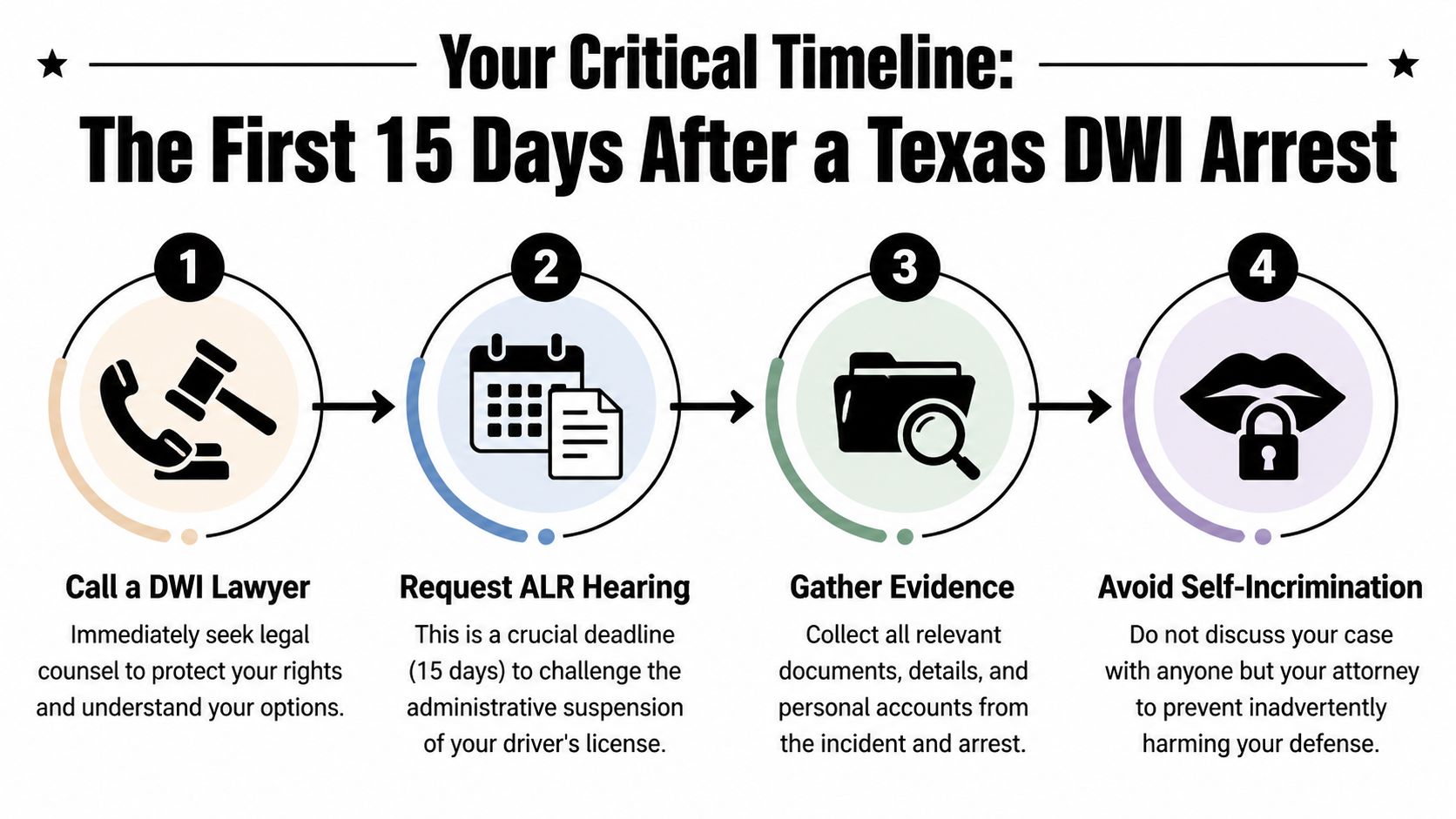
The First 15 Days Your Critical Timeline After a DWI Arrest
The most urgent deadline in many Texas DWI cases has nothing to do with your first court appearance. It involves your license.
Texas DWI defense often moves on two tracks at once. One is the criminal case. The other is the administrative license suspension hearing, sometimes called an ALS or ALR matter. Under the verified data, you have only 15 days to request an ALS hearing to avoid automatic license suspension, and represented defendants can reduce conviction rates by 25 to 40% through challenges to the stop and evidence according to the DWI defense overview discussed here.
Two cases can be moving at once
Many people think, “I’ll deal with my license when I go to court.” That’s often too late.
The administrative case is separate from the criminal charge. Even before your DWI case is resolved, the State can move against your driving privileges. A successful hearing can protect or restore your ability to drive while the criminal case is still pending.
What to do right now
Use the first days wisely. Start with a short list.
Request legal help quickly
The hearing deadline comes fast. If you wait, you can lose the chance to challenge the suspension.Write down everything you remember
Do this while the details are fresh. Note where you were stopped, what the officer said, whether there were witnesses, whether you were asked to perform field sobriety tests, and whether you gave breath or blood.Save every document
Keep your bond paperwork, citation, notice of suspension, towing paperwork, and any property receipt in one folder.Stop talking about the case
Don’t post online. Don’t text your version of events to friends. Don’t try to “clear things up” with police.Act before the deadline expires
Many individuals often lose their strategic advantage without realizing it.
Missing the administrative hearing request can damage your position before your criminal defense is fully underway.
For a practical breakdown of early next steps after arrest, this guide on what to do after a DUI arrest in Texas is worth reviewing.
Why this deadline changes the whole case
Your license often affects everything else. If you can’t drive, getting to work, school, treatment, or family obligations becomes harder. That pressure pushes many people into quick pleas that aren’t in their long-term interest.
A lawyer handling the case early can evaluate both tracks together. That means looking at the stop, testing, paperwork, officer reports, and hearing strategy as one connected problem instead of two separate headaches.
How to Find the Right DWI Lawyer in Your Texas Community
Typing dwi lawyer near me into a search bar is easy. Choosing well is harder.
The right fit is usually not the lawyer with the loudest ad or the shortest promise. DWI defense is local work. Court culture differs from county to county, and the lawyer you hire should understand how these cases move where your arrest happened.

What local experience really means
A Texas DWI attorney should know more than the statute. They should know how prosecutors in that county negotiate, how judges handle bond conditions, and how local officers typically document stops and testing.
That doesn’t mean you need the closest office by zip code. It means you need someone who handles DWI cases in the place where your case is pending.
If you’re comparing firms, look beyond slogans and review a page about working with a criminal defense attorney near you in Texas. It helps frame what “near me” should mean in legal terms.
Strong signs and warning signs
Here’s a simple way to sort your options.
| What to look for | Why it matters |
|---|---|
| Criminal defense focus | DWI cases involve criminal procedure, evidence issues, and license consequences |
| County-level experience | Local court knowledge changes strategy and timing |
| Clear explanation of process | Good lawyers can explain the case without hiding behind jargon |
| Real discussion of weaknesses | Honest counsel identifies problems, not just promises wins |
| Fee clarity | You should know what the representation includes |
Red flags matter just as much:
- Guaranteed results. No honest lawyer can promise dismissal.
- Pressure to hire on the first call. You should have room to ask hard questions.
- No discussion of the license case. That can be a sign the practice is too general.
- Fees that sound unrealistically low. Cheap up front can mean limited work later.
Credentials are helpful, but strategy matters more
Board Certification in Criminal Law can be a useful sign. So can deeper DWI training and regular courtroom work. But credentials should support strategy, not replace it.
One option Texans often consider is Law Office of Bryan Fagan PLLC, which handles DWI defense, protective-order matters, and record-clearing work across multiple Texas markets. Whether you hire that firm or another, look for a lawyer who can explain what they would do in your specific case during the first month, not just what they’ve done for other people.
The right attorney should make your case clearer after one conversation, not more confusing.
Your First Meeting Preparing for the Consultation
Your first consultation should feel less like a sales pitch and more like a working meeting. You’re hiring someone to protect your future. That means you should arrive ready to ask direct questions and listen carefully to the answers.
Bring what you have, even if it feels incomplete.

What to bring with you
You don’t need a perfect file. Start with the basics:
- Arrest paperwork and any citation you received
- Bond papers and court-date notices
- Notice about license suspension or hearing rights
- Tow or impound records
- A written timeline of what happened before, during, and after the stop
- Medical information if you have conditions that may affect balance, speech, or testing
- Names of witnesses who saw the stop, your driving, or your condition before arrest
If you’ve already found guidance on good intake questions, this list of questions to ask a criminal defense attorney can help you organize the meeting.
Questions that reveal real experience
Ask questions that force a concrete answer.
How will you approach the license issue right away?
A strong answer should mention the hearing deadline and early action.What facts in my case concern you most?
Good lawyers don’t pretend every case is easy.What evidence will you want first?
Look for discussion of video, reports, testing records, and timelines.Who will handle my case?
You should know whether you’ll be working with the lawyer you met or someone else in the office.How do you evaluate plea offers versus trial?
The answer should sound strategic, not automatic.
A short video can also help you think through what a productive attorney meeting should feel like.
Understand the fee conversation
Fee structures vary. Some lawyers use flat fees for a standard DWI case. Others bill hourly, especially if the matter becomes more contested. Ask what the fee includes, whether the administrative hearing is included, and whether trial work is separate.
Don’t assume the lowest quote is the smartest choice. In DWI defense, the primary question is what work the lawyer plans to do for that fee. Discovery requests, motion practice, hearing preparation, and expert review all take time.
A useful consultation leaves you with a plan, a timeline, and a realistic sense of risk.
Understanding Common Defenses and Potential DWI Outcomes
DWI defense is rarely about one dramatic argument. More often, it’s about careful pressure on each part of the State’s proof.
Under Texas Penal Code § 49.04, the State still has to prove the charge with admissible evidence. That opens the door to real defense work. A lawyer may challenge how the stop happened, how field sobriety tests were given, how breath or blood evidence was handled, and whether the timeline supports intoxication at the time of driving.

The stop and the officer’s observations
A case can weaken early if the traffic stop lacked proper legal grounds. If the officer didn’t have a valid reason to stop you, later evidence may be vulnerable.
Then comes the officer’s narrative. Many DWI reports rely on common observations like odor of alcohol, red eyes, slurred speech, or “unsteady balance.” Some of those observations are subjective. Some may have innocent explanations. The defense question is not whether the officer wrote it down. It’s whether the evidence is reliable and legally sufficient.
Field sobriety tests are not simple roadside truth machines
Field sobriety tests often sound more scientific than they are. The walk-and-turn and one-leg-stand tests depend on instructions, footing, lighting, footwear, weather, physical condition, and the officer’s scoring.
Verified data also notes that DWI defense often turns on testing issues. The Intoxilyzer 8000, a device common in Texas, has a 12 to 18% margin of error, and challenges to breath evidence and subjective field tests have been associated with a 28% dismissal rate in counties like Harris, compared with 8% for unrepresented defendants, as described in this discussion of how to beat a DUI case.
That doesn’t mean every machine result is wrong. It means every machine result deserves scrutiny.
Breath and blood evidence can be challenged
Breath and blood results often look decisive to a person reading the paperwork at home. In court, they still depend on process.
A defense lawyer may examine:
- Whether the machine was operating properly
- Whether required procedures were followed
- Whether the sample handling creates doubt
- Whether the test reflects your level at the time of driving
- Whether rising BAC is an issue, especially when the test happened later
When technical science becomes central, it helps to understand the standards lawyers use for vetting forensic expert witnesses in Texas. Expert review can be critical when the State’s case leans heavily on numbers instead of clear behavior.
Some DWI cases are won by showing the science is weaker than it first appears.
What outcomes are realistic
Not every case goes to trial. Not every case should end in a plea on the first setting either.
Possible outcomes may include:
| Possible result | What it can mean |
|---|---|
| Dismissal | The State drops the case or loses key evidence |
| Reduction | The charge may be resolved as a lesser offense depending on the facts and local practice |
| Plea agreement | You accept a negotiated outcome to limit risk |
| Trial and not guilty verdict | A jury or judge finds the State did not prove the charge |
| Conviction and sentencing | The court imposes penalties under Texas law |
Sentencing depends on the offense level, your history, and the facts. In a basic first-offense case, possible consequences can include fines, community supervision, classes, and license-related consequences. Cases with an accident, high test result, a child passenger, or prior history can become much more serious.
A good defense lawyer will explain where your case likely sits on that spectrum and why.
Beyond the DWI Charge Protecting Your Family and Your Future
A DWI arrest is often treated like a stand-alone criminal case. For many Texans, it isn’t.
If you’re going through a divorce, custody dispute, or protective-order fight, a DWI allegation can spill into family court quickly. Verified data states that in major counties like Harris, up to 18% of DWI cases involve concurrent family law filings, especially around custody or protective-order issues, and that only 22% of eligible individuals successfully expunge their DWI records, often because they don’t know about options like petitions for nondisclosure, as noted in this discussion of DWI consequences beyond the criminal case.
Why family law issues can escalate fast
If there was a child in the vehicle, a tense domestic situation at home, or an existing custody order, the arrest may become evidence in another courtroom. A co-parent may argue that the incident shows poor judgment. Temporary orders may be requested. Parenting exchanges may become more restricted.
That doesn’t mean the family court result is automatic. It does mean your criminal defense strategy should account for those risks early, especially before you make statements or accept terms that could be used elsewhere.
Your record matters after the case ends
A lot of people focus only on getting through the next court date. That’s understandable, but short-term survival can create long-term damage if nobody talks to you about record relief.
Depending on how the case ends, you may have options such as:
- Expunction, which may be available in some dismissed cases
- Petition for nondisclosure, which can limit public access to certain records
- Occupational or licensing planning, if your work depends on a clean background
Post-conviction relief is not an afterthought. It’s part of rebuilding your life. If your case can be resolved in a way that protects future sealing or nondisclosure options, that should be part of the strategy from the start.
Take the First Step to Protect Your Rights and Your Future
A DWI arrest can make your world feel small very quickly. You may be worried about court, your license, your family, your job, and whether one mistake is about to define you. It doesn’t have to.
What helps most is quick, informed action. Protect the deadline tied to your license. Gather your paperwork. Stay off social media. Speak carefully. Ask direct questions when you meet with a lawyer. And if alcohol use may be part of a bigger problem, addressing that issue can help both personally and legally. For people who need that kind of support, resources for individualized addiction care can be an important step alongside legal defense.
The legal system can be intimidating, but it is still a system built on proof, procedure, and rights. A charge is not a conviction. A bad night is not the whole story of your life.
If you’ve been charged with a crime in Texas, call Law Office of Bryan Fagan PLLC for a free and confidential consultation. Our defense team is ready to protect your rights.