Skip to content
Being arrested in Texas can be terrifying — but you don’t have to face it alone. When you see flashing lights in your rearview mirror, the last thing on your mind is legal jargon. But in Texas, the difference between terms like DWI and DUI is significant, and the distinction boils down to one simple thing: your age.
For anyone 21 or older, there is no legal difference between the two terms. They both point to the same criminal charge: Driving While Intoxicated (DWI). However, if you are under 21, a DUI—Driving Under the Influence—charge applies if you have any detectable amount of alcohol in your system. This is how Texas enforces its zero-tolerance policy for underage drinking and driving. Understanding these terms is the first step in protecting your rights.
Understanding the DWI vs DUI Distinction in Texas Law

An arrest is a stressful and confusing experience, and the mix-up over legal acronyms only makes it worse. Many people use DWI and DUI as if they mean the same thing. While that’s common in everyday conversation, Texas law draws a clear line based on your age.
If you are 21 or older, the only charge you can face for intoxicated driving is DWI. You might hear people, or even the media, say DUI, but the offense is legally defined in the Texas Penal Code § 49.04 as Driving While Intoxicated. The bottom line is this: if you are an adult, a DWI is the charge you will be up against, no matter what it's called on the street.
Key Definitions at a Glance
So, what does "intoxicated" actually mean in a Texas courtroom? The state gives prosecutors two ways to prove it, and they only need to establish one to get a conviction.
- Per Se Intoxication: This is the definition most people know. Your blood alcohol concentration (BAC) is 0.08% or higher. It is a straightforward, scientific measurement that leaves little room for debate.
- Impairment: This is where things become more subjective. You are considered impaired if you have lost the normal use of your mental or physical faculties because of alcohol, drugs, or a combination of both.
That second definition is a big deal. It means you can be charged with a DWI even if your BAC is technically under the 0.08% legal limit. An officer’s observations—like how you were driving, if you were slurring your words, or how you performed on field sobriety tests—can all be used as evidence to argue you were impaired.
The Bottom Line
The table below breaks down the core distinction. While the terms get mixed up all the time, knowing the legal reality is the first step toward building a solid defense. For adults, there's no real difference—DWI and DUI both mean driving while intoxicated. For minors, it's a completely different story. You can read more on how Texas officially defines these offenses to see the statutes for yourself.
| Term | Legal Meaning in Texas | Who It Applies To |
|---|---|---|
| DWI (Driving While Intoxicated) | The official charge for operating a motor vehicle while intoxicated (BAC of 0.08% or impaired faculties). | Adults (21+) |
| DUI (Driving Under the Influence) | The official charge for a minor operating a vehicle with any detectable amount of alcohol. | Minors (Under 21) |
If you’re facing an intoxicated driving charge, understanding the precise legal language and what the prosecutor must prove is vital. An experienced DWI attorney knows how to analyze the state's case and fight to protect your rights.
How Texas Law Defines Intoxication
If you are facing a DWI charge in Texas, you might think it all comes down to the number on a breathalyzer. While your blood alcohol concentration (BAC) is a key piece of evidence, it’s not the only way the state can prove you were intoxicated. Texas law gives prosecutors two different paths to secure a conviction, and they only need to prove one of them.
Understanding these two legal definitions is critical because it shows how the state can build a case against you even if you blow under the legal limit of 0.08% BAC. An arrest isn't the end of your story; it's the beginning of a legal fight where every detail matters.
The Two Legal Standards for Intoxication
The Texas Penal Code § 49.01 lays out two distinct ways you can be considered legally intoxicated while operating a motor vehicle. This is the foundation of every DWI case in the state.
- "Per Se" Intoxication: This is the most black-and-white definition. If a chemical test—whether it's breath, blood, or urine—shows your BAC is 0.08% or higher, you are considered intoxicated "per se." The term literally means "by itself." The prosecutor doesn't have to prove you were swerving or slurring your words; that number alone is enough to meet the legal standard.
- Loss of Normal Use: This definition is far more subjective and often harder for the state to prove. You can be found guilty of DWI if you have lost the normal use of your mental or physical faculties because of alcohol, a drug, a controlled substance, or any combination of these.
That second standard is crucial. It means you can be arrested and successfully prosecuted for DWI even when your BAC is under 0.08. For instance, if you were driving erratically and performed poorly on field sobriety tests, an officer will argue that you’ve lost the normal use of your faculties, regardless of your BAC reading.
What Does "Loss of Normal Use" Really Mean?
The phrase "loss of normal use" can sound vague. In a DWI investigation, it comes down to your ability to perform the simple mental and physical tasks that safe driving requires. An officer is trained to look for specific signs of impairment from the moment they pull you over.
Evidence they will use to prove this can include:
- Driving Behavior: Were you weaving, speeding, braking suddenly, or unable to stay in your lane?
- Physical Appearance: Did the officer note things like bloodshot eyes, a flushed face, or the smell of an alcoholic beverage?
- Your Speech: Was your speech slurred? Did you have trouble answering basic questions?
- Coordination: Did you fumble for your license and registration? Did you seem unsteady on your feet when you got out of the car?
The most powerful evidence prosecutors use to argue "loss of normal use" is your performance on the Standardized Field Sobriety Tests (SFSTs). These are physical and mental exercises specifically designed to be difficult for an impaired person to complete.
The Role of Field Sobriety Tests
Standardized Field Sobriety Tests (SFSTs) are a series of evaluations police use during a traffic stop to measure a driver's impairment. The three standardized tests are the Horizontal Gaze Nystagmus (HGN) test, the Walk-and-Turn test, and the One-Leg Stand test. An officer’s subjective interpretation of your performance becomes a central part of their police report and the evidence used against you in court.
However, these tests can be unreliable. Factors like fatigue, nervousness, medical conditions, or even poor weather can affect your performance. An experienced DWI defense attorney knows how to challenge the validity of these tests, questioning everything from how the officer administered them to their interpretation of the results.
If you want to dive deeper into this topic, you can learn more about the key differences between BAC law and similar offenses in our detailed guide. Knowing how the state defines intoxication is the first step in building a powerful defense tailored to your situation.
Comparing Adult DWI and Minor DUI Charges
For adults in Texas, DWI and DUI are essentially two names for the same crime. But when a driver is under 21, the conversation about DWI vs. DUI in Texas becomes much more specific. A DUI charge for a minor is a separate offense with its own set of rules, all because of the state's strict zero-tolerance policy.
Understanding the difference between an adult DWI and a minor DUI is essential for young drivers and their families. While a DUI is technically a less severe charge than a DWI, a conviction can still create major obstacles for a young person's future, affecting everything from college applications to job searches.
Texas Zero Tolerance Law for Minors
In Texas, it is illegal for anyone under 21 to drive with any detectable amount of alcohol in their system. This is a much stricter standard than the 0.08% BAC limit for adults. A single sip of beer or even some alcohol-based cough syrups could potentially lead to a DUI charge.
This "zero tolerance" rule is outlined in the Texas Alcoholic Beverage Code. Unlike with a DWI, a prosecutor does not have to prove the minor was impaired or had a specific BAC level—they only need to show that the minor had any alcohol in their system while driving.
This diagram breaks down the two main ways Texas law defines intoxication for adults, which is the foundation for a standard DWI charge.
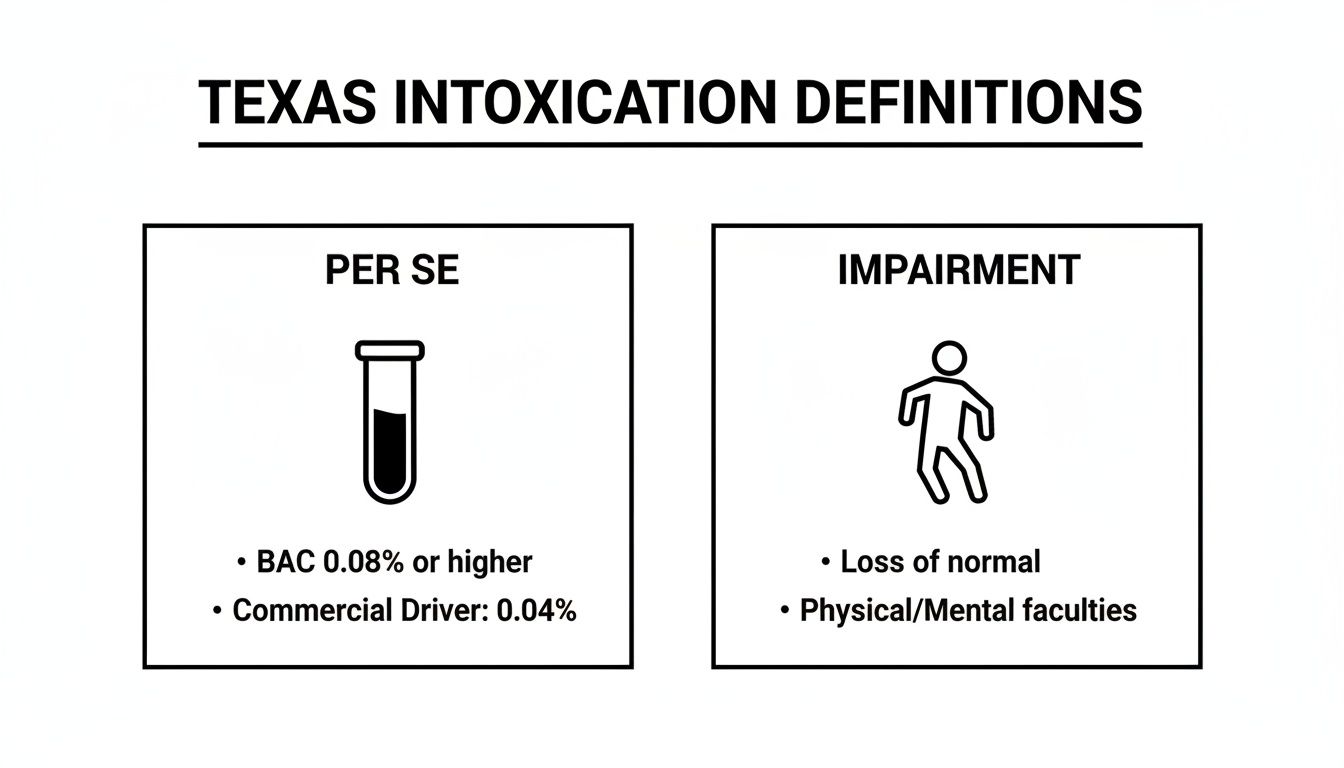
The key takeaway is simple: adults have a clear BAC limit and an impairment standard. Minors face a "zero tolerance" rule where any trace of alcohol is against the law.
Side-by-Side DWI vs. DUI Comparison
Facing a DWI as an adult is a completely different legal battle than what a minor faces for a DUI. The criminal charges, fines, and license penalties are worlds apart. A first-time adult DWI is a Class B Misdemeanor, a serious criminal offense that can result in jail time. A first-time minor DUI, on the other hand, is a Class C Misdemeanor—similar to a traffic ticket—but it still leaves a permanent mark on your record.
Let's look at the practical differences.
Adult DWI vs. Minor DUI in Texas At a Glance
Here's a quick breakdown comparing a first-time DWI for an adult against a first-time DUI for a minor.
| Factor | Adult DWI (21 and Over) | Minor DUI (Under 21) |
|---|---|---|
| Legal Standard | 0.08% BAC or loss of normal faculties | Any detectable amount of alcohol |
| Criminal Charge | Class B Misdemeanor | Class C Misdemeanor |
| Maximum Fine | Up to $2,000 | Up to $500 |
| Jail Time | 72 hours to 180 days | No jail time for a first offense |
| License Suspension | Up to 1 year | 60 days |
| Additional Penalties | Probation, DWI classes, possible ignition interlock | Mandatory alcohol awareness course, community service |
As you can see, the legal fight and potential outcomes are completely different depending on your age. The immediate consequences for an adult are far more severe, but a DUI conviction can negatively impact a young person for years to come.
The most critical difference is the legal standard itself. An adult DWI requires the prosecutor to prove intoxication (either a 0.08 BAC or actual impairment). A minor DUI only requires proof of any alcohol consumption while driving.
This distinction is why you need a legal defense tailored to your specific charge. For a minor, the focus is often on preventing one mistake from harming their educational and career goals. For an adult, it's about staying out of jail, keeping their driver's license, and avoiding a serious misdemeanor on their record.
No matter the charge, the stakes are high. An experienced criminal defense attorney can review the specifics of your case, challenge the state's evidence, and build a strategy to protect your rights and your future.
How a DWI Can Escalate to a Felony
While a first-time DWI is typically a Class B Misdemeanor, it is a serious mistake to underestimate the charge. Under certain circumstances, what seems like a standard misdemeanor can quickly become a felony, carrying the risk of state prison time, significant fines, and a permanent mark on your record.
Understanding these "enhancing" factors is critical because they completely change the legal landscape. A felony DWI conviction can strip you of fundamental rights, like owning a firearm, and create permanent barriers to finding a job or a place to live.
The Progression of Repeat DWI Offenses
The most common way a DWI becomes a felony is through prior convictions. The Texas Penal Code creates a clear ladder, with the penalties becoming much more severe with each offense.
- First DWI Offense: This is usually a Class B Misdemeanor, with penalties ranging from 3 to 180 days in jail and a fine up to $2,000.
- Second DWI Offense: A second DWI elevates the charge to a Class A Misdemeanor. The potential jail time increases to between 30 days and one year, and the maximum fine doubles to $4,000.
- Third DWI Offense: This is where everything changes. A third DWI charge is automatically a Third Degree Felony. This is a life-altering charge, bringing a potential prison sentence of 2 to 10 years and a fine as high as $10,000.
It doesn't matter how long ago your prior convictions were. A DWI from 20 years ago can still be used to enhance a new charge to a felony. This is why it is so important to fight every single DWI charge, starting with the very first one.
Other Felony DWI Enhancements
Repeat offenses are not the only way to face a felony charge. Several other situations can turn a single incident into a felony right from the start. These involve aggravating factors that the law views as especially dangerous.
DWI with a Child Passenger
If you are arrested for DWI and have a child under the age of 15 in your vehicle, the charge is automatically enhanced to a State Jail Felony.
According to Texas Penal Code § 49.045, this offense is punishable by 180 days to two years in a state jail facility and a fine of up to $10,000. The law is designed to protect children from the danger of riding with an intoxicated driver.
Intoxication Assault
If you cause an accident while driving intoxicated and another person suffers a "serious bodily injury," you will be charged with Intoxication Assault. This is a Third Degree Felony.
A "serious bodily injury" is legally defined as an injury that creates a substantial risk of death, causes serious permanent disfigurement, or leads to the long-term loss or impairment of a body part or organ. A conviction carries a prison sentence of 2 to 10 years.
Intoxication Manslaughter
The most severe DWI-related charge is Intoxication Manslaughter. If your intoxicated driving leads to a fatal crash, you will face this charge, which is a Second Degree Felony.
A conviction for Intoxication Manslaughter can result in a prison sentence of 2 to 20 years and a fine of up to $10,000. Defending against this charge requires an aggressive and experienced legal strategy. Facing this level of charge can be overwhelming, but our guide to understanding your Texas DWI felony rights and defense can give you the crucial information you need.
Given the devastating consequences of a felony conviction, it is absolutely essential to have a skilled defense attorney in your corner. An experienced lawyer can scrutinize every piece of evidence to build the strongest possible defense and fight for your future.
Navigating the Two Cases You Face After an Arrest
If you have been arrested for a DWI in Texas, you may feel like you're caught in a legal storm. One of the most confusing parts of the process is realizing you are not just fighting one case—you are fighting two separate battles at the same time.
An arrest starts both a criminal proceeding and a civil one, each with its own rules and consequences. Understanding how these parallel tracks work is the first step toward protecting your freedom and your future.
The Criminal Case: Your Freedom is on the Line
The first battle is the criminal charge of Driving While Intoxicated. This is where a prosecutor, representing the State of Texas, must prove your guilt "beyond a reasonable doubt."
That phrase is crucial. It is the highest standard of proof in our legal system, meaning the state must present evidence so compelling that a jury has no other logical explanation for the facts except that you committed the crime. The stakes are incredibly high, with potential penalties including:
- Jail or Prison Time: This can range from a few days in county jail for a first offense to years in a state prison for a felony conviction.
- Steep Fines: Fines can run from thousands to tens of thousands of dollars, not including court costs and other fees.
- A Permanent Criminal Record: A conviction follows you forever, creating roadblocks for jobs, housing, and even your right to own a firearm.
The Civil Case: The Fight for Your Driver's License
The second battle is the Administrative License Revocation (ALR) process. This is a civil case handled by the Texas Department of Public Safety (DPS), and it is completely separate from your criminal court case.
The ALR hearing has one purpose: to decide if your driver's license should be suspended. This process is automatically triggered if you refuse to provide a breath or blood sample, or if you provide a sample showing a BAC of 0.08% or higher.
The most important thing to know about the ALR process is the deadline. You have only 15 days from the date of your arrest to request a hearing and challenge the automatic suspension of your license. If you miss this window, your license will be suspended without a fight.
Different Standards, Different Fights
The criminal and ALR cases run on separate tracks and use different standards of proof. While the criminal court demands proof "beyond a reasonable doubt," the ALR hearing only requires the state to prove its case by a "preponderance of the evidence."
This means the DPS only needs to show it is more likely than not that the officer had a valid reason to stop you and probable cause for the arrest. It's a much lower bar to clear. This is why it’s entirely possible to win your criminal case but still lose your license in the ALR hearing—or vice versa. For more guidance on what to do right away, check out our detailed article on what to do after a DWI arrest.
Even with this tough legal landscape, an arrest is not a conviction. DWI arrests are common; Harris County alone sees 10,000-12,000 of them annually. Yet, in places like Dallas County, dismissal rates can hit 25%, with reductions to lesser charges pushing the total non-conviction rate for first offenses toward 55%.
Navigating the complexities of a DWI requires skilled legal help, and understanding strategies for DWI law firm outreach can offer insight into how the best attorneys connect with clients in need. An experienced lawyer can defend you on both fronts, fighting to protect your criminal record in court while simultaneously working to save your driving privileges in the ALR hearing.
Answering Your Top Questions After a Texas DWI Arrest
After the chaos of a DWI arrest, your mind is probably racing with questions. That is completely normal. The legal system is complex and intimidating when you are suddenly thrown into it. Getting straight answers is the first step toward regaining control of your situation.
This section is designed to provide direct answers to the questions we hear most often from people facing a DWI charge in Texas.
What Should I Do in the First 24 Hours After a DWI Arrest?
That first day is absolutely critical. The steps you take immediately after being released can have a huge impact on your criminal case and your ability to keep driving.
Focus on these three things right away:
- Write Down Everything You Remember. As soon as you can, write down every detail of the traffic stop, the arrest, and any tests you were asked to take. Memories fade quickly, and these small details can become major assets for your defense.
- Find Your Release Paperwork. The police should have given you documents when you were released. One of them is a "Notice of Suspension," which also serves as your temporary driving permit. This form contains crucial deadlines you cannot afford to miss.
- Call a DWI Attorney. This is the most important step. You only have 15 days to request an Administrative License Revocation (ALR) hearing to save your license. A good lawyer needs to get started on your case right away.
Should I Refuse the Breathalyzer or Blood Test?
This is one of the trickiest decisions you can be forced to make on the side of the road, and there’s no single "right" answer that fits every situation. Under Texas's "implied consent" law, you have already agreed to provide a breath or blood sample just by having a driver's license.
Refusing has immediate consequences. Your license will be automatically suspended for 180 days for a first-time refusal. Additionally, the officer will almost certainly just get a warrant to take your blood anyway. So, what is the potential upside of refusing?
A refusal denies the prosecutor their strongest evidence: a scientific number showing a high BAC. While it triggers an automatic license suspension, it forces the state to prove its criminal case using more subjective evidence, like the officer's opinion of your driving and your performance on field sobriety tests. That can be a much harder case for them to win.
Can I Get a DWI for My Prescription Medication?
Yes, you absolutely can. The "I" in DWI stands for "Intoxicated," and Texas law defines that as impairment from alcohol, a drug, a controlled substance, or any combination of them. It makes no difference if a doctor legally prescribed the medication to you.
If your prescription medicine impairs your ability to drive safely, you can be arrested and convicted of DWI. This is common with medications that warn against operating heavy machinery, such as painkillers, anti-anxiety drugs, or sleep aids. The legal question is not whether the drug is legal, but whether you have lost the "normal use" of your mental or physical faculties because of it.
What Happens If I Have a Commercial Driver’s License (CDL)?
For a commercial driver, a DWI charge is not just a legal problem—it's a potential career-ender. The stakes are incredibly high. The federal BAC limit for a CDL holder is a very low 0.04%, and a first-offense conviction triggers a one-year disqualification of your CDL. A second conviction results in a lifetime disqualification.
Even getting a DWI in your personal vehicle on a Saturday night can put your CDL and your entire livelihood on the line. Fighting the charge aggressively is essential to protecting your career.
Is It Possible to Get a First-Time DWI Dismissed?
Yes, it is definitely possible to get a first-time DWI dismissed in Texas. Remember, an arrest is just an accusation, not a conviction. A skilled defense lawyer can challenge the state's case from multiple angles.
A dismissal often comes down to challenging the evidence through strategies like:
- An Illegal Traffic Stop: If the officer did not have a legitimate, legal reason to pull you over, any evidence they collected afterward—including the breath test—can be thrown out of court.
- Improperly Administered Field Sobriety Tests: These tests are notoriously unreliable and have strict protocols. If the officer made mistakes in the instructions or scoring, the results can be challenged.
- Flawed Chemical Test Results: Breathalyzers can malfunction and require constant calibration. Blood samples can be contaminated or improperly stored. Any error can make the results inadmissible.
The sad reality is that drunk driving has taken a devastating toll on Texas roads. Between 2014 and 2023, DWI-related crashes were responsible for over 37% of all traffic deaths in the state, claiming 14,389 lives. While legal reforms like the 2015 mandatory ignition interlock law have helped cut these fatalities by 8.5%, the courts and prosecutors still take these cases very seriously. You can discover more insights about Texas DWI statistics to see the bigger picture.
Will I Go to Jail for a First DWI?
While a first-time DWI is a Class B Misdemeanor that carries a potential jail sentence of up to 180 days, it is not common for a defendant with a clean record to serve significant time. More often, a good lawyer can negotiate a plea deal for probation, which involves fines, community service, and DWI education courses instead of jail.
However, jail time is always a possibility, especially if your case involves "aggravating factors" like an extremely high BAC, a car accident, or having a child in the vehicle. Your best chance at staying out of jail is building a powerful defense with an experienced attorney.
If you’ve been charged with a crime in Texas, call The Law Office of Bryan Fagan, PLLC for a free and confidential consultation. Our defense team is ready to protect your rights. https://texascriminallawyer.net