Being arrested in Texas can be terrifying — but you don’t have to face it alone. Getting pulled over is stressful enough, but being told you’re being arrested for Driving While License Invalid (DWLI) can be a terrifying shock. Many people don't even realize there's a problem with their license until that moment.
So, what exactly is a DWLI charge? In Texas, it means you were caught operating a vehicle when your license was suspended, revoked, canceled, or perhaps never even issued. This isn't just a simple traffic ticket—it's a criminal offense under the Texas Penal Code that can land you in a world of legal trouble.
Understanding Your DWLI Charge and Taking Control

The moments after a DWLI arrest can be a blur of confusion and fear. Suddenly, you're thrust into a legal system that feels designed to overwhelm you. You're not alone in this; thousands of Texans face this exact charge every year, often because of old tickets, unresolved state surcharges, or a bureaucratic mix-up they thought was handled long ago.
Here's the truth: a DWLI charge is about more than just a fine. It puts a criminal record on your name that can follow you for years, making it harder to get a job, rent an apartment, or even keep your car insurance rates from skyrocketing. But it’s critical to remember that a charge is not a conviction. You have rights and options.
Why This Happens to Good People
Most people facing a DWLI charge are not career criminals. They are ordinary Texans—parents, employees, and students—who made a mistake or got lost in the system.
Common scenarios we see all the time include:
- Forgetting to pay an old traffic ticket, which automatically triggered a license suspension.
- Never receiving the official suspension notice in the mail from the Texas Department of Public Safety (DPS).
- Falling behind on the state's mandatory driver responsibility surcharges.
- Having a license suspended as part of a past DWI case and not realizing it was still invalid.
Think of it like a doctor diagnosing an illness before prescribing a treatment. Our first and most important step is to find out why your license was suspended in the first place. Only by identifying the root cause of the suspension can we effectively challenge the criminal charge itself.
This guide is your first step toward understanding the process and taking back control of your situation. A DWLI charge doesn't have to derail your life, and knowing your legal rights is the key to protecting your future.
Understanding Texas DWLI Charges and Penalties
If you’ve been pulled over and handed a ticket for Driving While License Invalid (DWLI), you’re probably wondering what this means and just how serious it is. Let's break down the legal jargon into plain English. The law covering this is Texas Transportation Code § 521.457, but you don’t need to be a lawyer to understand what’s on the line.
A DWLI isn't a single, straightforward offense. Think of it more like a ladder—the charge can start on the bottom rung but can quickly climb to much more serious levels depending on your situation.
At its most basic, a DWLI is a Class C misdemeanor, putting it in the same category as a routine traffic ticket. But don’t let that fool you. Even a Class C conviction puts a permanent mark on your criminal record. From there, things can escalate fast.
How DWLI Charges Escalate
The seriousness of a DWLI charge in Texas really boils down to two things: your driving history and whether you had car insurance at the time of the stop. If this isn't your first DWLI, or if you were driving without the state-required liability insurance, the charge automatically gets bumped up to a higher level. You can get a better sense of how Texas ranks these offenses in our guide comparing a misdemeanor vs. a felony in Texas.
The consequences get even worse if your license was suspended in the first place because of a DWI.
A DWLI charge connected to a past DWI is a massive red flag for prosecutors and judges. The law treats this situation with extreme seriousness, and the penalties, including mandatory jail time, reflect that increased risk.
It's absolutely critical to understand these differences because they directly determine whether you're looking at a fine or facing significant jail time. A simple mistake on the road can suddenly have life-altering consequences, which is why having a trusted guide is so important.
Texas DWLI Offense Levels and Potential Penalties
The table below breaks down the different DWLI classifications and what they could mean for you under the Texas Transportation Code. It’s a quick reference to see how a charge can move from a simple fine to a serious criminal matter with lasting consequences.
| Offense Level | Common Circumstances | Maximum Fine | Potential Jail Time |
|---|---|---|---|
| Class C Misdemeanor | This is your first DWLI offense, and you had valid auto insurance at the time of the stop. | Up to $500 | No jail time |
| Class B Misdemeanor | You have a previous DWLI conviction, OR you were driving without valid car insurance when you were stopped. | Up to $2,000 | Up to 180 days |
| Class A Misdemeanor | You caused a car accident that resulted in serious bodily injury while driving without a license and without insurance. | Up to $4,000 | Up to 1 year |
As you can see, the penalties for DWLI in Texas are far from one-size-fits-all. The specific details of your case will dictate whether you're dealing with a manageable fine or a criminal conviction that could land you behind bars. This is exactly why having an experienced Houston criminal lawyer look at every detail of your case is so important.
How a Prior DWI Complicates Your DWLI Case
Many DWLI charges don’t just happen out of the blue. A huge number of them are directly connected to a past Driving While Intoxicated (DWI) conviction, which almost always comes with an automatic license suspension. When these two offenses stack up, you’re not just facing a traffic ticket anymore—you’re in a much deeper legal hole.
This is a familiar story for many Texans. With over 90,000 DWI arrests happening every year in our state, countless drivers end up with a suspended license. It’s easy to see how this creates a cycle of legal trouble, putting good people at risk for a DWLI charge down the road. That's exactly why prosecutors and judges take a DWLI connected to a DWI so seriously; in their eyes, it's a pattern of behavior that didn't stop with the first conviction.
Why the Stakes Are Higher with a DWI Link
Here’s the hard truth: when your DWLI charge stems from a DWI-related suspension, the law stops treating it like a simple mistake. It’s automatically escalated from a fine-only ticket to a serious crime, mainly because the court assumes you knew your license was suspended. After all, it was a direct result of a major criminal case.
This "enhancement" means you’re looking at a whole different level of trouble:
- A Class B Misdemeanor Charge: Forget a Class C ticket. Your charge immediately jumps to a Class B misdemeanor.
- Mandatory Jail Time: A conviction comes with a required minimum of 30 days in county jail. No exceptions.
- Harsher Fines: The financial hit gets a lot bigger, with fines climbing up to $2,000.
This decision tree shows exactly how a prior DWI dramatically changes the path your DWLI case will take.
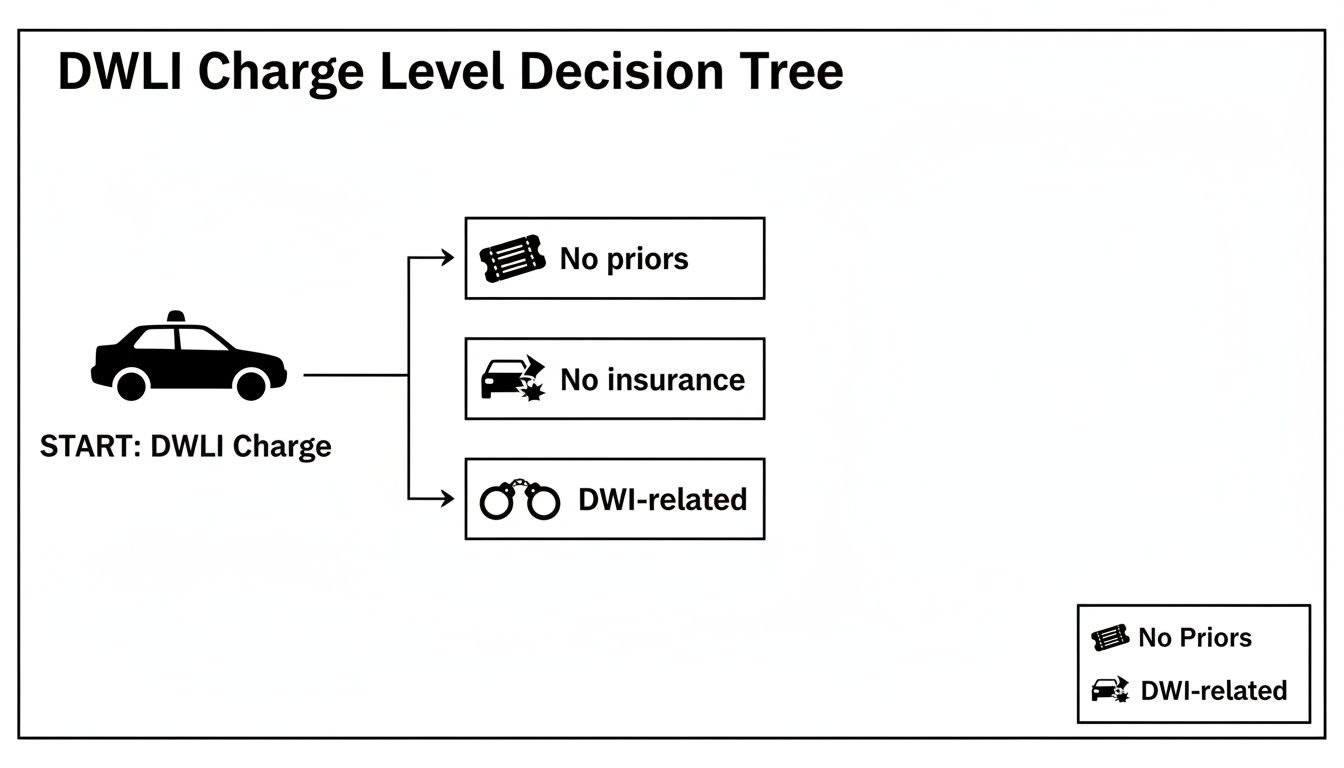
As you can see, that DWI-related suspension puts you squarely on the path toward the most severe misdemeanor penalties for driving with an invalid license.
Because these issues are so tangled together, it's absolutely critical to find a defense attorney who has deep experience in both DWI and DWLI cases. The strategies needed here are far more complex than for a run-of-the-mill traffic stop. To get a better handle on the original penalties that set this all in motion, you can learn more about Texas DWI punishments in our guide.
An attorney who understands how these cases overlap can build a defense that tackles both the old DWI suspension and the new DWLI charge, giving you the best possible shot at protecting your freedom and your future.
Your Action Plan After a DWLI Arrest

The moments after being arrested for Driving While License Invalid (DWLI) can feel like a blur. You’re likely feeling anxious, confused, and overwhelmed about what to do next. But here's the good news: what you do in the hours and days that follow can make a huge difference in the outcome of your case. This is your practical step-by-step guide.
This isn't a time to wait and see what happens. The first and most critical move is to contact a criminal defense attorney who knows the ins and outs of DWLI cases. A lawyer can immediately start protecting your rights, advising you on what to say—and, more importantly, what not to say—and begin building your defense.
Once you have an expert in your corner, you can shift your focus to the immediate practical steps of getting your life back on track.
Navigating the First 48 Hours: Bail and Arraignment
The first two days after an arrest are absolutely crucial. You’ll be dealing with the bail process and getting ready for your initial court appearance, and every decision matters.
- Bail and Release: Getting out of jail is priority number one. This is usually done by posting bail, which is a financial promise that you’ll show up for your court dates. An attorney can be a lifesaver here, often speeding up the process and sometimes arguing for a lower bail amount or even a personal recognizance (PR) bond, which lets you out without paying.
- The Arraignment: This is your first time in front of a judge. They will formally read the charges against you, and you'll be asked to enter a plea: "guilty," "not guilty," or "no contest." In nearly every situation, pleading "not guilty" is the right move. It keeps all your legal options open and gives your attorney time to investigate and fight the charges.
Never miss a court date. If you fail to appear for a scheduled hearing, the judge will issue a warrant for your arrest and hit you with additional criminal charges. It turns a bad situation into a disaster and signals to the court that you're not taking things seriously.
Dealing with the Administrative Side
A DWLI charge isn't just a criminal case; it’s a two-front battle. You have the court system on one side and the Texas Department of Public Safety (DPS) on the other. You have to address both.
This means you need to figure out why your license was suspended in the first place and start the process of fixing it. It can be a bureaucratic headache, but it’s a non-negotiable step toward getting your driving privileges back and putting this behind you.
You may also be required to get an SR-22 insurance certificate. An SR-22 isn't insurance itself—it’s a form your insurance company files with the state to prove you have the minimum liability coverage required by law. The court or the DPS will often demand it before reinstating your license after a serious driving offense like a DWLI.
The legal and administrative maze after an arrest is tough to navigate alone. You can find more practical advice on similar processes in our guide on what to do after a DUI arrest. Having an attorney to guide you through each requirement is invaluable—they'll help you meet every deadline and steer clear of the common mistakes that could cost you your freedom.
Building Your Strongest Defense Against a DWLI Charge

Getting charged with Driving While License Invalid (DWLI) can feel like a done deal, but it’s not. A charge is just the prosecutor’s opening move, not the end of the game. There are powerful, proven defense strategies that can get your case dismissed or the penalties significantly reduced.
A strong defense all comes down to the details. An experienced attorney doesn’t just glance at the ticket—we dig into the traffic stop, the original license suspension, and every piece of evidence the state plans to use against you. Often, the key to a win is buried in the details that most people miss.
The Power of “No Notice”
One of the most common and effective defenses for a DWLI charge in Texas is simple: you were never properly told your license was suspended. The state can’t just assume you knew. They have the burden to prove that the Texas Department of Public Safety (DPS) mailed a notification to your last known address.
Think of it this way: if a delivery company can’t prove they left a package at your door, you can’t be blamed for not having it. If we can show the notice went to an old address or that there's no real proof it was sent, the prosecutor’s case can fall apart.
In Texas, knowledge is a critical element of any DWLI offense. If the prosecution can’t prove beyond a reasonable doubt that you were actually aware of the suspension, they cannot legally get a conviction. This is a crucial point we will challenge aggressively.
Challenging the Traffic Stop and Other Winning Strategies
Beyond the notice issue, there are several other angles we can take to build your defense. A skilled Texas assault defense lawyer investigates every possibility to find the strongest strategy for your specific circumstances.
Here are a few common and effective defenses we look for:
- Challenging the Initial Stop: The police officer who pulled you over can’t just do it on a whim. They must have a legitimate, legal reason—what’s called “reasonable suspicion”—to stop you in the first place. If they stopped you on a hunch or for a bogus reason, any evidence they found, including the DWLI, can often be thrown out of court.
- Proving an Emergency: Sometimes, life throws you a curveball. If you were driving to escape immediate harm or to get help in a true medical emergency, it’s known as the "necessity defense." While the bar for this is high, it can be a powerful argument when the situation justifies it.
- Showing the Suspension Was a Mistake: Government agencies make mistakes. We can pull your complete DPS record to verify that the suspension itself was even valid. If your license was suspended by mistake or the suspension period was already over, you are not guilty of DWLI.
Every DWLI case is different, and the right defense always depends on the facts. The most important thing is to act fast and get a strong defender and trusted guide on your side who knows how to find the weak spots in the prosecution's case and fight for your rights.
Moving Forward After a DWLI Conviction: Expunctions and Nondisclosures
Getting convicted for Driving While License Invalid (DWLI) can feel like a heavy burden. That criminal record sticks around long after you’ve paid the fines, often increasing your insurance rates and making it tough to land jobs that require a clean driving history. But a conviction isn't always the final word. It's a setback, not a life sentence.
Thankfully, Texas law offers post-conviction relief for rehabilitation-focused readers. The two main tools are an expunction and an Order of Nondisclosure. An expunction completely destroys the record of an arrest, but it's only available if your case was dismissed. If you were convicted, an Order of Nondisclosure is your best option. Think of it as putting your criminal record in a locked file cabinet. While law enforcement can still see it, it becomes invisible to most employers, landlords, and anyone else running a standard background check.
Sealing Your Record with an Order of Nondisclosure
An Order of Nondisclosure is your shot at a fresh start. Once a judge grants your petition, the DWLI offense is effectively erased from public databases. This single action can open doors that were slammed shut, allowing you to apply for jobs and housing without that conviction hanging over your head.
But here's the catch: not everyone gets this opportunity. To seal a DWLI conviction, you must meet all legal requirements.
Generally, you’ll need to:
- Complete every part of your sentence, including probation and community service.
- Pay off all your fines, court costs, and associated fees.
- Wait for a specific amount of time to pass after you’ve completed everything (the waiting period varies by offense level).
The process has its share of legal hoops to jump through, but the peace of mind it brings is worth the effort. It’s a powerful step toward reclaiming your future.
Why Local Legal Experience Is So Important
Here’s something most people don’t realize: where you get charged with a DWLI in Texas can make a huge difference in the outcome. The odds aren't the same in every courthouse. For example, Bexar County (San Antonio) tends to have lower non-conviction rates, hovering around 30-40%. Head over to Travis (Austin) or Dallas counties, and those rates jump to 45-55%.
As you can see in this report on impaired driving trends in Texas, these numbers show just how much location matters. A one-size-fits-all defense just doesn't work.
An attorney who works in the Harris, Bexar, or Travis County courts day in and day out knows the local landscape. They understand the prosecutors' habits and the judges' leanings. That kind of insider knowledge is exactly what you need to negotiate a better deal or successfully navigate post-conviction options like nondisclosure.
Frequently Asked Questions About Texas DWLI Laws
Getting hit with a Driving While License Invalid (DWLI) charge in Texas throws a lot of questions your way, and you need answers fast. The legal system can feel like a maze, but getting clear, plain-English answers is the first step to getting back on track. Here are the questions we hear most often from people in your shoes.
What Is the Difference Between DWLS and DWLI?
People often use the terms DWLS and DWLI interchangeably. It’s confusing, but the distinction is actually pretty simple.
Think of Driving While License Invalid (DWLI) as the official legal name for the crime in Texas. It's the broad category.
Driving While License Suspended (DWLS) is just one specific reason you could be facing a DWLI charge. The DWLI umbrella also covers situations where your license was revoked, canceled, or perhaps you never even had one to begin with.
Can I Get My License Back After a DWLI Charge?
Absolutely. Getting your license back is completely possible, but it’s a two-part process. Just dealing with the DWLI charge is only half of the work.
To fully restore your driving privileges, you have to resolve the criminal case and fix the original problem that got your license suspended. That means paying old fines, finishing a required class, or whatever else the Texas DPS requires for reinstatement.
You have to work on both problems at the same time. Simply resolving the court case won’t magically make your license valid again, which is why having an attorney guide you is so helpful.
Do I Really Need a Lawyer for a Minor DWLI Charge?
It’s tempting to think you can handle a simple Class C DWLI charge by yourself, especially since there’s no jail time. But here's the catch: even that "minor" ticket creates a permanent criminal record. That conviction will follow you, popping up on background checks and making your car insurance rates go up.
Hiring an experienced attorney isn't just a cost—it's an investment in protecting your future. A good lawyer can often negotiate to get the charge dismissed or deferred, keeping it off your record entirely. That saves you from the long-term headaches that always follow a conviction for DWLI in Texas.
If you’ve been charged with a crime in Texas, call The Law Office of Bryan Fagan, PLLC for a free and confidential consultation. Our defense team is ready to protect your rights. https://texascriminallawyer.net