Being arrested in Texas can be terrifying—but you don’t have to face it alone. If that arrest involves an accusation of family violence, you may suddenly find yourself served with an emergency protective order (EPO). This immediate court order can feel confusing and deeply unfair, especially when it bars you from your home or from contacting loved ones.
Its primary job is to create a legally-mandated "cooling-off" period by forbidding you, the arrested person, from contacting or going near the alleged victim for a specific amount of time. Understanding what this order means and what your rights are is the first step toward regaining control of your life.
What an Emergency Protective Order Means for You
Receiving any kind of court order is unsettling, especially one that appears suddenly after an arrest. An Emergency Protective Order, often called an EPO, is not a conviction or a finding of guilt. You should think of it as a quick, preventative measure a judge puts in place to keep everyone safe while the legal process unfolds.
What you need to understand right away is that a magistrate typically issues this order without you ever getting to tell your side of the story. The decision is made on the spot, based on the information available at that moment—which is usually just the police report and the nature of the arrest. While it’s not the final word on your case, it is a legally binding order with serious, immediate consequences.
Key Aspects of a Texas EPO
An EPO is a very specific type of court order, and it’s critical to understand how it’s different from other orders, like a restraining order. They might sound similar, but their legal grounds and the penalties for violating them are worlds apart.
Here are the essential things you absolutely need to know about an Emergency Protective Order:
- It’s a Criminal Court Order: An EPO is tied directly to a criminal arrest for offenses like assault family violence, stalking, or sexual assault, as defined in the Texas Penal Code.
- It’s Temporary: This order isn’t meant to last forever. Under Texas law, an EPO typically lasts between 31 and 91 days, depending on the seriousness of the alleged offense.
- Its Goal is Safety: The entire point is to prevent any more potential harm by creating both physical and digital distance between everyone involved.
The most critical thing to remember is that an EPO is not a suggestion—it is a direct command from a judge. Violating any of its terms, even with something that seems as harmless as a quick text message, is a separate criminal offense that can land you right back in jail.
An EPO is often just the first step in a much longer and more complicated legal journey. Fully understanding its rules and what they mean for you is essential to protecting your rights and staying out of more legal trouble as your main case proceeds.
To help you get a quick handle on this, here’s a table summarizing the most important features.
Key Features of a Texas Emergency Protective Order
| Feature | What It Means for You |
|---|---|
| Issued by a Judge | This is a legally binding court order, not a suggestion from the police. |
| Tied to an Arrest | You'll only face an EPO if you've been arrested for a specific type of offense, usually involving family violence. |
| No Hearing Required | The order can be issued without you present, based solely on the arrest report. |
| Strict "No Contact" Rules | You are prohibited from all forms of contact: in-person, phone calls, texts, emails, and social media. |
| Temporary Duration | It lasts for a set period (31-91 days) and does not stay on your record forever like a final protective order can. |
| Criminal Penalties | Violating the EPO is a Class A Misdemeanor, leading to a new arrest, fines, and jail time. |
Knowing these basics is a good start, but there's more to the picture. For a deeper dive into how these orders compare, it's helpful to understand the difference between a protective order and a restraining order in Texas. Grasping that distinction can bring much-needed clarity about your specific legal obligations and restrictions.
How an Emergency Protective Order Is Issued
To get a handle on your legal situation, you need to see how this process plays out from the moment an arrest happens. An Emergency Protective Order isn't something you fight over in a drawn-out court battle. It's a rapid decision made right after an incident, and the whole system is built for one thing: speed.
The process usually kicks off at the scene of an arrest for a qualifying offense, like assault involving family violence. From there, a few different people can get the ball rolling. The arresting officer can request the order for the alleged victim. The victim themselves, their guardian, or even the prosecuting attorney can also ask the magistrate for one directly.
It’s a streamlined path from arrest to a judge's desk, ensuring an immediate decision is made. This flowchart breaks down that fast-moving, three-step sequence.
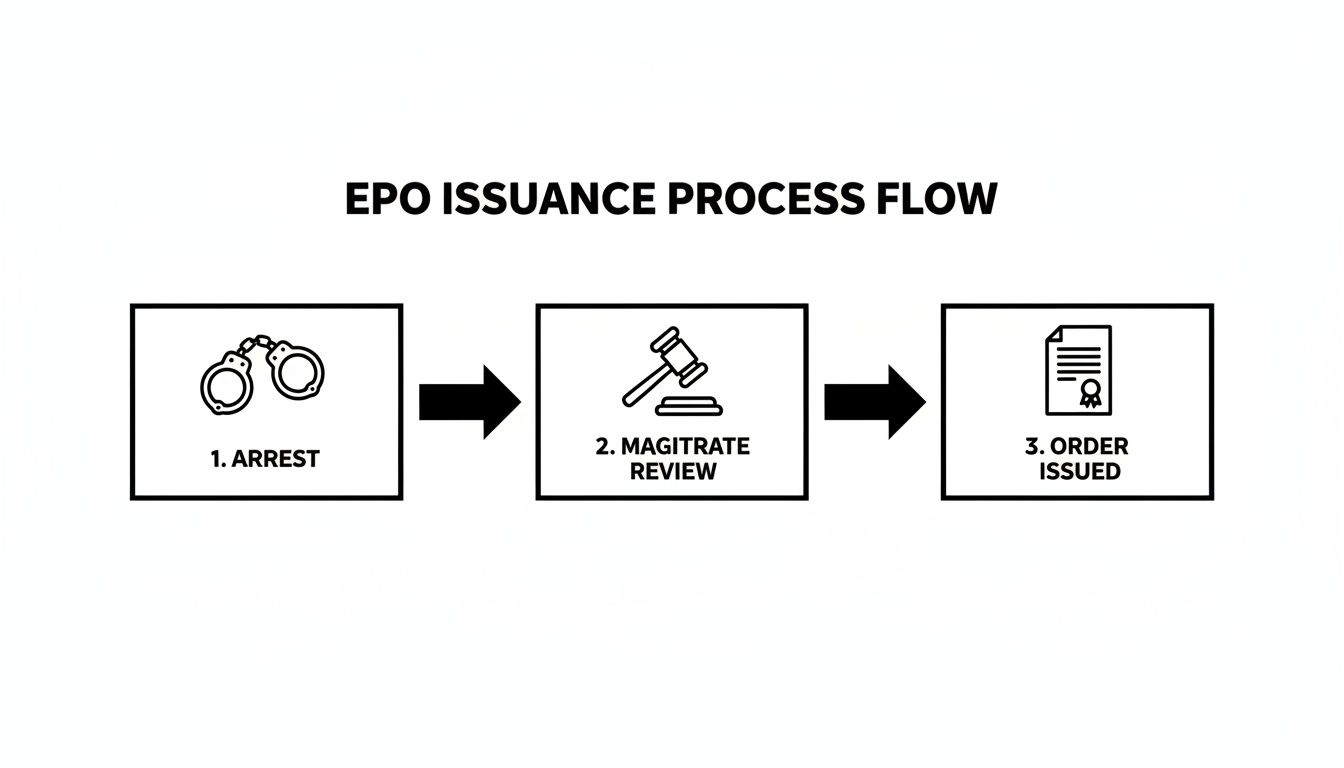
As you can see, the path to getting an EPO is direct. It’s designed to bypass the long hearings you see in other court cases, focusing instead on immediate judicial action right after an arrest.
The Magistrate’s Swift Decision
Once someone makes the request, a magistrate judge looks over the facts. This happens fast—often at your very first court appearance or arraignment shortly after you've been taken into custody. It's critical to understand that this is not a trial. You don't get to present evidence or tell your side of the story.
The judge's decision rests on a much lower legal standard than a criminal conviction. They aren't trying to decide if you are guilty "beyond a reasonable doubt." Instead, the magistrate only needs to find that two things are likely true:
- An act of family violence, stalking, or sexual assault occurred.
- The same kind of violence is likely to happen again.
This decision is often made based only on the police report and the nature of the charge against you.
Under Texas Code of Criminal Procedure Art. 17.292, a magistrate can issue an EPO on their own initiative or at the request of the victim or prosecutor. This means an order can be placed on you even if the alleged victim never asked for it—or even if they later say they don’t want it.
Why the Process Is So Fast
The speed of the EPO process is intentional. The law prioritizes the immediate safety of the alleged victim above everything else. The court sees the situation as a potential emergency and moves to create a mandatory "cooling-off" period. This is designed to stop all contact and prevent any more conflict while the criminal case gets started.
Because it’s a temporary measure—lasting between 31 and 91 days—the system is designed to grant it quickly based on the initial arrest information. This one-sided process can feel incredibly unfair, but it’s standard procedure in Texas family violence cases. Understanding that the system is built for speed and prevention can help you prepare for what comes next, which should absolutely include calling a defense attorney to plan your response.
Navigating the Strict Rules of an EPO
An Emergency Protective Order isn't a list of polite suggestions—it's a set of direct, legally binding commands from a judge that you must follow perfectly. The moment that order is issued, its rules are in full effect, and they are designed to be absolute.
Think of the EPO document as a contract you never got to negotiate but are legally required to honor down to the last letter. Understanding these rules is critical not just for your criminal case but for avoiding a whole new set of legal problems. Even a small, accidental violation can trigger a new arrest and a separate criminal charge.

The Absolute No-Contact Mandate
The heart of nearly every emergency protective order in Texas is a complete ban on contacting the protected person. This is the rule that trips people up the most, because "no contact" means exactly that: zero communication of any kind, whether direct or indirect.
This ban includes:
- Direct Communication: No phone calls, text messages, emails, or approaching the person in public. Period.
- Digital Interaction: You're blocked from messaging them on social media like Facebook or Instagram, commenting on their posts, or even "liking" their pictures.
- Third-Party Contact: You absolutely cannot ask a friend, family member, or coworker to pass along a message for you. A text to your friend saying, "Please just tell her I'm sorry," is a violation.
Even a seemingly harmless message can become a new criminal offense. The court doesn’t care about your intentions; it only cares about your actions. A simple "I'm sorry" or "We need to talk" text is enough to land you back in jail.
Staying Away: Physical Boundaries
Beyond communication, an EPO sets strict geographical limits. These rules are meant to create a safe physical buffer zone around the protected person, and you have to be extremely careful about where you go.
Common distance requirements include:
- Residences: You’ll be ordered to stay a certain distance—often 200 to 500 feet—away from the protected person's home. If you lived together, this means you are legally barred from your own house while the order is active.
- Workplaces: The order will almost certainly prohibit you from going near their place of employment.
- Schools and Daycares: If children are involved, you will be forbidden from going to or near their school or daycare.
These rules apply 24/7. Accidentally running into the person at the grocery store could be seen as a violation if you don't immediately turn around and leave. You must be constantly aware of your surroundings and the specific locations listed in your court order.
It's crucial to understand that the protected person cannot give you permission to violate the order. Even if they call you or invite you over, you are still legally bound by the judge's command. If you respond, you are the one who will be arrested, not them.
Surrendering Firearms and Other Conditions
A standard condition of an EPO in Texas is the immediate prohibition on possessing a firearm. Under Texas law, if you are subject to an EPO, you cannot legally have a gun.
This means you must make arrangements to surrender any firearms you own or have in your possession. You can't just leave them at home; you'll likely need to transfer them to a licensed dealer or law enforcement for safekeeping for the duration of the order.
Finally, remember that the specific conditions of your EPO are unique to your case. Read the document carefully. Understanding the precise requirements is critical, much like how other legal actions are governed by strict legal deadlines and adherence to rules. Don't make assumptions. Your best first step after being served with an EPO is to have an experienced criminal defense attorney review it with you, line by line, to make sure you understand every single restriction.
The Serious Consequences of an EPO Violation
Violating an Emergency Protective Order is one of the biggest mistakes you can make. It's critical to understand that this isn't a minor slip-up. It is a brand-new crime that will land you right back in jail, forcing you to fight a second legal battle while you’re still dealing with the first one.
The court system takes these orders with the utmost seriousness. An EPO is a direct command from a judge, and any action that goes against its terms is seen as a direct defiance of the court's authority. The consequences are swift, severe, and can have a devastating impact on your life.
Criminal Penalties for an EPO Violation
Under Texas Penal Code §25.07, violating a protective order is usually charged as a Class A Misdemeanor. This is a serious offense on its own, carrying heavy penalties.
A conviction for this can mean:
- Jail Time: Up to one year in county jail.
- Fines: A fine of up to $4,000.
These penalties are in addition to whatever you might be facing from the original charge that led to the EPO. This means you could be fighting two separate criminal cases at the same time, each with its own potential for jail time and fines. For a deeper dive into these charges, you can learn more about what a violation of a protective order in Texas entails and how a defense is built.
When a Violation Becomes a Felony
The situation can get much worse. A violation can be elevated from a misdemeanor to a third-degree felony under certain circumstances. This typically happens if you have two or more previous convictions for violating a protective order.
It can also be charged as a felony if the act of violating the order involved committing another crime at the same time, like assault or stalking.
A felony conviction is life-altering. It carries a potential prison sentence of two to ten years and a fine of up to $10,000. It also means losing certain civil rights, including the right to own a firearm and the right to vote while you're incarcerated.
How a Violation Can Damage Your Other Cases
Beyond the immediate threat of a new criminal charge, violating an EPO can cause catastrophic damage to your credibility in other legal matters. The prosecutor in your original family violence case will point to the violation as proof that you're a threat who can't follow court orders, making it much harder to negotiate a favorable plea bargain.
This ripple effect extends into family court, too. If you are going through a divorce or a child custody fight, an EPO violation is devastating. A family court judge is highly unlikely to look favorably on a parent who willfully disobeyed a court order designed to protect the other parent or children. It can severely impact decisions about:
- Child Custody: A judge may see you as a risk to your children’s safety, potentially leading to supervised visitation or a complete loss of custody.
- Divorce Proceedings: It weakens your position in negotiations over property, assets, and everything else.
- Future Legal Matters: A conviction for violating a protective order goes on your permanent criminal record, creating long-term roadblocks for jobs and housing.
The stakes could not be higher. Full, absolute compliance with every single term of the EPO isn't just a suggestion—it is the only way to protect your freedom and your future.
Your First Steps After Being Served an EPO
The moments after a police officer hands you an Emergency Protective Order can feel disorienting and deeply unfair. Your mind is probably racing, but it’s critical to understand that your actions right now will set the tone for your entire case. This isn't the time to react emotionally. It's the time to be calm, deliberate, and strategic.
The first and most important rule is absolute: you must comply completely with every word of the order. The urge to reach out, to explain your side of the story, or to "work things out" is understandable, but it's incredibly dangerous. A single text message or phone call, no matter how well-intentioned, can lead to a new arrest and a separate criminal charge.

Your Immediate Action Plan
Navigating an emergency protective order in Texas requires a clear, step-by-step approach. Following this practical advice helps you stay in control of the situation and immediately begin building a foundation for your defense. Your freedom depends on making the right moves from the very start.
Here is what you need to do the moment you have that order in your hands:
Read the Order Meticulously: Don't just skim it. Read every single word to understand its specific rules. Know the exact "stay-away" distances, the names of all protected persons (which can include children or other family members), and the exact expiration date.
Cease All Communication Instantly: This is non-negotiable. Block the person's number on your phone. Unfriend or block them on all social media platforms. Do not send messages through friends or family. Any form of contact is a violation.
Arrange for Personal Belongings Carefully: If the order forces you out of your home, you cannot just go back to get your things. You must coordinate with local law enforcement to arrange for a "civil standby," where an officer accompanies you to retrieve essential personal items.
Being served with an EPO can feel like your rights have been stripped away without a chance to be heard. While the initial order is one-sided, the legal process does provide a path forward. Your immediate compliance is the first step toward regaining control.
Document Everything and Seek Legal Counsel
While you are strictly following the EPO's rules, it's time to shift into a defensive mindset. Your memory and documentation will be crucial tools for your attorney.
Start by writing down a detailed, chronological account of the events that led to the arrest and the issuance of the EPO. Be as specific as possible with dates, times, and what was said or done. This written record helps preserve details that can fade over time and will be invaluable to your legal team.
Finally, and most importantly, your next call should be to an experienced criminal defense attorney. Don't wait. An attorney who understands the complexities of Texas protective orders can immediately review your case, explain every restriction, and start planning a defense strategy. Getting the right protective order legal representation in Texas is not just a good idea—it is the most critical step you can take to protect your rights, challenge the order if possible, and fight the underlying criminal charge.
Can You Challenge or Change an EPO?
Being served with an Emergency Protective Order can feel like you've been found guilty without ever getting a chance to speak. It’s a one-sided process by design, built for immediate safety in a crisis. But that doesn't mean you're voiceless, and the order isn't set in stone.
While you absolutely must follow the EPO exactly as it's written, Texas law gives you the right to ask the court to change or even dissolve it completely. There is a path for you to be heard, but you have to know how to navigate it. This is not something you should ever try to handle on your own.
Filing a Motion to Modify or Vacate
Your primary legal tool here is a Motion to Modify or Vacate the EPO. This is a formal request your attorney files with the court that issued the order, asking a judge to take a second look at its terms.
- "Modify" means you're asking to change specific conditions.
- "Vacate" means you're asking to cancel the order entirely.
Once your attorney files this motion, the court schedules a formal hearing. This is your opportunity—the one you didn’t get at the beginning—to present your side of the story. Unlike the initial EPO process, this is a real adversarial hearing where both sides can present evidence and testimony.
The judge’s main concern will always be the safety of the alleged victim. To succeed, you can't just argue that the order is unfair or inconvenient. You have to provide compelling reasons and solid evidence to back up your request.
The Hearing and What You Must Prove
At the hearing, a judge will listen to arguments from your attorney and the prosecutor. You may get a chance to testify, and you can present evidence like text messages, emails, or witness statements that tell a different story than the original claims.
To convince a judge to alter the order, your attorney needs to prove a few key things, as laid out in the Texas Code of Criminal Procedure:
- The order is unworkable: You must show that a specific term of the EPO isn't just an inconvenience but creates an impossible situation. For example, if the stay-away provision keeps you from getting to your job because your workplace is too close to the protected person's home, a judge might see that as unworkable.
- The change won't increase risk: You have to demonstrate that your proposed modification will not put the protected person in any more danger than the original order did.
- The change won't endanger anyone: This is the bottom line. Any proposed change has to maintain the safety of everyone protected under the order.
It’s important to be realistic. Courts are very hesitant to completely throw out an EPO unless there is definitive proof that the original accusation was false. More often, a successful motion leads to a modification of the terms, making them more reasonable while still ensuring everyone’s safety. An experienced attorney can help you frame a realistic request that a judge is more likely to grant.
Common Questions About Texas Protective Orders
When you’re suddenly hit with an Emergency Protective Order, questions pile up fast. The whole situation is incredibly stressful, and the legal jargon just makes it worse. Here are some clear, straightforward answers to the questions we hear most often.
How Is an EPO Different From a Restraining Order?
This is a huge one, and the difference is critical. An emergency protective order is a criminal court order. It's issued after an arrest for family violence, and violating it is a brand-new crime that will get you arrested on the spot.
A restraining order, on the other hand, is usually a civil matter. Think divorces or property disputes, where a judge orders someone not to sell off shared assets. While there are consequences for violating a restraining order, breaking an EPO comes with far heavier criminal penalties, including the real possibility of more jail time.
Can I Be Forced to Leave My Home?
Yes, absolutely. If you live with the person who is protected by the order, the judge has the power to grant them exclusive use of the home for the entire time the EPO is in effect. That means you are legally required to pack your bags and move out immediately.
It doesn’t matter if your name is the only one on the lease or the deed. The protective order temporarily overrides any ownership or rental rights you have.
The arrest that led to the EPO is a criminal matter and will appear on background checks. Any charge for violating the EPO will also show up. While the protective order itself is tied to this criminal case, it's the criminal charges that employers and others typically see.
Will This Show Up on a Background Check?
The arrest for the original charge—like assault family violence—will absolutely appear on a background check. On top of that, if you're charged with violating the protective order, that creates a whole new entry on your criminal record.
There is a light at the end of the tunnel. Once the case is fully resolved, an attorney can walk you through options for post-conviction relief, like an expunction or having the record sealed, especially if your case is dismissed or you complete deferred adjudication. This is the path to clearing your name down the road and moving forward with your life.
Family law can get complicated, and protective orders are just one piece of the puzzle. People often have questions about other legal tools, so it's useful to understand things like what a prenuptial agreement is and how it works to protect assets in different situations.
If you’ve been charged with a crime in Texas, call The Law Office of Bryan Fagan, PLLC for a free and confidential consultation. Our defense team is ready to protect your rights.