Being arrested for a felony in Texas can be terrifying—but you don’t have to face it alone. Having a felony charge hanging over your head feels like carrying a massive weight, but I want you to know that expunging a felony in Texas is possible in certain situations. Generally, you can pursue an expunction if your case was dismissed, a jury found you not guilty, or you finished a pretrial diversion program. If successful, you can legally deny the arrest ever happened.
Your Path to a Clean Slate After a Felony Charge

Getting arrested for a felony in Texas is a frightening experience. Long after the court case is over, the consequences can follow you, creating serious barriers to passing a background check, finding a safe place to live, or even getting into school. It can feel like one mistake has slammed every door shut.
At The Law Office of Bryan Fagan, PLLC, we see the anxiety and frustration this causes every day. You don't have to navigate this alone. A criminal charge—especially one that never led to a conviction—should not get to define the rest of your life. Thankfully, the Texas legal system provides a powerful tool called an expunction to help you truly move on.
What Does Expunction Mean in Plain English?
So, what is an expunction, really? Think of it as a legal process that completely destroys your arrest records. They aren't just hidden or sealed away; it's as if the arrest never happened in the first place. Under the Texas Code of Criminal Procedure, once a judge signs that expunction order, every government agency has to physically destroy their files on your case.
This means you can legally and honestly say "no" when asked if you've ever been arrested or charged with that crime on applications for jobs, housing, or loans. It offers a genuine fresh start—a powerful step toward rebuilding your reputation and your future.
Who Is Generally Eligible for a Felony Expunction?
While every situation is a little different, your eligibility for expunging a felony almost always comes down to how your case ended. You may be able to clear your record if:
- The prosecutor outright dismissed your felony charge.
- You went to trial and were acquitted (found "not guilty") by a judge or jury.
- You successfully completed a pretrial diversion program, which is a special arrangement with the prosecutor's office.
- You were granted a pardon by the Governor of Texas.
It’s critical to understand that a felony conviction—where you were found guilty and sentenced—is almost never eligible for expunction. However, recent changes in Texas law are slowly creating more opportunities for relief. This guide will walk you through the possibilities to help you figure out if this is the right path for you.
Do You Qualify for a Texas Felony Expunction?
Figuring out if you even qualify for an expunction is the single most important step in this entire journey. In Texas, the law is very specific about who gets this powerful second chance. The good news is that the rules are straightforward, even if the legal jargon feels overwhelming at first.
The most common path to expunging a felony in Texas is when your case did not end in a conviction. That’s the key takeaway right there. Expunction is designed for people who were accused but never found legally guilty.
Understanding Non-Conviction Outcomes
So, what does a "non-conviction" look like in the real world? You are likely eligible to pursue an expunction if your felony case ended in one of these ways:
- Your case was dismissed. This can happen for all sorts of reasons. Maybe there wasn't enough evidence, a key witness disappeared, or your attorney successfully argued for a dismissal.
- You were acquitted at trial. This is a powerful outcome—it means a judge or jury found you "not guilty." An acquittal is a definitive statement that the prosecution simply could not prove its case.
- You completed a pretrial diversion program. These are special programs run by the district attorney's office. If you meet all the conditions, the charge gets dismissed, opening the door for an expunction.
- A grand jury "no-billed" your case. Before a felony case can even proceed, a grand jury has to review it. If they decide there isn't enough probable cause, they issue a "no bill," and the case stops dead in its tracks.
It's a common myth that any felony can just be wiped away with enough time. Unfortunately, if you were convicted of a felony—meaning you pleaded guilty or were found guilty and sentenced—you are almost certainly not eligible for an expunction. This is a firm rule with very few exceptions.
A felony conviction generally bars you from seeking an expunction in Texas. The law reserves this remedy for arrests that did not lead to a finding of guilt. This is why understanding the final outcome of your case is so critical.
The Waiting Period Mandate
Even if your case was dismissed, you can't just run down to the courthouse the next day and file. The Texas Code of Criminal Procedure lays out mandatory waiting periods. These waiting periods are there to make sure the statute of limitations for the offense has expired, meaning the state can no longer try to prosecute you for that crime.
The clock starts ticking from the date of your arrest, not the date of the dismissal. For felonies, you must typically wait:
- Three years from the date of arrest if your felony case was dismissed.
This timeline is crucial. Filing your petition too early is one of the most common—and easily avoidable—reasons for denial. An experienced attorney will double- and triple-check these dates to make sure your petition is filed at the right time, giving you the best shot at success. If you are unsure about your specific timeline, you can learn more about expungement law and eligibility in our detailed guide.
What If I Don't Qualify for Expunction?
Hearing that you don't qualify can be tough, but it doesn't mean you're out of options. For many people with felony convictions, especially those who completed deferred adjudication probation, there's another path: an Order of Nondisclosure.
While an expunction completely destroys your record, a nondisclosure seals it from the public. This means private employers, landlords, and the general public won't see it on a background check. It's an incredibly powerful tool for getting your life back on track, and we'll dig into the differences in the next section.
Expunction vs. Nondisclosure: What Is the Difference?
When you start looking for ways to clean up your criminal history in Texas, you'll run into two key terms: expunction and nondisclosure. It's easy to get them mixed up, but they're entirely different legal tools with completely different results. Understanding this difference is the first step toward figuring out the right path for your situation.
An expunction is the gold standard for clearing your name. Think of it as a legal process that results in the complete destruction of all records tied to an arrest or charge. It’s like hitting a reset button—the law treats the event as if it never happened.
A nondisclosure, on the other hand, is more like putting your record in a locked filing cabinet. The record itself still exists, but it gets sealed from public view. This means private employers, curious neighbors, and landlords won't see it on a typical background check.
Who Can See Your Record After Each Process?
The biggest difference between the two really comes down to who can access your information afterward. With a successful expunction, the records are gone. Period. You can legally deny the arrest ever happened on job applications, housing forms, or anywhere else. No one—not even law enforcement—can access the destroyed records without a special court order, which is incredibly rare.
With a nondisclosure, the story is a bit different. While the public is blocked, a specific list of government agencies and licensing boards can still see the sealed record. This group includes:
- Law enforcement agencies
- State licensing boards (for jobs like doctors, nurses, or teachers)
- School districts
- Hospitals
- Banks and other financial institutions
This means if you're applying for a job in law enforcement or for a professional license, a nondisclosed offense will still be visible to those key decision-makers. If you want to dig deeper into the specifics, you can read our detailed comparison of expungement vs. nondisclosure in Texas.
A Clear Comparison of Your Options
To really see the differences side-by-side, let's break down the key features of each legal remedy. This should help you understand why one might be a much better fit for your case than the other.
The core difference is simple: Expunction destroys the record entirely, while nondisclosure just hides it from the public. Your eligibility for one over the other depends almost entirely on the outcome of your original criminal case.
Here’s a practical table that compares the two processes and what they mean for you.
Comparing Expunction and Nondisclosure in Texas
This table breaks down the key differences between having a felony record expunged versus having it sealed through an order of nondisclosure.
| Feature | Expunction (Record Destruction) | Nondisclosure (Record Sealing) |
|---|---|---|
| Effect on Your Record | Records are completely destroyed or returned to you. | Records are sealed and hidden from the general public. |
| Who is Eligible | Primarily for cases that did not result in a conviction (dismissals, acquittals, pretrial diversions). | Mainly for cases where you successfully completed deferred adjudication probation. |
| Who Can See It | Virtually no one. You can legally deny the arrest ever occurred. | Still visible to law enforcement, prosecutors, and certain government and licensing agencies. |
| Common Scenarios | A felony drug charge was dismissed by the prosecutor. | You completed probation for a state jail felony without a conviction. |
Ultimately, choosing between these two paths isn’t just a matter of preference—it’s dictated by the specific facts of your case. An arrest that ended in a dismissal is treated far differently than one that resulted in deferred adjudication, and that distinction is what makes all the difference.
Navigating the Felony Expunction Process
Trying to file for an expunction can feel like you're trying to solve a legal puzzle blindfolded. The amount of paperwork, strict court rules, and firm deadlines are enough to overwhelm anyone, especially when your future is on the line. But think of it like a roadmap—once you understand the steps, the journey becomes much easier to manage.
This section will walk you through the real-world steps of expunging a felony in Texas. We'll break down each phase into clear, practical information to pull back the curtain on the process and show you that with the right guidance, a clean slate isn't just possible—it's achievable.
Gathering Your Essential Documents
Before you even think about writing the first word of a legal petition, you have to get your hands on all the necessary information about your case. This is the foundation of your entire effort. Any mistake or missing piece of information at this stage can cause major delays or even get your petition denied. It’s like trying to build a house without all the materials—it’s just not going to work.
You’ll need to track down some very specific records, including:
- Arrest Records: You need the official report with the date of your arrest, the exact felony charge, and the name of the arresting agency (like the Houston Police Department or Harris County Sheriff's Office).
- Court Dispositions: This is the official document from the court that spells out the final outcome of your case. It will clearly state whether the charge was dismissed, you were found not guilty at trial, or you successfully finished a pretrial diversion program.
- Case Numbers and Identifiers: Every case has a unique cause number. You'll need this, along with any other identifying numbers tied to your arrest.
Hunting down these records can sometimes be a hassle, but they are absolutely essential for drafting a petition that the court will actually consider.
This infographic helps visualize the distinct outcomes of expunction versus nondisclosure, two key paths for record relief in Texas.
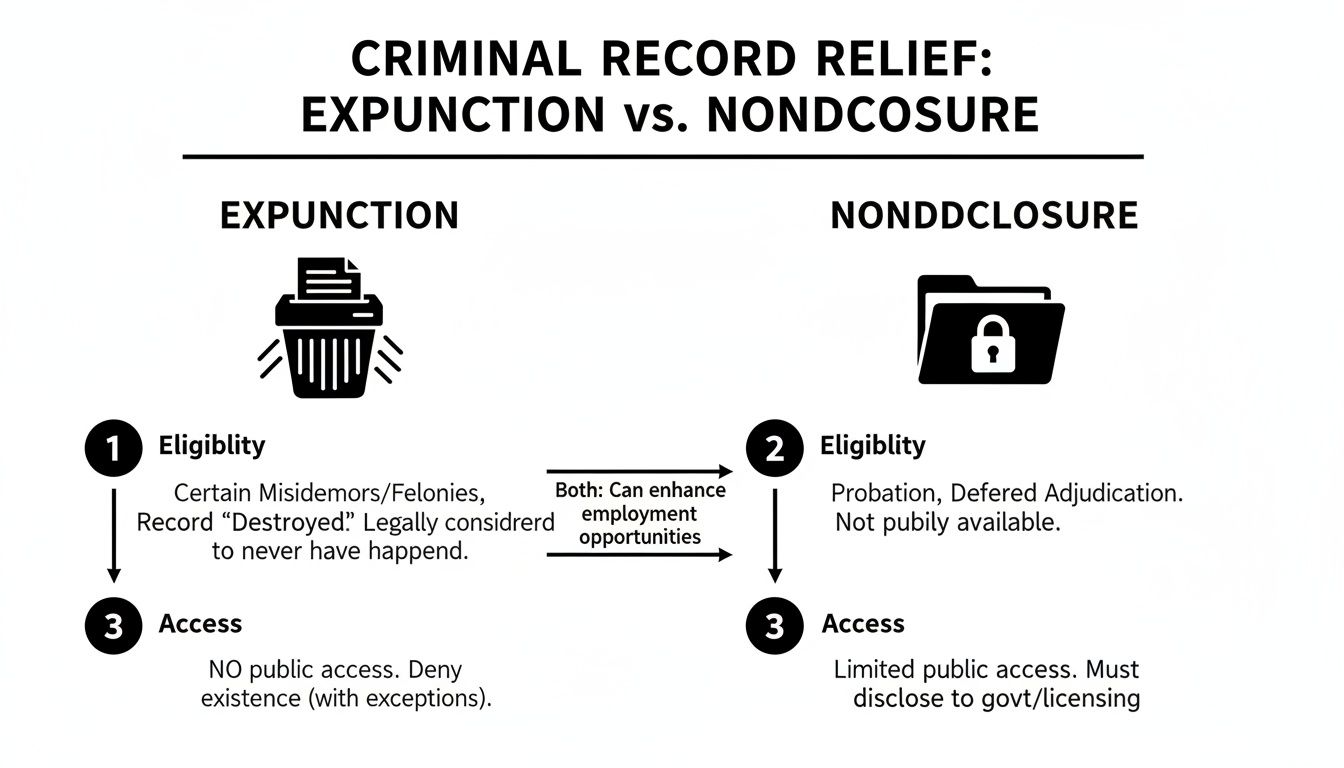
As you can see, an expunction results in the complete destruction of your record. A nondisclosure, on the other hand, just seals it from the public. That's a huge difference in terms of privacy and finality.
Drafting and Filing the Petition for Expunction
Once all your documents are in order, the next move is drafting the Petition for Expunction. This is the formal legal document you file with the court to officially ask for your records to be destroyed. This document has to be perfect—there’s no room for error here.
The petition must name every single government agency that could possibly have a record of your arrest. This is, without a doubt, one of the biggest pitfalls for people trying to do this on their own. You have to think beyond just the police department and the court. The list needs to include entities like:
- The Texas Department of Public Safety (DPS)
- The specific county or district attorney's office that handled your case
- Any other local or state agency that might have been looped in on your arrest.
Forgetting even one agency gives the prosecutor an opening to object, which could sink your entire petition. After the petition is flawlessly drafted, it gets filed with the district court in the county where the arrest happened. You can find more details on what this process entails by exploring our guide on how to clear your record in Texas.
Under the Texas Code of Criminal Procedure, every relevant state agency must be properly notified of your petition. Failing to serve notice to even one of them is often grounds for the prosecutor to object and for the judge to deny your request. It's a procedural trap that catches too many people.
The Court Hearing and Final Order
After the petition is filed and every agency has been properly notified, the court will schedule a hearing. In many straightforward expunction cases, this hearing is just a formality, especially if no one objects. But you can't count on that. The prosecutor’s office has every right to contest your expunction. If they do, you or your attorney will have to stand before the judge and argue why you are legally entitled to have your record wiped clean.
This is where having a skilled attorney in your corner is priceless. A lawyer can anticipate the State's arguments, respond to legal challenges on the spot, and make sure the judge has everything they need to make the right call.
If the judge agrees you’ve met all the legal requirements, they will sign an Order of Expunction. This is the final, official court order that commands every single agency to find and destroy their records of your arrest. It is the key that finally unlocks your fresh start.
How New Laws Are Changing Felony Expungements
The legal landscape for clearing a criminal record in Texas isn't set in stone; it's constantly evolving. Just recently, state lawmakers passed legislation that opens up new opportunities for people trying to move past an old arrest. It's made expunging a felony in Texas more accessible than it has ever been.
For years, the burden fell entirely on you. Even if your felony case was dismissed or a jury found you not guilty, the record of that arrest stuck around unless you hired an attorney and jumped through the long, often expensive hoops of filing for expunction. This created a massive barrier for countless Texans who were legally entitled to a clean slate but just couldn't navigate the system.
Recognizing this was a real problem, Texas lawmakers took a monumental step forward. This isn't just some minor tweak to the law—it’s a fundamental shift in how the state handles records for cases that don't end in a conviction.
The Groundbreaking Impact of New Legislation
A game-changing "Second Chance Bill" brings major updates to the Texas Code of Criminal Procedure. This new law is so significant because it introduces automatic expungement for certain qualifying cases.
This means that for many people, the difficult and costly process of petitioning the court is no longer necessary. Imagine getting arrested for a felony drug possession charge, only to have the case thrown out. Under the new law, that kind of scenario now triggers automatic expungement for many dismissed charges and acquittals. Your record gets wiped clean without you having to file a single piece of paper.
This monumental shift replaces outdated sections of the code with the goal of giving Texans a true fresh start. Before this, the hassle of paperwork, court fees, and waiting periods kept many eligible folks from even trying. You can find more details on how recent Texas expunction law updates can clear your criminal record.
This change aims to tear down the walls that previously stopped millions of eligible Texans from getting the relief they deserved. It acknowledges a simple truth: if the state couldn't prove its case against you, the record of that accusation shouldn't follow you for life.
Who Benefits From These New Automatic Expungement Rules?
While this new law is incredibly powerful, it's crucial to understand who it actually helps. The automatic process generally applies to arrests that happen on or after the law's effective date and end in one of two ways:
- An acquittal: You went to trial and were found "not guilty" by a judge or jury.
- A dismissal: The prosecutor decided to drop the charges before you were ever convicted.
But there are some catches. For instance, if your case was dismissed as part of a plea deal for another crime, you probably won't qualify for this automatic relief. The system is designed to help those who are genuinely innocent of any wrongdoing tied to that specific arrest.
The whole point of this legislation is to make sure that a simple arrest, without a conviction, doesn't become a life sentence of closed doors and missed opportunities. It’s about fairness and giving people the clean slate the law always intended them to have.
This reform is both a compassionate and practical approach to criminal justice. It recognizes that clearing these records not only helps individuals get back on their feet but also benefits the entire state by allowing more people to become productive members of the workforce and their communities. If you think your case might fall under these new rules, or if you have an older case that still requires a traditional petition, our team is here to help you figure out your rights and take the next step.
Why You Need an Experienced Attorney for Your Case

It’s tempting to think you can handle your own expunction petition. I get it—it looks like a way to save a little money. But from my experience, it's one of the riskiest bets you can make with your future. The process of expunging a felony in Texas is a minefield of procedural rules and legal deadlines.
A single slip-up, like forgetting to notify just one of the many required government agencies, can get your entire case tossed out of court. If that happens, you’re right back at square one, having wasted months and a lot of effort.
The stakes are just too high to go it alone. An experienced criminal defense attorney does a lot more than just fill out paperwork. We’re your advocate and guide, making sure every single detail is handled with the precision the law demands.
Navigating Complex Legal Arguments
Successfully getting a felony expunged isn't always a simple matter of filing the right forms. If the District Attorney’s office objects to your petition—and they often do—you’ll suddenly find yourself in a contested hearing in front of a judge. You'll be expected to make a compelling legal argument, citing specific sections of the Texas Code of Criminal Procedure, to prove you’re entitled to have your record cleared.
This is where a skilled attorney becomes your most valuable asset. We can anticipate the State’s objections, build a strong counter-argument, and present your case in the most persuasive way possible. Our job is to stand up for you and fight for your right to a fresh start.
One of the most common reasons I see petitions get denied is the failure to properly identify and serve notice to every single agency that has a record of your arrest. An attorney ensures this complex notification process is handled flawlessly, removing a huge obstacle to your success.
Your Trusted Guide to a New Beginning
At The Law Office of Bryan Fagan, PLLC, we understand this is more than just a legal case for you; it's about getting your future back. Our defense team handles the entire process from start to finish—from tracking down every last record to arguing your case in court. We take that weight off your shoulders so you can finally focus on moving forward.
Don't let a procedural mistake stand between you and a clean slate. A good attorney ensures your petition is drafted correctly, filed on time, and argued effectively, giving you the best possible shot at success.
If you’ve been charged with a crime in Texas, call The Law Office of Bryan Fagan, PLLC for a free and confidential consultation. Our defense team is ready to protect your rights.
Frequently Asked Questions About Texas Expunctions
When you start digging into the process of clearing a felony record, it's natural for a lot of questions to pop up. We hear them all the time from clients. Below, I’ve put together answers to some of the most common ones we get about expunging a felony in Texas, hoping to give you some quick, clear information about what to expect.
How Long Does the Expunction Process Take?
The timeline for an expunction can vary quite a bit, but realistically, most cases take between three to six months from the day we file the petition. It’s not an overnight fix because a series of legal steps have to happen in a very specific order.
Once the petition is filed, every state agency involved gets a 30-day window to respond or object. After that, we have to get a hearing date on the court’s calendar, which is entirely dependent on how busy that particular court is. If no one objects, things move along smoothly. But a packed docket or a prosecutor who decides to fight it can definitely add delays.
Can I Say I Was Never Arrested After an Expunction?
Yes, absolutely. This is the single most powerful benefit of getting an expunction. Once a judge signs that final order, Texas law gives you the legal right to deny the arrest ever happened. That goes for job applications, housing forms, and pretty much every other situation you can think of.
The legal effect is powerful: it’s as if the arrest never happened. The records are physically destroyed, giving you a true clean slate that a nondisclosure (record sealing) simply cannot offer.
This is a critical difference. A nondisclosure just hides your record from public view, but an expunction wipes it off the books completely.
What Happens If My Expunction Petition Is Denied?
Getting a denial can be a real setback, but it doesn't always mean it's the end of the road. If a judge denies your petition, they have to explain why, and that reason is the key to figuring out what to do next.
We see denials happen for a few common reasons:
- Procedural Errors: A frequent mistake is forgetting to notify a required state agency. It's a technicality, but it matters. This is usually something an attorney can fix before refiling.
- Eligibility Issues: The judge might decide your case just doesn't meet the strict criteria laid out in the Texas Code of Criminal Procedure.
- The State Objects: Sometimes, the prosecutor successfully argues against your petition, convincing the judge that it shouldn’t be granted.
Depending on why it was denied, you might be able to correct the error and try again. In other situations, we may need to pivot and explore another option, like an Order of Nondisclosure. This is where having an experienced attorney is crucial—we can analyze the denial and map out the most effective way forward. Don't let an initial setback stop you from clearing your name.
If you’ve been charged with a crime in Texas, call The Law Office of Bryan Fagan, PLLC for a free and confidential consultation. Our defense team is ready to protect your rights. https://texascriminallawyer.net