Skip to content
Being arrested for a DWI in Texas can be terrifying—but you don’t have to face the aftermath alone. If you're dealing with the consequences of a DWI charge, the biggest question on your mind is probably, "Will this follow me forever?"
Let's be clear: erasing a DWI conviction in Texas is impossible. If you were found guilty or accepted a plea deal that resulted in a conviction, that mark on your record is permanent. However, if your DWI charge did not end in a conviction, you may have a clear path to completely wiping the arrest from your record through a legal process called an expunction.
Can a DWI Arrest Be Erased in Texas?
A DWI arrest can feel like a life sentence. It casts a long shadow over everything—your job prospects, housing applications, and even professional licenses. The good news is that under very specific circumstances, Texas law allows you to get a true fresh start.
The key is understanding the difference between a DWI arrest and a DWI conviction. This distinction is the single most important factor in determining if you can clear your record.

An expunction, as defined under the Texas Code of Criminal Procedure, is a powerful legal tool that orders the permanent destruction of all records related to your arrest. The records aren’t just sealed or hidden—they are gone for good. This means you can legally deny the arrest ever happened. But this powerful remedy is reserved for only a few specific outcomes.
Who Qualifies for a DWI Expunction?
Eligibility for expunging a DWI in Texas is narrow and depends entirely on how your case was resolved. You absolutely cannot have been convicted of the crime. This means if you accepted a plea bargain for the DWI or a lesser offense like reckless driving that resulted in a conviction, expunction is off the table.
You might be eligible for a DWI expunction only if your case ended in one of these ways:
- Acquittal: You went to trial and a judge or jury found you "not guilty."
- Dismissal: The prosecutor dropped the charges against you, often due to weak evidence, a procedural mistake, or your completion of a diversion program.
- No-Bill by Grand Jury: A grand jury reviewed your case and decided there wasn't enough evidence to formally charge you (indict you).
- Successful Pre-Trial Diversion: You completed a court-approved program that resulted in your charges being dismissed.
These are the only pathways to a complete expunction in Texas. It's also critical to understand that a dismissal doesn't automatically clear your record. You have to take proactive legal steps by filing a Petition for Expunction with the court.
The table below breaks down these eligibility paths in plain English.
Eligibility Paths for Texas DWI Expunction
| Case Outcome | What It Means for You | Can the Record Be Expunged? |
|---|---|---|
| Acquittal | You were found not guilty at trial. | Yes. You have an absolute right to a full expunction. |
| Dismissal | The prosecutor dropped the case before trial. | Yes. This is a common path to expunction. |
| No-Bill | A grand jury declined to indict you. | Yes. The case never moved forward. |
As you can see, the outcome of your original DWI case is everything. If your case didn't end with one of these favorable results, an expunction is simply not an option.
The Critical Role of a Favorable Outcome
The law is unforgiving when it comes to DWI convictions in Texas. Even a first-time offense will stay on your criminal record forever. But for those whose cases don't end in a conviction, the opportunity for a clean slate is very real.
Once your case is acquitted or dismissed, the entire arrest record can be wiped clean, making it inaccessible to landlords, employers, and even government agencies. You can learn more about the specific requirements in our detailed guide on how a DWI can be expunged in Texas. This entire process underscores just how important a strong defense is from the very beginning.
Key Takeaway: An arrest is not a conviction. The final outcome of your criminal case is what determines whether you can pursue an expunction and truly put the incident behind you for good.
When you start looking for ways to clear a DWI from your record, you'll quickly run into two legal terms: expunction and nondisclosure. They might sound similar, but they are completely different processes with drastically different outcomes for you and your future.
Getting this right is critical. One option offers a true clean slate, while the other provides a much more limited form of relief. Let's break down what each one really means for you.

What Is a DWI Expunction?
An expunction is the gold standard for clearing your name. When a judge grants an expunction, it’s a court order to destroy every single record related to your arrest. This isn't a partial measure; the records are permanently erased as if the arrest never happened.
This means you can legally and honestly deny the arrest ever took place on job applications, housing forms, or loan documents. Law enforcement agencies, courts, and prosecutors are all required by law to physically destroy their files on the matter.
But here’s the catch: eligibility for a DWI expunction is extremely narrow. It's only available if your case did not result in a conviction. That means you were found not guilty at trial, the charges were outright dismissed, or a grand jury returned a "no-bill," effectively killing the case before it started.
What Is an Order of Nondisclosure?
An order of nondisclosure, which most people call record sealing, is a different tool altogether. It doesn’t destroy your criminal record; instead, it seals it from public view. Think of it like putting the record in a locked file cabinet that most people can't open.
After a judge grants a nondisclosure, private employers, landlords, and the general public won't see the DWI on a standard background check. However, the record still exists and remains fully accessible to:
- Law enforcement agencies
- State licensing boards (like nursing, teaching, or law)
- Government employers
- Certain other state and federal entities
This is a huge difference. While a nondisclosure provides valuable privacy and can open doors to new opportunities, it is not the complete erasure that an expunction offers. To get a deeper understanding of the legal distinctions, you can review our detailed comparison of expungement vs. nondisclosure in Texas.
The Key Difference for a DWI Conviction
Here is the single most important point: a DWI conviction can never be expunged in Texas. Period. But, thanks to relatively recent changes in the law, certain first-time DWI convictions may be eligible for an order of nondisclosure.
This "second chance" law, as it's often called, created a pathway to seal a DWI conviction if you meet a very strict set of criteria. For instance, it must be your first and only DWI offense, your blood alcohol concentration (BAC) must have been below 0.15, and you must have successfully completed every part of your sentence, including any probation.
Key Takeaway: An expunction erases an arrest that did not lead to a conviction. A nondisclosure seals a record—often a first-time conviction—from public view but not from the government.
To make things even clearer, this simple table lays out the differences side-by-side. This should help you quickly see which path might be available for your specific situation.
Comparing Expunction and Nondisclosure for DWI Records
| Feature | Expunction (Record Destruction) | Nondisclosure (Record Sealing) |
|---|---|---|
| Eligibility | Your DWI case was dismissed, you were acquitted, or the case was no-billed. No conviction. | You were convicted of a first-time DWI and meet strict criteria (e.g., BAC < 0.15, completed sentence). |
| What Happens to the Record? | All records are physically destroyed and permanently erased from existence. | The record is hidden from the public but remains visible to government and licensing agencies. |
| Can You Deny the Arrest? | Yes. You can legally state the arrest never happened on any application. | No. You cannot deny the arrest or conviction if asked directly by a government or licensing agency. |
| Effect on Background Checks | The arrest will not appear on any public or private background check. | The conviction will not appear on most private background checks used for jobs or housing. |
| Best For | Individuals whose DWI charges did not result in a conviction. | First-time DWI offenders who were convicted but meet specific legal requirements for sealing. |
Trying to navigate these options on your own can be confusing, and a mistake can have long-lasting consequences. The right choice depends entirely on the specific facts and final outcome of your DWI case.
Using Pre-Trial Diversion to Achieve a DWI Dismissal
For many people facing a first-time DWI charge, the best path to an expunction starts way before the case is ever resolved. It begins with a proactive legal strategy aimed at one single goal: getting the case dismissed. One of the most common and effective ways to do that is through a Pre-Trial Diversion (PTD) program.
PTD programs are a lifeline, offering a genuine chance to sidestep a conviction and keep your record completely clean. You can think of it as a contract between you and the prosecutor's office. If you hold up your end of the bargain by completing all their requirements, they agree to dismiss your DWI charge. That dismissal is what makes you eligible for a full expunction down the road.
What Does a PTD Program Involve?
Let's be clear: these programs are not a "get out of jail free" card. They demand real commitment and strict compliance with every single rule. While the specific requirements can differ from one county to the next, most PTD agreements for a DWI will include a mix of these conditions:
- Substance Abuse Counseling: You'll almost certainly have to complete an alcohol or drug education course.
- Community Service: Performing a set number of volunteer hours is standard practice.
- Ignition Interlock Device: For a period of time, you'll likely have to install a breathalyzer device in your vehicle.
- Regular Check-ins: Reporting to a probation officer or program supervisor is a must.
- Random Drug and Alcohol Testing: You must stay sober for the entire duration of the program.
Successfully completing all these requirements over a period that typically lasts from 6 to 18 months is non-negotiable. Any slip-up or violation can get you kicked out of the program, sending your case right back to court to face the original DWI charge.
Real-World Scenario: Imagine Sarah, a recent college grad who made a mistake after a celebratory dinner. With no criminal history and a low BAC, her attorney was able to proactively negotiate with the Harris County District Attorney's office for her to enter their PTD program. For 12 months, Sarah completed her classes, did her community service, and never failed a random test. Because she did everything asked of her, the prosecutor dismissed her DWI case. Two years after her arrest, her lawyer filed a Petition for Expunction, and the court ordered every record of the incident destroyed, letting her pursue her career with a truly clean slate.
The Prosecutor's Discretion
It is vital to understand that PTD programs aren't a right; they are offered entirely at the discretion of the District Attorney’s office. Factors like your criminal history, the specific facts of your case (like a high BAC or causing an accident), and the general policies of that particular county all come into play. An experienced Houston criminal lawyer can often make all the difference in convincing a prosecutor that you are a good candidate for diversion.
These programs offer a critical statistical pathway to a clean slate, but they require dedication. While getting a handle on statewide DWI dismissal rates can be tough, successfully completing a PTD program is one of the most reliable ways to secure that dismissal and become eligible for expunction. You can find more insights about Texas DWI dismissal statistics and their connection to expunction eligibility on traviscountycriminalattorney.com.
It's also crucial not to confuse PTD with another common legal outcome: deferred adjudication. While both can help you avoid a conviction, only a dismissal that comes from a PTD program makes you eligible for a full expunction. To understand this critical difference, take a moment to learn about what deferred adjudication is in Texas and its limitations. For many, getting into a PTD program is the first and most important step toward permanently clearing a DWI arrest in Texas.
The Process of Filing for a DWI Expunction
So, you’ve confirmed you're eligible for a DWI expunction. What's next? Getting your record wiped clean is a formal legal process, but it doesn't have to be a nightmare. Knowing the road ahead is the best way to take back control and get the fresh start you deserve.
Think of this process as a civil lawsuit. You’re essentially suing the government to force them to destroy every last trace of your arrest. Because of that, precision is absolutely critical. One small misstep can derail the whole thing.
For many, the ideal path starts long before the expunction, with a Pre-Trial Diversion (PTD) program that leads to a dismissal.
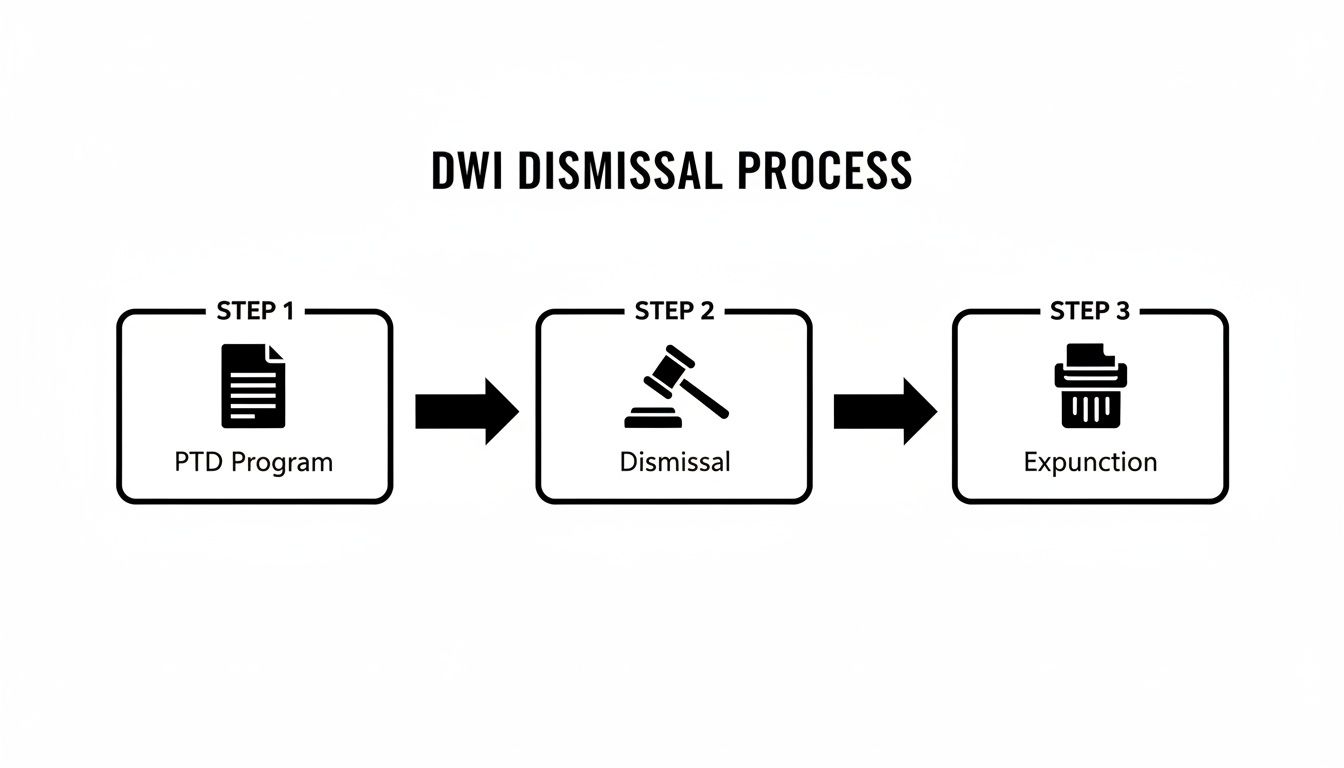
As you can see, a dismissal is the key that unlocks the door to an expunction. Without it, your record stays put. Here is a step-by-step guide to the expunction process.
Step 1: Preparing and Filing the Petition for Expunction
The first official move is drafting and filing a Petition for Expunction. This isn’t some simple form you download and fill out. It’s a detailed legal document that gets filed in a civil district court in the county where your arrest took place.
The petition must include specific details: your personal information, the arrest date, the exact charge, and the case number. Most importantly, it must lay out the legal reasons you’re eligible—for instance, that the prosecutor dismissed your case or a jury found you not guilty.
Getting every detail right is non-negotiable. An incorrect date or a typo in a name can cause huge delays or even get your petition denied, forcing you to start from scratch and pay filing fees all over again.
Step 2: Identifying and Notifying All Relevant Agencies
This is where the DIY approach often falls apart. Your petition has to list every single government agency that holds a record of your arrest. That list is much longer than you might think.
Sure, it includes the obvious ones, like the arresting police department and the District Attorney’s office. But the list goes on:
- The Texas Department of Public Safety (DPS)
- The county clerk and district clerk
- Any crime labs that handled evidence
- The local jail or sheriff’s department
- Any other municipal agency that touched your case
Once the petition is filed, every agency on that list must be formally served notice of the lawsuit. This is their chance to object if they believe you are not eligible. If you miss even one agency, the entire expunction could be invalid.
Key Insight: The entire point of an expunction is to destroy all records. If an agency with a file on you isn't notified, their record remains. This defeats the whole purpose and leaves a piece of your past exposed for anyone to find.
Step 3: The Expunction Hearing and Final Order
After all the agencies are properly served, the court schedules a hearing, usually 30 to 45 days later. In many straightforward cases where the state has no objections, your attorney can often finalize everything without you ever stepping into the courtroom. This is handled through what’s called an "agreed order."
However, the District Attorney’s office has the right to fight the expunction. They might object if they believe you filed too early, before the statute of limitations on your charge ran out. If they do, a hearing is required. Your attorney will have to present evidence and make legal arguments to the judge, explaining why you are entitled to the expunction under Texas Code of Criminal Procedure Chapter 55.
If the judge sides with you, they will sign an Order of Expunction. This is the court's official command telling every agency you listed to find and destroy their records of your arrest. But the job isn't done yet. Those agencies must be served with that final order to ensure they comply—a final, crucial step an experienced attorney will handle meticulously to truly secure your clean slate.
Common Missteps That Derail Expunction Petitions
Getting a DWI expunged in Texas is a game of rules and deadlines. You can be perfectly eligible, but one simple mistake can get your petition denied, forcing you to start over—and pay all the fees again. As defense attorneys, we’ve seen countless people with a solid case sabotage their own fresh start with a preventable error.
Knowing what these common pitfalls are is half the battle. Successfully clearing your record isn’t just about qualifying; it’s about flawlessly executing a very specific legal process from start to finish.
Mistaking a Dismissal for a Clean Slate
This is easily the most common and damaging misconception. When a prosecutor dismisses your DWI case, it’s a massive win. But here’s the critical part: that dismissal does not automatically wipe the arrest from your record.
Without an expunction, the arrest, the charge, and the case file all remain public information. They’ll pop up on background checks for jobs, apartments, and loans for years to come. The only way to truly destroy those records is to proactively file a Petition for Expunction and get a judge to sign a court order.
Key Takeaway: A dismissal makes you eligible for an expunction, but it doesn't grant you one. You have to take that next legal step to formally clear your name.
Filing Before the Waiting Period Ends
Timing is everything with expunctions. Texas law is incredibly strict about this. There are mandatory waiting periods—also known as statutes of limitations—that must pass after a dismissal before you can file. Filing your petition even one day too early is an automatic denial from the court.
These waiting periods are tied to the severity of the offense:
- Class C Misdemeanor: 180 days from the date of arrest.
- Class A & B Misdemeanor: Two years from the date of arrest.
- Felony: Five years from the date of arrest.
A first-time DWI is almost always a Class B Misdemeanor. So, if your case gets dismissed, you must wait a full two years from the day you were arrested before you can file your petition. Trying to rush it will only cost you time and money.
Assuming Deferred Adjudication Qualifies
This is another huge legal trap. Many people confuse deferred adjudication with an outcome that qualifies for expunction, but for a DWI, it absolutely does not. Under Texas law, if you successfully complete deferred adjudication for a DWI, you are permanently barred from ever having that arrest record expunged.
While deferred adjudication is great for avoiding a final conviction, the law specifically carves out DWI cases and prevents them from being expunged. Your only potential remedy down the road might be an order of nondisclosure, which only seals the record from public view instead of destroying it. It’s a crucial distinction that trips up many people.
Failing to Notify Every Necessary Agency
When you file an expunction petition, the law requires you to identify and formally notify every single government agency that could possibly have a record of your arrest. The list is way longer than most people realize and often includes more than a dozen different entities.
If you miss just one, the entire expunction can be ruled invalid. A complete list has to include agencies like:
- The arresting police department or sheriff's office
- The District Attorney's and County Attorney's offices
- The District and County Clerks
- The Texas Department of Public Safety (DPS)
- Any crime labs that processed evidence in your case
An experienced Texas DWI attorney knows how to run a thorough check to make sure every single relevant agency is properly served notice. That kind of meticulous detail is often what separates a successful expunction from a failed attempt that leaves your record exposed for everyone to see.
Your Top Questions About Texas DWI Expunctions, Answered
Even after getting the big picture, you probably still have some specific questions. That’s completely normal. Let’s cut through the legal jargon and get you some plain-English answers to the most common concerns we hear every day.
How Long Do I Have to Wait to Expunge a DWI Arrest?
This is one of the most critical parts of the entire process, and getting it wrong is an expensive mistake. The waiting period, known as the statute of limitations, is a hard-and-fast rule. If you file your petition too early, the court will deny it, and you'll lose your filing fees and have to start all over again.
Remember, the clock starts ticking on the date of your arrest, not the date the case was dismissed.
The timeline depends entirely on the level of the offense you were arrested for:
- Class C Misdemeanor: You must wait 180 days from the arrest date.
- Class A or B Misdemeanor: The waiting period is two years from the arrest date. A typical first-time DWI falls into this category as a Class B Misdemeanor.
- Felony: You’ll have to wait five years from the date of your arrest.
Now, there is one huge exception to these waiting periods. If you fought your case at trial and won an acquittal (a "not guilty" verdict), or if a grand jury "no-billed" your case, there is no waiting period. You can file your Petition for Expunction immediately. This is a massive advantage that underscores the power of winning your case outright.
Can I Expunge My DWI If I Got Deferred Adjudication?
This is a firm and absolute no. Texas law is crystal clear on this point: successfully completing deferred adjudication for a DWI makes that arrest record permanently ineligible for expunction. This is a special rule written into the law that applies only to DWI cases.
It's a common point of confusion because deferred adjudication for many other offenses can often be expunged. The Texas legislature, however, decided that a DWI is different and carved out this exception.
Key Distinction: While a DWI that ends in deferred adjudication can never be expunged, you might be eligible to have the record sealed through an order of nondisclosure. Sealing hides the record from the public, but it doesn’t destroy it like an expunction does. This is a crucial difference to understand.
What Happens If I Don't Expunge an Eligible DWI Arrest?
When a prosecutor dismisses your DWI case, it’s a huge relief. But that dismissal doesn't magically wipe the slate clean. The arrest, the charge, and all the associated court filings remain in the public record, easily accessible to anyone who runs a background check.
If you are eligible for an expunction but decide not to follow through, that arrest record will shadow you for years. It can pop up at the worst possible times and create frustrating hurdles when you’re:
- Applying for a new job
- Trying to rent an apartment or buy a house
- Seeking a professional license (for nursing, real estate, teaching, etc.)
- Applying for a loan
Even though the case was ultimately dismissed, the mere presence of a DWI arrest on your record can make people suspicious and lead to negative judgments. An expunction is the only legal tool available to completely destroy these records and give you a genuinely fresh start.
Is a Lawyer Really Necessary for a DWI Expunction?
Legally, you are allowed to file for an expunction on your own—this is called filing "pro se." However, calling the process complicated would be an understatement. It's a formal civil lawsuit with strict procedural rules, precise paperwork requirements, and firm deadlines that have to be met perfectly.
A single mistake can get your entire petition thrown out of court. For example, if you fail to properly identify and notify just one of the dozen or more government agencies holding your records, the entire process can be invalidated.
An experienced Texas criminal defense attorney knows exactly how to navigate this complex system. Hiring a lawyer dramatically increases your odds of a successful outcome by ensuring every form is correct, every deadline is met, and your rights are fully protected in court.
If you’ve been charged with a crime in Texas, call The Law Office of Bryan Fagan, PLLC for a free and confidential consultation. Our defense team is ready to protect your rights. Visit us at https://texascriminallawyer.net to learn more.