Being arrested for a felony in Texas can be terrifying—but you don’t have to face it alone. A felony isn't just a charge; it's the most serious category of crime you can face. A conviction carries life-altering penalties, from years in prison and massive fines to a permanent criminal record that follows you forever. If you're staring down an accusation, understanding what you're up against is the first, most critical step toward protecting your rights and your future.
Remember this: an accusation is not a conviction. You have options, and with the right legal team, you can fight back.
Facing a Felony Charge in Texas
Hearing the words "you're under arrest for a felony" can make your entire world feel like it's collapsing. The fear, confusion, and sheer uncertainty of what comes next are completely normal. But the single most important thing to know is that you don’t have to go through this overwhelming experience alone. A felony charge is worlds apart from a misdemeanor, carrying the potential for lengthy prison sentences—from months in a state jail to life behind bars—and fines that can easily hit $10,000 or more.

This guide was created to give you clear, straightforward information about the Texas criminal justice system. We will break down complex legal concepts into plain English, helping you understand the charges you or a loved one are facing and what you can do about them.
Why Immediate Legal Counsel is Crucial
The moments immediately following a felony arrest are the most important for your defense. Make no mistake, the prosecution is already building its case against you, and anything you say or do can be twisted and used to secure a conviction. Having an experienced criminal defense attorney by your side from the very start ensures your rights are protected at every turn.
An attorney can help you:
- Understand Your Rights: You have the right to remain silent and the right to an attorney. A lawyer makes sure those rights are more than just words—they're enforced.
- Navigate the Bail Process: A good attorney can argue for a reasonable bond, which drastically improves your chances of getting out of jail while your case is pending.
- Challenge the Evidence: We don’t wait around. We immediately start digging into the prosecution's case, searching for weaknesses, illegal police procedures, or violations of your constitutional rights.
A felony accusation can feel isolating, but it's a legal fight that can be won. The state's case against you is often not as solid as it first appears. A proactive, aggressive defense is your most powerful tool.
This guide will walk you through the different classifications of Texas felonies, the legal process you're about to enter, and potential defense strategies. Knowledge is power, and understanding the road ahead is the first step toward regaining control of your situation.
How Texas Classifies Felony Offenses
When you’re staring down a criminal charge in Texas, one of the first things you need to understand is how the state categorizes offenses. The Texas Penal Code doesn’t just lump all felonies together. Instead, it uses a classification system based on the seriousness of the crime—think of it like a ladder, where each rung represents a higher level of severity and steeper consequences.
This system can feel a little confusing, but it’s absolutely critical for understanding what you’re up against. Knowing whether a charge is a State Jail Felony or a First-Degree Felony makes a world of difference in the potential prison time and fines you face.
The Five Levels of Texas Felonies
Texas law breaks down felonies into five distinct categories. Starting from the least severe and moving up, they are: State Jail Felony, Third-Degree Felony, Second-Degree Felony, First-Degree Felony, and Capital Felony. Each level comes with its own specific range of punishments, and the jumps between them are significant.
The infographic below gives you a quick visual snapshot of a few key felony levels, showing how the potential outcomes escalate from the lower end to the most serious charges.
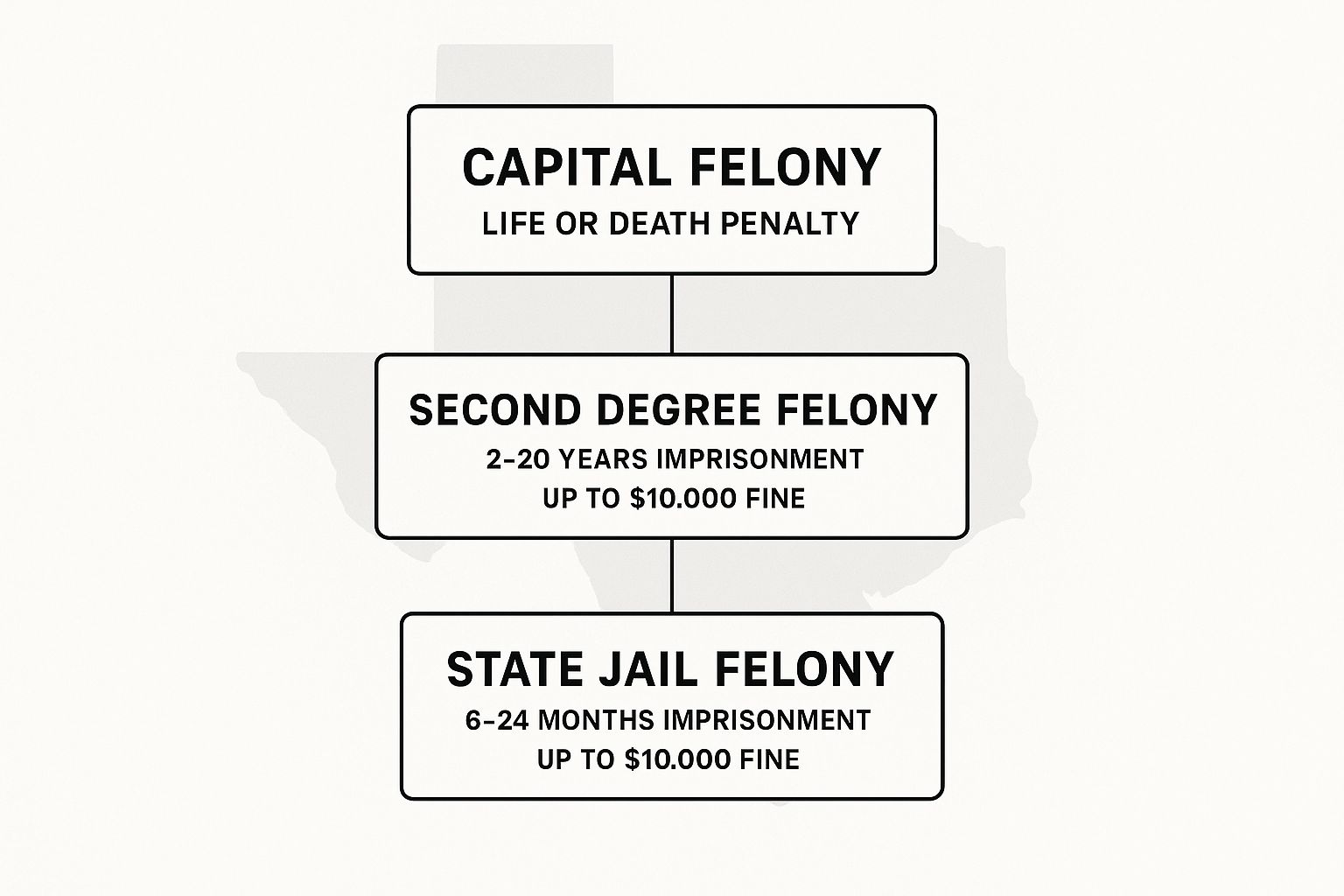
As you can see, the difference in potential sentences is stark. This highlights just how critical it is to know exactly where a specific charge falls within this hierarchy.
To give you a clearer, more complete picture, here’s a full breakdown of the penalty ranges for each classification.
Texas Felony Classifications and Penalties at a Glance
The following table lays out the potential prison time and maximum fines for each level of felony in Texas. It's a quick reference to see just how dramatically the stakes increase from one classification to the next.
| Felony Classification | Potential Prison Sentence | Maximum Fine |
|---|---|---|
| State Jail Felony | 180 days to 2 years in a state jail facility | Up to $10,000 |
| Third-Degree Felony | 2 to 10 years in a state prison | Up to $10,000 |
| Second-Degree Felony | 2 to 20 years in a state prison | Up to $10,000 |
| First-Degree Felony | 5 to 99 years (or life) in a state prison | Up to $10,000 |
| Capital Felony | Life in prison without parole or the death penalty | Up to $10,000 |
This table makes it easy to see how a small difference in the details of a case can lead to a massive difference in consequences. For example, possessing less than one gram of a Penalty Group 1 drug like cocaine is a State Jail Felony. But possessing between four and 200 grams of that same substance? That escalates the charge all the way to a First-Degree Felony, which carries a potential life sentence.
Understanding State Jail vs. State Prison
One of the most common points of confusion is the difference between serving time in a state jail versus a state prison. They are not the same thing, and the distinction has a massive impact on your experience if you are convicted.
- State Jail Facilities: These are for the lowest-level felonies. Critically, sentences are served "day-for-day," which means there is generally no opportunity for parole or good time credit to shorten the sentence. You serve the time you're given.
- State Prisons (TDCJ): These are for third-degree felonies and higher. Inmates in state prison are often eligible for parole after serving a portion of their sentence—a crucial difference that offers a path to earlier release.
This distinction is just one of many complexities woven into the Texas Penal Code. To get a better handle on its overall framework, you can explore our detailed guide on understanding the Texas Penal Code's structure and provisions.
How a Charge Can Be Enhanced
It's also vital to know that the classification of a felony isn't always set in stone. Sometimes, a charge can be "enhanced," or bumped up to a higher level. This means the potential punishment becomes more severe because of certain factors in your case.
A prior criminal history is one of the most common reasons for enhancement. For instance, if you have a previous felony conviction, a new State Jail Felony charge could be enhanced to a Third-Degree Felony. That single change could more than double the minimum potential prison sentence.
Other factors that can trigger an enhancement include:
- Using a deadly weapon during the commission of the crime.
- The offense being classified as a hate crime.
- The status of the victim (e.g., if they were a public servant or a child).
Because of these rules, what might look like a lower-level offense on paper can quickly become something far more serious. This is exactly why you need an experienced attorney who can dig into every detail of your case, challenge the prosecution's evidence, and fight to prevent any unjust enhancements.
What Happens After a Felony Arrest in Texas
The flashing lights in your rearview mirror, the cold click of handcuffs, the confusing ride to the station—the moments after an arrest are a blur of fear and uncertainty. If you've been arrested for one of the many felonies in Texas, you're not just scared; you're facing a legal machine that moves fast and has little room for error. Let's walk through exactly what happens next, step by step, so you can get a handle on the road ahead.

From the very beginning, the process is designed to move quickly, and every decision is critical. The most important choice you can make is getting a skilled defense attorney in your corner right away.
The Initial Steps: Booking and Arraignment
Once you're in custody, the first stop is booking. This isn't an interrogation; it's an administrative process where the police take down your personal information, take your mugshot, and collect your fingerprints. This is where a formal record of your arrest is officially created.
The Texas Department of Public Safety (DPS) is tasked with tracking this information from local police departments statewide. Under Chapter 66.353 of the Code of Criminal Procedure, the DPS makes sure local jurisdictions report arrest data consistently. You can see how the DPS compiles these crime records reports and statistical information on their site.
After booking, you'll be held until your first court appearance, called an arraignment. This has to happen without unnecessary delay, which usually means within 24 to 48 hours of your arrest. At the arraignment, a judge will:
- Formally inform you of the charges filed against you.
- Advise you of your constitutional rights, like the right to an attorney.
- Review whether there was probable cause for your arrest.
- Set your bail amount.
Understanding the Bail Hearing
The bail hearing is one of the most pivotal moments in the early stages of your case. Bail is a financial guarantee that you'll show up for future court dates if you're released from jail. It is not a punishment. The judge weighs several factors when deciding on an amount.
The real purpose of bail isn't to punish you before you've even had your day in court—it's to make sure you come back. A good attorney can make a powerful argument for a reasonable bond by showing the court you're a responsible person, not a flight risk or a danger to others.
Here's what a judge looks at:
- The seriousness of the charge: A more severe felony almost always means higher bail.
- Your criminal history: A past record can convince a judge to set a higher bond.
- Your community ties: Things like a steady job, family in the area, and a local home can all help lower the bail amount.
Getting out on bail is crucial. It lets you get back to your life, keep your job, and—most importantly—work closely with your lawyer to build a strong defense. To get a deeper look at these first steps, take a look at our guide on how the Texas justice system unfolds.
The Role of Plea Bargaining
Once the initial hearings are over, your case enters a phase where plea bargaining often comes into play. A plea bargain is a negotiation between your lawyer and the prosecutor. The deal is usually straightforward: in exchange for you pleading guilty or "no contest," the prosecutor agrees to recommend a lighter sentence or reduce the charge to something less serious.
For example, a sharp attorney might successfully negotiate a third-degree felony down to a state jail felony, or maybe even a misdemeanor. That single negotiation can be the difference between years behind bars and probation.
But accepting a plea deal is a major decision with lifelong consequences. It’s a negotiation, and you need a strong advocate fighting for the best possible outcome. Your lawyer will dig into the evidence, find the weak spots in the prosecutor's case, and give you honest advice on whether a plea offer makes sense or if your best shot is to take the case to trial. Every decision, from the moment of arrest, will shape what happens next.
Common Felony Charges and Their Consequences
It’s one thing to know the felony classification system, but it’s another to see how it plays out in real life. The line between a simple misdemeanor and a life-altering felony can be razor-thin, and it often comes down to the specific details of what the police say happened. Let's dig into some of the most common felonies in Texas to see what prosecutors actually have to prove to get a conviction.
Thinking about these laws in terms of real-world situations makes the abstract legal framework much clearer. It gives you a better handle on how these charges are applied and what a defense might look like.
Drug Possession of a Penalty Group 1 Substance
Texas takes drug charges extremely seriously. The penalties are tied directly to the type of drug and, most importantly, the amount. Penalty Group 1 is reserved for the most heavily restricted substances, including drugs like cocaine, heroin, and methamphetamine.
Under the Texas Health and Safety Code, getting caught with any amount of a Penalty Group 1 drug is an automatic felony. There's no misdemeanor option.
- Less than 1 gram: This is a State Jail Felony, putting you at risk of 180 days to 2 years in a state jail.
- 1 to 4 grams: The charge jumps to a Third-Degree Felony, with a potential prison sentence of 2 to 10 years.
- 4 to 200 grams: This escalates to a Second-Degree Felony, which carries a punishment range of 2 to 20 years in prison.
For a conviction, the prosecutor must prove beyond a reasonable doubt that you knowingly and intentionally possessed the substance. "Possession" isn't just about having it in your pocket; it means you had actual care, custody, control, or management over the drug. This is often where a strong defense is built—by challenging whether the possession was truly "knowing," especially if the drugs were found in a shared space like a car with multiple people.
Aggravated Assault
A simple assault is typically a misdemeanor. But it can quickly become a much more serious felony, known as Aggravated Assault, based on two specific factors laid out in Texas Penal Code Section 22.02.
The charge gets "aggravated" in one of two main ways:
- The assault causes serious bodily injury to another person. This isn't just a black eye or a bruise. It means an injury that creates a substantial risk of death, causes permanent disfigurement, or leads to the long-term loss or impairment of a body part or organ.
- You use or exhibit a deadly weapon during the assault. A deadly weapon is more than just a gun; it can be a knife or literally anything capable of causing death or serious bodily injury in how it's used.
Aggravated assault is generally a Second-Degree Felony. But the stakes get even higher if it's committed against a public servant or a family member, which can bump it up to a First-Degree Felony.
A bar fight that results in a broken jaw, or the simple act of pulling a knife during a heated argument, can instantly transform a misdemeanor spat into a felony charge with a potential 20-year prison sentence hanging over your head.
Felony Driving While Intoxicated (DWI)
Most people know that a first or second DWI is usually a misdemeanor. What many don't realize is that Texas has a "three strikes" rule that automatically elevates the charge to a felony. A third DWI offense is a Third-Degree Felony, and it doesn't matter how much time has passed since your prior convictions.
The consequences for a felony DWI are severe and designed to be a deterrent.
- Prison Time: A conviction carries 2 to 10 years in a state prison.
- Fines: You could face fines up to $10,000.
- License Suspension: Your driver's license can be suspended for up to two years.
- Ignition Interlock Device: You'll be required to have an ignition interlock device installed on your vehicle.
A DWI can also become a felony right from the start, even on a first offense. If the incident results in serious bodily injury, it's charged as Intoxication Assault. If it causes someone's death, it's Intoxication Manslaughter—one of the most serious felonies on the books.
Felony Theft
In Texas, the difference between a slap on the wrist for shoplifting and years in prison for theft comes down to one thing: the value of the property or services stolen. The thresholds are clearly defined in Texas Penal Code Section 31.03.
- $2,500 to $30,000: Stealing property in this value range is a State Jail Felony.
- $30,000 to $150,000: The charge becomes a Third-Degree Felony.
- $150,000 to $300,000: This is a Second-Degree Felony.
To get a conviction, the prosecutor has to prove you unlawfully took property with the specific intent to permanently deprive the owner of it. Defenses often revolve around challenging the prosecution's valuation of the property—was it really worth that much?—or arguing that there was no criminal intent to steal in the first place.
Building a Strong Defense Against Your Charges
Getting arrested for a felony in Texas is a terrifying experience, but it’s not the end of the story. It’s the moment the fight for your future begins. While facing the full power of the state can feel hopeless, a smart, strategic defense can punch holes in the prosecution's case and completely change the outcome. Your freedom, your reputation, and your future all hinge on taking the right steps, right now.

This fight starts with a deep dive into every single detail of your case. A skilled criminal defense attorney never just takes the police report at face value. We dig deeper, scrutinize every piece of evidence, and hunt for the procedural mistakes that law enforcement often makes.
Challenging the Prosecution's Case
A powerful defense is all about dismantling the state’s narrative, piece by piece. We start by examining the very foundation of the case against you—questioning the legality of the arrest itself and the evidence they collected.
Key areas we immediately investigate include:
- Illegal Search and Seizure: Did the police have a valid warrant? Did they have probable cause to search you, your car, or your home? Any evidence gathered in violation of your Fourth Amendment rights can often be thrown out, meaning the prosecutor is forbidden from using it against you.
- Weaknesses in the Evidence: We tear apart police reports looking for inconsistencies, challenge the reliability of witness statements, and scrutinize the chain of custody for physical evidence. A case that looks airtight on the surface can quickly unravel when put under a microscope.
- Challenging Forensic Evidence: Building a solid defense often means knowing how to use and challenge scientific evidence. This frequently requires bringing in a forensic expert witness who can make sense of complex data or poke holes in the prosecution's findings.
It’s worth noting that Texas has seen some significant crime trends. In 2022, the state's violent crime rate was 432 per 100,000 residents, which is higher than the national average. This statistic highlights the immense pressure on police and prosecutors to secure convictions, which can unfortunately lead to rushed investigations and critical errors.
Common Defense Arguments in Felony Cases
Beyond just poking holes in the evidence, a strong defense often involves asserting specific legal arguments that either justify your actions or prove you never had criminal intent in the first place. Every case is different, but many successful defenses are built on time-tested legal principles.
The prosecution carries the entire burden of proving every single element of the crime beyond a reasonable doubt. Our job is to create that doubt by telling a compelling counter-story and showing the jury a different version of events.
Some common defense strategies we use include:
- Mistaken Identity: Eyewitness testimony is notoriously unreliable. We can challenge shady identification procedures or present a solid alibi to prove you were somewhere else when the crime happened.
- Lack of Criminal Intent: Many felonies in Texas require the state to prove you acted "knowingly" or "intentionally." We can argue your actions were accidental, a misunderstanding, or that you simply lacked the specific mental state the law requires for a conviction.
- Self-Defense: Texas law is clear: you have the right to protect yourself and others from harm. If you used reasonable force to defend against a credible threat, it can be a complete defense to charges like assault.
These are just a handful of the many avenues available to fight the allegations you're facing. To get a better sense of the possibilities, read our guide on criminal defenses, justifications, and excuses under Texas law. Remember, an arrest is just the beginning, and with the right legal team, you can build a formidable defense.
Exploring Your Options After a Conviction
Even after a conviction for one of the many felonies in Texas, the story doesn't have to end. The legal system provides tools that offer a second chance, allowing you to move forward and rebuild your life. Our commitment at The Law Office of Bryan Fagan, PLLC extends beyond the courtroom; we want to help you secure your future long after a case is closed.
Understanding the path forward starts with knowing your options. Two of the most powerful tools available are expunctions and orders of nondisclosure. Though they sound similar, they work in very different ways.
Expunction: Erasing the Record
An expunction is the most complete way to clear your criminal history. Think of it as hitting the "delete" button on an arrest record. When a judge grants an expunction, all records of the arrest are physically destroyed. Legally speaking, it's as if it never happened.
You might be eligible for an expunction if:
- You were found not guilty (acquitted) at trial.
- The prosecutor dismissed your case.
- You received a pardon after being convicted.
- You successfully finished a pretrial diversion program.
This powerful remedy is generally reserved for situations where the case didn't result in a final conviction, giving you a truly clean slate.
Nondisclosure: Sealing the Record
An order of nondisclosure, on the other hand, seals your criminal record from the public eye. The record still exists, but it's hidden from public databases. This means it can't be accessed by potential employers, landlords, or schools during most background checks.
Eligibility for nondisclosure often opens up for people who successfully completed a special type of probation called deferred adjudication. After a mandatory waiting period, you can petition the court to seal the record of the offense.
The life-changing benefits of clearing your record cannot be overstated. It opens doors to better job opportunities, more housing options, and the ability to pursue higher education without a past mistake holding you back.
The Importance of Accurate Crime Data
The records involved in these legal processes are part of a massive statewide data collection effort. Recently, Texas improved how this information is gathered by moving to the National Incident-Based Reporting System (NIBRS).
This new system, which became mandatory for all law enforcement on September 1, 2023, provides far more detailed and accurate crime data than the old summary-based method. You can learn more about how Texas gathers this comprehensive crime data through its UCR Program.
The petitioning process for both expunctions and nondisclosures can be complex, with strict eligibility rules and deadlines. Having an experienced attorney guide you through the paperwork and court proceedings is crucial to ensuring your petition is successful. Taking this step is a powerful investment in your future.
Frequently Asked Questions About Felonies in Texas
When you’re facing a serious charge, your mind is probably racing with questions. This section is designed to cut through the legal noise and give you direct, clear answers to some of the most common concerns people have when tangled up in the Texas justice system. Think of it as a starting point to help you build some clarity and ease the uncertainty.
What Is the Difference Between a State Jail Felony and a Third-Degree Felony?
The real difference comes down to where you serve time and whether you can get out early. A state jail felony is the lowest level, and it comes with a sentence of 180 days to 2 years. That time is usually served "day-for-day" in a state jail facility, which means parole or early release for good behavior is often off the table.
A third-degree felony, on the other hand, is a much bigger deal. We're talking 2 to 10 years in a state prison. The critical distinction here is that people serving time in state prison are typically eligible for parole after they’ve served a portion of their sentence. That parole eligibility can open up a path to an earlier release, something that just doesn’t exist for most state jail sentences. An attorney can break down exactly how these differences might play out in your specific situation.
Can a Felony Charge in Texas Be Reduced to a Misdemeanor?
Yes, it absolutely can—and frankly, this is the main goal in a lot of criminal defense cases. Through sharp negotiation and a deep understanding of the law, a good attorney can often convince a prosecutor to knock a felony charge down to a misdemeanor.
This outcome, known as a reduction, is most likely when the evidence against you is thin, the police made procedural mistakes during your arrest, or other mitigating circumstances exist. A successful reduction is a huge win. It dramatically lessens the potential penalties and softens the long-term blow to your personal and professional life.
How Long Will a Felony Stay on My Record in Texas?
Unfortunately, a felony conviction in Texas is a permanent mark on your public record unless you take specific legal steps to clear it. It doesn't just fade away over time. However, that doesn't mean you're out of options.
If you successfully completed deferred adjudication probation, you might be able to petition for an order of nondisclosure. This doesn't erase the record, but it seals it from the public's view. If your case was dismissed outright or you were found not guilty at trial, you could qualify for an expunction, which completely destroys the arrest record as if it never happened. The only way to know for sure if you're eligible is to consult an attorney who can review the details of your case.
If you’ve been charged with a crime in Texas, call The Law Office of Bryan Fagan, PLLC for a free and confidential consultation. Our defense team is ready to protect your rights. Let us help you build your defense.