Skip to content
A past mistake shouldn't feel like a life sentence, especially long after you’ve paid your debt to society. But for many Texans with a felony conviction, being told you can never legally own a firearm again is a frustrating and permanent reality. At The Law Office of Bryan Fagan, PLLC, we believe in second chances, and we're here to cut through the confusion with clear, practical guidance.
Being arrested and convicted in Texas can be terrifying, but you don’t have to face the long-term consequences alone. Losing your Second Amendment rights can affect how you protect your family and whether you can enjoy activities like hunting. You’re not alone in feeling this way.

This guide is for Texans just like you who are looking for a path forward. We'll walk you through the complex world of firearm rights restoration, starting with the critical differences between state and federal laws that trip so many people up.
Understanding the Legal Maze
Here’s the thing about Texas law: it can be incredibly complicated. A past conviction, particularly a felony, puts a major roadblock between you and legal gun ownership. The first step is figuring out exactly what type of conviction is on your record, as that single detail determines your eligibility and what you need to do next. To get a better handle on these terms, you can learn more about what a felony in Texas is and its lasting impact.
The loss of firearm rights is one of the most enduring penalties of a criminal conviction. It impacts not only your constitutional rights but also your ability to feel secure and fully reintegrated into society.
This guide is designed to bring some much-needed clarity to the process. We’ll explore who qualifies for restoration, what the process actually looks like, and how recent shifts in federal law might open up new avenues for people who thought they had no options left. Our goal is to give you the knowledge and confidence to take that next step. Let's explore how you can start working to reclaim your rights.
Figuring Out if You Qualify for Gun Rights Restoration
Before you can even think about getting your firearm rights back, you have to know where you stand. The law is a maze, and your eligibility boils down to the specifics of your past conviction and, most importantly, the conflicting rules between Texas and federal law. A lot of folks assume an old conviction is a permanent dead end, but that’s not always the case.
Getting a handle on this legal landscape is the first, most critical step.

How Texas Law Looks at Your Rights After a Felony
Here in Texas, the law actually carves out a specific, automatic path for some people with felony convictions. You’ll find it in Texas Penal Code § 46.04, the statute covering unlawful possession of a firearm by a felon.
In plain English, a felony conviction restricts your right to have a gun, but that restriction isn't necessarily forever. Under Texas law, your right to possess a firearm at your home is automatically restored five years after your release from prison or discharge from parole, whichever date is later.
Key Takeaway: Texas law offers a limited, automatic restoration of firearm rights for certain felons, but it only applies to possessing a firearm on the premises where you live and only after a five-year waiting period.
This is a detail you can’t afford to miss. This Texas-specific rule does not give you the right to carry a firearm in your car or out in public. It’s a very narrow exception that applies only to your residence. This is a common point of confusion that has landed well-meaning people in a lot of trouble.
When a Misdemeanor Creates a Lifetime Ban
While most people focus on felonies, certain misdemeanors can wipe out your firearm rights for life under federal law. The most common one we see is a conviction for a "misdemeanor crime of domestic violence."
Thanks to the federal Lautenberg Amendment (18 U.S.C. § 922(g)(9)), anyone convicted of a misdemeanor involving the use or threat of physical force against a family or household member faces a lifetime ban. This federal law trumps whatever Texas law might say. So, if you have an old assault family violence charge on your record, you’re looking at this federal prohibition, even if it was just a misdemeanor in Texas. This is where understanding the difference between expungement vs. nondisclosure in Texas becomes so important, as simply sealing a record doesn't solve this problem.
The Clash Between Texas and Federal Law
This is where things get really tricky for Texans. Even if Texas law says you can have a gun at home, federal law can still come in and say you can’t. As a general rule, federal law under 18 U.S.C. § 922(g) bans anyone convicted of a crime punishable by more than a year in prison from ever possessing a firearm.
This conflict creates a serious legal trap. You could honestly believe you’re legally allowed to have a shotgun in your closet based on Texas Penal Code § 46.04, but a federal agent could still arrest you for being a "felon in possession." The feds simply do not recognize Texas's five-year automatic restoration rule.
To help you see the differences clearly, here is a comparison of how state and federal laws handle your rights after a conviction.
Texas vs. Federal Firearm Rights After a Conviction
This table compares how Texas and federal laws treat firearm possession after a criminal conviction, highlighting the key differences you need to know.
| Scenario | Texas Law (Texas Penal Code § 46.04) | Federal Law (18 U.S.C. § 922(g)) |
|---|---|---|
| Non-Violent Felony | Your right to possess a firearm at home is restored 5 years after your sentence is fully completed. | A lifetime ban is generally imposed on possessing a firearm anywhere. |
| Misdemeanor Domestic Violence | May not automatically prohibit firearm ownership, depending on the specific charge. | A lifetime ban on firearm possession is imposed, with very few exceptions. |
| Expunged Conviction | If a conviction is fully expunged, it is as if it never happened, restoring all rights. | An expungement generally removes the federal prohibition, but the specifics matter. |
As you can see, just waiting out the five-year period is rarely enough to get your Second Amendment rights fully back. To get around the federal ban, you will almost certainly need to pursue a pardon or look at other legal options. This is exactly why navigating firearm rights restoration is something you shouldn't try to do alone.
A New Federal Path to Firearm Rights Restoration
For years, if you had a felony in Texas, you were stuck in a legal Catch-22. Even when state law allowed you to possess a firearm at home five years after your sentence ended, a lifetime federal ban still loomed over you. It was a frustrating and seemingly permanent roadblock for non-violent offenders who had paid their debt to society.
But things are finally starting to shift. For the first time in over thirty years, a new federal path is opening up, giving real hope to people who thought their Second Amendment rights were lost for good.
The Return of 18 U.S.C. § 925(c)
The change revolves around a federal law called 18 U.S.C. § 925(c). This statute gives the U.S. Attorney General the authority to grant "relief from disabilities" for individuals who lost their firearm rights because of a federal conviction. In simple terms, it's a way to petition the government to have your rights formally restored.
So why haven't you heard of it? Because while the law has existed for a long time, Congress cut all funding for the program back in 1992. With no money, the Department of Justice (DOJ) couldn't process any applications, and the door to relief slammed shut.
Now, in a major policy reversal, the DOJ is bringing the 18 U.S.C. § 925(c) program back to life. For the first time in a generation, there's a clear federal process on the horizon. You can explore more details on this DOJ budget move to see just how significant this is.
Who Might Qualify for This New Program
The exact rules are still in development, but the revived § 925(c) program will likely focus on people with non-violent felony convictions. The main hurdle will be proving to the Attorney General that you are not a danger to public safety and that giving you your rights back is in the public's best interest.
To qualify, you'll probably need to show a long track record of good behavior, stable employment, and solid ties to your community. This won't be an automatic approval. It’s a formal petition process that requires you to build a compelling case for your rehabilitation.
We expect potential candidates to include those with past convictions for:
- Certain drug possession offenses
- White-collar crimes like fraud or embezzlement
- Theft or burglary that didn't involve violence
The DOJ is anticipated to start accepting applications in 2026, but it's never too early to start putting your case together.
This revival is a huge policy shift. It’s an acknowledgment that people can change and provides a real, legal pathway for rehabilitated individuals to fully rejoin society by regaining their constitutional rights.
What This Means for Texans
This new federal pathway is a big deal for Texans caught between state and federal law. Right now, even if you’re five years past your sentence and can legally keep a gun at home under Texas law, you’re still technically a felon in possession according to the federal government.
The § 925(c) program offers a direct solution to that conflict. If your petition is successful, you'd get relief from the federal prohibition, clearing the single biggest legal obstacle to full gun ownership. Given the decades-long backlog, we expect a flood of applications once the program opens. Having a strong, professionally prepared petition will be absolutely critical to standing out and getting approved.
Building a Compelling Case for Your Restoration
Getting your firearm rights back isn't just about filling out a form. It's about proving you've turned your life around. Whether you're seeking a governor's pardon or navigating the newly reopened federal § 925(c) process, you have to show them, with clear and compelling evidence, that you're no longer the person you were at the time of your conviction.
Gathering Your Evidence of Rehabilitation
Think of this process as making a case for yourself, where every piece of paper tells part of your story. The goal is to build a file so thorough that it leaves no doubt about the responsible person you are today. You can't just say you've changed; you have to prove it.
Here’s a look at the kind of evidence that really makes a difference:
- Proof of Steady Employment: Pay stubs, tax returns, or a letter from your boss all show that you’re a stable, productive member of society.
- Character Reference Letters: These are incredibly powerful. Get them from people who know you well—a pastor, a long-time neighbor, a volunteer supervisor, or a mentor. They can speak to your reliability and good character firsthand.
- Records of a Completed Sentence: You'll need all the official paperwork proving you finished your prison time, probation, or parole. This also includes proof that you've paid all your fines and restitution.
- Evidence of Personal Growth: Did you earn a degree, get a vocational certificate, or complete counseling or a substance abuse program? Include every transcript, certificate, and letter of completion.
This next infographic gives you a simplified look at the federal path, from conviction to getting your rights back.
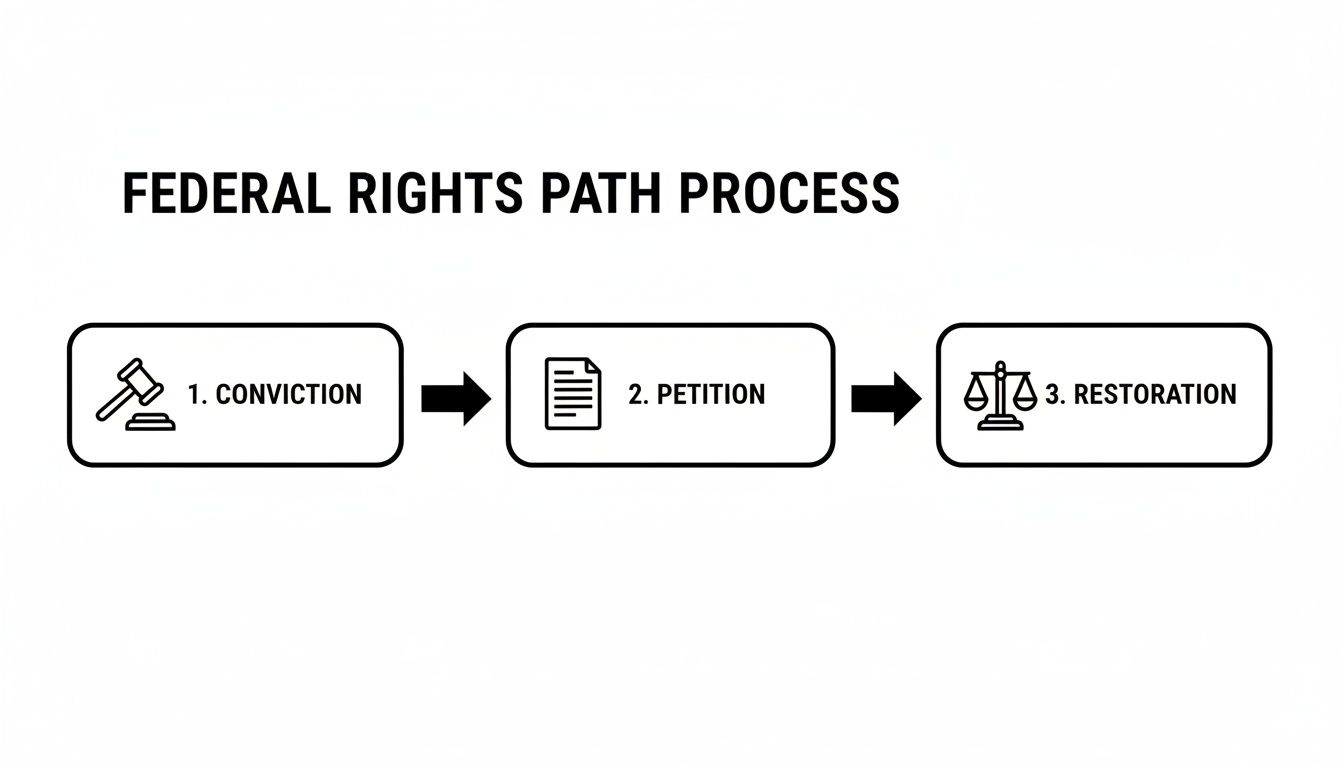
Demonstrating a Clean Record and Public Safety
Your track record since the conviction is probably the single most important part of your petition. A long history with no new arrests or criminal charges is non-negotiable. The officials reviewing your case need to be completely confident that your past mistakes are truly in the past.
A meticulously prepared petition demonstrates respect for the process and shows you are serious about regaining your rights. It tells reviewers that you have taken the time to build a new life worth recognizing.
With the federal § 925(c) process coming back online, the stakes are higher than ever. Because a flood of applications is expected, a disorganized or incomplete petition will almost certainly be pushed to the bottom of the pile. This is your chance to reclaim your rights after rebuilding your life from a past burglary, drug possession, or theft conviction. You can read more about how this federal program could impact millions of Texans and what it will take to be successful. Every document you provide helps build a narrative of redemption, proving you are a responsible citizen who can be trusted with a firearm once again.
Navigating Pardons, Petitions, and the Legal System
When you’re trying to get your gun rights back, you'll quickly find there isn't just one path forward. You might hear about pardons, federal petitions, or even expunctions. Figuring out which road to take is half the battle, which is why getting it right from the start is so important.
For some, the best-case scenario is a full pardon. This is an official act of forgiveness that can come from the Governor of Texas for a state conviction or the President for a federal one.
The Power of a Pardon
Let’s clear up a common myth: a pardon doesn’t wipe your record clean like it never existed. What it does do is serve as an official statement of forgiveness. More importantly, it can restore the specific rights you lost because of the conviction, including your Second Amendment right to keep and bear arms.
But getting one is a marathon, not a sprint. You have to submit an incredibly detailed application that proves you’ve been rehabilitated. This means gathering extensive evidence of your good conduct and how you’ve contributed to your community since the conviction. A pardon is an extraordinary remedy reserved for people who have genuinely turned their lives around.
Understanding the § 925(c) Petition Process
The federal government recently breathed new life into the 18 U.S.C. § 925(c) petition process. If you file a petition under this law, your case goes to the Office of the Pardon Attorney, which reviews it on behalf of the U.S. Attorney General.
Be prepared for an intense review. The agency will launch its own investigation, which could involve:
- Running deep background checks.
- Interviewing the character witnesses you’ve listed.
- Requesting a formal hearing to dig into your case.
You have to prove—by clear and convincing evidence—that you are not a danger to public safety. That's a very high legal bar, and there is absolutely no room for error in your petition.
An Ever-Changing Legal Landscape
The laws around firearm rights restoration are anything but set in stone. We're seeing a growing legal momentum for restoring rights, tied into the larger Second Amendment battles happening in courtrooms across the country. You can read about the recent court hearings shaping the Second Amendment to get a sense of the ongoing legal debates.
Navigating this complex intersection of pardons, federal petitions, and evolving case law requires a deep understanding of both state and federal procedures. Choosing the wrong strategy can waste valuable time and money.
Making the strategic choice between a pardon, a § 925(c) petition, or other post-conviction options is critical. For instance, while successfully expunging a felony conviction in Texas can restore your rights completely, the reality is that very few cases are even eligible. This is where an experienced criminal defense attorney becomes indispensable—to analyze your specific situation and find the most viable path.
Answering Your Top Questions About Restoring Your Gun Rights
Navigating the world of firearm rights restoration brings up a ton of questions. It's a confusing area of law where the rules are complex and the stakes are incredibly high. The process can feel overwhelming, but understanding these key points will give you a much better handle on what to expect.
How Long Does the Firearm Rights Restoration Process Take in Texas?
The honest answer is: it depends entirely on your situation. For a Texas felony conviction, your right to possess a firearm at your home is automatically restored five years after you've fully completed your sentence—that includes any prison time, parole, and probation.
But when we're talking about a federal prohibition, it's a much longer and more uncertain road. Applying for a pardon is a process that can drag on for several years with no guarantee of success. With the new federal 18 U.S.C. § 925(c) petition process expected to open up around 2026, we anticipate a massive backlog. It could easily take years to get a decision.
Can I Restore My Gun Rights After a Misdemeanor Domestic Violence Conviction?
This is one of the toughest legal hurdles a person can face. Thanks to a federal law known as the Lautenberg Amendment, a conviction for a "misdemeanor crime of domestic violence" triggers a lifetime ban on possessing a firearm.
Unlike many other convictions, this federal ban doesn't just fade away with time. It’s often permanent.
While a gubernatorial pardon could theoretically restore your rights, it is an extremely difficult and lengthy process with a very low success rate.
The new § 925(c) petition process might offer a path forward, but it's still unclear if people with domestic violence convictions will even be eligible to apply. It is absolutely essential to have an experienced attorney review the specific details of your case.
What Is the Difference Between Expungement and Firearm Rights Restoration?
This is a critical distinction that trips a lot of people up. Think of an expungement as a legal process that completely destroys the records of an arrest or charge. If a conviction is successfully expunged, it's as if it never happened in the eyes of the law. Since the disqualifying conviction no longer legally exists, your firearm rights would be restored.
The catch? Very few convictions are actually eligible for expungement in Texas.
A more common path is an order of nondisclosure, which seals your record from public view but keeps it visible to law enforcement and certain government agencies. An order of nondisclosure does NOT restore your federal firearm rights. Firearm rights restoration is a completely separate legal fight aimed specifically at lifting the gun ban, even if the conviction stays on your record.
Do I Need a Lawyer to Restore My Firearm Rights?
While you can technically file a petition on your own, it is strongly advised against. The legal standards are incredibly high. You have to prove you’ve been rehabilitated and are not a risk to public safety.
An experienced Texas criminal lawyer knows exactly how to:
- Gather the most powerful evidence of your good character and stable life.
- Craft a compelling legal narrative that tells your story of redemption.
- Navigate the frustrating and complex procedures of state and federal agencies.
When you start thinking about legal help, it's natural to wonder about the investment. Understanding how much a lawyer costs can help you budget for this critical step. With tens of thousands of applications expected for the new federal program, a professionally prepared petition will be the one that stands out. Hiring an attorney ensures your application is complete, persuasive, and filed correctly, which dramatically boosts your odds of getting a favorable outcome.
If you’ve been charged with a crime in Texas, call The Law Office of Bryan Fagan, PLLC for a free and confidential consultation. Our defense team is ready to protect your rights. Visit us at https://texascriminallawyer.net.