Being arrested in Texas can be terrifying — but you don’t have to face it alone. One moment, life is normal; the next, you're sitting in the back of a police car with your mind racing. What happens now? What about your job and your family? It's a scary and overwhelming experience, but your next steps are critical. The two most important things you can do are to exercise your right to remain silent and call an experienced Texas criminal defense attorney.
What to Do Immediately After an Assault Arrest in Texas

If you've been arrested for assault, especially for the first time, it's natural to feel disoriented and anxious. The mix of fear and confusion is enough to overwhelm anyone. But take a deep breath. Remember, an arrest is not a conviction. What you do in these first few hours and days will lay the foundation for your entire defense.
Exercise Your Right to Remain Silent
Your Fifth Amendment right to remain silent isn't just a line from a movie—it's your most powerful shield. Police officers are trained to get you talking. They might ask questions that seem harmless, but they are often designed to get you to admit to key facts of the alleged crime.
Politely but firmly tell the officers, "I am exercising my right to remain silent, and I would like to speak with my attorney." Do not try to explain your side of the story or make small talk. Anything you say can be twisted and used against you.
Navigate the Booking and Bail Process
After an arrest, you’ll be taken to jail for booking. This is an administrative process where police will take your fingerprints, a mugshot, and record your personal information. Afterward, you will see a magistrate judge who will formally read the charge against you and set your bail amount.
The purpose of bail is not to punish you; it’s to make sure you appear for future court dates. A skilled lawyer can argue for a reasonable bail amount or even for a personal recognizance bond, which allows you to be released without paying money upfront.
For a deeper dive into these first crucial hours, you can learn more about what happens when you get arrested in our detailed guide.
Contact an Experienced Defense Attorney Immediately
This is the single most important step you can take. Don't wait. The sooner you have an attorney on your side, the better they can protect your rights. An experienced Houston criminal defense lawyer can get involved early, advise you during any questioning, and start building your defense strategy right away. When your future is on the line, getting the right legal help is everything. Choosing an attorney with a solid track record and understanding the value of effective lawyer reputation management can help you find the best counsel for your situation.
Preserve Evidence and Document Everything
While the incident is still fresh in your mind, write down every detail you can remember. No detail is too small.
- The exact date, time, and location of the incident.
- Who else was there and what each person said or did.
- What happened in the moments leading up to the alleged assault.
- Any injuries you sustained, even minor ones. Take pictures.
Also, start preserving any evidence that could help your case. Save text messages, emails, voicemails, or take screenshots of social media posts. Do not delete anything, even if you think it looks bad—your attorney needs the whole story to defend you properly. These steps help you regain a sense of control and give your legal team the tools they need to fight for you.
Understanding Texas Assault Laws
When you hear "assault," you probably picture a physical fight. But in Texas, the legal definition is much broader, and it can trap people who never intended to harm anyone. The first step in defending against a first-time assault charge in Texas is understanding exactly what the state has to prove to convict you.
The law, found in Texas Penal Code Section 22.01, gives prosecutors three different ways to charge someone with assault. It's also important to know that not all physical contact counts. The prosecutor must prove you acted with a specific mindset—that your actions were intentional, knowing, or reckless. This is a critical detail where a good defense attorney often finds weaknesses in the state’s case.
The Three Types of Simple Assault
In Texas, you don't even have to injure someone to be charged with simple assault. The law breaks it down into three distinct actions:
- Causing Bodily Injury: This is the most common type. It means you intentionally, knowingly, or recklessly caused someone physical pain, illness, or any kind of physical impairment. Even something minor, like a scratch or a bruise that causes pain, can qualify.
- Threatening Imminent Harm: You can be charged with assault without ever touching someone. If you intentionally or knowingly threaten another person with immediate bodily injury, that threat alone can be considered an assault. The key word is "imminent"—it must feel like it's about to happen right now.
- Making Offensive Physical Contact: This is the lowest-level assault. It involves intentionally or knowingly making physical contact with someone when you know (or should have known) they would find it offensive or provocative. This could be an unwanted poke, a shove, or even spitting on someone.
Understanding which of these three categories your charge falls into is crucial. Each one requires the prosecutor to prove a different set of facts, which means each one opens up different strategies for your defense. For a deeper dive into the specifics, you can explore the legal definitions of assault in Texas in our detailed guide.
Understanding Misdemeanor Assault Charges
For first-time offenders, the good news is that most assault charges are misdemeanors. The bad news? Even misdemeanors can lead to serious penalties and a permanent criminal record. In Texas, simple assault is typically classified as either a Class C or a Class A misdemeanor.
Key Insight: The difference between a Class C and a Class A assault often comes down to one thing: pain. An offensive touch without any resulting pain is usually a Class C. The moment you cause any level of physical pain, the charge jumps to a much more serious Class A misdemeanor.
These charges are very common. According to official state data, assault cases make up a significant portion of all new misdemeanors filed each year. In fact, filings for these offenses increased by at least 8% in the last reporting year alone. You can see the statistics for yourself in the Texas Judiciary’s Annual Statistical Report for Fiscal Year 2023. This trend shows just how important it is to get strong legal representation from the start.
To make it clearer, here is a breakdown of the different levels of misdemeanor assault you might face.
Types of Misdemeanor Assault in Texas
| Assault Type (Texas Penal Code) | Common Actions | Classification | Potential Penalties |
|---|---|---|---|
| Offensive Contact or Threat | A shove, an unwanted touch, a verbal threat of immediate harm. | Class C Misdemeanor | A fine of up to $500, but no jail time. |
| Causing Bodily Injury | An act that causes pain, like a punch, slap, or push that results in a bruise. | Class A Misdemeanor | Up to 1 year in county jail and/or a fine up to $4,000. |
As you can see, the penalties escalate quickly. While a Class C might seem like a simple ticket, a Class A misdemeanor carries the threat of significant jail time and a hefty fine—consequences that can turn your life upside down.
When a First-Time Assault Charge Becomes a Felony
Most people think of assault as a misdemeanor that, while serious, won't completely derail their lives. But in Texas, certain situations can instantly raise the stakes, turning a heated argument into a life-altering felony charge. The consequences—years in prison, huge fines, and the permanent loss of rights—are worlds apart.
A prosecutor's decision to upgrade an assault to a felony isn't random. They rely on specific "aggravating factors" laid out in the law. A good defense attorney's job is to challenge those factors and fight the state’s attempt to paint you as a felon.
Key Factors That Elevate Assault to a Felony
The Texas Penal Code is very clear about what turns a simple assault into something more. The law looks at who was hurt, how badly they were hurt, and whether a weapon was involved.
Three of the most common reasons a first-time assault charge in Texas is upgraded to a felony are:
- The Identity of the Alleged Victim: The law offers extra protection to certain people. If you're accused of assaulting a public servant (like a police officer or firefighter), an emergency room doctor, a security guard, or a government official, the charge becomes much more serious.
- The Severity of the Injury: There's a huge legal difference between "bodily injury" (which can just mean causing pain) and "serious bodily injury." The second involves an injury that creates a real risk of death, causes permanent disfigurement, or results in the long-term loss of a body part or organ.
- Using or Exhibiting a Deadly Weapon: If a deadly weapon was used—or even just displayed—during the assault, the charge is automatically filed as "aggravated assault," which is a second-degree felony. A "deadly weapon" can be anything capable of causing death or serious injury, like a baseball bat, a steel-toed boot, or even a car.
These lines can be blurry. For example, assaulting a public servant can elevate the charge to a third-degree felony, which carries a potential prison sentence of 2 to 10 years and a $10,000 fine. You can discover more insights about how these penalties are applied in Texas on davidsmith.law.
Understanding Aggravated Assault
When an assault involves either "serious bodily injury" or a deadly weapon, it is almost always charged as Aggravated Assault under Texas Penal Code §22.02. This is a second-degree felony, a charge that carries the threat of 2 to 20 years in a Texas state prison.
Let's put that in perspective. Imagine a fight in a bar parking lot. One person shoves another, who falls and scrapes their knee. That is likely a Class A misdemeanor. But what if that same shove causes the person to fall backward, hit their head on the concrete, and suffer a severe concussion? That is "serious bodily injury," and prosecutors will almost certainly file a felony aggravated assault charge.
Crucial Distinction: The prosecutor doesn't have to prove you meant to cause a serious injury. They only have to prove that your reckless actions caused it. This is a critical point where a defense attorney can fight back by challenging the evidence and your intent.
How Assault Family Violence Becomes a Felony
The legal system treats assault charges involving family members, romantic partners, or people living in the same household with extreme severity. While a first offense for family violence is typically a Class A misdemeanor, it can easily be enhanced to a felony.
The most common trigger is a prior conviction. If you have any previous family violence conviction on your record, a new accusation will be filed as a third-degree felony. This is also true if the assault involved impeding someone's breathing or blood circulation, often called "Assault by Strangulation or Suffocation," which is a felony even for a first offense.
Because the consequences are so high, having an experienced attorney in your corner is non-negotiable. A lawyer can challenge the evidence, question whether the accuser legally qualifies as a "family member," or dispute the severity of the injury. Keeping a charge from being upgraded to a felony is one of the most important battles in a criminal case.
Navigating the Texas Criminal Court Process: A Step-by-Step Guide
Walking into a Texas courtroom for the first time can be intimidating. The entire system—with its confusing legal terms and formal procedures—can feel like a maze. But while it's serious, it follows a structured path. An experienced attorney will act as your guide, helping you navigate it one step at a time.
This section is your roadmap. We’ll walk through what happens after you are arrested for a first-time assault charge in Texas, from your first day in court to the final outcome.
Step 1: Arraignment and Bail
Your journey through the court system begins with the arraignment. This is your first appearance before a judge, where they will formally read the charges against you and ask for your plea. At this early stage, the standard plea is "not guilty." This gives your lawyer the time needed to investigate your case.
The judge will also set your conditions for release, known as bail or bond. Bail is not a punishment; it is a financial guarantee that you will show up for all your future court dates.
Along with a dollar amount, the judge will impose certain rules, such as:
- No-Contact Orders: You will almost certainly be ordered to have zero contact with the person who accused you. This means no calls, texts, emails, or messages through friends.
- GPS Monitoring: For cases involving family violence allegations, the court might require you to wear an ankle monitor.
- Regular Check-ins: You may have to report to a pretrial services officer on a set schedule.
Violating any of these conditions can get your bond revoked, landing you back in jail until your case is resolved.
Step 2: Discovery and Investigation
Once you are out on bond, your case moves into the discovery phase. This is when your attorney formally requests all the evidence the prosecutor has gathered against you. The State is legally required to hand over everything, including evidence that might help your case (this is called exculpatory evidence).
The evidence packet typically includes:
- Police reports and officer narratives
- Witness statements
- Photos and videos, like bodycam or security camera footage
- 911 call audio
- Any physical evidence collected at the scene
Your lawyer will carefully review every piece of evidence, looking for inconsistencies, weaknesses in the state's case, and any sign that your constitutional rights were violated. This investigation is the foundation of your defense strategy.
This visual shows how the specific details of a case can escalate a charge from a misdemeanor to a far more serious felony.
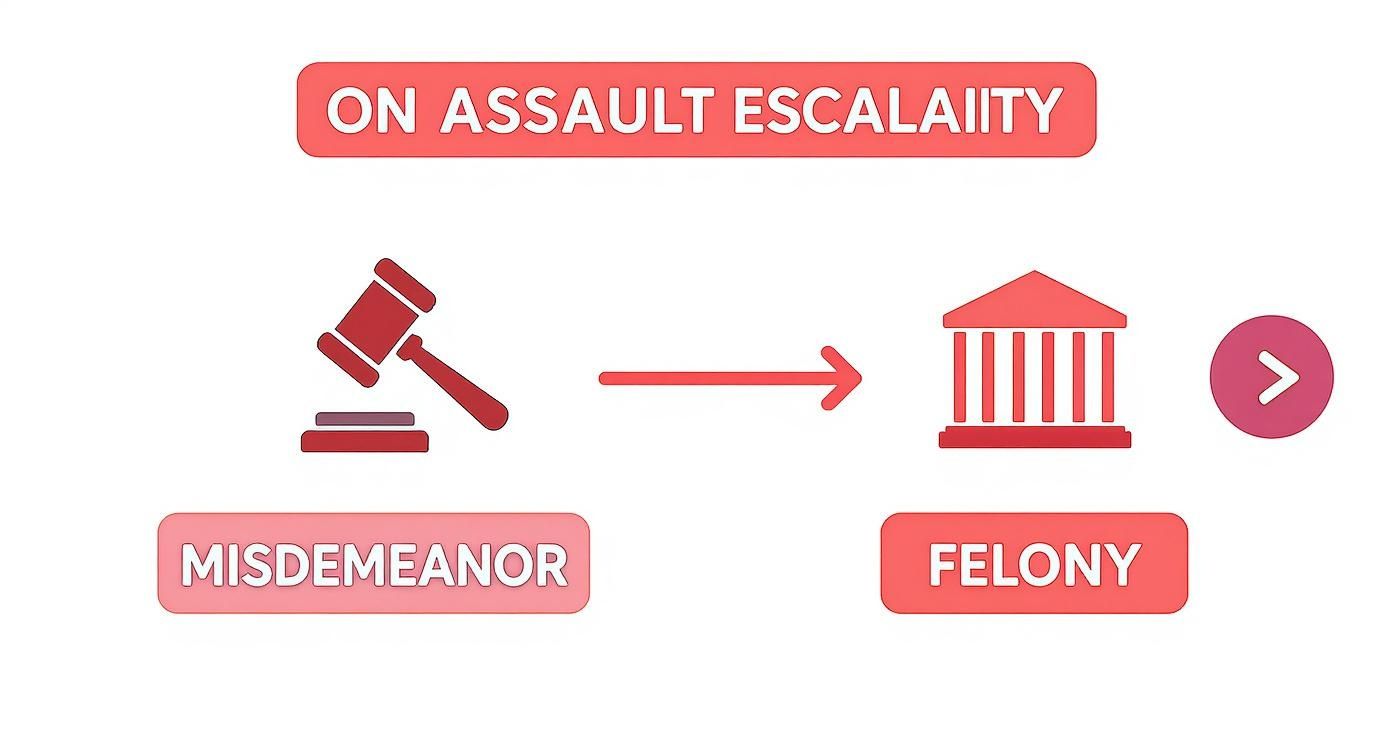
The infographic highlights that factors like the severity of injury or the identity of the victim can dramatically change the legal stakes you face.
Step 3: Pre-Trial Hearings and Plea Bargaining
In the weeks and months before a potential trial, your case will have several pre-trial hearings. These are check-in meetings with the judge and prosecutor to discuss the case's progress and handle legal motions. For example, your attorney might file a motion to suppress evidence if they believe it was collected illegally.
This is also when plea bargaining occurs. Your lawyer will negotiate with the prosecutor to see if a deal can be reached without a trial. A good outcome could mean getting the assault charge reduced to a lesser offense or agreeing to probation instead of jail time. For a deeper look at how these stages connect, check out our guide on the steps in the criminal justice process.
Important Takeaway: A plea agreement is not about giving up. It is a strategic decision made only after your attorney has evaluated all the evidence and determined the offer is in your best interest.
If a fair agreement can’t be reached, the case is set for trial. At trial, the prosecutor must prove every element of the assault charge beyond a reasonable doubt to a judge or jury. Having a skilled trial lawyer to tell your side of the story is your ultimate shield.
Common Defenses to an Assault Charge in Texas
https://www.youtube.com/embed/YbuYfekRcaA
Just because you've been arrested does not mean you will be convicted. The prosecutor carries the entire burden of proving their case beyond a reasonable doubt—a very high legal standard. A skilled defense attorney's job is to dismantle that case by presenting a strong, evidence-based defense.
Texas law provides several powerful defenses to an assault charge. These are fundamental rights designed to protect people from being wrongfully convicted.
Self-Defense
The right to protect yourself is a cornerstone of Texas law. Under the Texas Penal Code, you are justified in using force against someone when you reasonably believe it’s immediately necessary to protect yourself from their unlawful use of force. To successfully argue self-defense, your legal team must show:
- You had a reasonable belief you were in immediate danger.
- You only used the amount of force necessary to stop the threat.
- You did not provoke the other person or start the conflict.
For example, if someone corners you and raises their fist to hit you, pushing them away to create distance would likely be seen as reasonable self-defense. Your actions must be a proportional response to the threat you were facing.
Defense of Others and Property
The right to self-defense also extends to protecting other people. Texas law allows you to use force to protect a third person if you reasonably believe they are in immediate danger. The same rules of necessity and proportionality apply.
You can also use reasonable force to protect your property from theft or trespass. However, the rules for defending property are much stricter. You generally cannot use force that would cause serious bodily injury just to protect property.
Key Takeaway: The concepts of "reasonable belief" and "necessary force" are the heart of these defenses. Your attorney will work to present events from your perspective, showing the judge or jury why you believed your actions were justified.
Challenging the Prosecution's Case
Beyond affirmative defenses, a huge part of a solid defense strategy is poking holes in the prosecutor's story. Your attorney will scrutinize every piece of evidence, looking for weaknesses and inconsistencies.
Common ways to challenge the state's case include:
- Lack of Intent: An assault conviction requires the state to prove you acted intentionally, knowingly, or recklessly. If what happened was a genuine accident, you did not have the required criminal intent.
- False Accusations: Sadly, false allegations can arise from personal disputes, custody battles, or anger. Your defense team can investigate the accuser's background and motivations to expose inconsistencies and challenge their credibility.
- Inconsistent Evidence: A strong defense often highlights contradictions between what the accuser claims, what other witnesses say, and what the physical evidence shows. When the details don't add up, it creates the reasonable doubt needed to win a case.
Keeping a First-Time Assault Charge Off Your Record

For most people facing a first-time assault charge in Texas, the biggest fear is the shadow of a permanent criminal record. A conviction can follow you for years, making it harder to get a job, rent an apartment, or obtain a professional license.
The good news is that one mistake does not have to define your future. The Texas legal system has pathways designed to give people a second chance. An experienced attorney can help you navigate these options to protect your record.
Options to Avoid a Conviction
For first-time offenders, two of the most effective tools to avoid a conviction are deferred adjudication and pre-trial diversion.
- Deferred Adjudication: This is a special type of probation. You plead "guilty" or "no contest," but the judge holds off on finding you guilty. You are placed on community supervision with certain conditions. If you complete the probation period successfully, the case is dismissed, and you are never formally convicted.
- Pre-Trial Diversion Programs: Some Texas counties offer these programs as an alternative to the traditional court process. You agree to complete certain requirements, like anger management classes or community service, and in return, the prosecutor dismisses the charges against you.
The goal is simple but crucial: prevent a final conviction from ever hitting your public record. This is a huge win for your future.
Clearing Your Record After Your Case Is Over
Even after a case concludes, you may still have options to clean up your record. Texas law provides two main tools for this: expunctions and orders of non-disclosure.
Expunction: Wiping the Slate Clean
An expunction is the best way to clear your name. It doesn't just hide your arrest record; it completely destroys all records of the incident. Legally, you can deny the arrest ever occurred.
You may be eligible for an expunction if:
- Your case was dismissed by the prosecutor.
- You were found "not guilty" at trial (acquitted).
- You successfully completed a pre-trial diversion program.
Orders of Non-Disclosure: Sealing Your Record
If you successfully completed deferred adjudication for a first-time assault charge, you may be eligible for an order of non-disclosure. This is commonly called "sealing your record." It doesn't destroy the files, but it blocks them from public view. This means most private employers, landlords, and leasing agents will not see the charge during a background check.
Navigating the eligibility rules and deadlines for these options is complex. A skilled defense attorney can analyze your situation, determine the best path forward, and fight to keep your record clean.
First-Time Assault Charge in Texas: Frequently Asked Questions
When you're facing a first-time assault charge in Texas, your mind is likely filled with questions. The uncertainty can feel overwhelming, but getting clear, honest answers is the first step toward regaining control. Here are answers to the most common concerns we hear from people in your situation.
Can the Alleged Victim Just Drop the Charges?
This is the biggest misconception about assault cases. In Texas, once a report is filed, the case belongs to the State, not the person who made the accusation. The prosecutor, not the alleged victim, decides whether to press charges.
Even if the person who called the police changes their mind, the District Attorney's office can and often does move forward with the case. While their cooperation can influence the outcome, it does not automatically make the charges disappear.
Will I Go to Jail for a First-Time Assault?
For a Class A misdemeanor, up to one year in jail is possible, but it is not guaranteed for a first offense. Many factors come into play: the specific details of the incident, the strength of the evidence, and the skill of your lawyer. A good attorney can often negotiate alternatives that keep you out of jail, such as probation, deferred adjudication, or a pre-trial diversion program.
How Much Does a Good Defense Attorney Cost?
There is no single answer. The cost of a criminal defense lawyer depends on the complexity of your case and the attorney's experience. While it is a serious investment, consider the alternative. The cost of not having a skilled advocate—a criminal record, jail time, and lost opportunities—is almost always far greater. Most reputable defense firms offer a free consultation to discuss your case and provide a clear picture of their fees.
How Will This Affect My Job or My Right to Own a Gun?
An assault conviction can cast a long shadow over your future. Many employers run background checks, and a conviction can make it extremely difficult to find a job, especially in a licensed profession. For gun owners, the stakes are even higher. A felony assault conviction means you permanently lose your right to own a firearm under federal law. It's a life-altering consequence.
If you’ve been charged with a crime in Texas, call The Law Office of Bryan Fagan, PLLC for a free and confidential consultation. Our defense team is ready to protect your rights. Learn more at https://texascriminallawyer.net.