Being arrested in Texas can be terrifying — but you don’t have to face it alone. A single mistake can feel like it's about to derail your entire life, but it doesn't have to. For many people facing charges for the first time, first time offender programs provide a structured path to get back on track and, ultimately, get the charges dismissed.
Think of it less as a punishment and more as an earned second chance to keep your record clean. At The Law Office of Bryan Fagan, PLLC, we believe everyone deserves a strong defense, and we're here to guide you through your legal options with compassion and expertise.
Your Guide to a Second Chance in Texas

An arrest in Texas brings a storm of uncertainty. Questions about your job, your reputation, and your future can be overwhelming. The good news is the legal system often provides an alternative route for people with a clean record who are facing non-violent charges. This route is called a first time offender program, known formally in Texas as Pretrial Diversion (PTD).
Instead of going down the traditional path of plea bargains, trials, and a potential conviction, these programs offer a completely different outcome. They’re built on a simple but powerful idea: for many first-time offenders, rehabilitation and education are far more constructive than punishment.
What Is the Goal of a Diversion Program?
The main goal is straightforward: to help you avoid a permanent criminal record. In essence, the prosecutor agrees to put your case on hold while you complete a set of agreed-upon conditions. It’s like signing a contract for a clean slate.
These programs are designed to achieve a few key objectives:
- Rehabilitation: They give you educational tools to address the behavior behind the arrest, like alcohol awareness classes for a first DWI or anti-theft courses for shoplifting.
- Accountability: You’re required to take responsibility for your actions, often through community service, counseling, or regular check-ins with a supervision officer.
- Dismissal: This is the most critical part. Once you successfully complete all the requirements, the prosecutor dismisses the charges against you entirely.
This means you can legally and honestly say you were never convicted of the crime. For anyone worried about how an arrest could impact their career, housing applications, or educational goals, this is an invaluable result.
A dismissal through a diversion program is a critical first step. It paves the way for a future expunction, which is the legal process of destroying the arrest record itself, truly wiping the slate clean.
Understanding these options is the foundation of a strong defense. As you navigate this difficult time, knowing that pathways exist to protect your future can provide much-needed peace of mind. Our comprehensive Texas Fresh Start Guide offers more detailed information on clearing your record after a criminal charge.
How First Time Offender Programs Work

So, what exactly are these programs? At their core, first time offender programs are built on a powerful principle: for many first-time, non-violent offenses, rehabilitation is a far better outcome than a conviction. It benefits everyone—you, the community, and even the justice system itself.
Instead of fighting your case in a courtroom, a pretrial diversion (PTD) or pretrial intervention (PTI) program pauses the whole legal process. It’s like the prosecutor hits a pause button on your case to give you a chance to prove that one mistake doesn't define who you are.
The Contract for a Clean Slate
Think of entering a diversion program as signing a contract with the prosecutor's office. You agree to complete a specific set of requirements within a certain timeframe. In exchange for you holding up your end of the deal, the state agrees to dismiss your charges completely.
But if you don't follow through? The "pause" button is released, and your case picks right back up where it left off, proceeding toward trial.
This approach is rooted in the belief that many people who make a poor choice don't need jail time; they need education, guidance, and a chance to make things right. It's a pragmatic solution that helps good people get back on their feet while reducing the burden on the court system. For example, a first-time charge for Possession of Marijuana under 2 ounces, a Class B Misdemeanor under the Texas Penal Code, is often a prime candidate for such a program.
Different Names for the Same Goal
Depending on which Texas county you were charged in, you'll hear different terms for these programs. While the names might change from one jurisdiction to another, the ultimate goal is always the same: get the charges dismissed and keep your record clean.
Common names you might encounter include:
- Pretrial Diversion (PTD): This is one of the most common terms, used in places like Harris County for a wide range of misdemeanor offenses.
- Pretrial Intervention (PTI): Another frequently used name that works just like PTD, often involving a formal agreement and a period of supervision.
- Memorandum of Agreement (MOA): Some counties use this term to describe the formal contract you sign to enter the program.
- Specialty Programs: Certain offenses may have their own designated programs, like a specific DWI PTD program that requires alcohol education courses.
Understanding the specific DUI pretrial diversion defense strategies is especially important, as DWI-related programs often have very unique and strict requirements.
It is crucial to remember that getting into one of these programs is not a right—it is a privilege. A prosecutor has the final say on whether to offer you a spot. This is exactly why having a skilled Texas criminal defense attorney to negotiate for you is so important.
Your lawyer's job is to present you as the ideal candidate for this second chance. We build a compelling case for the prosecutor, highlighting your clean history, your ties to the community, and your willingness to take responsibility. We show them that offering you this opportunity is the right and just thing to do, ensuring you get the chance you deserve to protect your future.
Qualifying for a Diversion Program in Texas
Getting a spot in a first time offender program hinges on eligibility. But here’s the catch—it’s not a simple yes or no answer. The rules for pretrial diversion change dramatically from one Texas county to another. A case that easily qualifies in Harris County might be a non-starter in Williamson County, which highlights how localized these opportunities are.
Prosecutors are the gatekeepers, and they look at several key factors before extending an offer. Your eligibility isn't just about the charge you're facing; it’s about the whole picture—you, your history, and the specific circumstances of your arrest. Understanding what they’re looking for is the first step in building a strong case for why you deserve this second chance.
Key Factors Prosecutors Consider
Your attorney's job is to frame you as the ideal candidate, and that starts by meeting the core criteria prosecutors care about most. While every District Attorney's office has its own internal playbook, they generally zero in on the same areas when weighing their decision.
Common eligibility factors usually include:
- The Nature of the Offense: Most diversion programs are built for non-violent misdemeanor charges. Think first-time DWI, possession of a small amount of a controlled substance, shoplifting (theft under a certain dollar amount), or criminal mischief.
- Your Criminal History: This is a big one. These programs are almost always reserved for people with no prior criminal convictions. A clean record is usually a non-negotiable starting point.
- The Facts of Your Case: The details matter. For a DWI, a high blood alcohol concentration (BAC) or having a child in the car could disqualify you instantly. For a theft charge, the value of the items stolen will be looked at very closely.
- Your Attitude and Willingness to Cooperate: Prosecutors want to see that you understand the seriousness of this situation and are ready to take responsibility for your actions. Showing you’re committed to making things right can go a long way in swaying their decision.
This infographic breaks down the typical path to qualifying for a Texas diversion program.
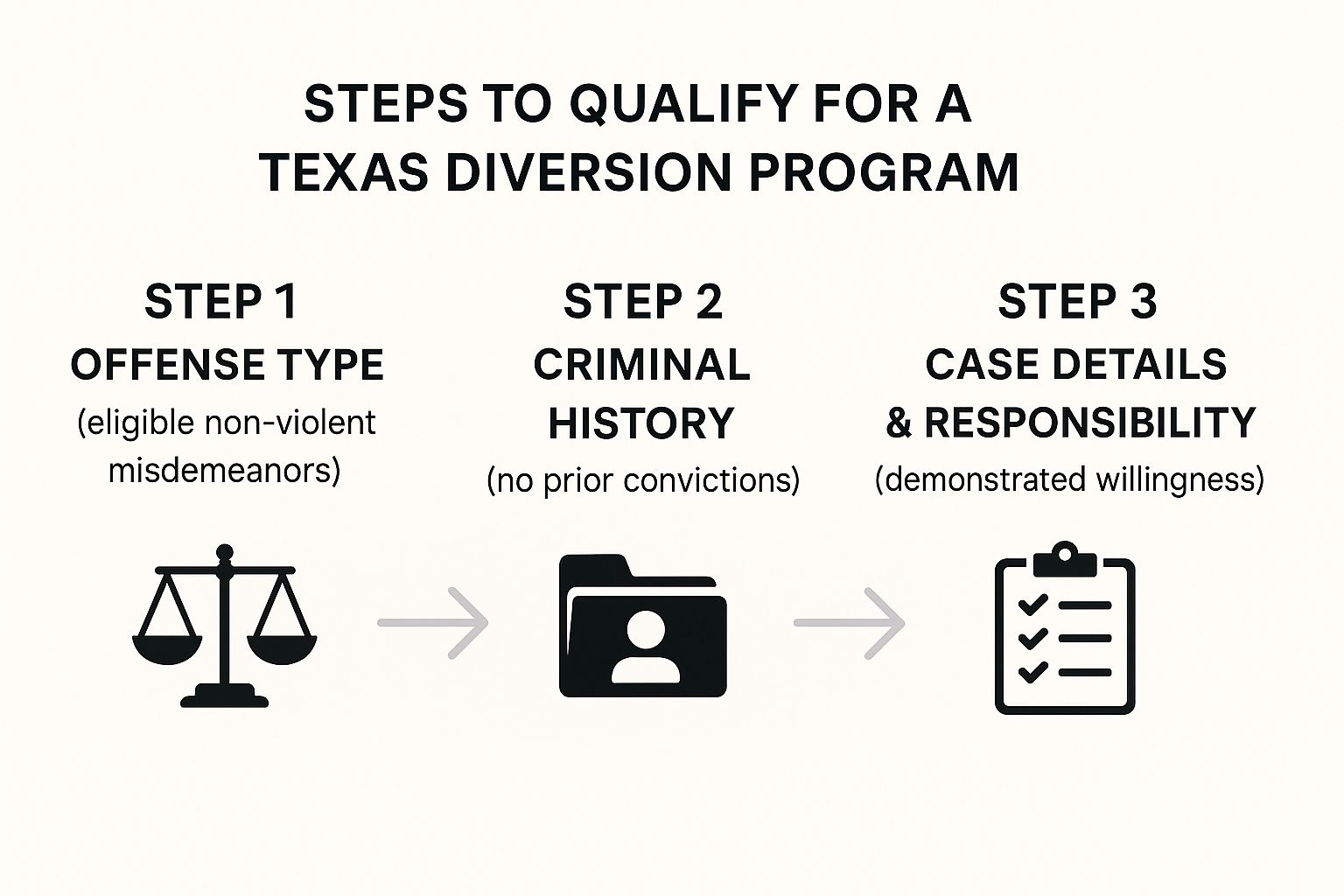
As you can see, eligibility is more like clearing a series of hurdles than checking a single box. You have to successfully pass muster at each stage—the offense, your background, and your demonstrated attitude—to keep moving forward.
Navigating County-Specific Rules
The differences between counties can be stark. For instance, some counties have a hard-and-fast rule against offering diversion for any DWI case, no matter the circumstances. Others have well-established DWI PTD programs. One county might disqualify you for a simple marijuana possession charge if you were in a drug-free zone, while another might not consider that a major factor.
This is exactly why having an experienced local criminal defense attorney, like a Houston criminal lawyer, is so critical. We know the official policies and, just as importantly, the unwritten rules of the prosecutors' offices across Texas. We understand what the DA in your specific county is looking for in a candidate and can shape our negotiation strategy to fit their expectations, giving you the best shot at getting in.
To give you a clearer picture, here’s how eligibility can vary for some common first-time offenses depending on the county's prosecutorial approach.
Typical Diversion Eligibility for Common First Offenses in Texas
| Offense | General Eligibility Factors | Common Exclusions | Example County A Approach (e.g., Harris) | Example County B Approach (e.g., Williamson) |
|---|---|---|---|---|
| First-Time DWI | No prior arrests, BAC below 0.15, no accident, cooperative with law enforcement. | Accident causing injury, child passenger under 15, failed to stop and render aid. | Has a formal DWI Pretrial Intervention Program for eligible candidates. | Historically has not offered diversion for any DWI cases, pursuing conviction instead. |
| Possession of Marijuana (< 2 oz) | Clean criminal record, small personal use amount, no intent to sell. | Possession in a drug-free zone (e.g., school), possession of other paraphernalia. | Often eligible for a standard misdemeanor diversion program. | May offer diversion, but with stricter requirements if near a school or park. |
| Theft (Misdemeanor) | Low-value items, no force used, no prior theft-related offenses. | Theft from a person (pickpocketing), theft by an employee, organized retail theft. | Generally eligible if the value is under a few hundred dollars. | May require full restitution upfront before considering a diversion offer. |
| Criminal Mischief | Minimal property damage, no violence or threats involved. | Damage to public property, graffiti, damage exceeding a certain monetary threshold. | Eligible if restitution is paid and it's a first offense. | Scrutinizes the nature of the property and the offender's motive more closely. |
This table isn't exhaustive, but it shows just how much your location can influence your options. What’s a straightforward path in one courthouse can be a dead end just one county over.
The decision to offer diversion is entirely at the prosecutor's discretion. They are not legally required to offer you a spot. Your attorney's role is to advocate on your behalf, presenting compelling reasons why you are a deserving candidate who will succeed in the program.
Ultimately, our job is to build a narrative that convinces the prosecutor that giving you this chance is the right call—not just for you, but for the community. We work to prove that you are someone who made a one-time mistake, not someone who poses an ongoing risk to public safety.
Navigating the Application and Approval Process
Getting into a first time offender program isn't like filling out a form at the DMV. It’s a formal process with a series of steps, but it doesn't have to be overwhelming. With a clear roadmap and an experienced lawyer guiding you, you can approach each stage with confidence. The journey starts almost immediately after an arrest, with your defense team working right away to secure your spot.
The entire process is a negotiation. You can’t just apply on your own and hope for the best. The prosecutor holds all the cards, and their decision is final. This is why the very first move is always your attorney reaching out to the prosecutor to start fighting for you.
Step 1: Initial Negotiation and Advocacy
This is where the real work begins, and it's the most critical stage of all. Shortly after you’re charged, your attorney will get in touch with the prosecutor handling your case. We don't just ask for a diversion program; we build a compelling argument for why you’re the perfect candidate. This means putting together what’s known as a mitigation packet.
This packet is a collection of documents that paints a complete picture of who you are beyond this one mistake. It often includes:
- Proof of Employment or School Enrollment: This shows you’re a productive member of the community with stable ties.
- Character Reference Letters: Powerful letters from employers, mentors, or community leaders who can vouch for your good character.
- Proactive Steps Taken: Evidence that you’ve already signed up for counseling, an alcohol awareness class, or other relevant courses shows you’re taking this seriously.
The goal here is to convince the prosecutor that this was a one-time error in judgment and that rehabilitation, not a conviction, is the right call. If we succeed, the prosecutor will agree to let you move forward with a formal application.
Step 2: The Formal Application and Interview
Once the prosecutor gives the initial green light, you'll usually need to fill out a formal application for the first time offender program. This paperwork asks for detailed personal information, your side of the story, and a statement explaining why you believe you deserve this chance.
Writing this statement is a delicate balance. You have to accept responsibility for your actions without formally admitting legal guilt. Your attorney will help you craft this statement carefully to protect your legal rights.
After you submit the application, you’ll likely have an interview with a program supervisor or a probation officer. They want to look you in the eye and gauge your sincerity and commitment to finishing the program successfully.
Think of this interview as a job interview for a second chance. The interviewer is looking for accountability, a genuine desire to make things right, and a clear understanding of the program's strict rules.
Step 3: The Final Agreement
If you pass the interview and the program officially accepts you, the last step is signing a formal contract. This document, sometimes called a Memorandum of Agreement (MOA), is a legally binding contract that lays out every single rule you must follow. It will detail the length of the program, required classes, community service hours, fees, and drug testing schedules.
By signing this agreement, you promise to follow the terms exactly. In return, the state agrees to dismiss your charge once you successfully complete everything. This agreement essentially hits "pause" on the criminal case against you and puts the power to shape your future squarely in your hands.
What to Expect During Your Diversion Program

Once you’re accepted into a first time offender program, you can breathe a sigh of relief—but the real work is just getting started. Think of your diversion agreement as a contract for a clean slate. Your only job is to follow every single condition, no matter how small.
While the requirements demand discipline, they're designed to be achievable. They’re a small price to pay for a dismissal. Each program is shaped around the person and the offense, but most share a common framework. These conditions aren't meant to be punishment in the traditional sense. Instead, they’re constructive steps designed to address whatever led to the arrest and make sure it doesn’t happen again.
Your Core Responsibilities
When you sign that diversion agreement, you’re committing to a specific set of rules for a set period, usually somewhere between six months and two years. Your success hinges entirely on your ability to meet every single requirement without fail.
Most programs are built on a few non-negotiable pillars:
- Regular Supervision: You'll likely be assigned a supervision officer or case manager. Checking in with them—whether in person, by phone, or online—is mandatory. This is how they track your progress.
- Program Fees and Court Costs: Participants are almost always responsible for paying administrative fees for the program, along with any court costs tied to the case.
- Abstaining from Criminal Activity: This is the big one. You absolutely must not get arrested for any new offense while in the program. A new charge is the fastest way to get kicked out and find yourself right back in front of the judge.
These foundational rules are the bedrock of every diversion program. Following them isn't optional; it's the first and most important step toward a successful outcome.
Offense-Specific Conditions and Classes
Beyond the basics, your agreement will include conditions directly related to your charge. The goal here is education and rehabilitation. Prosecutors want to see that you understand the seriousness of your actions and have taken real steps to correct your behavior.
This usually means you'll have to complete a few things:
- Educational Courses: For a first-time DWI, this would be an Alcohol Awareness or DWI Education class. For a theft charge, it might be an anti-theft or impulse control workshop.
- Community Service Hours: You’ll need to complete a set number of hours of unpaid work for an approved non-profit. It's a way of giving back to the community.
- Regular Drug and Alcohol Testing: Random drug and alcohol screenings are standard, especially for drug possession or DWI cases. You must remain completely sober for the entire duration of the program.
- Counseling or Treatment: In some cases, a judge or prosecutor may require you to attend counseling sessions or undergo a substance abuse evaluation to address underlying issues.
While these commitments may seem like a lot to juggle, remember what's at stake. Each completed class, every clean drug test, and every hour of community service is another step toward a full dismissal of your charges.
Staying organized and proactive is key. Keep a calendar of all your appointments, deadlines, and class schedules. Don’t wait until the last minute to get your community service hours done. By treating the program with the seriousness it deserves, you prove to the prosecutor that they made the right call in giving you this chance.
Securing a Clean Record After Your Program
Finishing a first time offender program is a huge win. It’s a moment of incredible relief—you held up your end of the bargain, and the prosecutor, as promised, dismisses the charges. But hold on. There's one last, critical step you need to take to truly put this behind you and protect your future from a past mistake.
A lot of people think a dismissal means the whole incident just vanishes from their record. That’s not how it works. While the charge is officially gone, the record of your arrest stays put. That arrest record can still pop up on sophisticated background checks for jobs, housing, and even professional licenses, casting a shadow that can follow you for years.
The Difference Between a Dismissal and a Clean Slate
It’s absolutely vital to understand this distinction. A dismissal means you were not convicted of a crime. An expunction, on the other hand, is a separate legal process that forces government agencies to completely destroy the records related to your arrest.
- Dismissal: The court case is closed, and you are not found guilty.
- Expunction: The arrest record itself is physically and digitally erased.
Think of it this way: a dismissal stops the bleeding, but an expunction gets rid of the scar. Without taking this final step, a single bad day could unfairly keep costing you opportunities long after you’ve proven yourself and moved on.
Expunction: The Ultimate Goal
Here’s the good news. Completing a pretrial diversion program is one of the strongest paths to becoming eligible for an expunction in Texas. Under the Texas Code of Criminal Procedure, Article 55.01, you have a legal right to get your arrest records expunged if your case was dismissed after you successfully finished a diversion program.
This is the ultimate prize. An expunction gives you the legal right to deny the arrest ever happened. If a future employer asks if you’ve ever been arrested, you can truthfully and legally answer "no."
Securing an expunction means that a one-time mistake does not have to become a lifelong explanation. It provides true closure, ensuring your future is defined by your potential, not your past.
The process involves filing a formal petition with the court, and you have to follow specific waiting periods and procedural rules. Because the requirements can get tricky, working with a defense attorney is the smartest way to make sure your petition is filed correctly and your record is wiped clean. Our team has helped countless clients navigate this final step to secure the clean slate they earned.
Common Questions About First Offender Programs
When you're facing the legal system for the first time, your mind is probably swimming with questions. The idea of a first time offender program sounds like a lifeline, but you need straight answers before you can make a decision that will affect your life. Let's tackle some of the most common concerns we hear from clients in your shoes.
What Happens If I Fail to Complete the Program?
This is a major concern, and you’re right to ask. If you don't hold up your end of the bargain—whether that means missing a class, failing a drug test, or, even worse, getting arrested for a new offense—the consequences are swift. The prosecutor will terminate your participation in the program.
Your case doesn't just vanish. Think of it like the prosecutor hitting "play" after pausing your case. Your original criminal charge is dropped right back onto the active court docket. You’ll be facing the same charge, only this time, the chance to get it dismissed through a program is gone, and you'll proceed toward a plea bargain or trial.
Is Pretrial Diversion the Same as Probation?
No, and this is a critical distinction to understand. They might feel similar since both involve checking in with a supervisor and following a set of rules, but legally, their outcomes are night and day.
- Pretrial Diversion: This is an agreement you make with the prosecutor before any conviction or finding of guilt. If you successfully complete it, your case gets dismissed. You are never convicted.
- Probation (or Deferred Adjudication): This comes after you plead guilty or no contest. While deferred adjudication can eventually lead to a dismissal, it still requires a plea of guilt that can be used against you later. Regular probation is part of a sentence following a conviction that stays on your record.
The entire point of a first time offender program is to keep that conviction from ever happening in the first place, protecting your clean record.
Do I Have to Admit Guilt to Get In?
This is a tricky but really important question. Most diversion programs will require you to "accept responsibility" for what happened, usually in a written statement. But here's the key: this is legally different from standing up in a courtroom and pleading guilty.
Your attorney's job is to help you write a statement that satisfies the prosecutor's need for accountability without legally sinking your case. It’s about walking a fine line—showing you're taking this seriously while still protecting your constitutional rights in case the program falls through. You absolutely need experienced legal guidance to get this part right.
How Much Do These Programs Usually Cost?
The cost of a first time offender program can vary quite a bit depending on the Texas county you're in and the details of your charge. You should budget for a few different expenses.
Generally, you can expect to pay for:
- Program or Supervision Fees: These are monthly fees you pay to whatever agency is monitoring you.
- Class Costs: You’ll be on the hook for any required courses, like a DWI education class or an anti-theft workshop.
- Court Costs: Every court case comes with standard administrative fees.
- Restitution: If someone lost money because of the alleged offense, you will be required to pay that victim back in full.
While there are costs involved, you have to weigh them against the lifelong price of having a permanent criminal conviction. A few hundred or even a few thousand dollars now can save you from lost job opportunities and other financial hits for years to come.
If you’ve been charged with a crime in Texas, call The Law Office of Bryan Fagan, PLLC for a free and confidential consultation. Our defense team is ready to protect your rights. https://texascriminallawyer.net