Skip to content
Being arrested in Texas can be terrifying, but for many, the real trouble starts long after the case is over. A criminal record can follow you like a shadow, making it tough to get a good job, rent a decent apartment, or even qualify for a loan. It can feel like a single mistake or misunderstanding has put a permanent roadblock in your path—but you don’t have to face it alone.
If you’re reading this, you probably know that feeling all too well. We want to be clear: a past arrest does not have to define your life forever.
Erasing the Past: More Than Just Sealing a Record
There's a powerful legal tool in Texas designed to give you a true fresh start. It’s called an expunction, and it’s a game-changer. An expunction doesn’t just hide your record—it orders the complete and total destruction of every document and computer file related to your arrest.
This process is outlined in Chapter 55 of the Texas Code of Criminal Procedure. Once a judge grants your expunction, government agencies are legally required to physically destroy the records. We’re talking about every single trace of the incident.
This includes files held by:
- The police department that arrested you
- The county and district clerk’s offices
- The prosecutor’s office
- The Texas Department of Public Safety (DPS)
The Power to Legally Say "No"
Here’s what makes an expunction so different from just sealing a record. Once the process is complete, it's as if the arrest never happened in the eyes of the law. You regain the legal right to deny the arrest ever occurred, even on official applications, without any fear of penalty.
An expunction is about more than just clearing a record; it's about reclaiming your future and closing a chapter you're ready to leave behind.
So, when a potential employer asks on a job application, "Have you ever been arrested?" your correct and legally protected answer is "No." This is a massive advantage that reopens doors that were once firmly shut. At The Law Office of Bryan Fagan, PLLC, we’ve guided countless Texans through this exact process, and we understand the incredible weight that lifts when it’s finally done. We’re here to help you get there.
Who Is Eligible to Get a Record Expunged
Figuring out if you can get your record expunged is the single most critical step in this entire journey. The rules are laid out in Chapter 55 of the Texas Code of Criminal Procedure, and while they can feel dense, they follow a specific logic. We'll break down what that means for you in plain English so you know exactly where you stand.
At its heart, an expunction is meant for situations where the justice system never found you guilty of a crime. Think of it as the law’s way of admitting the arrest shouldn't have happened or didn't lead to a conviction, so the record of it should be permanently destroyed. It’s a powerful remedy, but it's reserved for very specific outcomes.
The Four Main Paths to Expungement
Generally, you can get an expunction in Texas if your case ended in one of these four ways:
You were acquitted: If you went to trial and a judge or jury found you "not guilty," you are eligible to have the records of that arrest and trial expunged. This is the most direct path to clearing your name.
Your case was dismissed: A prosecutor might drop the charges against you for any number of reasons, like not having enough evidence or after you successfully completed a pre-trial intervention program. If your case was formally dismissed and the statute of limitations has passed, you most likely qualify.
You were never formally charged: Sometimes an arrest doesn't lead to the prosecutor's office filing a formal charge. If the clock has run out for the state to charge you (the statute of limitations has expired) and they never did, you can file for an expunction.
You received a pardon: While it's a less common route, getting a pardon from the Governor of Texas for a specific crime also makes you eligible to have that record expunged.
This flowchart breaks down the two main ways to deal with an arrest record: either destroying it through expunction or hiding it through nondisclosure.
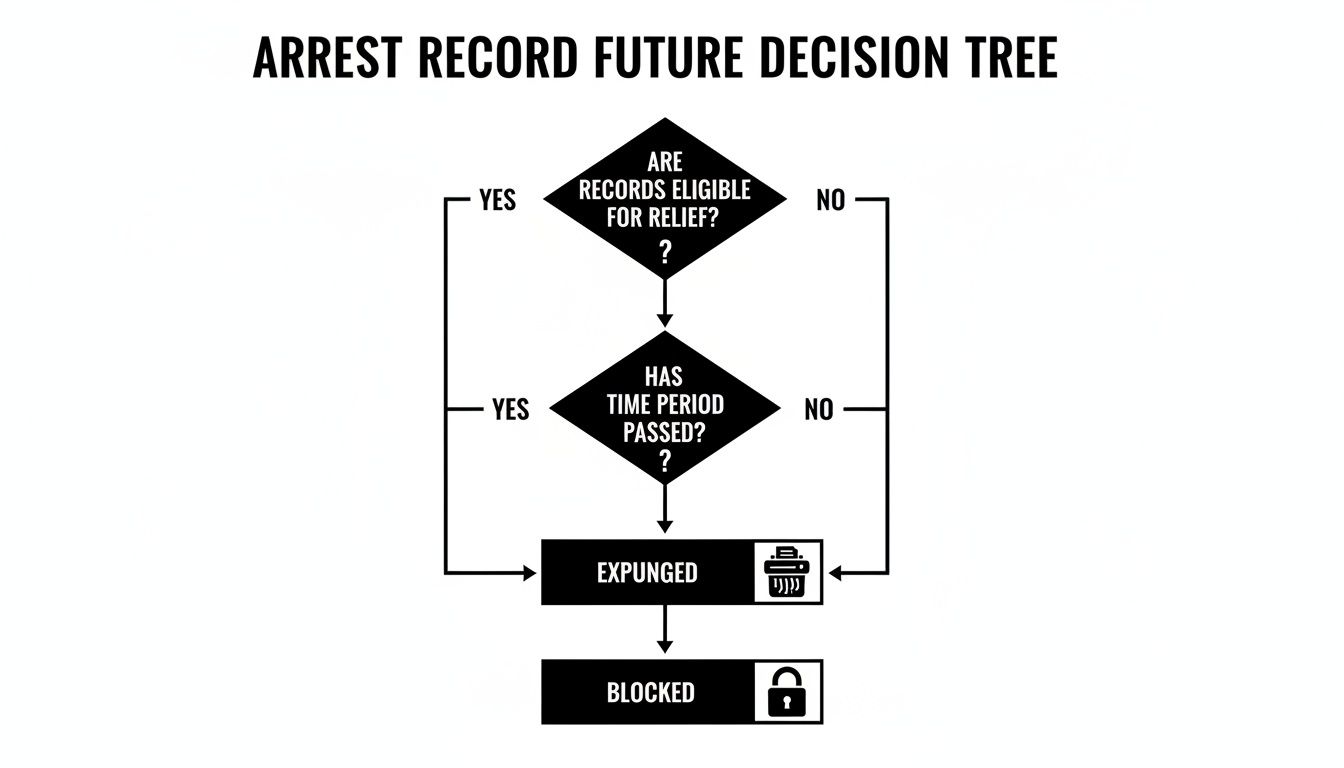
As the image shows, an expunction means your record is completely destroyed. Other outcomes might only seal it from the public, which is a big difference.
What About Deferred Adjudication?
This is where many people get tripped up, and the distinction is vital. If you accepted a plea deal for deferred adjudication probation, you are not eligible to get that record expunged. Why? Because in the eyes of expunction law, deferred adjudication is not a true dismissal.
Instead, successfully completing deferred adjudication might make you eligible for an Order of Nondisclosure. This seals your record from public view but doesn't destroy it.
To help clarify, let's look at the two options side-by-side.
Expunction vs. Nondisclosure: What's the Difference?
Understanding the distinction between destroying a record (expunction) and sealing it (nondisclosure) is key to figuring out your legal path. The right option for you depends entirely on how your criminal case was resolved.
| Feature | Expunction (Record Destruction) | Order of Nondisclosure (Record Sealing) |
|---|---|---|
| What happens to the record? | All records are physically destroyed. | Records are sealed from public view. |
| Who can see it? | No one. You can legally deny the arrest. | Law enforcement and certain state agencies can still see it. |
| Typical eligibility? | Acquittals, dismissals, pardons, or never charged. | Successful completion of deferred adjudication. |
| Can you deny the arrest? | Yes. | No, you must disclose it in certain situations (e.g., applying for a state license). |
While nondisclosure is a valuable tool, it's not the same as the complete and total reset that an expunction provides.
Here’s a real-world example: say you were arrested for felony drug possession and completed deferred adjudication. Your record could likely be sealed with an Order of Nondisclosure. However, if that same charge was "no-billed" by a grand jury (meaning they chose not to indict you), you would be eligible for a full expunction after the waiting period. Learn more about the specific requirements by reading our detailed guide to Texas expungement law and eligibility.
Waiting Periods and Special Circumstances
Eligibility isn't always immediate. Texas law requires specific waiting periods for certain offenses before you can file for an expunction, but only if your case was dismissed or never charged. These periods exist to make sure the statute of limitations—the time the state has to bring charges against you—has officially expired.
For example:
- For a Class C Misdemeanor, the waiting period is 180 days from the date of your arrest.
- For Class A and B Misdemeanors, you have to wait one year from the arrest date.
- For most Felonies, the waiting period is three years from the arrest date.
It's critical to remember these waiting periods do not apply if you were acquitted at trial. If a judge or jury found you not guilty, you can start the expungement process right away.
Understanding these differences is the first step to pursuing the right legal path for your situation.
Navigating the Texas Expungement Filing Process

So, you’ve confirmed you're eligible to get a record expunged. Now it's time for the real work. The legal journey can feel overwhelming from the outside, but it’s really just a series of logical steps. Let’s walk through the key stages so you can approach this with confidence, turning a daunting legal task into a clear, manageable plan.
The very first move is to gather every critical piece of information about your case. This isn't just about what you remember; you need the exact details to get your legal filings right. Think of it as building the foundation for a house—if it's weak, the whole thing can come crashing down.
Gathering Your Case Information
Before a single legal document is drafted, you have to collect the specifics of your arrest and the court case that followed. This step is non-negotiable and demands precision.
You'll need to pinpoint:
- The date of your arrest: The exact day you were taken into custody.
- The arresting agency: Which specific police department or sheriff’s office arrested you?
- The offense you were arrested for: The charge listed on your initial paperwork.
- The court and cause number: This is the unique ID for your case and is absolutely crucial for tracking it.
Having this information ready makes the entire process run smoother and dramatically cuts down the risk of errors that could delay or even torpedo your petition. If you're hitting a wall trying to find these details, an experienced attorney can track down the necessary records for you.
Once you have this data in hand, it's time to prepare your official request to the court. This isn't a simple form you just fill out; it's a formal legal document that kicks the whole process into gear.
Drafting the Original Petition for Expunction
The heart of your case is the Original Petition for Expunction. This is a formal legal pleading you file with the court to officially request the destruction of your criminal records. It has to be drafted with extreme care to meet every requirement in the Texas Code of Criminal Procedure.
The petition can't just ask for an expungement—it has to prove to the judge that you are legally entitled to one. This means it must lay out the facts of your case, cite your eligibility under Texas law, and list every single government agency that has a record of your arrest.
The expungement process is a game of details. Missing just one agency or filing a petition with an error can send you right back to square one. Meticulous preparation is not optional.
Identifying every relevant agency is one of the most common places where people trip up. If you forget even one, they are not legally required to destroy their records, leaving a piece of your past still out there.
A standard list of agencies includes:
- The arresting police department or sheriff’s office
- The county or district clerk where the case was filed
- The district attorney’s or county attorney’s office
- The Texas Department of Public Safety (DPS)
- Any other city, state, or federal agency that might have received information about your arrest
Once the petition is drafted and double-checked, it's ready to be officially submitted. Our team can help you identify every necessary agency for your case, including the specific details for anyone seeking an expungement in Harris County, Texas.
Filing and Serving the Petition
After your petition is complete, you must file it with the District Court in the county where you were arrested. This is a formal move that involves submitting the document to the District Clerk and paying the required filing fees, which can vary from county to county.
But filing the petition is only half the job. Next, you have to legally notify every agency you listed that you are seeking an expungement. This formal process is called "service." Each agency must receive a copy of your filed petition, giving them official notice of the court date and a chance to contest the expungement if they think you're not eligible.
Proper service is a strict legal requirement. If you fail to correctly notify even one agency, a judge can deny your petition.
Attending the Court Hearing
The final step is the court hearing. This is where a judge reviews your Petition for Expunction, listens to any arguments, and makes the final call. The prosecutor for the state will be there and will have the opportunity to object if they believe you don't meet the legal standards.
During the hearing, your attorney will present your case and explain to the judge exactly why you qualify for an expunction under Texas law. If the prosecutor objects, your lawyer will be ready to push back on their arguments and defend your right to have the record destroyed.
Having an experienced Houston criminal lawyer by your side at this hearing is invaluable. A skilled attorney knows how to present the facts persuasively, handle surprise objections from the state, and answer any tough questions the judge might have. If the judge agrees that you meet all the criteria, they will sign the Final Order of Expunction. This signed order is the legal command that compels every agency you listed to find and destroy all records of your arrest, finally giving you the clean slate you've worked for.
Avoiding Common Pitfalls in Your Expungement Case
Getting the green light for an expungement feels like the final hurdle, but it’s not. The reality is that the path to a clean slate is loaded with procedural landmines. We've seen far too many people who are 100% eligible for an expungement get denied by a judge, not because of their case, but because of a simple mistake on a form.
These aren't just minor clerical errors; they can derail your entire case, forcing you to start from scratch and costing you precious time and money. Knowing what these common pitfalls are ahead of time is your best defense.
Filing Too Soon
Jumping the gun is probably the single most common reason for an expungement denial. The law is incredibly strict about this. If your case was dismissed or you were never charged, you absolutely must wait for the statute of limitations to expire. Filing your petition even one day early will get it thrown out.
The waiting periods are black and white, with no room for error:
- Class C Misdemeanors: You have to wait 180 days from the day you were arrested.
- Class A and B Misdemeanors: The clock runs for one year from the arrest date.
- Felonies: This is typically a three-year wait from the date of your arrest.
It's surprisingly easy to get these dates wrong, especially if you’re fuzzy on the exact arrest date or the final charge classification. A judge won’t give you a pass on this, so getting the timing perfect is non-negotiable.
Failing to Notify Every Agency
Here’s another big one: not telling everyone who needs to know. Your Petition for Expunction must list every single government agency that has a record of your arrest. If you leave just one out, that agency has no legal duty to destroy its files. That means a piece of your record survives, defeating the whole purpose.
You have to think bigger than just the local police. The list can be long:
- The arresting agency (city cops, sheriff's office, state troopers)
- The county or district clerk where the courthouse is located
- The prosecutor's office (could be the District Attorney or County Attorney)
- The Texas Department of Public Safety (DPS)
- Any municipal courts or pretrial services you dealt with
A practical tip we often give clients is to run a comprehensive background check on yourself before filing. This can help uncover agencies you may have forgotten about, ensuring your petition is complete and no stone is left unturned.
This step is far too important to guess at. A complete and thorough list is what makes an expunction order truly powerful, forcing every agency to wipe the slate clean.
The Criminal Episode Complication
This is where things can get really frustrating. The "criminal episode" rule trips up a lot of people. In short, Texas law says you can't expunge an eligible charge if it happened during the same incident as another charge you were convicted of—even if that other charge was something minor.
Let’s say you were pulled over and arrested for two things: a felony drug possession charge and a Class C misdemeanor for drug paraphernalia. Later, the felony gets dismissed, which should make it eligible for expungement. But here's the catch: if you just paid the ticket for the paraphernalia (which legally counts as a conviction), it blocks you from ever expunging the dismissed felony.
This rule catches people by surprise all the time. It shows how even minor, unrelated charges from the same arrest are all tied together in the eyes of the law. You have to look at your entire criminal history, not just the one charge you’re focused on. An experienced attorney can spot these "criminal episode" issues from a mile away and map out the best strategy for your specific situation.
Your Life After a Successful Expunction

When the judge finally signs your Order of Expunction, it’s more than just a win in court. It’s the moment you get to reclaim your life. From a legal standpoint, the arrest that’s been casting a shadow over your future is officially gone.
That court order is a direct command. Once signed, the court clerk distributes copies to every single government agency you named in your petition—from the local police department that made the arrest to the Texas Department of Public Safety (DPS). They are now legally required to hunt down and physically destroy every file, database entry, and record of that arrest.
The Record Destruction Timeline
Now, this doesn't all happen with the flip of a switch. While the judge's order is effective immediately, government agencies have their own internal processes for finding and destroying records. You have to be a little patient.
Here’s a general idea of the timeline:
- Order Distribution: The court clerk’s office will typically send the signed order out to all the listed agencies within about 30 days.
- Agency Compliance: Texas law gives these agencies up to 12 months to fully scrub their records. In our experience, most act much faster, but that’s the maximum window they have to get it done.
It’s a waiting period, for sure, but one with a concrete finish line. All the while, the bureaucratic gears are turning in your favor, working to wipe the slate clean.
Your Right to Deny the Arrest
Here’s the most important part. Once that expunction is granted, you gain the legal right to deny the arrest ever happened. This isn't just advice; this right is explicitly spelled out in Chapter 55 of the Texas Code of Criminal Procedure.
So, when you're filling out that job application, rental agreement, or loan paperwork and see the dreaded question, "Have you ever been arrested for or charged with a crime?"—you can confidently check "No."
After an expunction, when asked if you've ever been arrested, the correct legal answer is 'No.' This isn't just advice; it's your right under Texas law.
That simple "No" lifts an enormous weight. You no longer have to live in fear of a past mistake popping up and wrecking a great opportunity. You are, for all legal purposes, starting fresh.
What About Private Background Check Companies?
This is a common question, and it’s a good one. Government agencies are one thing, but what about all those private companies that sell background checks? These data brokers constantly scrape public records and build their own databases, which unfortunately don't always get updated in real time.
So yes, it is possible for an old, expunged record to surface on a third-party background check. It’s incredibly frustrating, but it’s also fixable.
If this happens to you, don’t panic. You have clear legal recourse. You or your attorney can:
- Send the company a copy of your signed Expunction Order.
- Formally demand that they remove the false and outdated information immediately.
- Reference your rights under the Fair Credit Reporting Act (FCRA), a federal law that requires them to report accurate information.
These companies are legally required to fix their records once you’ve notified them. Taking this final step is what truly slams the door on your past, ensuring you can move forward with the complete freedom you earned when you decided to get a record expunged.
Common Questions We Hear About Texas Expunctions
Even after walking through the steps, you’re bound to have questions. That's completely normal. The path to getting a record expunged is deeply personal, and the little details make all the difference. We’ve put together answers to some of the most common questions we get from clients, hoping to give you the clarity you need to move forward.
How Much Does It Cost to Get a Record Expunged?
This is usually one of the first questions people ask, and for good reason. You need to know what to expect financially. The total cost is a mix of a few things: court filing fees, the cost to serve legal notice to every required agency, and of course, the attorney fees for handling the whole process for you. The final number can shift depending on the county and how complex your case is, but it's best to see it as a powerful, one-time investment in yourself.
Think of it this way: you're not just paying a fee; you're investing in a future where a past mistake doesn't hold you back. That cost unlocks a lifetime of better job opportunities, housing options, and the simple peace of mind that comes with a clean slate.
Can a Felony Arrest Be Expunged in Texas?
Yes, but the rules are extremely strict. You can only get a felony arrest record expunged if you were found "not guilty" at trial, if a grand jury threw out the case (a "no-bill"), or if you were granted a pardon.
Here's the critical part: if you received any kind of probation for that felony, even deferred adjudication, you are not eligible for an expunction. This is a common point of confusion, and it’s why we always have to start by digging into the exact outcome of your case.
The road to expunging a felony arrest is narrow, but for the few who qualify, it’s a total game-changer. It’s absolutely essential to confirm how your case was resolved before you start the process.
How Long Does the Expungement Process Take?
Once the paperwork is filed, you’ll need some patience. From the moment we file your Petition for Expunction to the day a judge signs the final order, the process typically takes anywhere from three to six months.
Several factors can stretch out this timeline, and many are simply part of the court system.
- The judge's current caseload and the court’s schedule.
- Whether the District Attorney's office decides to challenge the expunction.
- The time it takes to properly serve all the government agencies involved with legal notice.
While we push your case forward as quickly as possible, some of these things are just out of our hands.
What if I Am Not Eligible for an Expunction?
Hearing you don’t qualify for an expunction is tough, but it's not the end of the road. Don't lose hope. If you successfully finished deferred adjudication probation for a charge higher than a Class C misdemeanor, there's another powerful legal tool that might be perfect for you.
You could be eligible for an Order of Nondisclosure. While an expunction completely destroys a record, a nondisclosure seals it from public view. This means most employers, landlords, and the general public won’t see it on a background check. You can read more about the important differences between expungement and nondisclosure in our guide to figure out which path fits your situation. Our team can break down your case and make sure we pursue every single option available to you.
If you’ve been charged with a crime in Texas, call The Law Office of Bryan Fagan, PLLC for a free and confidential consultation. Our defense team is ready to protect your rights.