In Texas, a straightforward misdemeanor often resolves in about 1 to 3 months, while a felony is supposed to finish within about 4 to 12 months under the courts' model standards. In real life, many misdemeanor cases last 3 to 6 months, many non-violent felonies last 6 to 12 months, and complex felonies can last 12 months or longer.
Being arrested in Texas can be terrifying. You may be worried about jail, your job, your driver's license, your family, and the question that keeps coming back at night: how long does a criminal trial take in Texas?
The hard part is that people often use the word trial to mean two different things. Sometimes they mean the actual day or days in court. Sometimes they mean the entire case from arrest to final result. Most of the time, what really takes so long is not the courtroom presentation itself. It's everything around it: charging decisions, evidence review, court settings, plea talks, motions, and scheduling.
If you're facing charges for DWI, assault, theft, drug possession, or another offense, you need a clear picture of the road ahead. You also need to know what you can control, what your lawyer can push forward, and what delays may protect you instead of hurting you.
The Anxiety of the Unknown After a Texas Arrest
The first days after an arrest feel disorienting. You may hear different answers from police, bondsmen, friends, or the internet. One person says your case will be over quickly. Another says it could drag on forever. Both statements can sound believable when you're standing in the middle of the process with no map.
A Texas criminal case usually doesn't move in one straight line. Even if the charge seems simple, the court still has to handle filings, appearances, evidence exchange, and scheduling. If the case involves a contested stop, a search issue, witness problems, surveillance video, or forensic testing, the timeline can stretch.
What people usually mean by trial length
For many, the question isn't how many hours they'll sit in a courtroom. It's this:
- How long until I know what's happening
- How long until I can move on
- How long will this hang over my record, license, and work
- How long until I have to decide whether to plead or fight
Those are fair questions.
Under Texas court performance targets, misdemeanors are expected to move much faster than felonies. But actual case timelines are often slower than the official goals. That gap creates a lot of anxiety because people expect a deadline that the system doesn't always meet.
Practical rule: A short hearing doesn't mean a short case. Most of the waiting happens before trial, not during it.
Why your timeline may look different from someone else's
Two people can both be charged in Texas and still have very different timelines. The difference may come from the type of charge, the county, the court's workload, whether you're asking for a jury, and whether your lawyer needs time to challenge the State's evidence.
For example, a first-time theft case may move very differently from an aggravated assault allegation. A DWI case may involve not only the criminal charge but also your driver's license issue. Drug possession cases may depend on lab work and search challenges. Assault cases often turn on witness statements, injury evidence, or self-defense issues under the Texas Penal Code.
If you're new to this process, the main thing to remember is simple. Delay doesn't always mean your case is going badly. Sometimes it means your lawyer is doing the work that protects you.
The Criminal Justice Roadmap From Arrest to Verdict
On day one, it can feel like your case should have a clear countdown. You were arrested, you got a court date, and it seems reasonable to assume the system now runs on a set schedule. In real life, Texas criminal cases move more like a series of checkpoints than a straight line. The court gives dates. The work between those dates often decides how long the case really lasts.
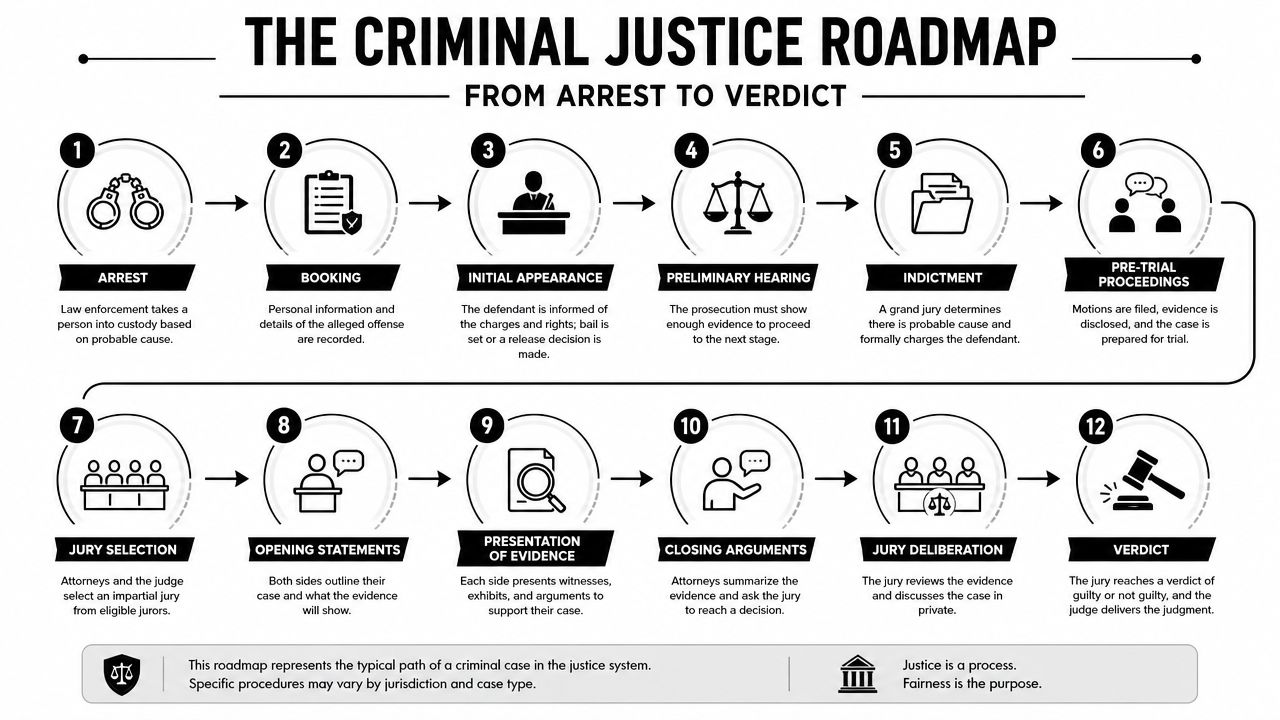
If you want a second plain-English overview, this guide to the steps in the Texas criminal justice process helps show how the stages fit together.
Arrest and booking
The process usually begins with an arrest, a citation that leads to formal charges, or a warrant being served. After that, booking follows. The jail records your information, takes fingerprints and photographs, and starts the bond process.
This stage feels fast because so much happens at once. But fast does not mean simple. An arrest only means the State believes it has a case. It still has to prove it.
Charging and first court appearances
Next, the prosecutor decides what charges to file and how to file them. In felony cases, that can include grand jury review. In misdemeanor cases, the process is often more direct, but it still depends on paperwork, prosecutor review, and court scheduling.
Your first court setting may be an arraignment or another initial appearance. That is the point where the court formally identifies the charge and a plea is entered. If you have counsel, your lawyer can often handle much of this stage and start protecting you from avoidable mistakes early.
Pretrial work is where the calendar usually expands
This is the part clients do not see coming. The court date on the paper looks important, and it is, but it is often only a status check. Substantive work happens between settings.
Pretrial work can include:
- Discovery review. Your lawyer obtains and studies police reports, body camera footage, lab results, witness statements, and other evidence.
- Motions. The defense may challenge a traffic stop, search, confession, lineup, or other police conduct.
- Negotiations. The lawyers may discuss dismissal, reduction, diversion, or a plea offer.
- Defense investigation. Your lawyer may collect records, talk to witnesses, visit the scene, or consult an expert.
A good way to understand this phase is to compare it to building a house inspection before closing. The hearing itself may be short. The careful review beforehand is what keeps you from accepting hidden problems.
If your case involves science-based proof, extra preparation can add time for good reason. For readers trying to make sense of lab issues, RiverAxe LLC on DNA evidence offers a simple explanation of how forensic DNA analysis works and why it can affect case preparation.
A court setting often marks progress, not the finish line.
Trial, sentencing, and what happens after
If the case does not end in a dismissal, diversion program, or plea agreement, it goes to trial. That trial may be in front of a judge or a jury. The prosecutor presents evidence first. Your defense then gets the chance to question witnesses, object to improper evidence, present favorable evidence, and argue that the State has not met its burden.
The trial itself is often much shorter than clients expect. The longer stretch is usually the waiting, reviewing, filing, and preparing that comes before anyone is sworn in. That gap between the official court schedule and the actual timeline is normal in criminal cases, and it is one of the main reasons people feel caught off guard.
If there is a plea or conviction, sentencing follows. After that, some cases continue through motions for new trial, appeal, expunction, nondisclosure, or other post-case relief, depending on the outcome and the charge.
Misdemeanor vs Felony Timelines in Texas
Not every criminal case moves at the same speed. The biggest practical difference is usually whether you're facing a misdemeanor or a felony.
A misdemeanor is the less serious category, though it can still carry jail time, fines, probation, and a damaging record. Common examples include some theft, assault, marijuana possession, and many first-time DWI cases. A felony carries much higher stakes and often more complicated evidence. Common examples include aggravated assault, robbery, burglary of a habitation, and some drug charges.
Texas lawyers commonly report that a case may be scheduled for trial 6 to 12 months after arrest, with misdemeanor cases typically lasting 3 to 6 months, non-violent felony cases 6 to 12 months, and complex felonies 12+ months. The same Texas source also notes that felony cases often last three months to over a year, and serious felonies can take even longer when they involve multiple witnesses, motions, or forensic evidence, as discussed in this Texas criminal case timeline overview.
A useful starting point if you're unsure where your charge fits is this explanation of misdemeanor vs felony in Texas.
Typical case timelines in Texas
| Factor | Misdemeanor (e.g., DWI, Theft under $1,500) | Felony (e.g., Aggravated Assault, Robbery) |
|---|---|---|
| Usual pace | Often moves faster | Often moves slower |
| Reported real-world timeline | Typically 3 to 6 months | Often 6 to 12 months, with complex cases 12+ months |
| Court level | Usually county court | Usually district court |
| Evidence issues | Often fewer witnesses and fewer expert issues | More likely to involve extensive records, experts, or contested facts |
| Stakes | Jail, fines, probation, license issues, record impact | Prison exposure, stricter supervision, major record and employment impact |
| Common examples | DWI, simple assault, lower-level theft, some drug possession | Aggravated assault, robbery, serious drug allegations, burglary |
The video below gives another useful overview of how Texas criminal cases can unfold in practice.
Why the charge level matters so much
Felony cases usually require more courtroom time before trial because there's more to dispute. Your lawyer may need to review body camera footage, medical records, phone records, search warrant paperwork, or forensic material. The prosecution may also take longer to organize and disclose everything.
For a misdemeanor, the issue may be narrow. For a felony, the same case may involve self-defense, intent, identity, witness credibility, and punishment strategy all at once. That's why the answer to how long does a criminal trial take in Texas often starts with one question: what level of charge are you facing?
Common Reasons Your Criminal Case Gets Delayed
Many clients think a delayed case means someone forgot about them. Usually, that isn't what's happening. Delay often comes from the way Texas courts handle crowded dockets, repeated settings, evidence review, and negotiations.

The court keeps resetting the case
One of the biggest surprises for defendants is that a court setting may not be a trial date in the everyday sense. It may be a progress date. In Texas practice, many criminal cases have three to six or more pretrial settings and may remain on the docket for 6 to 18 months depending on court workload, according to this Texas-focused discussion of pretrial settings and delays.
That can feel maddening when you miss work, arrange child care, and prepare emotionally, only to hear, “Come back next month.”
The lawyers are still building the case
A defense attorney can't give good advice until the evidence is reviewed. That takes time. In a DWI case, your lawyer may need the stop video, body camera footage, intoxilyzer records, or officer reports. In an assault case, your lawyer may need witness statements, injury photos, or medical records. In a drug case, the defense may challenge whether the stop, search, or seizure was lawful.
Pretrial motions also matter. If your lawyer files a motion to suppress evidence because police violated your rights, the court has to set and hear that motion before the case can move cleanly toward trial or negotiation.
Some delay is harmful. Some delay is preparation. Your lawyer's job is to know the difference.
Parallel proceedings can slow things down
A criminal case doesn't always travel alone. DWI cases are a strong example. The criminal charge may move through one track while your driver's license issue moves through another.
The same Texas source notes that DWI cases can run alongside separate ALR license hearings scheduled 60 to 120 days after the request. That extra process catches many people off guard because they think everything will be handled in one courtroom on one timeline.
Common delay points in plain language
- Crowded dockets: Courts handle many cases, and your hearing may be one of many set for the same day.
- Missing evidence: Police video, lab results, or witness materials may not be ready.
- Defense investigation: Your lawyer may need more time to gather facts that help your case.
- Negotiation efforts: A good plea offer or dismissal opportunity may take time to develop.
- Unavailable witnesses: Officers, experts, or civilian witnesses may not be present on the first setting.
If you're frustrated by resets, that reaction is normal. The important question isn't only why the case is delayed. It's whether the delay is helping your defense, hurting your rights, or both.
Understanding Your Texas Speedy Trial Rights
You may hear the words "speedy trial" at court and feel a surge of hope. It sounds like the law should force your case to end by a certain date. In Texas, it does not work that way.
Your speedy trial right comes from the Constitution. It protects you from unreasonable delay, but it is not a simple countdown clock that automatically expires. The gap between the court's official scheduling goals and what happens in real life is where many people get confused. Courts set target timeframes for how cases should move. Actual cases slow down for many reasons, including crowded dockets, evidence problems, witness issues, and defense motions that need to be heard before trial.
That gap matters because a delay can mean two very different things. Sometimes it is a sign the system is dragging its feet. Sometimes it gives your lawyer the time needed to protect you.
Court targets are goals, not automatic dismissal dates
Texas courts use model time standards as performance goals for how quickly criminal cases should be resolved. Those standards are useful because they show what the court system considers a reasonable pace. But they do not create a rule that says your case must be dismissed the moment it passes a target date.
A simple way to understand it is this. The official timeline is like the speed limit posted on a highway. It tells you how traffic is supposed to move. It does not guarantee that your drive will take exactly that long, and it does not tell you what remedy applies if traffic backs up.
So if your misdemeanor has gone on longer than you expected, or your felony is still pending many months later, that alone does not end the case. The legal question becomes whether the delay is unreasonable in your specific situation, why it happened, whether your side asked for a faster setting, and whether the delay has caused real harm.
How courts look at a speedy trial complaint
Judges do not usually decide these issues with a stopwatch. They look at the full picture.
That picture often includes the length of the delay, the reason for it, whether the defense clearly asserted the right to a speedy trial, and whether the delay hurt the accused person's case or daily life. Harm can be practical, not just legal. A missing witness can weaken your defense. Faded memories can make testimony less reliable. Bond conditions can interfere with work, travel, child custody, or professional licenses.
This is one reason pretrial settings matter so much. If you want a clearer sense of where these timing disputes often develop, this guide to what happens during pretrial hearings in Texas can help.
What your lawyer is actually doing during a delay
A good lawyer does more than wait for the next court date. Your lawyer tracks who caused the delay, whether the prosecution is ready, whether the court has available time, and whether asking for speed helps or hurts your defense.
Sometimes the right move is to press the issue early and make a clear record that you want the case to move. Sometimes asking for more time is the wiser choice because a motion still needs briefing, a witness needs to be interviewed, or key records have not arrived yet. That written advocacy can matter, much like drafting a legal brief, because the court often needs a clear, organized explanation of why delay has become unfair or why more preparation time is justified.
A speedy trial right works best when it is used carefully and at the right moment.
When delay becomes a real legal problem
Delay becomes more serious when it starts damaging your ability to defend yourself or prolongs restrictions on your life without a good reason. If the State is not ready, witnesses keep disappearing, or the case keeps getting reset with no meaningful progress, your lawyer may decide it is time to demand action and put the issue in front of the judge.
That does not mean every long case leads to dismissal. It means your lawyer should treat time as evidence, not just inconvenience. The official timeline tells you what the system aims for. Your lawyer's job is to compare that ideal with the reality of your case and decide when the delay has crossed the line from ordinary court backlog into something legally unfair.
How a Defense Attorney Can Help Manage Your Case Timeline
You can't control the court's calendar, but you can control how prepared your side is. That changes the experience of a criminal case more than is commonly understood.
Some lawyers merely appear at settings and wait. A proactive defense lawyer uses time as part of the defense itself. Sometimes that means moving the case faster. Sometimes it means slowing it down for a reason that helps you.
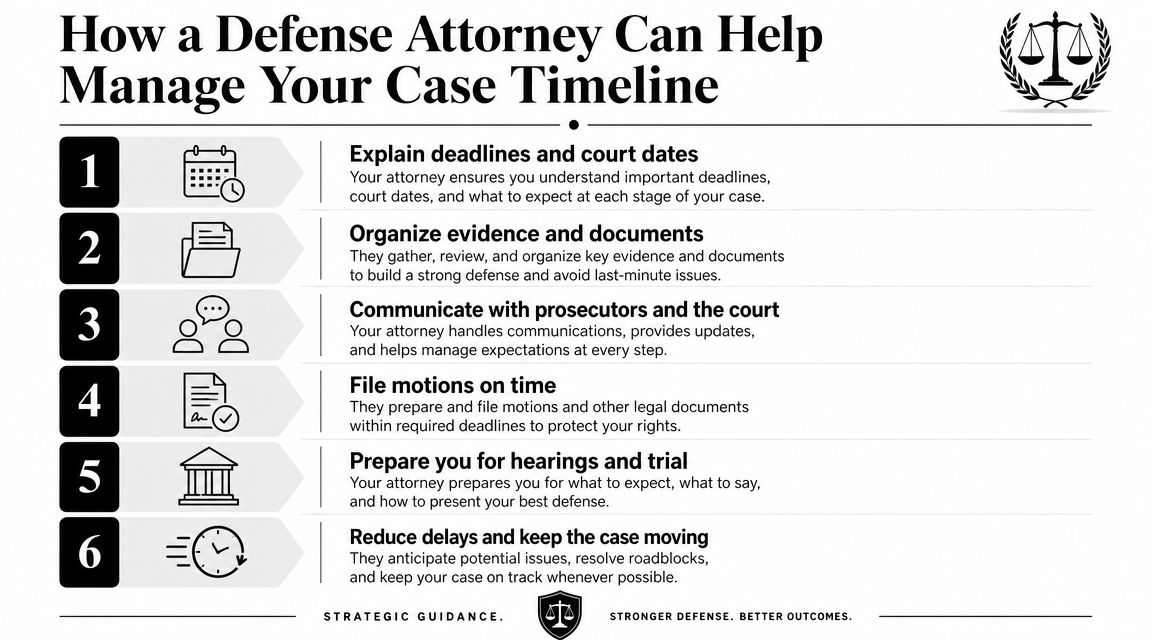
Ways a lawyer can shorten the process
A defense attorney may be able to speed things up by pushing for discovery, getting hearings set, identifying weak points early, and opening productive plea discussions. In some misdemeanor cases, quick preparation can lead to a quicker resolution because the prosecution sees the defense is ready.
That matters in cases like theft, simple assault, or some drug possession charges, where early mitigation can influence the outcome. It may also help in some DWI cases when your lawyer quickly obtains the records needed to evaluate the stop and testing issues.
Ways a lawyer may use extra time to protect you
Not every delay is bad. Sometimes more time helps because your attorney can:
- Challenge the stop or search: This is common in DWI and drug possession cases.
- Develop self-defense facts: Important in assault and aggravated assault allegations under the Texas Penal Code.
- Collect mitigation: Counseling, treatment, employment proof, or character materials can help negotiations or sentencing.
- Prepare written arguments: Strong legal writing matters when asking a judge to suppress evidence or dismiss an issue. If you want a simple outside explanation of that process, this guide to drafting a legal brief gives a useful overview.
The goal isn't speed for its own sake. The goal is the best outcome available under the facts.
Looking beyond the trial date
A good defense plan also considers what happens after the criminal case. If your case ends favorably, you may be able to pursue expunction or record sealing through nondisclosure, depending on the result and the offense. If there's a conviction, post-conviction relief may still matter for your future.
The Law Office of Bryan Fagan PLLC handles criminal defense cases as well as expunctions, nondisclosures, and related post-conviction matters, which can be important if your immediate goal is not only getting through the case but also rebuilding afterward.
When clients ask how long does a criminal trial take in Texas, the most honest answer is this: the calendar matters, but strategy matters more. A rushed case can miss defenses. An unmanaged case can drift. The right lawyer helps you avoid both problems.
If you've been charged with a crime in Texas, call Law Office of Bryan Fagan PLLC for a free and confidential consultation. Our defense team is ready to protect your rights.