Skip to content
Being arrested in Texas can be terrifying — but you don’t have to face it alone. If you're facing a marijuana charge, your head is probably spinning with questions about what comes next. Let's get right to the biggest one: possessing more than four ounces of marijuana is a felony. That specific weight is the bright, glaring line where a charge escalates from a misdemeanor to something that can change your life forever.
The Misdemeanor to Felony Dividing Line in Texas
When Texas law enforcement weighs the marijuana found in your possession, that number is the single most important factor determining your fate. While any amount is still illegal here, the law draws a clear and incredibly harsh line at four ounces. Fall under that amount, and you're in misdemeanor territory. Go one grain over, and the entire legal landscape shifts beneath your feet.
Understanding this distinction is the absolute first step toward protecting yourself. A misdemeanor might mean fines or a short stint in county jail, but a felony conviction brings devastating consequences that can shadow you for the rest of your life.
How Texas Classifies Marijuana Possession
The Texas Health and Safety Code is the rulebook that lays all this out in plain English. It creates a tiered system where the penalties get steeper as the amount of marijuana goes up. The most significant jump, by far, happens when a charge goes from a Class A Misdemeanor (for two to four ounces) to a State Jail Felony (for anything over four ounces).
This isn't just about facing more time behind bars; it changes everything. A felony on your record can strip you of fundamental civil rights that you probably take for granted, like:
- The right to vote
- The right to own a firearm
- The right to serve on a jury
It also creates a permanent criminal record that can slam the door on job opportunities, apartment applications, and professional licenses. You can learn more about the far-reaching consequences of different types of felonies in Texas in our detailed guide.
Texas Marijuana Possession Penalties at a Glance
Let's break down exactly how the penalties shift once you cross that four-ounce line. According to the Texas Health and Safety Code §481.121(b)(3), possessing more than four ounces but less than five pounds is a state jail felony. A conviction for this carries a potential punishment of 180 days to two years in a state jail facility and a fine of up to $10,000.
A simple mistake or a moment of poor judgment shouldn't define the rest of your life. Understanding the specific charge you're facing is the first step, but having a skilled legal advocate in your corner is the most critical one.
To make this crystal clear, the table below breaks down the key weight thresholds so you can see exactly where a specific charge falls and what's at stake.
| Amount of Marijuana | Offense Classification | Potential Jail/Prison Time | Maximum Fine |
|---|---|---|---|
| 2 ounces or less | Class B Misdemeanor | Up to 180 days in county jail | $2,000 |
| More than 2 oz, up to 4 oz | Class A Misdemeanor | Up to 1 year in county jail | $4,000 |
| More than 4 oz, up to 5 lbs | State Jail Felony | 180 days to 2 years in state jail | $10,000 |
| More than 5 lbs, up to 50 lbs | 3rd-Degree Felony | 2 to 10 years in prison | $10,000 |
As you can see, crossing from four ounces to just over four ounces means facing double the potential jail time and more than double the maximum fine. More importantly, it saddles you with a felony record. It’s a harsh reality, but knowing the stakes is the first step in building a strong defense.
Understanding the Tiers of Felony Marijuana Charges
Once you cross that four-ounce line, the legal trouble for marijuana possession in Texas doesn't just get worse—it explodes. The penalties escalate dramatically with every jump in weight. We’re not talking about a single felony charge; it’s a tiered system where the potential prison time and fines climb at a terrifying rate. Getting a handle on these specific levels is the first step in understanding just how serious your situation is.
This flowchart gives you a quick visual breakdown of how Texas law draws the line between a misdemeanor problem and a life-altering felony.
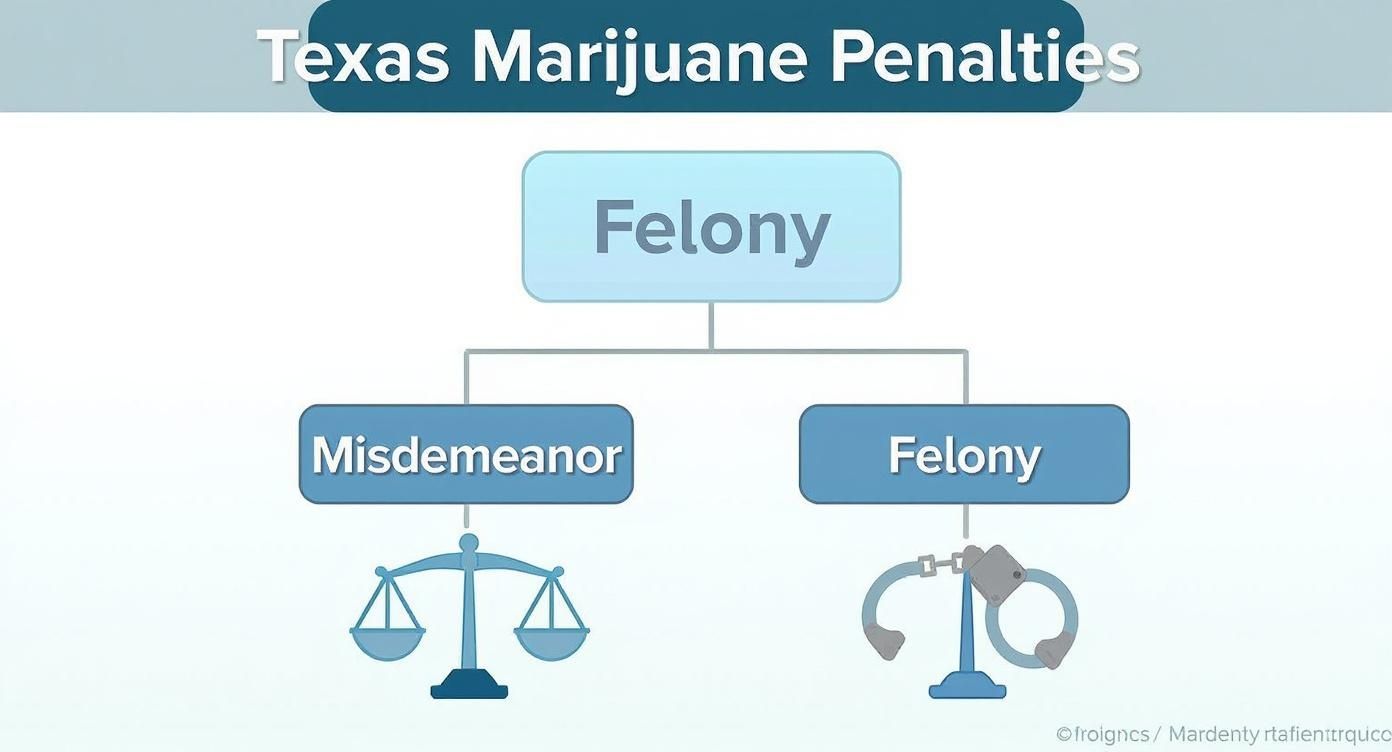
As you can see, the penalties take a huge leap once you move from the misdemeanor "scales" to the felony "handcuffs." That four-ounce mark is the critical dividing line. Each felony tier brings its own set of severe punishments, all laid out in the Texas Health and Safety Code.
State Jail Felony: The First Rung on the Felony Ladder
The very moment you're caught with more than four ounces of marijuana, you have stepped into felony territory. The entry-level charge is a State Jail Felony.
- Weight: Anything over 4 ounces, but not more than 5 pounds.
- Penalty: This charge can put you behind bars for 180 days to 2 years in a state jail facility.
- Fine: On top of that, you could be hit with a fine of up to $10,000.
This is the most common felony marijuana charge we see. And while it’s the "least severe" felony, don't be fooled. A conviction leaves you with a permanent felony record that will follow you for years, making it incredibly difficult to get a job, find housing, or even qualify for a loan.
Third-Degree Felony: A Serious Jump in Penalties
The next level up is a third-degree felony, which the state considers a substantial amount of marijuana. At this point, the potential prison time gets much more serious. You're no longer looking at state jail—you're facing time in a Texas state prison.
- Weight: More than 5 pounds, but no more than 50 pounds.
- Penalty: A conviction here can mean 2 to 10 years in the Texas Department of Criminal Justice (TDCJ).
- Fine: The maximum fine stays at $10,000.
With this much weight, prosecutors will almost always argue it was for more than just personal use. They’ll likely push for more serious charges, like possession with intent to distribute, which brings even heavier consequences. If you want to get deeper into how these offenses are defined, you can learn more by breaking down Texas drug laws in our detailed guide.
Second-Degree and First-Degree Felonies: The Highest Stakes
The top tiers of felony marijuana possession are reserved for amounts that law enforcement associates with major trafficking operations. The penalties are designed to match, with potential sentences that could last for decades—or even for life.
- Second-Degree Felony (50 to 2,000 lbs): This charge comes with a staggering 2 to 20 years in prison and a fine of up to $10,000.
- First-Degree Felony (Over 2,000 lbs): For the largest quantities, the charge becomes a first-degree felony. This is punishable by 5 to 99 years (or life) in prison and a fine up to $50,000.
These incredibly harsh penalties leave no doubt about how seriously Texas prosecutes large-scale marijuana offenses. The threat of spending decades in prison is very real, which makes an aggressive, strategic legal defense absolutely critical from the moment of arrest.
Trying to navigate these complex laws on your own is a huge risk. You need a deep understanding of the Texas Penal Code and the tactics prosecutors will use to get a conviction. An experienced criminal defense attorney can dissect the details of your case, challenge the state's evidence, and fight to protect your freedom against these life-changing charges.
How Texas Law Defines Marijuana Possession
When you hear the word "possession," you probably picture someone with a baggie of weed in their pocket. That’s the simple version, but Texas law casts a much, much wider net. Understanding exactly how the state defines and proves a possession charge is the first and most critical step in defending yourself, because a prosecutor doesn't need to prove you were physically holding anything to charge you with a serious crime.

This broader definition often traps people who had no idea they could be legally on the hook for something that wasn't even theirs. It all boils down to two legal concepts you absolutely must understand: actual possession and constructive possession.
Actual Possession vs. Constructive Possession
Getting a handle on the difference between these two types of possession is absolutely essential. This distinction can easily be the single factor that decides whether you're facing a misdemeanor or a life-altering felony.
Actual Possession: This is exactly what it sounds like. It means you have direct, physical control over the marijuana. If the police find it in your pocket, in a backpack you're wearing, or in a purse you're carrying, the state will argue you had actual possession. It's straightforward.
Constructive Possession: This is where things get tricky and where many people find themselves in deep trouble. You can be charged with constructive possession if marijuana is found in a place you control, even if you weren't touching it. Think about the glove box of your car, a nightstand in your bedroom, or stuffed under the seat you're sitting in.
This concept means you can be charged for marijuana that belongs to someone else entirely, simply because it was found in a space connected to you. In these cases, the prosecutor's entire argument will hinge on proving you knew the drugs were there and that you had the ability and intent to take control of them.
Proving Possession Through "Affirmative Links"
So, how does the state prove you "knew" about drugs you weren't physically holding? They can't read your mind, so they rely on circumstantial evidence. To connect you to the marijuana and convince a jury, prosecutors must build a case using what are called "affirmative links."
An affirmative link is just a legal term for a fact or piece of evidence that ties you to the drugs. The prosecutor’s job is to collect as many of these links as possible and weave them into a story for the jury—a story that paints a picture of knowing possession. One link is rarely enough; the strength of their case depends on the total number and quality of the links they can establish.
The concept of "affirmative links" is a battleground in many drug cases. A skilled defense attorney's job is to dismantle these connections one by one, creating reasonable doubt about whether you truly knew about or controlled the substance.
Here are some of the most common "links" prosecutors use to build their case:
- The marijuana was in plain sight.
- You were the owner or driver of the car where the drugs were found.
- You tried to run from the police or acted suspiciously nervous.
- You made incriminating statements to the officers.
- The drugs were found very close to where you were sitting.
- There was a strong smell of marijuana on you or coming from your vehicle.
- You were the only person in the car or had exclusive access to the location.
- The amount of marijuana was large enough to suggest you had to know it was there.
If you've been arrested, you can be sure the prosecution is already working to forge this chain of links against you. Understanding their strategy is the first step, but taking it apart requires immediate and experienced legal help.
Navigating the Felony Arrest Process: What to Expect
An arrest for any crime is jarring and frightening. When the charge is a felony, that fear gets dialed way up. The minutes and hours after the handcuffs click can feel like a chaotic blur, but understanding what’s coming next is the first step toward getting back some control. Let's walk through the felony arrest process in Texas so you know what to expect and can start making smart decisions right away.
Remember, your most important right clicks into place the second you’re detained: the right to remain silent. It’s not just a line from TV shows; it’s a critical constitutional shield. You are not required to answer questions, explain what happened, or help the police build their case against you.
From Handcuffs to a Holding Cell: The Booking Process
This is the first step after an arrest. Police will transport you to a local station or county jail for what’s called "booking." This is purely an administrative step where an officer will:
- Record your personal information (name, date of birth, etc.)
- Take your photograph, or "mug shot"
- Take your fingerprints
- Search you and confiscate your personal property for safekeeping
During this entire process, you should assume that anything you say can and will be used against you. Police officers are trained to ask seemingly casual questions designed to get you talking and potentially admitting to something. The best—and only—response is to state clearly and politely, "I am exercising my right to remain silent, and I want to speak with an attorney." Say it and stick to it.
Seeing the Judge: Your First Court Appearance and Bail
After booking, you will be held until you can see a magistrate judge for your initial appearance, often called an arraignment. This almost always happens within 24 to 48 hours of your arrest. It’s a brief hearing where the judge will:
- Tell you the formal charges you’re facing.
- Remind you of your constitutional rights, including your right to a lawyer.
- Decide on a bail amount, if you’re eligible.
Bail is a financial promise to the court that you will show up for all your future court dates. The judge looks at a few things when setting the amount, like how serious the crime is, your past criminal record, and whether you have solid ties to the community (like a job or family). Getting out of jail on bond is a huge first step. It allows you to help build your own defense from home instead of behind bars.
The Grand Jury and Indictment: How a Felony Case Proceeds
Here is where felony cases really differ from misdemeanors. Misdemeanors are filed directly by the prosecutor, but in Texas, a felony case must first go through a grand jury. This is a group of citizens who review the prosecutor's evidence to determine if there’s enough probable cause to formally charge you with a crime.
This is a completely one-sided process. You and your lawyer are not in the room. The prosecutor presents their side of the story, and if the grand jury believes there's enough evidence to move forward, they issue an indictment. An indictment is the official document that formally charges you with a felony and kicks the case into trial court.
The time between your arrest and a potential indictment is a crucial window for your defense. A sharp attorney can get to work immediately—investigating the facts, preserving evidence, and talking to the prosecutor. Sometimes, they can even present information that persuades the grand jury not to indict at all.
The criminal justice system is a maze, and it moves fast. Every single step, from the arrest to the grand jury’s decision, has specific rules and procedures. Having a knowledgeable lawyer in your corner ensures your rights are protected at every turn and gives you the best possible shot at fighting the charges.
Possession with Intent to Deliver: A More Serious Charge
When it comes to Texas marijuana laws, the amount you're caught with is only half the story. The other half—the one that can dramatically change your future—is what police find with the weed.
This is where the law draws a massive line in the sand between two very different charges: simple possession and the much more serious possession with intent to deliver. The first assumes the marijuana was for your personal use. The second assumes you’re a dealer.

This distinction is everything. A simple possession charge is based purely on weight. But an "intent to deliver" charge, which falls under the Texas Health and Safety Code § 481.112, can bump your charges up an entire felony level. That means you could be looking at significantly more prison time and crushing fines for the exact same amount of marijuana.
How Prosecutors Build an "Intent to Deliver" Case
Prosecutors are storytellers. When they can’t prove an actual sale happened, they build a narrative for the jury using circumstantial evidence. Their goal is to take a collection of ordinary items and paint a picture of a drug dealer, not just a casual user.
These items are often called "indicia of intent"—legal jargon for things that suggest you planned to sell. Even if selling was the furthest thing from your mind, the presence of certain objects gives a prosecutor the ammunition they need to pursue a much tougher conviction against you.
In an "intent to deliver" case, the prosecutor’s argument often boils down to this: “What other reason could this person have for possessing all these items together?” A powerful defense works to dismantle that story, showing the jury that there are, in fact, perfectly reasonable explanations.
Here are the most common pieces of evidence police and prosecutors use to turn a simple possession charge into something far worse:
- Drug Paraphernalia: Things like digital scales, a large supply of small plastic baggies, or even grinders can be framed as the tools of a drug trafficking trade.
- Large Amounts of Cash: If you’re carrying a lot of cash, especially in small bills, the prosecution will argue it’s the proceeds from drug sales.
- Multiple Phones or Ledgers: Having more than one cell phone is an immediate red flag for law enforcement. The same goes for any documents that look like they track sales or debts, often called "owe sheets."
- Incriminating Communications: Text messages or social media DMs talking about prices, quantities, or meeting spots are often the strongest evidence prosecutors have.
- How the Marijuana is Packaged: If the marijuana is already divided into several smaller, individually wrapped bags, it looks like it’s prepped for sale, not personal use.
The Impact on Your Charges
Let's put this into a real-world context. Say you get arrested with five ounces of marijuana. By itself, that’s a state jail felony for simple possession.
But now, let's say those same five ounces are found in a backpack with a digital scale, a box of Ziploc bags, and a couple hundred dollars in cash. All of a sudden, the prosecutor has what they need to charge you with possession with intent to deliver. That could elevate the charge to a third-degree felony, which skyrockets your potential prison time from a maximum of two years to as much as ten years.
This is exactly why understanding how much weed is a felony in Texas requires looking beyond the scales. The evidence found around the drugs can completely alter your legal jeopardy and underscores why you need a proactive, aggressive defense strategy from the moment you’re charged.
Strategic Defenses for Your Marijuana Case
Just because you’ve been charged with a felony for marijuana possession doesn’t mean your life is over. Far from it. An arrest is not a conviction, and the time to start fighting back is right now. You have rights, and there are powerful legal strategies we can use to protect your future.
With the right legal guidance, a felony charge can be challenged, reduced, or in some cases, dismissed entirely. We work to dismantle the prosecution's case piece by piece, building a defense strategy designed to secure the best possible outcome for you.
Challenging the Evidence Against You
One of the most effective ways to defend against any drug charge is to attack how the evidence was obtained in the first place. The U.S. Constitution protects every single one of us from unreasonable searches and seizures. If law enforcement violated your rights at any point, the evidence they collected could be thrown right out of court.
This is done by filing a legal tool known as a Motion to Suppress. For example, did the police have a valid reason to pull you over? Did they have the legal right to search your vehicle or your home? If the answer is no, then any marijuana they found simply cannot be used against you. You can learn more about how this powerful defense works in our article explaining what is a motion to suppress evidence.
A successful Motion to Suppress can gut the prosecution’s entire case. If the key evidence is deemed inadmissible, the district attorney is often left with no choice but to dismiss the charges completely.
Exploring Alternatives to a Conviction
Even when the evidence seems strong, a conviction isn't a foregone conclusion. Texas law provides several pathways that can help you avoid a permanent felony record. These options focus more on rehabilitation and second chances than pure punishment.
- Plea Bargaining: We can often negotiate with the prosecutor to get a felony charge reduced to a less serious offense, like a misdemeanor. This alone can help you avoid prison time and the devastating lifelong consequences of a felony conviction.
- Pretrial Diversion Programs: For many first-time offenders, these programs offer a direct path to a dismissal. If you complete the program’s requirements—which might include classes, community service, or counseling—the charge is dropped. You can later seek an expunction to completely clear your record.
- Deferred Adjudication: This is a special kind of probation. You plead "guilty" or "no contest," but the judge doesn't actually find you guilty. As long as you successfully complete the probationary period, the case is dismissed, and you won't have a final conviction on your record.
The severity of Texas drug laws has a long, tangled history. It’s hard to believe, but before 1973, possessing any amount of marijuana in Texas could potentially land you a life sentence. The Texas Controlled Substances Act of that year created the tiered system we see today, establishing a felony for amounts over four ounces—which still brought a heavy two-to-ten-year prison term.
Securing competent legal representation is the cornerstone of any strong defense. It helps to know the lingo, and understanding the distinction between an attorney and a lawyer is a good starting point. Your legal defender is your advocate, your guide, and your fighter, dedicated to exploring every one of these strategic options to protect your freedom and your future.
Questions Everyone Asks About Texas Marijuana Charges
When you're staring down a serious charge, you don't have time for complicated legal jargon. You need straight answers, and you need them now. Here are some of the most common questions people have when facing marijuana charges in Texas.
Can I Be Charged if the Weed Wasn’t Mine but Was in My Car?
Yes, absolutely. This is one of the most common and terrifying situations people find themselves in. The law calls it "constructive possession," and it’s a powerful tool for prosecutors.
It doesn't matter if the drugs were in your glove box, under a seat, or in a friend's backpack. If the state can argue you knew the marijuana was there and had control over the car it was in, they can charge you. A strong defense often comes down to poking holes in the evidence that supposedly links you to the drugs.
What's the Real Difference Between Deferred Adjudication and Probation?
This is a critical distinction that can change your future. Think of it this way: with deferred adjudication, you plead "guilty" or "no contest," but the judge intentionally holds off on finding you guilty. If you jump through all the hoops and successfully complete the supervision period, the case is dismissed. It never becomes a final conviction on your record.
Regular probation is completely different. It comes after a formal, final conviction has already been entered against you. Deferred adjudication offers a path to keep your record clean, while probation means you've already been found guilty.
Will a Felony Marijuana Charge Haunt My Background Checks Forever?
A felony conviction is a permanent mark on your public record unless you can take specific legal steps to get it removed. It doesn't just fade away with time.
An experienced attorney is your best bet for figuring out if you qualify for an expunction (which completely destroys the record of your arrest and case) or an order of nondisclosure (which seals it from public view). Getting either is a complex process that depends entirely on how your case ends, which makes getting expert legal advice essential from day one.
If you’ve been charged with a crime in Texas, call The Law Office of Bryan Fagan, PLLC for a free and confidential consultation. Our defense team is ready to protect your rights.