Being contacted by federal agents can turn your day upside down. You may have received a target letter, a grand jury subpoena, or a call asking for an “informal” interview. You may not even have been arrested yet, but you already know something serious is happening.
If that's where you are, your first question is usually simple: How do you choose the best federal defense lawyer? In Texas, that answer starts with one hard truth. A federal case is not just a bigger version of a state case. It's a different system with different rules, different prosecutors, different pressure points, and far less room for error.
A lot of people make the same mistake at the start. They hire the lawyer with the biggest local name, the nicest office, or the flashiest “Top Lawyer” badge. In a federal case, that can be the wrong move. What matters most is current, relevant, and verifiable federal court experience for the kind of charge you're facing.
Facing a Federal Investigation The Stakes Are Higher Than You Think
You're at work, and your phone rings. It's a federal agent. Or maybe agents showed up at your home early in the morning with questions and a warrant. Sometimes the first sign is a letter from the U.S. Attorney's Office or a subpoena demanding records. In white-collar matters, a business owner may first realize the problem through document requests or interviews with employees. In drug or conspiracy cases, the first sign may be a search, a seizure, or news that someone else has started cooperating.
That moment feels confusing because you may not know whether you're a witness, a subject, or a target. What you do know is that the federal government usually doesn't move quickly by accident. Federal investigations often feel quiet at first, then suddenly become very public and very serious.
Why urgency matters
The federal system is tough in a way many people underestimate. According to the Bureau of Justice Statistics report on federal felony defendants, 88% of felony defendants with publicly financed attorneys and 77% with private lawyers in U.S. federal court received prison sentences. That doesn't mean your case is hopeless. It means your lawyer needs more than general criminal defense experience.
Practical rule: If federal agents have contacted you, this is the time to get specific legal advice, not to “wait and see.”
This is especially true in cases involving business conduct, contracts, government work, or allegations that touch fraud, kickbacks, or public corruption. If your situation involves that kind of issue, it can help to understand the underlying conduct at a business level too. A plain-language guide to combating bribery and corruption can give useful context about how these allegations often develop before they ever become a criminal case.
The first decision shapes everything after it
In Texas state court, people often focus first on bond, the first court date, or whether the charge can be reduced. In federal matters, the first major decision is usually who speaks for you from the start. That lawyer may handle contact with agents, respond to subpoenas, assess whether an interview is a trap, and start protecting documents, devices, and witnesses.
A seasoned federal lawyer also knows that the early stage can affect everything that follows:
- Your statements: What you say now can become the backbone of the government's case.
- Your records: Phones, emails, bank records, and business files often become central evidence.
- Your strategy: Some cases need fast cooperation analysis. Others need silence and aggressive defense from day one.
- Your exposure: Federal sentencing issues may start taking shape long before formal charges are filed.
If you're trying to choose the best federal defense lawyer, start with this frame. You are not hiring for courtroom personality alone. You are hiring for judgment under pressure in a system that rarely gives second chances.
Why Federal Court is a Different Ballgame Than Texas State Court
A strong Texas criminal lawyer may be very effective in state court and still be the wrong fit for a federal case. That isn't criticism. It's a recognition that these systems work differently from the ground up.
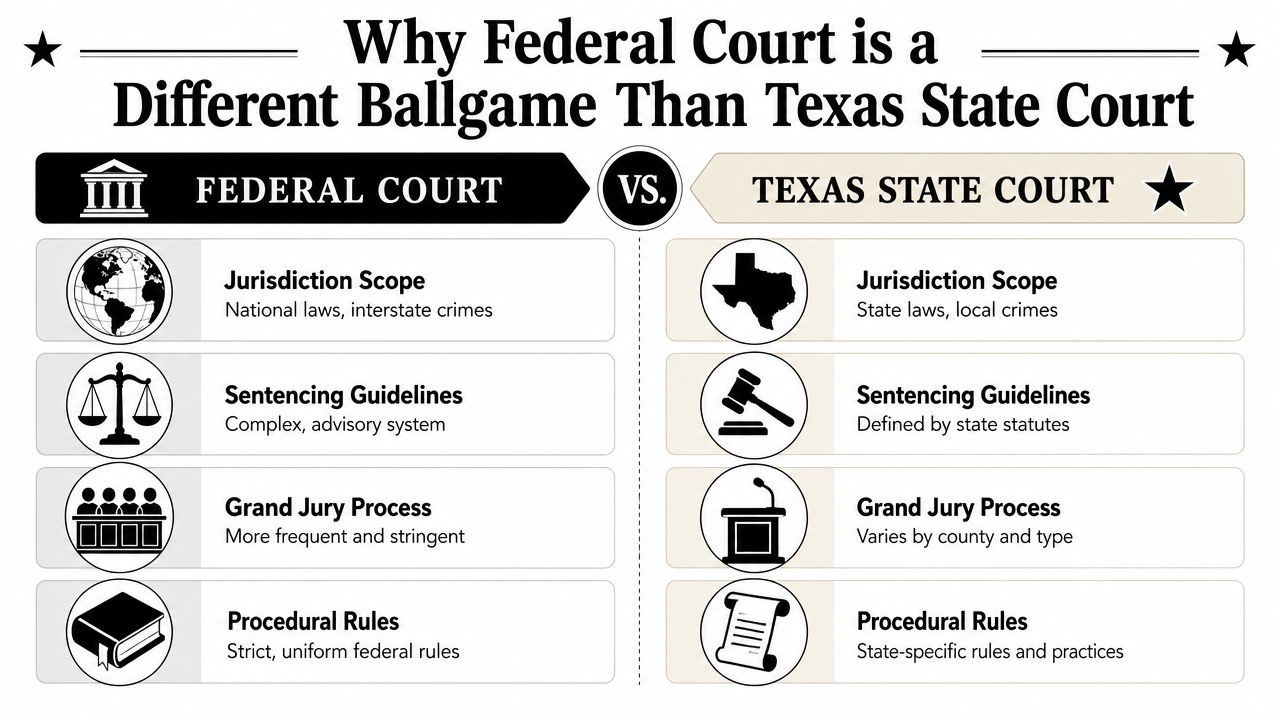
Different players, different procedures
In Texas state court, you may be dealing with local police, a county prosecutor, and rules shaped by state statutes and county practice. In federal court, the investigators may include agencies like the FBI or DEA, and the prosecutor is often an Assistant U.S. Attorney working inside a more standardized system.
Federal court also runs on different procedural expectations. Deadlines, motion practice, discovery issues, and sentencing preparation often require a lawyer who works in that environment regularly. If you want a side-by-side example of how charges and punishment can diverge, this discussion of assault punishment in Texas vs. federal court is a useful starting point.
| Aspect | Federal System | Texas State System |
|---|---|---|
| Jurisdiction | Federal crimes, interstate conduct, offenses involving federal law or agencies | Crimes charged under Texas law |
| Investigators | Federal agencies and task forces | Local police, county investigators, state agencies |
| Prosecutors | U.S. Attorney's Office | District Attorney or County Attorney |
| Procedure | Federal rules and federal court practice | Texas statutes and Texas criminal procedure |
| Sentencing focus | Federal sentencing process and federal advocacy | State punishment ranges set by Texas law |
Texas law still matters if your case overlaps
Some readers are dealing with conduct that could have been charged in state court but ended up in federal court instead. That overlap causes confusion. In a state case, punishment often turns on the Texas Penal Code offense level and your prior record. For example, under Texas Penal Code Section 12.42, prior convictions can increase punishment in repeat-offender cases. That issue comes up often enough that Repeat Offender and Sentencing Enhancements in Texas is worth reading if your history may affect state-level exposure.
But a federal lawyer's job involves more than knowledge of Texas punishment ranges. The lawyer has to understand the full federal workflow, from investigation to plea negotiations to sentencing advocacy. That's why “great in state court” doesn't automatically mean “ready for federal court.”
General criminal experience is not enough
People often ask whether any experienced criminal defense attorney can handle a federal indictment. The practical answer is no. Federal cases demand familiarity with federal judges, federal motion practice, federal evidentiary fights, and federal sentencing preparation.
Federal defense is a specialty. The risk isn't just hiring a bad lawyer. The risk is hiring a good state-court lawyer for the wrong courtroom.
That distinction matters in everyday Texas charges too. A person facing DWI, assault, theft, or drug possession in state court needs counsel who understands Texas procedure, local practice, arraignment, plea bargaining, trial, and sentencing under Texas law. Those cases may also lead to expunction or record sealing options later, depending on the result. A federal case follows a different path and usually calls for a different kind of strategist.
What to Look for Verifiable Federal Defense Credentials
A polished website doesn't tell you much. A badge on a directory doesn't tell you enough. If you want to know how to choose the best federal defense lawyer, focus on credentials you can test.
Start with actual federal work
Ask whether the lawyer regularly appears in federal court, not whether the lawyer is “able” to handle federal matters. Those are not the same thing. You want recent federal hearings, recent federal sentencings, and recent federal cases involving charges similar to yours.
Many people often get distracted by style over substance. A lawyer may speak confidently about criminal defense in general but still have limited current federal practice. A broader article on how to choose a criminal defense attorney can help with the basics, but federal hiring decisions should be narrower and more demanding.
Prioritize pretrial and negotiation skill
A lot of people think the “best” defense lawyer is the one who talks most about juries. Trial ability matters, but in federal court the most important work often happens much earlier. According to federal criminal defense statistics compiled here, fewer than 1% of federal defendants go to trial and win. The same source notes that drug offenses made up 31.3% of federal crimes in 2021 and economic offenses such as embezzlement, theft, and fraud made up 8% of the federal caseload.
That means you should ask hard questions about:
- Pretrial motions: Can the lawyer identify search issues, statement issues, suppression issues, or discovery gaps?
- Evidence review: Does the lawyer know how to handle digital records, financial records, wire evidence, or cooperating witness problems?
- Plea analysis: Can the lawyer explain the risks and benefits of negotiating early versus fighting longer?
- Sentencing preparation: Has the lawyer handled federal sentencing hearings, not just pleas?
A federal case is often won or lost in the investigation stage, the evidence stage, and the sentencing stage. Waiting to judge a lawyer only by trial talk misses where most federal work happens.
Match the lawyer to the charge
You should also match the lawyer's federal experience to the accusation itself. A lawyer who has handled federal drug conspiracy cases may not be the right fit for a document-heavy fraud matter. Likewise, a white-collar defense lawyer may not be the best choice for a federal gun or trafficking case.
That's especially important in cases tied to controlled substances. If the allegations involve possession, distribution, or trafficking conduct, Drug Crime Defense in Texas shows how these cases can differ even before you compare state and federal systems.
A practical rule is simple. Don't ask only, “Are you a federal lawyer?” Ask, “Have you recently handled this kind of federal case, in this kind of court, at this stage of the process?”
Your Consultation Checklist Questions That Reveal True Expertise
The consultation should feel less like a sales pitch and more like an interview. You are hiring for one of the most serious legal problems a person can face. Ask direct questions, and pay attention to whether the answers are specific or slippery.
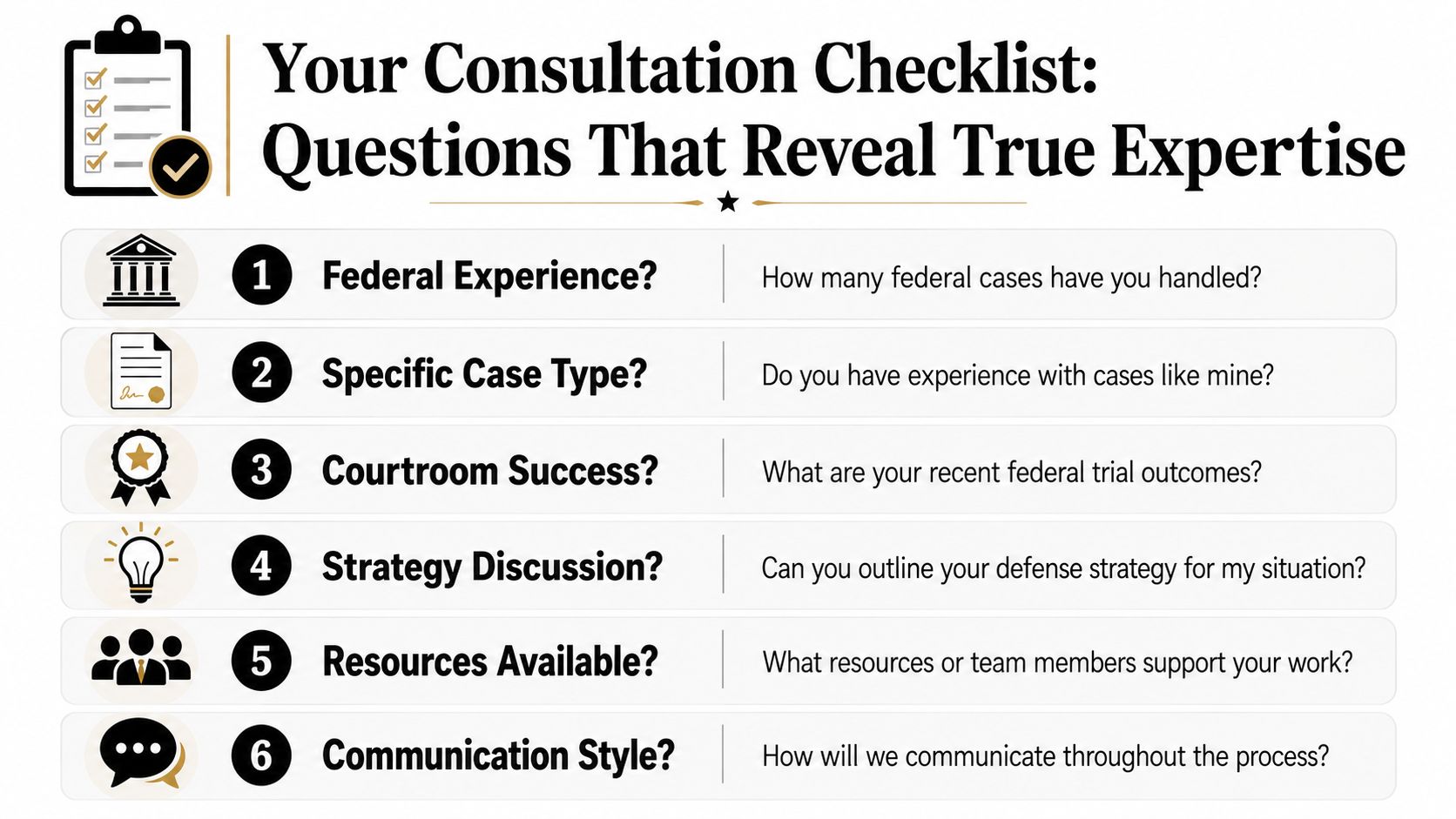
Ask for recent and relevant federal experience
One of the most useful federal-defense guides makes the point clearly. To verify federal-court specificity, you should ask how often the attorney appears in federal court, how many federal sentencing hearings they have handled, and when they last handled a federal case similar to yours, rather than accepting a vague claim of “federal experience,” as discussed in this federal defense qualities guide.
Use questions like these:
- How often do you appear in federal court?
- When was your last federal sentencing hearing?
- Have you handled cases involving my type of charge?
- Have you handled them in the federal district where my case is likely to be filed?
- What stage were those cases in when you entered them? Investigation, indictment, plea, trial, or sentencing?
If you want a broader list to compare with your own notes, these questions to ask a criminal defense attorney can help you prepare.
Ask how the lawyer thinks
The next set of questions should test judgment, not just resume lines.
What is your first concern in my case right now?
A good answer should focus on immediate risk, not just general reassurance.Do you think I should speak to agents?
The lawyer should explain why or why not based on facts, not ego.What documents or devices should I preserve?
Federal cases often rise or fall on records.What are the biggest weaknesses you see in the government's position so far?
Even early on, a serious lawyer should be able to identify pressure points or at least explain what must be reviewed before making that call.
Don't judge a consultation by whether the lawyer sounds confident. Judge it by whether the lawyer asks smart follow-up questions and gives careful, case-specific answers.
Ask who will actually do the work
The importance of this question is frequently overlooked. Some firms market with one senior attorney and assign much of the case elsewhere. You need clarity.
Ask:
- Who will be my main point of contact?
- Who will appear in court?
- Who will review discovery?
- Who will draft motions?
- How often will I get updates?
A federal case can last a long time and involve large amounts of discovery, repeated court settings, and detailed sentencing preparation. Communication has to be organized.
Ask about fees without embarrassment
Money is part of the decision, and hiding from that conversation doesn't help you. Ask whether the fee is hourly, staged, or tied to phases such as investigation, indictment, motions, trial, or sentencing. Ask what is included and what is not. Ask whether expert work, investigators, or trial preparation are billed separately.
You don't need the cheapest lawyer. You need a clear fee structure and a realistic understanding of what your case may require.
What a good consultation usually feels like
A strong consultation often has these features:
- Specific questions from the lawyer: The attorney wants dates, documents, names, and procedural details.
- Careful language: No guarantees. No bragging that substitutes for analysis.
- A sensible action plan: Preserve evidence, avoid contact with agents unless advised, and prepare for the next procedural step.
- Respect for your anxiety: You should feel informed, not rushed or bullied.
If the meeting leaves you with more clarity and more disciplined next steps, that's a good sign. If it leaves you with only slogans, keep looking.
Common Myths and Red Flags When Hiring a Federal Lawyer
People under stress are vulnerable to bad hiring decisions. That's normal. Federal investigations create fear, and fear makes bold promises sound attractive. This is the stage where you need skepticism.

Myth that a big local name is automatically better
A familiar name in Houston, Dallas, Austin, or San Antonio may be comforting, but comfort isn't the same as fit. One of the most important overlooked points in federal defense is that depth of relevant federal experience often matters more than proximity or general reputation, as explained in this guide to finding the right federal lawyer.
That means a lawyer with narrower but deeper federal-system experience may be the better choice than a very visible local state-court brand.
Myth that “knowing the judge” will decide your case
No ethical lawyer should sell you on secret access. Federal judges expect professionalism, strong briefing, good evidence work, and sound advocacy. Relationships don't replace preparation.
If a lawyer hints that personal connections with prosecutors or judges are the main reason to hire them, take a step back. That's usually a sign the lawyer is leaning on image instead of method.
Red flags you should treat seriously
Some warning signs are obvious. Others are subtle.
- Guarantees of dismissal or acquittal: No honest lawyer can promise a result in a federal criminal case.
- Vague answers about federal practice: “We handle all kinds of cases” is not enough.
- Pressure to sign immediately: You should be able to ask questions and think clearly.
- More talk about awards than work: Marketing badges may reflect visibility, not courtroom readiness.
- No clear explanation of who handles the case: If staffing is fuzzy at the start, it usually won't get clearer later.
If a lawyer cannot explain recent federal work in concrete terms, don't assume the details will appear later.
Don't confuse state criminal skills with federal readiness
In Texas state cases, lawyers often guide clients through arrest, arraignment, plea bargaining, trial, sentencing, and later options such as expunction or nondisclosure. Those are critical services. For many Texans facing DWI, assault, theft, or drug possession charges under the Texas Penal Code, the right state-court lawyer can make an enormous difference.
But that doesn't answer the federal question. Federal court demands a lawyer who is already fluent in the federal process, not someone learning it while your liberty is on the line.
One practical option for Texans who need to assess criminal defense representation generally is the Law Office of Bryan Fagan PLLC, which handles Texas criminal matters including defense through investigation, plea negotiations, trial, and post-conviction stages. For a federal case, though, the key screening test remains the same. Ask for recent, relevant, provable federal experience tied to your exact charge.
Taking the Next Step with a Trusted Advocate
If you've read this far, you already know more than many do when they begin this search. The best federal defense lawyer is not merely the most famous one, the closest one, or the one with the most polished marketing. The right lawyer is the one whose federal experience is current, specific, and matched to your case.
That means you should look for proof, not slogans. Ask when the lawyer last appeared in federal court. Ask how many federal sentencing hearings the lawyer has handled. Ask whether the lawyer has dealt with your kind of charge. Ask who will do the work, how the case will be staffed, and what the early strategy should be.
If your case also involves Texas charges or related state exposure, you may need advice about Texas criminal procedure too. In state court, your path may involve arrest, magistration or arraignment, pretrial motions, plea negotiations, trial, sentencing, and possibly later relief such as expunction, record sealing, or other post-conviction remedies. In federal court, the procedures and stakes are different, which is exactly why choosing the right lawyer requires discipline.
You don't need to solve everything today. You do need to make a careful first move. Bring your documents. Write down your questions. Don't talk to investigators without legal advice. And don't confuse confidence with competence.
If you've been charged with a crime in Texas, call The Law Office of Bryan Fagan PLLC for a free and confidential consultation. Our defense team is ready to protect your rights.