Being arrested in Texas can be terrifying, but the shadow of that arrest record can follow you for years, making it harder to get a job, find housing, or move on with your life. You don’t have to face this alone. In Texas, an expungement offers a true fresh start by legally ordering all agencies to destroy every record of the incident. It’s a powerful tool that allows you to legally deny the arrest ever happened.
Your Path To A Clean Slate: Understanding Texas Expungement

Here’s something most people don't realize: even if your case was dismissed or you were found not guilty at trial, the record of the arrest itself doesn't just disappear. It remains publicly accessible, creating major roadblocks in your personal and professional life. This can feel deeply unfair, especially when the justice system ultimately found you were not at fault.
Fortunately, Texas law provides a way to permanently erase this mark from your history. An expungement—also called an expunction—is a court order that forces all government and private entities to physically destroy any records related to your arrest.
What Is An Expungement?
Unlike sealing a record, which just hides it from public view, an expungement treats the arrest as if it never occurred. According to Chapter 55 of the Texas Code of Criminal Procedure, once a judge grants your expunction, you can legally deny the arrest and any related court proceedings ever took place.
This complete legal erasure is specifically designed for situations where an arrest didn't lead to a conviction, ensuring that a simple accusation doesn't get to define your future. The benefits of a successful expungement are truly life-changing.
A few of the key benefits include:
- Restored Opportunities: You can finally apply for jobs, professional licenses, and housing with confidence, knowing a past arrest won't surface on a background check.
- Legal Denial: You gain the legal right to state that you were never arrested for the offense on most applications.
- Complete Removal: Every record—from police reports to fingerprints and mugshots—is completely destroyed by every single agency holding them.
An expungement is more than just a legal procedure; it's a powerful tool for reclaiming your narrative and ensuring that a past mistake doesn't unfairly limit your future potential.
Expungement vs. Nondisclosure
It’s crucial to understand the difference between an expungement and an order of nondisclosure (often called record sealing). While both offer relief, they apply to very different situations and have distinct outcomes. To see just how big of an impact clearing your record can have, it's helpful to know what information typically shows up during an employment background check. You can learn more by reviewing a guide on What Shows Up On A Background Check For Employment?.
An expungement is reserved for cases that were ultimately resolved in your favor—think dismissals, acquittals, or situations where charges were never even filed. A nondisclosure, on the other hand, is generally for people who successfully completed deferred adjudication probation. It seals the record from the public but keeps it accessible to law enforcement and certain government agencies.
We’ll dig deeper into nondisclosures later in this guide. For now, just remember this: an expungement provides the most complete form of record clearing available under Texas law. It's the gold standard for a clean slate.
Determining Your Eligibility For Expungement In Texas
Before you file any paperwork, the first and most critical question you have to answer is, "Do I qualify?" Getting this wrong wastes time, money, and emotional energy. Texas law is incredibly specific about who gets a clean slate, and it all comes down to how your criminal case ended.
An expungement isn't a second chance or a tool for forgiveness after a conviction. It’s a way to completely erase the record of an arrest that should not continue to follow you. Think of it this way: if the system ultimately found you innocent or dropped the case, you shouldn't have to wear the mark of an arrest for the rest of your life.
When You Are Likely Eligible For Expungement
In Texas, your opportunity for an expungement is directly tied to the final outcome of your case. You have a strong chance if your situation falls into one of these categories.
Let's say you were arrested, but the prosecutor’s office never actually filed formal charges against you. Maybe the grand jury returned a "no-bill," or the District Attorney's office simply rejected the case. If that's your situation, you are a prime candidate. The catch? You have to wait for the statute of limitations for that specific crime to run out.
This waiting period is typically:
- Two years for most misdemeanors (like theft or simple assault).
- Three years for most felonies.
Once that clock runs out and no charges have been filed, the coast is clear to petition the court to destroy that arrest record for good.
Another very common path is a dismissal. If your case was formally filed but later dismissed by the prosecutor or the judge, you’re in a great position. This often happens when key evidence is thrown out or the state realizes it doesn't have the proof to win at trial. Just like with a no-charge scenario, you’ll likely have to wait out the statute of limitations before filing your petition.
The most straightforward route to an expungement? An acquittal. If you took your case to trial and a judge or jury declared you "not guilty," you are immediately eligible. There is absolutely no waiting period. You can start the process the very next day.
A "not guilty" verdict is the court's definitive statement that the prosecution failed to prove its case beyond a reasonable doubt. Because of that finality, Texas law allows you to move quickly to clear your name and reclaim your reputation.
Common Situations That Disqualify You
Unfortunately, this is where many people receive disappointing news. The single biggest barrier to getting an expungement is a conviction. If you pleaded guilty or "no contest" and were sentenced—whether to jail time, a fine, or regular probation—you cannot have that record expunged.
This is also where the confusion around deferred adjudication comes in. While successfully completing deferred adjudication probation means the case gets dismissed and you avoid a final conviction, it does not make you eligible for an expungement in most situations.
Why not? Because to get deferred adjudication, you first have to plead guilty or "no contest." Even though the judge doesn't enter a final finding of guilt, the court system still views that initial plea as an admission of fault. That’s why deferred adjudication almost always leads to an Order of Nondisclosure (record sealing), not a full expungement (record destruction). You can get the full breakdown by reading our guide on Texas expungement law and eligibility requirements.
There is one important exception. If you received deferred adjudication for a Class C misdemeanor—like a minor traffic ticket or public intoxication—you can get that record expunged. For any offense more serious than that, deferred adjudication closes the door on expungement and points you toward nondisclosure instead.
Navigating The Texas Expungement Filing Process
Knowing you might qualify for an expungement is a huge relief. But it's also just the starting line. This next phase is about turning your eligibility into a court order that erases your criminal record for good. The process involves precise paperwork, strict deadlines, and communicating with multiple state agencies.
It all starts with a crucial document: the Petition for Expunction. This isn't just a form you fill out; it's a formal legal document that must be drafted with complete accuracy. One small error or omission can cause significant delays or even get your petition rejected by the court before a judge ever sees it.
To get a clearer picture of what's involved, this flow chart breaks down the key factors that determine if you're ready to file.
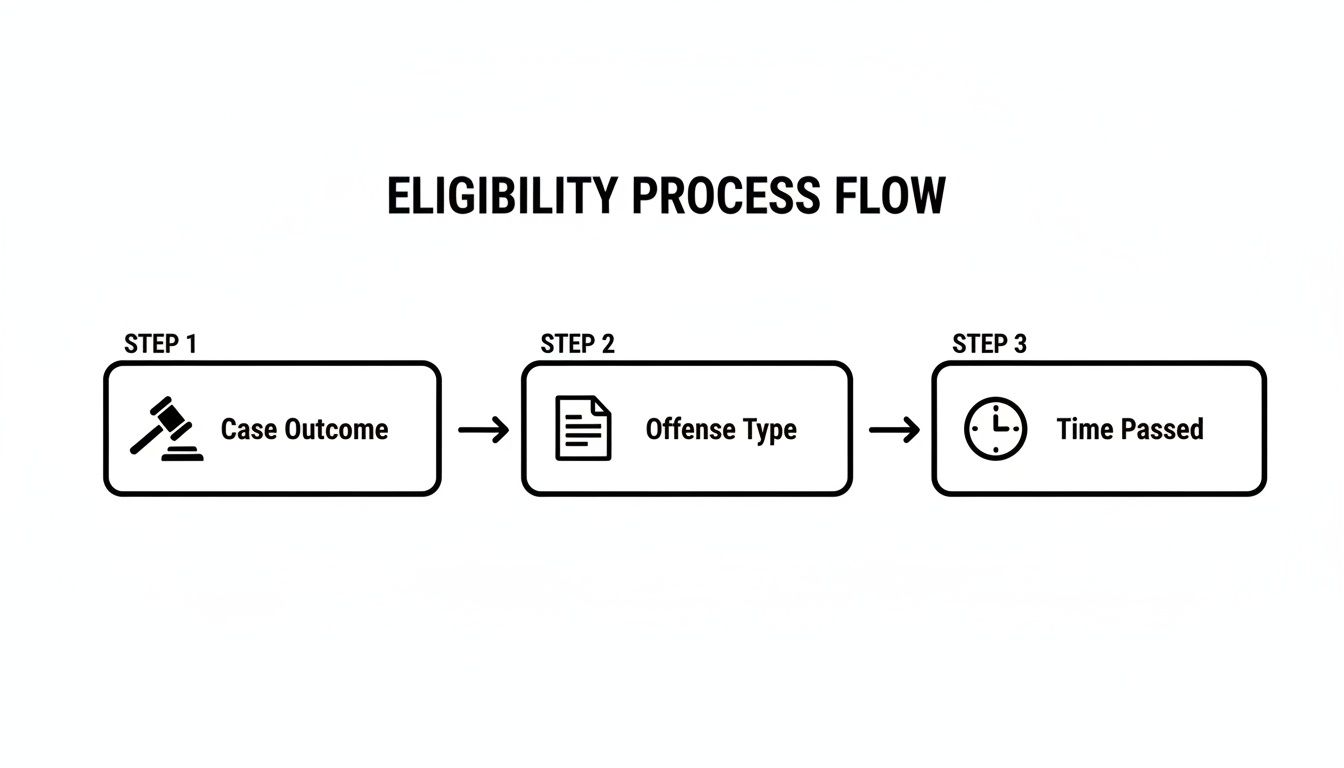
As you can see, the case outcome, the type of offense, and the time that has passed all have to align perfectly before you can move forward.
Gathering Your Essential Documents
Before your attorney can begin to draft your petition, they need the raw materials of your case. Your memory of dates and details might be a little hazy, but the court relies on official records.
The most critical pieces of information include:
- Arrest Records: This means the police report, which details the date, time, and location of your arrest, along with the specific offense you were charged with.
- Case Number and Court Information: Every criminal case is assigned a unique number. You'll need this, plus the name and number of the court that handled your case (for example, Harris County Criminal Court at Law No. 5).
- Final Disposition: This is the official court document showing exactly how your case ended. Whether it was a dismissal, a "not guilty" verdict from a jury, or a grand jury "no-bill," this is the proof of your eligibility.
Don't worry if you don't have these documents handy. Your lawyer can help you track them down. This initial legwork is vital for drafting a petition that accurately reflects your case history and meets every single legal requirement under the Texas Code of Criminal Procedure.
Drafting And Filing The Petition
Once all the necessary information is in hand, it's time to draft the Petition for Expunction. This formal legal document officially asks the court to order the destruction of all records related to your arrest. Critically, it must be filed in the district court of the county where you were arrested, which isn't always where you live now.
A properly drafted petition has to include:
- Your full name, date of birth, and other identifying information.
- The date of the arrest and the offense you were charged with.
- The name of the law enforcement agency that arrested you.
- The case number and the court where the charge was handled.
- A list of all government agencies that might have records of your arrest.
That last point is incredibly important. The petition has to name every single state and local agency that could have your records—from the arresting police department and the county sheriff to the Texas Department of Public Safety (DPS). If you forget even one, you could end up with an incomplete expungement, which defeats the whole purpose.
After the petition is filed, the court clerk will set a hearing date, which is usually at least 30 days out. This waiting period is required by law to give all the agencies you listed time to respond.
Under Texas law, every agency named in your petition has a right to be notified and an opportunity to contest the expungement. This notification process is a mandatory part of the legal procedure.
The Court Hearing: What To Expect
In many expungement cases, especially those based on an acquittal or a clear dismissal, the hearing is a straightforward formality. If no agencies object and your petition is filed correctly, the judge will likely sign the Order of Expunction without much debate. Often, your attorney can appear on your behalf, so you may not even need to show up to court.
But sometimes, a prosecutor or one of the state agencies might object. This can happen if they believe you aren't actually eligible, if there's an error in the paperwork, or if they try to claim a "legitimate state interest" in keeping the records—though this is rare for eligible cases.
If an objection is filed, a contested hearing will take place. During this hearing, your attorney will present evidence and legal arguments to the judge, explaining exactly why you meet the criteria for expungement under Texas law. Having a skilled Houston criminal lawyer in your corner is absolutely essential in these situations to counter the state's arguments and protect your right to a clean slate.
Understanding The Expungement Timeline In Texas
So, you're ready to get this done. The first question on your mind is probably, "How long is this actually going to take?" It’s a perfectly fair question. You want to close this chapter for good, and knowing what to expect from the timeline helps manage the stress of the unknown.
Let's be upfront: expunging your record in Texas isn’t a quick fix. It’s a formal legal process that moves at a deliberate pace. While every case has its own unique path, you can generally expect the entire journey—from the day we file the petition to the final confirmation that your record is gone—to take somewhere between four and twelve months.
That might sound like a long time, but there's a good reason for it. The system is built to be thorough, making sure every legal box is checked and every government agency involved is properly notified.
Factors That Influence The Timeline
Several things can speed up or slow down your expungement. The biggest variable is often the county where the arrest happened. A petition filed in a massive metropolitan area like Harris County is going to move at a different speed than one in a smaller, rural county, simply because of the volume of cases the courts are handling.
Other elements that come into play include:
- The Complexity of Your Case: A straightforward expungement after being found not guilty at trial is usually much faster than one for a dismissed case where you have to wait for the statute of limitations to run out.
- Agency Response Times: After we file, the court notifies all the relevant agencies. They have a mandatory window to respond or object. If an agency needs more time or decides to fight the expungement, that can cause delays.
- Court Backlogs: The local court’s own schedule plays a huge role. If the court is swamped, it can take longer just to get a hearing date on the calendar.
Statewide, you’re looking at that four to twelve-month average. Simpler cases often wrap up in four to nine months, but in busy jurisdictions like Houston, it can stretch closer to a full year. For instance, in Harris County, one study showed that 70% of expungement petitions took about 7.2 months to resolve. About a quarter of those faced delays from agencies pushing back—like the Texas DPS, whose reviews can tack on an extra 60 days. You can find more details on Texas expungement timelines and what to expect.
A Stage-By-Stage Breakdown
To give you a clearer picture, let's walk through what happens after your attorney files your petition.
First, your lawyer files the Petition for Expunction with the district court. The court clerk then sets a hearing date, which by law has to be at least 30 days out. This 30-day window is legally required to give every government agency listed in your petition—like the arresting police department and the DPS—enough time to receive notice and decide if they want to contest it.
This waiting period is non-negotiable and built right into the Texas Code of Criminal Procedure. It ensures every single entity holding a record of your arrest has a fair chance to respond before a judge makes a final decision.
Once the hearing happens and the judge signs the Order of Expunction, the process isn't over. The signed order is then sent out to all those agencies. From that point, they have a legal duty to destroy their records, but this final step can take several more months to complete. A good attorney stays on top of this, following up to make sure every agency complies and providing you with the final confirmation that your slate is truly clean. You can read more about how long the expungement process can take in Texas in our in-depth guide.
What If You Don't Qualify? Exploring Nondisclosures
Discovering you don't meet the strict criteria for an expungement can feel like a setback. It’s a frustrating moment, but it doesn't mean you're out of options. In Texas, another powerful legal tool can help you reclaim your future: an Order of Nondisclosure.
While an expungement literally destroys your record, a nondisclosure seals it from public view. Think of it like putting your criminal history in a locked vault. The general public—including potential employers, landlords, and neighbors—can no longer see it.
This is a very common path for people who successfully completed a special kind of probation called deferred adjudication for offenses like DWI or theft. Even though you can't expunge the record in this scenario (except for certain Class C misdemeanors), you can take steps to hide it, which offers a massive advantage in your daily life.
The Power of Sealing Your Record
Once a judge signs an Order of Nondisclosure, your criminal record is effectively hidden. It doesn't disappear entirely—law enforcement and specific government agencies can still access it if needed—but it is removed from the public databases that feed most background checks.
This means you can apply for jobs and housing without the constant fear of a past mistake holding you back. For all practical purposes, the arrest and court case become a non-issue in your civilian life.
The benefits are significant:
- Employment: You can legally deny the arrest and resulting case on most job applications.
- Housing: Landlords running background checks will not see the sealed offense.
- Privacy: It prevents the general public from looking up your case online.
Expungement vs. Nondisclosure: Key Differences
Understanding which path is right for you starts with knowing the fundamental differences between these two legal tools. They both offer a fresh start, but they apply to very different situations.
| Feature | Expungement (Record Destruction) | Nondisclosure (Record Sealing) |
|---|---|---|
| What Happens | Your record is completely wiped out and destroyed. | Your record is hidden from public view. |
| Who Qualifies | Cases that were dismissed, you were found not guilty (acquitted), or you were never formally charged. | Cases where you successfully completed deferred adjudication probation. |
| Legal Right | You can legally deny the arrest ever happened to anyone. | You can deny the arrest on most applications (with a few exceptions). |
| Accessibility | No one can see the record, not even law enforcement. | Law enforcement and certain state agencies can still see it. |
The key takeaway is that both legal remedies are designed to help you move forward. Expungement is the gold standard for cases resolved in your favor, while nondisclosure is the go-to solution for those who proved they could stay out of trouble after deferred adjudication. To get a more detailed look at the nuances, you can explore our in-depth article on the differences between expungement and nondisclosure in Texas.
An Order of Nondisclosure is not a consolation prize; it is a strategic legal tool that restores your privacy and removes significant barriers to your personal and professional growth.
Even if a full expungement is off the table, you still have a viable strategy for a better future. The path to sealing your record is just as important, and our team is here to guide you through every step of that process.
Why An Experienced Attorney Is Your Greatest Asset

Legally, you have the right to file for an expungement on your own. But the Texas legal system is a minefield of procedural traps. A single mistake on a form, a missed deadline, or a failure to notify the right agency can get your petition thrown out, forcing you to start all over again.
Partnering with a legal professional isn't just about convenience; it's a strategic investment in your future. An experienced Houston criminal defense attorney from The Law Office of Bryan Fagan, PLLC, does more than just fill out paperwork. We are your advocate, your guide, and your shield through this entire process.
Navigating The Complexities With Confidence
The very first thing we do is definitively confirm you're eligible. We don't guess—we dig into your case history and measure it against the strict standards of the Texas Code of Criminal Procedure. This ensures you qualify before you spend a single dollar on filing fees.
From there, we take over, drafting a flawless Petition for Expunction that leaves no room for error or objections.
This isn't a simple task. It involves:
- Identifying every single agency that has a record of your arrest, from the local police department to the Texas Department of Public Safety (DPS) and even small municipal courts.
- Handling all communications with the court clerks and the District Attorney's office, so you don't have to worry about saying the wrong thing.
- Anticipating potential objections from the prosecutor’s office and preparing to counter them before they become a problem at your hearing.
Our team’s deep understanding of local court procedures across Texas gives us a massive edge. We know the clerks, we know the judges’ expectations, and we know the common pitfalls that trip up self-filed petitions. This proactive approach saves you time, money, and an incredible amount of stress.
An Investment In Your Peace Of Mind
This is about more than just avoiding mistakes. It’s about the confidence that comes from knowing a dedicated advocate is fighting to clear your name. The path to an expungement is more accessible than you might think. From September 2018 to February 2025, a staggering 9,555 individuals in just one Texas county successfully had their records expunged.
This data proves that with the right guidance, a clean slate is an achievable goal for people whose cases were dismissed, acquitted, or never charged. You can learn more about the success rates of Texas expungements and see the annual totals.
Hiring an attorney transforms the expungement process from a stressful, high-stakes gamble into a clear, strategic legal action. It’s the surest way to secure the fresh start you deserve.
Don't let your future hinge on a technicality. Let our team handle the legal heavy lifting so you can focus on what really matters—moving forward with your life.
Common Questions About Expunging a Record in Texas
When you're trying to put an arrest behind you for good, it’s natural to have questions. Here are clear, straightforward answers to what people like you ask us most often.
Can I Expunge a Felony in Texas?
Yes, but only under specific circumstances. You can expunge a felony arrest record if you were found not guilty at trial (an acquittal), received a pardon from the governor, or if the prosecutor dismissed the case and the waiting period has passed.
Here’s the critical distinction: a felony conviction is almost never eligible for expungement in Texas. Once you've been convicted, that record is generally permanent, which is why having a strong Texas assault defense or drug possession lawyer from the very beginning is so important.
What Is the Cost of an Expungement?
The total cost depends on your situation. You'll have court filing fees, which usually land somewhere between $300 and $500, depending on the county where the arrest happened.
On top of that are the attorney's fees, which are based on how complex your case is. When you meet with us for a free consultation, we'll give you a completely transparent breakdown of what to expect, so there are no surprises.
Do I Have to Go to Court for the Hearing?
In many cases, the answer is no. If the prosecutor agrees to the expunction and is not fighting your petition, your lawyer can often handle the court hearing on your behalf. This saves you from having to take time off work and travel to the courthouse.
However, if a government agency objects to the expunction, your presence might be helpful. We'll walk you through the strategy and advise you on the best approach for your specific situation.
It's also worth noting that Texas law is always evolving. Recent legislative updates have actually made things a bit easier by expanding eligibility, shortening some waiting periods, and even creating automatic expungements for certain dismissals and acquittals. You can learn more about the impact of recent Texas legislation on criminal record expungement.
How Will I Know If My Record Is Officially Expunged?
Once the judge signs the final Order of Expunction, it gets sent to every government agency that has a record of your arrest—the police department, the sheriff's office, the DPS, and so on—with a clear directive: destroy the records.
Your attorney will receive confirmation once the order is signed and will follow up to make sure every agency has complied. Be patient, though, as this final step can sometimes take several months to fully complete.
If you’ve been charged with a crime in Texas, call The Law Office of Bryan Fagan, PLLC for a free and confidential consultation. Our defense team is ready to protect your rights. https://texascriminallawyer.net