Being arrested in Texas can be terrifying—but you don’t have to face it alone. The moment you see flashing lights in your rearview mirror, the fight for your future begins. What you do in the first few hours and days is absolutely critical. Your top priorities are simple but non-negotiable: protect your rights by remaining silent, get an experienced DWI attorney on the phone, and beat the strict 15-day deadline to request a hearing to save your driver's license. These initial moves lay the groundwork for your entire defense.
Your First Steps After a Texas DWI Arrest
Getting arrested for Driving While Intoxicated (DWI) is a frightening experience. The flashing lights, the handcuffs, the sheer uncertainty of it all—it's enough to make anyone feel powerless. But it's vital to remember you have rights, and the choices you make right now are the most important ones for building a strong defense down the road. The process can feel like a tidal wave, but with a trusted guide, you can navigate it.
Your single most important protection is your right to remain silent. You are not obligated to answer questions about where you were, what you were doing, or whether you had anything to drink. Just state politely and firmly, "I choose to remain silent and I would like to speak with my attorney." Anything and everything you say can be used against you by the prosecution.
The Booking and Arraignment Process
Once you're arrested, you’ll be taken to a police station for booking. This is the part you've seen in movies: they take your mugshot, record your personal information, and take your fingerprints. After that, you'll be held until your arraignment, which is your first time in front of a judge.
During the arraignment, the judge will:
- Tell you the official charges filed against you.
- Read you your constitutional rights.
- Set your bail amount.
This is a formal and often intimidating procedure, but it's a standard part of the system. Having a lawyer with you at this stage can make a huge difference in your bail conditions and how the court handles your case from the get-go. For a deeper dive into this initial phase, you can learn more about what to do after a DUI arrest on our blog.
The Most Important Deadline You Must Not Miss
While the criminal case is just getting started, a completely separate civil case against your driver's license begins immediately. In Texas, you have only 15 days from the date of your arrest to request an Administrative License Revocation (ALR) hearing.
If you miss this 15-day window, the Texas Department of Public Safety will automatically suspend your driver's license. This suspension usually starts 40 days after your arrest and happens whether you are ultimately found guilty or innocent in your criminal DWI case.
This is not a deadline you can afford to ignore. It’s your first and best chance to keep your driving privileges.
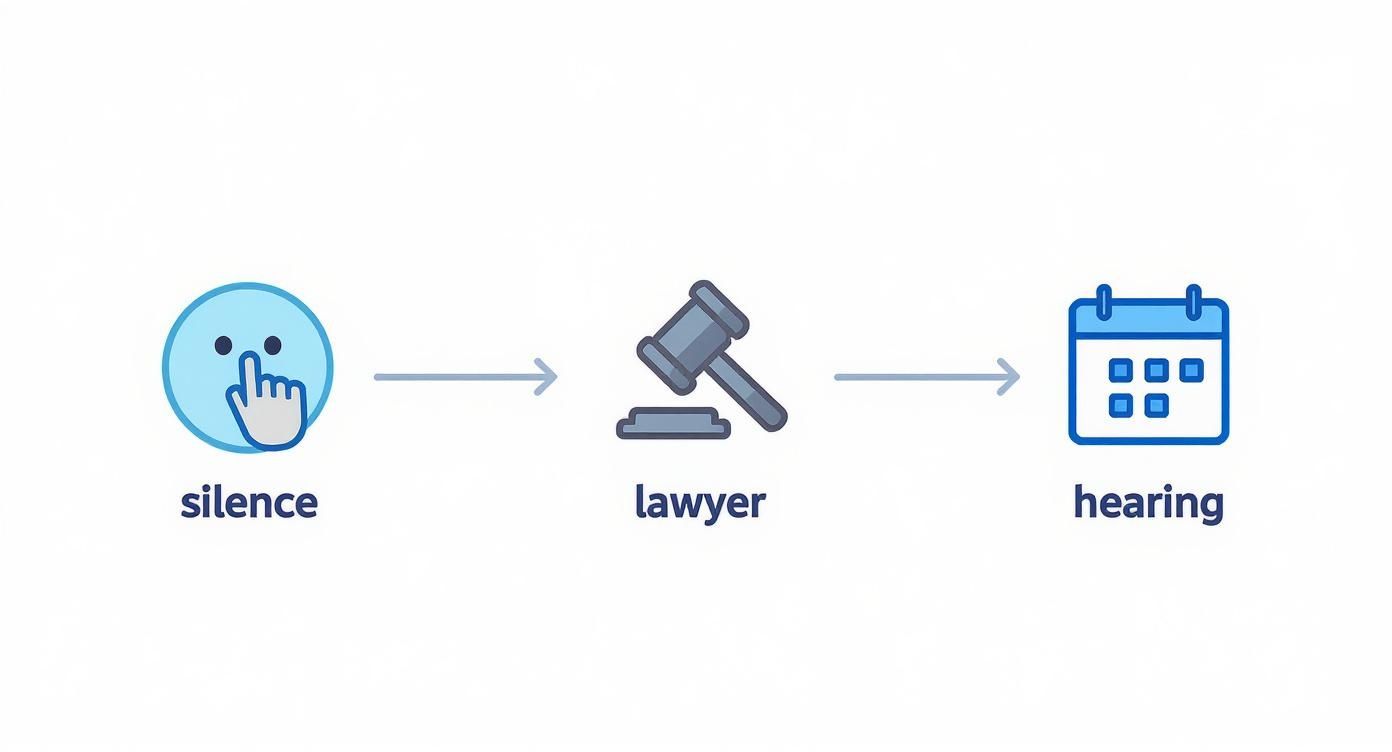
The infographic above perfectly illustrates the three non-negotiable first steps: stay quiet, call a lawyer, and request that ALR hearing.
The ALR hearing is more than just a fight for your license. It’s an invaluable opportunity for your attorney to gather evidence and question the arresting officer under oath. This can expose weaknesses in the state’s case long before a criminal trial even begins. It's often the first, and best, chance to challenge the evidence against you. As you start this process, choosing a qualified legal professional is paramount.
Because of this critical deadline, contacting a skilled DWI defense attorney right away isn't just a good idea—it's essential. An experienced lawyer will handle the ALR request for you, ensuring you don't miss the deadline. They start building your defense from day one, fighting to protect your rights and keep your life on track.
Challenging the Initial Traffic Stop and Arrest
Every Texas DWI case begins long before you see a courtroom. It starts on the side of the road, the moment those flashing lights appear in your rearview mirror. The fight for your freedom often hinges on whether the police followed the law during that initial traffic stop and the arrest that followed. One mistake by law enforcement can completely unravel the state’s case against you.

The Fourth Amendment protects you from "unreasonable searches and seizures." In plain English, that means a police officer can't pull you over on a whim or a gut feeling. They need a specific, legally valid reason—what the courts call "reasonable suspicion"—to believe you've broken a traffic law or are involved in criminal activity.
What is Reasonable Suspicion?
Think of reasonable suspicion as more than a guess but less than concrete proof. An officer has to be able to point to specific, observable facts that justify pulling you over. This is the first thing a sharp defense attorney will scrutinize by demanding all dash-cam and body-cam footage.
Common reasons officers give for a stop include:
- Driving mistakes: Speeding, not using a turn signal, or rolling through a stop sign.
- Equipment issues: A busted taillight, an expired registration sticker, or window tint that's too dark.
- "Weaving": This one is a classic because it’s so subjective. Was it a small drift inside your lane, or were you actually violating Texas Transportation Code § 545.060 by failing to stay in a single marked lane?
An attorney's job is to pick apart the officer's story. If the video shows you were driving perfectly, that "weaving" claim falls apart. If the stop was illegal, any evidence collected after that point gets thrown out. This includes everything: the field sobriety tests, the breathalyzer results, and even the officer's own observations. This is a legal rule often called the "fruit of the poisonous tree."
From Reasonable Suspicion to Probable Cause for Arrest
Okay, let's say the stop was legal. The officer's mission now shifts to finding "probable cause" to arrest you for DWI. This is a much higher legal standard than reasonable suspicion. To put you in handcuffs, the officer needs enough evidence to convince a reasonable person that you were, in fact, driving while intoxicated.
They try to build this case by documenting things like:
- Your physical appearance (bloodshot eyes, slurred speech).
- Any admission to drinking (even "just one").
- The smell of alcohol coming from you or the car.
- Your performance on the Standardized Field Sobriety Tests (SFSTs).
Here’s the thing: all of these observations are incredibly subjective. Nerves, fatigue, a medical condition, or just being clumsy can easily be mistaken for signs of intoxication. This is especially true in busy urban areas. Data shows cities like Dallas and Houston have high numbers of DWI stops, and certain demographics—like male drivers aged 19 to 35—often face extra scrutiny. You can dig deeper into these patterns by checking out some DFW drunk driving statistics on dhillonlawfirm.com.
Key Takeaway: If an attorney can prove the officer lacked either reasonable suspicion for the stop or probable cause for the arrest, the court is legally required to suppress all illegally obtained evidence. More often than not, this forces the prosecutor to dismiss the DWI charge entirely.
Fighting a DWI in Texas successfully is all about dissecting every second of your interaction with law enforcement. An experienced defense lawyer knows exactly where to find the procedural errors and constitutional shortcuts that can turn a seemingly hopeless case into a win. Your defense starts by holding the police accountable to the very same laws they’re sworn to uphold.
Finding Weaknesses in the Prosecution's Evidence
Winning a DWI case in Texas isn't just about what you say in the courtroom. It’s about methodically dismantling the evidence the state plans to use against you. On the surface, the prosecution's case might look airtight, but it’s often built on shaky ground—subjective officer observations and tests with well-known flaws. A strong defense attorney finds every crack in that foundation.
This process means taking a hard look at the three pillars of almost every DWI case: the field sobriety tests, the breath test, and the blood test. Each one comes with its own set of strict rules and, more importantly, its own potential for error.
Unpacking Standardized Field Sobriety Tests
The Standardized Field Sobriety Tests (SFSTs) are the physical and mental gymnastics an officer asks you to perform on the side of the road. While they are called "standardized," the way they’re administered is anything but. The officer has to give instructions and demonstrate the tests exactly as their training manuals dictate. Any slip-up can make the results completely unreliable.
Lots of things besides alcohol can cause someone to "fail" these tests:
- Medical Conditions: Problems with balance, old injuries, inner ear issues, or neurological conditions can make it physically impossible to perform these tests correctly.
- Environmental Factors: Was the ground uneven? Was it dark? Were cars whizzing by? Bad weather? All of these can throw off your performance.
- Nerves and Anxiety: Let's be honest, getting pulled over is stressful. That stress alone can make you stumble through tests that demand perfect focus and balance.
A good defense lawyer will immediately get the dash-cam and body-cam footage to see if the officer followed protocol to the letter. If they gave wrong instructions or had you perform the test on a dangerous, sloping shoulder, those results can be thrown out.
The Inherent Flaws of Breathalyzer Tests
That breath test number—often from a machine like the Intoxilyzer 9000—is the cornerstone of the prosecution's case. But these machines are far from perfect. For a breath test result to even be considered in a Texas court, the state has to prove the machine was working perfectly and that the certified officer followed every single procedural step.
Here are some of the most common problems we find:
- Improper Calibration: These machines need constant maintenance. If the logs show it hasn't been calibrated correctly or on schedule, the results are junk.
- Operator Error: The officer must watch you for a full 15-minute observation period before the test. This is to make sure you don't burp, vomit, or put anything in your mouth that could taint the sample. A failure to do this can invalidate the entire test.
- Medical Conditions: Things like acid reflux (GERD) or even a high-protein diet can create "mouth alcohol," which gives a falsely high reading that has nothing to do with your actual blood alcohol level.
Prosecutors love to present a breathalyzer result as an undeniable scientific fact. The truth is, it's just a number from a machine with a long history of potential problems. A thorough defense means digging into the machine’s maintenance logs and making sure every single rule was followed.
Challenging the science behind these devices is a huge part of a strong DWI defense. For a deeper dive, you can learn more about DWI breathalyzer legal challenges right here on our site.
Challenging Blood Test Results and Warrants
If you refuse a breath test or there's an accident, the officer will likely try to get a warrant for a blood draw. A blood test is generally seen as more accurate than a breath test, but it opens up a completely new can of worms for a defense attorney to investigate.
The first thing to attack is the warrant itself. Was it based on legitimate probable cause? If the officer’s affidavit was weak, misleading, or just plain sloppy, the entire warrant could be thrown out, and the blood evidence with it.
Even if the warrant is solid, the process is riddled with potential mistakes:
- Chain of Custody: We need a perfect, unbroken record of every person who handled your blood sample, from the draw to the lab analysis. Any gap or mix-up can get the evidence suppressed.
- Lab Contamination: The lab that tests the blood must follow rigid scientific protocols. We can investigate the lab’s history to see if they have a track record of contamination or procedural errors.
- Improper Draw: The person drawing your blood must be medically qualified. Crucially, they have to use a non-alcoholic sterilizer. Using a simple alcohol swab can contaminate the sample and artificially inflate the result.
The following table breaks down how a defense attorney systematically challenges the state's evidence.
Common DWI Evidence and Potential Defenses
This table outlines the key pieces of evidence in a Texas DWI case and the common legal strategies used to challenge their validity.
| Type of Evidence | What Prosecutors Argue | How a Defense Attorney Challenges It |
|---|---|---|
| Officer Observations | Defendant had slurred speech, red eyes, and smelled of alcohol. | These are subjective and can be caused by fatigue, allergies, or medical issues. |
| Field Sobriety Tests | Defendant "failed" the tests, showing a lack of coordination and balance. | The tests were administered improperly, or medical/environmental factors affected performance. |
| Breath Test Results | The BAC number is over the legal limit, proving intoxication scientifically. | The machine was not calibrated, the officer made an error, or a medical condition created a false positive. |
| Blood Test Results | A lab analysis of the blood sample shows a BAC over the legal limit. | The warrant was invalid, the chain of custody was broken, or the sample was contaminated during the draw or at the lab. |
| Defendant's Statements | The defendant admitted to drinking ("I only had two beers"). | The statement was made before Miranda Rights were read or was taken out of context. |
Every piece of evidence has a counter-argument, and it's an experienced attorney's job to find it.
Given the stakes, you have to understand why these cases are prosecuted so aggressively. From 2014 to 2023, Texas reported that more than 37% of all traffic fatalities involved impaired drivers. These numbers are why the state comes down so hard on DWI defendants, and it’s why your defense has to be even more meticulous. Your future depends on an attorney who knows exactly where to look for the weaknesses in the state’s case.
Deciding Between a Plea Bargain and a Trial
After your attorney has dug into every piece of evidence—from the reason for the traffic stop to the chemical test results—you’ll hit a critical crossroads. The prosecutor will almost certainly make a settlement offer, what we call a plea bargain. This is the moment you and your lawyer have to make a tough, strategic call: take the deal or fight it out in front of a jury for a "not guilty" verdict?
This is one of the biggest decisions you'll make, and it’s rarely black and white. It’s a balancing act, weighing the certainty of a known outcome against the risks and potential rewards of a trial. There's no single right answer; the best path forward depends completely on the facts of your case and what you're willing to risk.
Understanding a Texas DWI Plea Offer
In the world of criminal defense, plea bargaining is how most cases get resolved. It’s a straightforward trade: the prosecutor offers to reduce the charge or recommend a lighter sentence, and in return, you agree to plead guilty or "no contest." This saves the state the time, money, and uncertainty of a trial.
So what does a typical plea offer for a first-time Texas DWI look like? Often, it means getting the charge knocked down to something less damaging.
- Obstruction of a Highway: This is still a Class B misdemeanor, the same level as a first DWI. The key difference? It doesn't carry the heavy social stigma or the automatic, expensive driver's license surcharges that come with a DWI conviction.
- Reckless Driving: This is another common reduction. A reckless driving charge looks far better on your record and usually has less severe consequences for your insurance rates and professional life.
Taking a plea gives you a sense of control in an otherwise chaotic process. You know exactly what’s going to happen, and you get to avoid the stress of a jury trial where your fate rests in the hands of six strangers.
But it’s crucial to remember that even a reduced charge is still a conviction. It will go on your permanent criminal record. You have to talk through the full implications with your attorney, including how a plea might affect you years from now. Our guide on understanding guilty vs. no contest pleas can give you more insight here.
The High Stakes of a DWI Trial
Let's say the evidence against you is shaky, or the prosecutor’s offer is just plain bad. In that case, taking your case to trial might be the smartest move you can make. A trial is your constitutional right to force the state to prove its case against you beyond a reasonable doubt. That’s the highest standard of proof in our entire legal system.
A DWI trial is a full-scale battle. Your attorney's job isn't to prove you're innocent; it's to punch holes in the prosecution's case and create that reasonable doubt in the minds of the jury.
The trial itself has several key phases:
- Jury Selection (Voir Dire): Your lawyer questions potential jurors to identify and remove anyone with a clear bias against people accused of DWI, looking for those who can be fair.
- Opening Statements: Both sides lay out a roadmap of what they intend to prove.
- The State's Case: The prosecutor calls their witnesses—most importantly, the arresting officer—and presents their evidence.
- Cross-Examination: This is your attorney’s time to shine. They will aggressively question the officer, exposing procedural mistakes, inconsistencies in the report, and the subjective nature of the field sobriety tests.
- The Defense's Case: Your lawyer might call an expert witness to dismantle the science behind the breath or blood test or present other evidence that helps your side.
- Closing Arguments: Both sides get one last chance to make a persuasive pitch to the jury.
The biggest upside of a trial is obvious: the potential for a "not guilty" verdict. An acquittal means the whole ordeal is over, and you can get the arrest expunged from your record for good. But the risk is just as significant. If you lose, the judge or jury sets the punishment, and it could be much harsher than what the prosecutor offered in the plea deal.
This decision requires a brutally honest conversation with your defense attorney. They’ll give you a realistic assessment of your chances at trial, walk you through the pros and cons, and give you the guidance you need to make the best choice for your future.
The Real Consequences of a Texas DWI Conviction
Most people think a DWI is just a really expensive traffic ticket. It’s not. A conviction in Texas goes far beyond the courtroom, creating ripples that can disrupt your freedom, your finances, and your future for years. Understanding exactly what’s on the line is the first step—and the best motivation—for building a rock-solid defense.
These penalties aren't just empty threats; they're harsh realities enforced aggressively by Texas law. Why the tough stance? It's fueled in part by the devastating impact of impaired driving. Texas sees around 1,699 alcohol-related driving fatalities each year where the driver had a BAC of 0.08% or higher. That sobering figure accounts for 40% of all traffic deaths in the state. You can dig deeper into these numbers in the FY 2025 Texas Impaired Driving Plan.
Penalties for a First DWI Offense
Even if it’s your first time being charged, the consequences are severe. A first DWI is typically a Class B Misdemeanor, assuming there are no aggravating factors like a car accident or an especially high BAC.
A conviction can mean:
- Jail Time: A mandatory minimum of 72 hours, with a maximum of 180 days in county jail.
- Fines: Up to $2,000, and that doesn’t even include court costs and other administrative fees that pile up quickly.
- License Suspension: Your driver's license can be suspended for up to a full year.
- Ignition Interlock Device (IID): You may be ordered to install a device on your vehicle that requires you to blow into it before the car will start.
And that’s just what the judge orders. The collateral damage—like skyrocketing car insurance rates—can stick with you for years, costing you thousands more.
Escalating Consequences for Subsequent Offenses
If you have a prior DWI conviction, the stakes get dramatically higher. Texas law is unforgiving here; there is no "lookback period." This means a DWI from 20 years ago will still be used to enhance the penalties for a new charge.
A second DWI is a Class A Misdemeanor, and the penalties jump significantly:
- Jail Time: From 30 days up to one year behind bars.
- Fines: Up to $4,000.
- License Suspension: A longer suspension, from 180 days to two years.
- Mandatory IID: An ignition interlock device is no longer optional; it becomes a required condition.
A third DWI automatically becomes a third-degree felony. This is a life-altering charge that carries 2 to 10 years in a state prison and a fine of up to $10,000. A felony on your record means losing your right to vote and own a firearm, creating a permanent barrier to many professional careers.
The Hidden Costs of a DWI Conviction
Beyond the fines and potential jail time, a DWI conviction leaves a long-lasting stain on your permanent criminal record. This isn't just an inconvenience; it's a major red flag for employers, landlords, and professional licensing boards.
A DWI conviction is more than a legal problem; it's a roadblock to your future. It can prevent you from getting the job you want, the apartment you need, or even a professional license in fields like nursing, real estate, or commercial driving.
These consequences are exactly why fighting the charge is so critical. It's an investment in protecting your livelihood and your future. For many, a DWI charge also becomes an unexpected wake-up call, prompting them to reassess their relationship with alcohol and begin exploring the life-changing benefits of sobriety.
Answering Your Top Texas DWI Questions
When you're facing a DWI charge in Texas, your mind is probably racing with a thousand urgent, stressful questions. The legal system feels like a maze, and the uncertainty can be overwhelming. Getting clear, straightforward answers is the first step toward taking back control.
Let's cut through the noise and tackle some of the most common questions people have when they're figuring out how to fight a DWI in Texas.
Should I Refuse the Breathalyzer Test in Texas?
This is one of the toughest calls you'll have to make on the side of the road, usually under immense pressure. Here’s the deal: Texas has an "implied consent" law. What that means is, just by having a driver's license and driving on a Texas road, you’ve legally agreed to take a breath or blood test if you're lawfully arrested for DWI.
If you refuse, the consequences are immediate and automatic. You're looking at a 180-day driver's license suspension for a first-time refusal. This suspension happens right away, completely separate from your criminal case—it doesn't matter if you're eventually found not guilty.
On the flip side, refusing the test means the prosecutor doesn't have a specific BAC number to use against you. They can still charge you with DWI based on the officer’s observations, your driving, and how you performed on any field sobriety tests. But a refusal can sometimes strengthen your criminal defense by limiting the state's evidence. It's a complex choice with instant consequences, and it's something you need to discuss with a DWI attorney to understand the full picture.
Can a Texas DWI Charge Actually Be Dismissed?
Absolutely. In fact, getting a DWI charge thrown out is often the main goal of a solid defense strategy. A complete dismissal isn't just a fantasy; it happens more than you'd think, but only under the right circumstances.
For example, what if the officer didn't have a valid reason to pull you over in the first place? If we can prove the initial traffic stop was illegal because the officer lacked reasonable suspicion, then all the evidence they gathered after that stop can get thrown out. Game over.
A case can also fall apart if key evidence, like a breath or blood test, is suppressed. This can happen because of procedural mistakes, broken or uncalibrated equipment, or improper handling of a blood sample. A sharp DWI lawyer will dig into every single detail to find these weak spots and fight for a full dismissal.
How Much Does It Cost to Hire a DWI Lawyer in Texas?
There's no single price tag for a DWI lawyer in Texas. The cost really depends on the complexity of your case and the attorney's level of experience. A straightforward case that ends with a plea agreement will almost always cost less than a case that has to be fought in a full-blown jury trial.
It's crucial to view this cost not as an expense, but as an investment. The long-term financial fallout of a DWI conviction—thousands in fines, court fees, probation costs, insane insurance premiums, and even potential job loss—is almost always far greater than the cost of a strong legal defense.
Most reputable firms, including ours, will offer a free consultation. This gives you a chance to discuss your specific situation and get a clear picture of the potential costs before you make any decisions.
Can I Ever Seal a First-Time DWI in Texas?
This is a huge concern for anyone worried about their future. While a DWI conviction generally can't be expunged (meaning completely destroyed) in Texas, many first-time offenses may be eligible for an order of nondisclosure. Think of it as sealing the record from the public's view. Once it's sealed, it won’t show up on most background checks for jobs or housing.
To qualify for nondisclosure, you usually need to meet a few conditions: your BAC must have been below 0.15, you weren't involved in an accident, and you successfully completed every part of your sentence.
Now, if your case is dismissed outright or you're found not guilty at trial, you are typically eligible for an expunction, which completely destroys the arrest record. An attorney can look at the facts of your case and tell you if you qualify for this critical relief.
If you’ve been charged with a crime in Texas, call The Law Office of Bryan Fagan, PLLC for a free and confidential consultation. Our defense team is ready to protect your rights.