Being arrested in Texas can be terrifying—but you don’t have to face it alone. An arrest record can feel like a permanent stain, but it doesn't have to be. For many, an expunction offers a true clean slate by legally destroying the records of an arrest and the subsequent case. It’s a powerful legal process that lets you truthfully deny the arrest ever happened, clearing the path for your future.
A Fresh Start Is Possible: Understanding Expunction
An arrest record can follow you for years, popping up during job interviews, housing applications, and even when you’re just trying to get on with your life. But you don’t have to let one mistake define you.
So, what exactly is an expunction? Think of it as a complete and total erasure of your record. It's a court-ordered process where a judge instructs every government agency—from the local police department to the district clerk—to destroy every file, document, and digital entry related to your arrest.
This isn’t just about hiding a record; it’s about making it disappear as if it never happened. Once a judge grants the expunction order, you are legally allowed to deny the arrest on any application or in any interview, with only a few very specific exceptions.
What an Expunction Truly Achieves for You
The real power of an expunction is in its finality. It gives you a genuine second chance by tearing down the walls a criminal record builds.
A successful expunction helps you:
- Secure Better Employment: You can pass background checks without the fear of an old arrest derailing your career goals.
- Find Safe Housing: Apply for apartments and homes without worrying about being denied because of your record.
- Pursue Education and Licensing: Gain admission to schools or get the professional licenses that might have otherwise been out of reach.
- Restore Your Peace of Mind: Finally move forward without the constant anxiety that your past will resurface at the worst possible moment.
Before you start the process, it's a good idea to know exactly what's on your record. Pulling your own files ensures you provide the court with accurate information in your petition. You can learn more about how to find Texas court records to make sure you have all the necessary details handy.
The Growing Trend of Second Chances in Texas
If you're seeking this kind of fresh start, you’re not alone. Thousands of Texans successfully clear their records every single year.
In fact, data shows that from late 2018 to early 2025, a total of 9,555 criminal records were expunged in Texas. The numbers peaked in 2021 with 2,782 successful cases, a surge likely driven by expanded eligibility rules and a push to clear case backlogs.
These aren't just statistics; they're proof that the system is working for people who are ready to reclaim their futures. You can dig into the numbers and what they mean by reviewing these expungement totals and insights.
It’s also crucial to know the difference between an expunction and another type of relief called an order of nondisclosure. They sound similar, but they are not the same.
Expunction vs. Nondisclosure: What's the Difference for You?
Understanding which option fits your situation is the very first step. An expunction destroys the record entirely, while a nondisclosure only seals it from the public. This table breaks down the key distinctions.
| Feature | Expunction (Record Destruction) | Nondisclosure (Record Sealing) |
|---|---|---|
| What Happens to the Record? | The record is physically and digitally destroyed by all government agencies. | The record is sealed and hidden from public view. It still exists. |
| Who is Eligible? | Your case was dismissed, you were acquitted (found not guilty), or pardoned. | You successfully completed deferred adjudication for certain offenses. |
| Can You Deny the Arrest? | Yes. You can legally deny the arrest ever occurred in almost all situations. | No. You must still disclose the arrest to certain state licensing agencies. |
| Who Can See the Record? | No one. The record is gone for good. | Law enforcement, prosecutors, and specific government agencies can still see it. |
| Best For… | Cases that never resulted in a conviction, providing a true clean slate. | Cases where you pleaded guilty or no contest and completed deferred adjudication. |
While both are valuable tools, an expunction is the gold standard for clearing your name. A nondisclosure offers significant benefits by hiding your record from employers and landlords, but it doesn't erase the past completely. Figuring out which path you qualify for is the key to moving forward.
Do You Qualify for an Expunction in Texas?
Before you can move forward, the first question is always the same: are you legally eligible? Not every case in Texas qualifies for an expunction. The law lays out very specific rules in Chapter 55 of the Texas Code of Criminal Procedure. Understanding them is the key to determining if this powerful legal tool is available to you.
The law reserves complete record destruction for situations where the justice system either found you not guilty or decided not to pursue the case at all. You don't have to be a legal expert to understand it; eligibility almost always comes down to the final outcome of your arrest.
Common Scenarios That Lead to Eligibility
Many people who call our office are surprised to learn they qualify. They’ve carried the weight of an arrest for years, assuming it would follow them forever, only to discover a clear path to a fresh start.
Here are the most common situations where you can get your record expunged:
- You Were Arrested, But No Charges Were Ever Filed: If a prosecutor decided not to press charges and the statute of limitations for that offense has passed, you are generally eligible.
- Your Case Was Dismissed: If the prosecutor dropped the charges due to a lack of evidence or other reasons, a dismissal is a strong indicator of eligibility. This often happens in cases like minor drug possession or theft where the state’s case is weak.
- You Were Acquitted at Trial: If you took your case to trial and were found "not guilty" by a judge or jury, you have an absolute right to an expunction.
- You Received a Pardon: While rare, if you were convicted and later pardoned by the Governor of Texas or the U.S. President, you can have that record wiped clean.
- You Successfully Completed a Pretrial Diversion Program: Many Texas counties offer programs that result in the dismissal of your charges upon completion. Finishing the program typically makes you eligible for an expunction.
For a deeper look into these rules and how they apply in more complex situations, check out our comprehensive guide on Texas expungement law and eligibility.
Deferred Adjudication and Nondisclosure
This is where many people get confused. Deferred adjudication is often a positive outcome because it avoids a final conviction. However, it usually does not qualify for an expunction.
For most deferred adjudication cases, the right tool is an Order of Nondisclosure. This seals your record from the public instead of destroying it. While it's not quite as complete as an expunction, sealing your record is still an incredibly powerful step toward reclaiming your life.
This decision tree gives you a basic visual for how your record's fate is decided—either destroyed through expunction or sealed via nondisclosure.
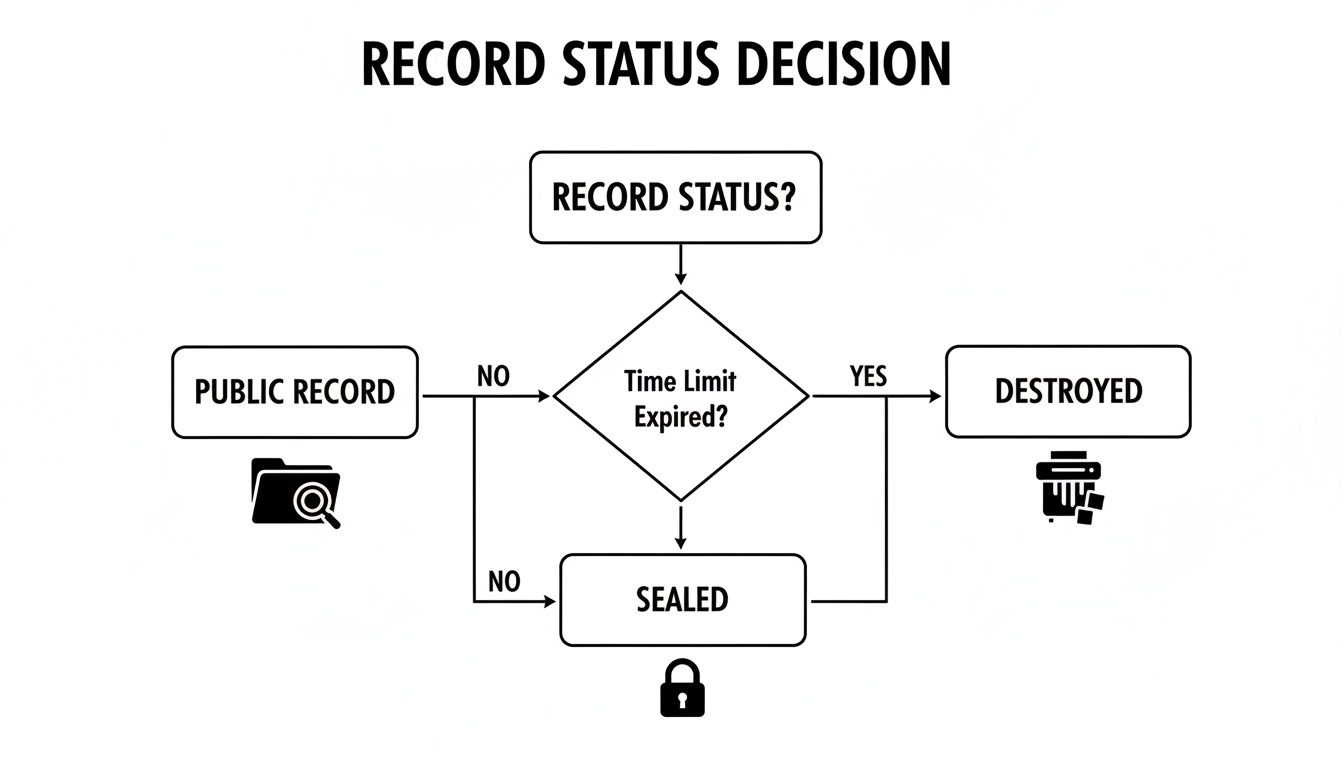
As you can see, the final outcome of your case—like a dismissal or an acquittal—is what really determines whether your record can be completely erased.
How Recent Law Changes Might Help You
It’s also worth noting that Texas laws are constantly evolving, often to give more people a second chance. Recent updates have made it easier for many folks to clear their records by expanding eligibility for certain misdemeanors and cutting down the mandatory waiting periods.
This means that many non-violent, first-time misdemeanor offenses now qualify for expungement more easily, particularly in major counties like Dallas and Tarrant, where the process is becoming more streamlined. If your case was dismissed after you finished probation or a diversion program, your path to a clean slate might be shorter than you think.
Figuring out your eligibility is the absolute first step. If your situation fits one of these scenarios, you're already on the right track to putting the past behind you for good.
Navigating the Mandatory Waiting Periods
Timing is everything when it comes to expunging a record in Texas. You can’t just file a petition the day after your case is dismissed. The law imposes mandatory waiting periods, and filing even one day too early guarantees an automatic denial from the court.
The clock for this waiting period starts ticking from the date you were arrested. You have to let the entire period run its course before your petition will be considered. This is a strict rule designed to ensure the legal process is final, and there’s no way around it.

Understanding the Timelines for Different Offenses
So, how long do you have to wait? It all depends on the severity of the offense you were arrested for. Texas law lays out clear timelines, and knowing which one applies to you is absolutely critical.
These waiting periods apply if you were arrested but the prosecutor never formally filed charges against you. Here’s the breakdown:
- Class C Misdemeanors: You must wait at least 180 days from the date of your arrest.
- Class A or B Misdemeanors: The waiting period is a full one year from your arrest date.
- Felonies: You have to wait three years from the date of the arrest.
There’s another crucial piece to this puzzle: for these timelines to apply, the statute of limitations for the offense must have also expired. This is a legal deadline that prevents the state from coming back and filing charges years later. Once it passes, your path to expunction is much clearer.
What Happens When a Case Is Dismissed?
If charges were filed against you but later dismissed, the rules change slightly. Typically, the waiting period starts from the date of the dismissal, not the arrest.
Let’s say you were arrested for a Class B misdemeanor like theft. Six months later, the prosecutor dismisses the case. Your one-year waiting period would begin on the day the judge signed that dismissal order.
A lot of people think a dismissal instantly clears their record. It doesn’t. A dismissal just makes you eligible for an expunction. You still have to respect the waiting period and file a formal petition to get the arrest record destroyed for good.
Patience is essential. Even a felony arrest that went nowhere still forces you to wait three full years before you can start the process of clearing your name. Trying to file too early will only result in wasted time, money, and effort.
Understanding these legal clocks is complicated, which is why getting it right from the start is so important. For a deeper look at how these timelines are calculated, you might want to review our detailed guide on the Texas expungement process timeline. Getting the timing right is the foundation of a successful expunction petition.
Your Guide to Filing the Expungement Petition
Once you've patiently waited out the mandatory period, you are ready to take action. The next step is filing a Petition for Expunction, which is the formal legal document that starts the entire process.
This isn't just about filling out a form. It's a precise legal move where every single detail matters. Getting it right the first time is crucial if you want to avoid frustrating delays or a denial that sends you right back to the beginning.
This is your step-by-step guide to navigating the legal system with confidence.

Gathering Your Essential Documents
Before drafting the petition, you need to collect all the necessary information about your case. Accuracy here is non-negotiable. One small mistake can jeopardize your entire petition.
You will need to gather the following:
- Your Personal Information: This includes your full name, date of birth, driver's license number, and Social Security number.
- Arrest Details: You'll need the exact date of the arrest, the specific offense you were arrested for (e.g., assault, theft), and the name of the arresting agency (like the Houston Police Department or Harris County Sheriff's Office).
- Case Information: This is the court where the case was heard (for example, Harris County District Court), the cause number, and how the case ended (e.g., dismissal or acquittal).
If you’re missing some of this info, you can usually get it from the district clerk's office in the county where the arrest happened. This initial legwork ensures your petition is built on a solid, factual foundation.
Drafting and Filing the Petition
The Petition for Expunction is a formal legal document filed with the district court in the county of your arrest. It tells the court who you are, lays out the details of the arrest you want cleared, and explains exactly why you are legally entitled to have the record destroyed under Texas Code of Criminal Procedure, Chapter 55.
The petition has to be sworn to and verified, which means you’re signing it under oath. It must also list every single government agency that could possibly have a record of your arrest.
A common—and critical—mistake is failing to list all the relevant agencies. If an agency isn't notified, it has no legal obligation to destroy its records. This leaves a major hole in your "clean slate." The list almost always includes the arresting agency, the prosecutor's office, the district clerk, and state-level bodies like the Texas Department of Public Safety (DPS).
Once the petition is drafted, you'll file it with the district clerk. This comes with a filing fee, which usually runs between $250 and $500, depending on the county. If you can't afford the fee, you might be able to file an "Affidavit of Indigency" to ask the court to waive it. For more local details, you can find helpful information on the process for expungement in Harris County, Texas and what to expect there.
Serving Notice to Government Agencies
After filing, you must formally "serve" a copy of the petition to every single agency you listed. This is a legal requirement that gives them official notice of the lawsuit and a chance to respond. These agencies have the right to contest your expunction if they believe you are not eligible.
The District Attorney's office is the party most likely to raise an objection. This is why having an experienced Houston criminal lawyer is so valuable—we can anticipate potential objections and come to the hearing prepared with a strong legal argument to counter them.
What to Expect at the Court Hearing
Once all agencies have been served, the court will set a hearing date, typically 30 to 60 days after you file. In many straightforward cases, the hearing is just a formality. If no agency objects and your petition is flawless, the judge will simply review the paperwork and sign the Final Order of Expunction.
However, if an agency objects or if the judge has questions about your eligibility, the hearing becomes a critical moment. This is when your attorney will present evidence and make legal arguments on your behalf, explaining to the judge why you meet all the legal requirements for an expunction.
Having a skilled Texas assault defense attorney or DWI attorney by your side can be the deciding factor between approval and denial. We make sure the petition is filed correctly, all parties are properly notified, and we show up ready to advocate for you in court, turning that fresh start from a possibility into a reality.
Life After Your Record is Expunged
You won. The judge reviewed your case, agreed you were eligible, and signed the final order. A wave of relief washes over you, but then a new question arises: now what? This is where your hard work pays off, and the true benefits of a clean slate begin.
The single most powerful benefit of an expunction is your restored right to legally deny the arrest ever happened. On applications for jobs, housing, professional licenses, and even loans, you can truthfully answer "no" to questions about past arrests. This isn't just a suggestion; it’s your right under Texas law.
Your Record Is Officially Destroyed
That signed court order is more than just a piece of paper. It’s a direct command sent to every government agency that holds a record of your arrest. It is a mandatory recall notice for your personal data.
These agencies are legally required to take action. They must:
- Physically destroy any paper files related to the incident.
- Permanently delete all digital entries from their databases.
- Remove any mention of the arrest from their official records.
This process covers everyone from the local police department that arrested you to the Texas Department of Public Safety (DPS) in Austin. The goal is complete and total erasure, leaving no official trace of the event. Once this is done, it's as if it never occurred in the eyes of the law.
Navigating Background Checks with Confidence
After an expunction, you can finally face background checks without that familiar knot of anxiety. When a potential employer runs your name, the expunged arrest simply won't appear on official reports from state and federal databases. This levels the playing field, allowing your skills and qualifications to speak for themselves.
But here’s a real-world catch: private data brokers. These companies collect court data and may not update their records immediately. This is one reason the expunction process takes time; it allows the official order to circulate so that third-party databases can eventually catch up.
If an expunged record ever incorrectly shows up on a private background check, you now have the legal power to fix it. Your signed expunction order is the ultimate proof that the information is inaccurate and must be removed. An experienced attorney can help you enforce this by sending a copy of the order to the company and demanding they correct their files.
Using Your Clean Slate to Build a Better Future
Life after an expunction is about looking forward, not back. The weight of that past mistake is finally lifted, opening doors that were once firmly shut. This is your chance to pursue the career you’ve always wanted, find safe and stable housing for your family, and apply for educational programs without fear of rejection.
It's about more than just practical benefits; it's about restoring your dignity and peace of mind. You no longer have to live with the constant worry that your past will resurface and derail your progress. Your record is clear, your future is your own, and you have the freedom to build the life you truly deserve.
Answering Your Top Texas Expungement Questions
Navigating the expungement process can feel like a maze, and it’s completely normal to have questions. You’re not alone. We've helped countless Texans clear their records, and a few key questions come up time and time again.
Below are clear, straightforward answers to the most common concerns we hear from clients just starting their journey to a clean slate.
How Much Does It Cost to Get a Record Expunged in Texas?
The total cost can vary, but you should generally budget for a few different expenses. First are the court filing fees, which typically run between $250 and $500. On top of that, you'll have service fees to legally notify all the state agencies involved, which can add another $100 to $200.
The biggest variable is the attorney's fee. This can range from $1,500 to $5,000, depending on the complexity of your case. While you can technically file on your own, the legal process is unforgiving of even small mistakes. An experienced attorney ensures it's done right the first time, preventing a costly denial that would force you to start all over again.
Can I Expunge a DWI in Texas?
This is a very common question, and the answer is tricky. A DWI conviction or a case where you received deferred adjudication cannot be expunged. Texas law is incredibly strict on this point.
However, there is hope in certain situations. You may be eligible for an expungement if:
- Your DWI case was completely dismissed by the prosecutor.
- You went to trial and were found not guilty (acquitted).
- You were arrested for DWI, but charges were never formally filed.
If your case fits one of those scenarios, you can pursue an expunction after the mandatory waiting period has passed. For those who completed deferred adjudication for a DWI, an order of nondisclosure (record sealing) might be an option, but a full record destruction is not.
How Long Does the Expungement Process Take?
Patience is a key part of this process. Once you file the petition, it generally takes about 3 to 6 months from start to finish. By law, the hearing cannot be scheduled for at least 30 days after filing, which gives state agencies time to review your petition and decide if they want to respond.
After that initial 30-day period, the timeline depends heavily on the court's calendar and whether any agency files an objection. If there are no issues, a judge can sign the order relatively quickly.
Once the judge signs the final order, it can still take a few more months for all government agencies to receive the command and completely destroy their records. While the legal part is over, the administrative process of erasure takes time. The end result—a truly clean slate—is well worth the wait.
Can an Expunged Record Affect a Family Law Case?
Yes, in a very positive way. In Texas family law cases, such as a child custody dispute, a judge will consider a parent’s history to determine what is in the child's best interest. An old criminal record can absolutely be used against you.
Once a record is successfully expunged, it is legally destroyed. This means it cannot be used against you in court. A clean record can significantly strengthen your position, showing the court that you are a stable and responsible parent focused on your child’s well-being.
If you’ve been charged with a crime in Texas, call The Law Office of Bryan Fagan, PLLC for a free and confidential consultation. Our defense team is ready to protect your rights. https://texascriminallawyer.net