Being arrested in Texas can be terrifying—but you don’t have to face it alone. If a past arrest is casting a long shadow over your life, preventing you from securing a job, finding housing, or moving forward, there is a powerful legal solution. The process of getting a criminal record expunged in Texas involves filing a petition to have the records of an arrest and case completely destroyed. The goal is to wipe the slate clean.
Once an expunction is complete, you can legally deny the incident ever occurred. It's a true fresh start, and this guide will walk you through how to achieve it.
Giving You a True Second Chance in Texas

Trying to move forward with a criminal record hanging over your head feels like an endless uphill battle. It throws up roadblocks when you’re trying to find a decent job, secure a safe place for your family to live, or simply get on with your life. Every background check becomes a moment of anxiety and judgment, forcing you to relive a chapter you desperately want to close.
This guide is for Texans who are ready for that genuine fresh start.
At The Law Office of Bryan Fagan, PLLC, we believe everyone deserves a second chance. We’re here to walk you through Texas’s legal process for permanently destroying a criminal record, a powerful legal tool known as expunction.
Understanding the Power of an Expunction
Let's be clear: an expunction is far more than just hiding a record—it’s about total erasure.
When a judge signs an Order of Expunction, they are legally commanding every government agency holding a record of your arrest to physically destroy it. This isn't a pardon; it's a complete legal obliteration of the arrest from your past. From that point on, you can legally and honestly state that the arrest never happened.
This remedy is fundamentally different from an order of nondisclosure, which only seals a record from public view but doesn't destroy it. Knowing which path is right for your situation is critical.
The process might seem complicated, but the benefits are truly life-changing. Beyond the practical advantages, many of our clients find immense peace of mind just knowing their past no longer defines their future. You can learn more about the emotional relief the expungement process provides in our detailed article.
An expunction can help you:
- Confidently apply for new jobs without the fear of a background check.
- Qualify for professional licenses or certifications you've worked hard for.
- Secure better housing opportunities for you and your family.
- Finally leave the stress and anxiety of a past mistake behind you.
Navigating this complex legal journey requires precision and experience. Our compassionate defense team is here to provide the expert guidance you need to reclaim your future.
Who Qualifies for Expunction in Texas
Figuring out if you're eligible for an expunction is the first—and most important—step in clearing your name. The rules are specific, laid out in the Texas Code of Criminal Procedure, Chapter 55, but you don’t have to be a legal scholar to understand the basics. At its core, an expunction is reserved for situations where the justice system never found you guilty or decided not to move forward with a conviction.
Think of it this way: if your case didn't end with a guilty plea or a guilty verdict, you may have a good shot at qualifying. Let's demystify the legal requirements so you can get a clear picture of where you stand.
The Main Paths to Eligibility
In Texas, you are generally eligible for an expunction if your case ended in one of a few key ways. Each one represents a scenario where a criminal charge didn't result in a conviction, making it unfair for that arrest record to follow you for life.
You’re likely eligible for an expunction if your arrest ended with one of these outcomes:
- You were acquitted: This is the most straightforward path. A judge or jury found you not guilty at trial. Your record should be wiped clean.
- Your case was dismissed: The prosecutor dropped the charges against you. As long as the statute of limitations for that crime has expired, you can file for an expunction. This is a very common scenario for people facing charges for assault, theft, or drug possession.
- You were never formally charged: You were arrested, but the prosecutor's office decided not to file formal charges (a "no-bill" by a grand jury is one example). Once the required waiting period is over, that arrest record can be destroyed for good.
- You successfully completed a pretrial diversion program: These are special programs offered by the District Attorney’s office. If you finish one successfully, the charges are typically dismissed, opening the door for you to get an expunction.
For dismissals or cases where no charges were filed, you must wait a specific amount of time before you can file your petition. This waiting period depends on the severity of the offense:
- 180 days for Class C misdemeanors.
- One year for Class A and B misdemeanors.
- Three years for felonies.
Common Reasons for Disqualification
Just as there are clear paths to eligibility, there are also specific situations that will disqualify you. The biggest roadblock? Being convicted of another charge from the same arrest.
Here’s a practical example: say you were pulled over and arrested for both DWI and Unlawful Carrying of a Weapon. The DWI gets dismissed, but you’re convicted on the weapon charge. In this case, you cannot get the DWI arrest expunged. The law treats it as a single "criminal episode."
A final eligibility check with an experienced attorney is crucial. The nuances of the Texas Code of Criminal Procedure are tricky, and one small detail from your past could make or break your case. An attorney ensures you don’t waste time and money on a petition that’s doomed from the start.
Understanding these rules is the first step toward getting your future back. To dive deeper into the specific legal requirements, check out our guide on Texas expungement law and eligibility.
Expunction vs. Nondisclosure in Texas At a Glance
It's easy to get "expunction" and "nondisclosure" mixed up, but they are fundamentally different. An expunction destroys your record, while an order of nondisclosure simply seals it from the public. Knowing which one you might qualify for is critical.
This table breaks down the key differences to help you see which path might be right for your situation.
| Feature | Expunction (Record Destruction) | Order of Nondisclosure (Record Sealing) |
|---|---|---|
| What Happens? | Your criminal record is permanently destroyed. All agencies must delete their files. | Your record is sealed from public view but remains accessible to law enforcement and certain government agencies. |
| Who Qualifies? | Cases that were dismissed, acquitted (found not guilty), or never formally charged. | Cases where you successfully completed deferred adjudication probation. |
| Effect on Background Checks | The arrest and charge will not show up. You can legally deny the arrest ever occurred. | Private employers cannot see the sealed record, but government and licensing agencies usually can. |
| Goal | To achieve a true "clean slate" as if the arrest never happened. | To limit the negative impact of a past mistake on employment and housing opportunities. |
| Common Scenarios | A wrongful arrest, a case dropped for lack of evidence, or winning your case at trial. | Completing probation for a first-time, low-level offense without a final conviction. |
In short, an expunction is the gold standard for clearing your record, but an order of nondisclosure is an incredibly powerful tool for those who don't qualify for full destruction.
Texas Expunction Law in a National Context
While Texas has its own specific laws, it's helpful to see how they fit into the bigger picture of criminal justice reform sweeping the country. There's a growing understanding nationwide that old criminal records create massive barriers to getting a job, finding housing, and keeping families stable.
As a result, many states are expanding their record-clearing laws. In fact, a majority of U.S. states—37 in total—have passed laws allowing for the expungement of at least some felony convictions, not just misdemeanors. This trend shows a major shift toward helping people fully rejoin society. You can learn more from this national survey on expungement and record sealing.
This national movement highlights how important your rights are here in Texas. An expunction isn't just a legal filing; it's a powerful tool for rebuilding your life. By figuring out if you qualify, you’re taking the first, most critical step toward closing a painful chapter and starting fresh with a truly clean slate.
Navigating the Texas Expunction Process
Once you’ve confirmed you’re likely eligible, the real work toward getting a clean slate begins. The Texas expunction process isn't just about filling out a form; it's a formal legal proceeding. It demands precision, an eye for detail, and a clear understanding of the legal road ahead.
Think of it as building a case. You're not just proving your innocence, but fighting for your right to have the record of an arrest permanently wiped out. Every step builds on the last, all leading to that final goal: a judge's signature on an Order of Expunction. Let's walk through this path together so you know exactly what to expect.
Step 1: Gathering Your Essential Documents
Before any legal paperwork can be drafted, you need to get your facts straight. The first move is to collect all the documents related to the arrest you want to expunge. This isn't just helpful—it’s absolutely critical for making sure your petition is accurate and complete.
You'll need to lock down key details like:
- The date of your arrest.
- The name of the arresting agency (e.g., Houston Police Department, Harris County Sheriff's Office).
- The specific offense you were charged with.
- The cause number or case number the court assigned.
- The date your case was resolved (e.g., the date it was dismissed or you were acquitted).
These details are the foundation of your entire petition. If you no longer have this information, an experienced attorney can help you track it down, ensuring nothing gets missed.
The infographic below shows the main paths to expunction eligibility in Texas, which helps determine what kind of documents you'll need to make your case.
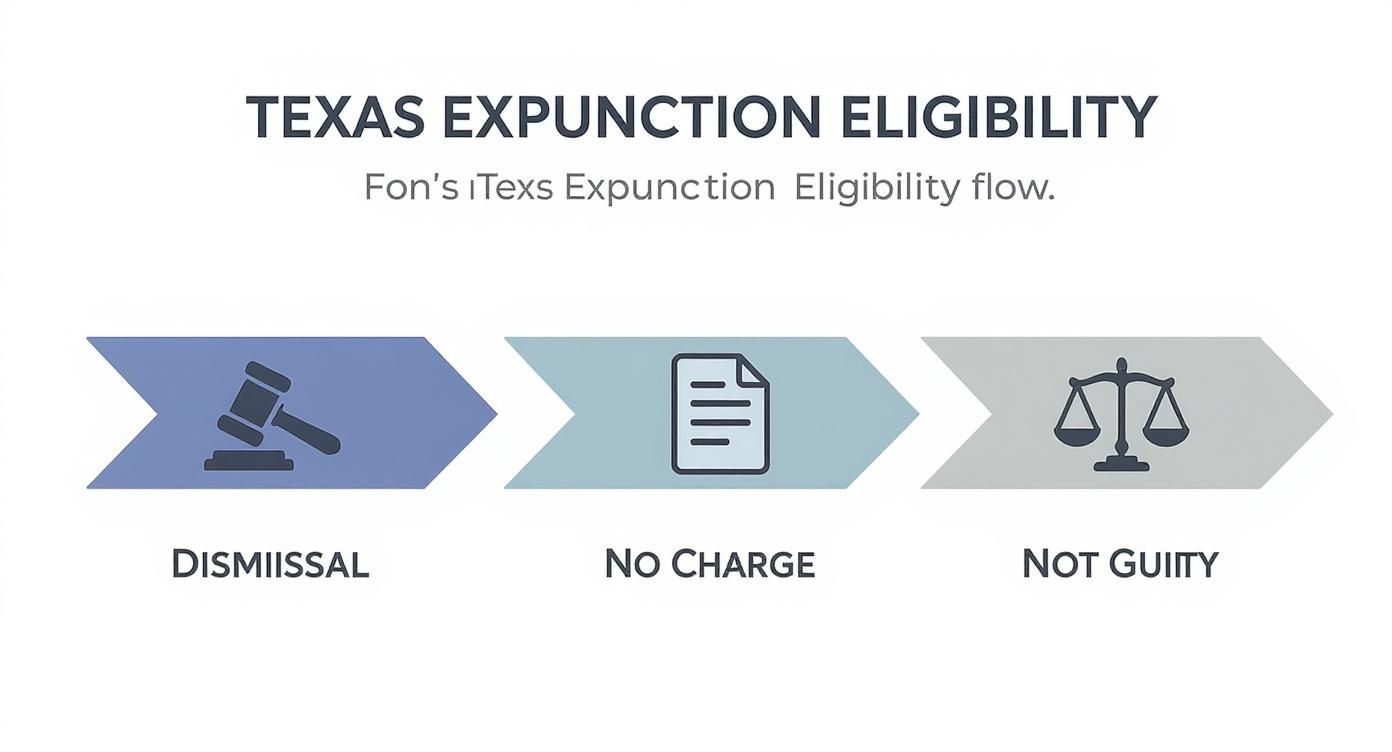
As you can see, whether a case was dismissed, never charged, or ended in a not guilty verdict, the outcome points toward a fresh start through expunction.
Step 2: Drafting and Filing the Petition for Expunction
With your information in hand, your attorney will prepare the Petition for Expunction. This is the formal legal document you file with the court to officially request the destruction of your criminal records. It must be filed in the district court of the county where you were arrested.
This document isn’t just a simple request. It's a sworn statement that must meticulously list every single government agency you believe has a record of your arrest. A common—and critical—mistake is failing to list all the relevant agencies. If an agency isn't named in the petition and served with notice, they have no legal duty to destroy their records. This could completely undermine the whole process. The petition must be accurate down to the smallest detail. Any error could lead to delays or, even worse, a denial from the court.
Step 3: Notifying Every Relevant State Agency
After the petition is filed, the next crucial step is to formally notify every agency you listed. In legal terms, this is called service of process. Each entity, from the local police department all the way up to the Texas Department of Public Safety (DPS), must receive a copy of your petition.
This gives them a chance to respond. Most of the time, agencies don’t object if the petition is filed correctly and you meet all the eligibility rules. However, the prosecutor's office (either the District Attorney or County Attorney) will review your petition and can choose to fight it if they believe you are not legally entitled to the expunction.
Properly serving all parties is a non-negotiable part of the process and a key reason why getting professional legal help is so valuable. To learn more about the specifics of the Texas process, you can find a comprehensive guide on how to clear your record in Texas.
Step 4: The Court Hearing and the Prosecutor's Response
Once everyone has been notified, the court will set a hearing date, usually somewhere between 30 to 60 days after filing. At this hearing, a judge will review your petition and listen to any arguments from you or your attorney, along with any objections from the prosecutor.
If the prosecutor agrees that you’re eligible, the hearing might just be a brief formality. In some cases, if there’s no opposition at all, the judge might even sign the order without a formal hearing. But if the prosecutor objects, your attorney will need to present a strong legal argument to the judge explaining exactly why you qualify under Texas law. This is where having an experienced Houston criminal lawyer on your side is invaluable.
This hearing is the final hurdle.
Step 5: Achieving the Goal: The Signed Order of Expunction
The final, and most rewarding, step is getting the judge to sign the Order of Expunction. This is the legally binding court order that commands every single agency to search their files and destroy all records related to your arrest.
After the order is signed, it gets sent to all the agencies listed in your petition. They then have a set amount of time, typically up to 180 days, to comply by destroying both their physical and digital records. Once that’s done, your fresh start is officially a reality.
What Life Looks Like After an Expunction

Securing an Order of Expunction is much more than a legal victory; it's the moment you truly get your life back. The biggest, most powerful benefit is the right to legally deny the arrest ever happened. Once a judge signs that order, it’s as if the entire event was wiped from your history.
Think about what that means. When you're filling out applications for jobs, housing, loans, or even college, you'll eventually see that dreaded question: "Have you ever been arrested?" After an expunction, your answer can be a confident and truthful "No." This simple change unlocks doors that a criminal record may have slammed shut, allowing you to compete for opportunities on a level playing field again.
A Fresh Start in the Real World
The impact of an expunction touches nearly every part of your daily life. Imagine applying for your dream job without that pit in your stomach, worrying that a background check will derail your chances. Picture yourself applying for an apartment in a great neighborhood, knowing your application won’t be tossed aside because of one past mistake.
This is the reality an expunction creates. It removes the constant anxiety that your past will unfairly define your future.
The legal power of an expunction is absolute. Under Texas Code of Criminal Procedure Art. 55.03, it is illegal for any person or entity who knows about your expunction to use the expunged record against you. This law protects your right to move forward without prejudice.
The benefits are tangible and often immediate:
- Employment: You no longer have to disclose the arrest to potential employers, opening up career paths that were previously blocked.
- Housing: Landlords running background checks won't see the expunged record, which dramatically improves your chances of securing a lease.
- Professional Licensing: You can apply for state licenses for careers like nursing, teaching, or real estate without the arrest record becoming a roadblock.
- Peace of Mind: The emotional weight of carrying a criminal record is finally lifted, providing immense personal relief.
The Timeline and Enforcing Your Clean Slate
While the judge’s signature is the final word, the process isn’t instantaneous. After the Order of Expunction is granted, it gets sent to all relevant government agencies. These agencies—from the local police department all the way up to the Texas DPS—are given up to 180 days to physically destroy their records of your arrest.
This is where patience is key. It's also where a common problem can pop up: private background check companies. These companies buy public data in bulk and don’t always update their databases in real time. So, even after your official record is destroyed, it might still appear on a background check from one of these third-party services.
If this happens, don't panic. Your Order of Expunction is your proof. You or your attorney can send a copy of the court order directly to that company, demanding they remove the outdated information. They are legally required to comply. An experienced attorney can handle this for you, making sure your clean slate is fully enforced.
Expunction as a Path to a Safer Community
Beyond the personal benefits, expunctions are proving to be an effective public safety measure. Research on recidivism rates for individuals with expunged records shows they are very unlikely to re-offend. For example, people with expunged misdemeanor convictions have a re-conviction rate of only 3.8% within five years.
Even for those with expunged violent felonies, the rate of re-conviction for another violent crime is less than 1%. These statistics show that giving people a true second chance helps them successfully reintegrate into society, which benefits everyone. You can discover more insights about the power of a clean slate from Cato.org.
Why an Attorney Is Your Strongest Ally

On paper, the Texas expunction process might look like just another set of forms to fill out. But in reality, it’s a formal lawsuit you are filing against the State of Texas, and it's loaded with legal traps. One simple mistake can get your petition thrown out, forcing you to start all over again and costing you valuable time and money.
This is where having a skilled Texas assault defense or DWI attorney shifts from a good idea to an essential part of your strategy. Your future is far too important to risk on a technicality. An attorney is your trusted guide and your shield, making sure your one shot at a clean slate is as strong as it can possibly be.
Avoiding Costly and Common Filing Errors
I've seen it happen time and time again: an expunction petition gets rejected because of a simple, avoidable error. The legal requirements are strict and unforgiving.
For example, your petition must correctly identify and list every single government agency that might have a record of your arrest. This goes way beyond just the arresting police department. You have to include the county clerk, the district clerk, the prosecutor’s office, the Texas Department of Public Safety (DPS), and any other entity that may have touched your file.
Forgetting even one agency can sink the entire process. An experienced attorney knows exactly who to name and how to ensure every party is properly notified, leaving no loose ends.
A denied petition doesn't just mean a delay; it means wasted time, lost filing fees, and the emotional drain of having to restart the entire process. Hiring an attorney from the start is an investment in getting it right the first time.
Accurately Determining Your Eligibility
Before you even think about filing, the most critical step is confirming you are legally eligible for an expunction. As we've covered, the rules around waiting periods, prior convictions, and deferred adjudication outcomes can be incredibly complex.
An attorney’s first job is to conduct a thorough review of your criminal history to give you a definitive "yes" or "no" on your eligibility. They will analyze the specific details of your case against the Texas Code of Criminal Procedure, sniffing out any potential red flags that a prosecutor might use to object to your petition. This expert analysis prevents you from going down a path that is legally blocked from the start.
Common issues an attorney can help you navigate include:
- Calculating precise waiting periods: The clock doesn't always start on the day of your arrest. An attorney ensures you file after the legally mandated waiting period has passed.
- Analyzing "criminal episodes": If you were arrested for multiple charges, an attorney can determine if a conviction on one charge disqualifies you from expunging another.
- Interpreting dismissal reasons: The reason your case was dismissed can impact eligibility, and an attorney understands these legal nuances.
Representing You in Court and Against Opposition
Once your petition is filed, the local prosecutor’s office will review it. If they find any reason to object—and they often look for them—they can fight your request in court. Facing a government attorney alone is intimidating and puts you at a huge disadvantage.
This is where your attorney becomes your champion. They will prepare a strong legal argument, backed by evidence and case law, to counter any objections from the state. They will speak on your behalf at the hearing, presenting your case to the judge in a clear, persuasive, and professional manner. This alone dramatically increases your odds of a successful outcome.
Finally, a lawyer ensures the final Order of Expunction is drafted correctly and, more importantly, fully enforced. They follow up with all the government agencies to confirm they have complied with the judge’s order, making sure your clean slate becomes a complete reality. You don't have to face this complex legal system alone; an experienced advocate can make all the difference in reclaiming your future.
Common Questions About Texas Expungement
Even after you get the basics down, it’s normal to have practical questions about what an expunction really means for you. We understand. Below, we've answered some of the most common questions our clients ask, cutting through the legal jargon to give you straightforward answers.
How Much Does an Expunction Cost in Texas?
Think of an expunction as an investment in your future. The total cost isn't just one flat fee; it’s a combination of court filing fees, the costs to serve legal notice to every required agency, and of course, the attorney fees for handling all the complex legal work.
While the final number can vary based on your case's complexity and the county you file in, the long-term benefits are often immeasurable. We’re talking about unlocking better job opportunities, securing safe housing, and simply moving on without a background check holding you back. Our firm offers a free, confidential consultation where we can give you a much clearer estimate based on your specific situation.
How Long Does the Expunction Process Take?
Patience is definitely needed on the expunction journey. A realistic timeline—from the day we file the petition to the moment a judge signs the final order—is anywhere from three to six months.
Several things can affect that timeline:
- The Court's Schedule: Some courts are busier than others. A backlog can affect how quickly your hearing gets scheduled.
- Number of Agencies: The more government entities we have to serve with the lawsuit, the more coordination it takes.
- The Prosecutor’s Response: If the District Attorney’s office decides to fight your petition, it can add time to the process as we prepare to counter their arguments.
We manage every single step to keep things moving as efficiently as possible, but it's important to have realistic expectations from the start.
Can I Get a Texas DWI Expunged?
This is one of the most critical questions we hear, and the answer comes down to one thing: the outcome of your case. If your DWI charge was dismissed or you were found not guilty at trial, then yes—you are absolutely eligible to seek an expunction. That’s the best-case scenario for completely wiping your record clean.
However, it is crucial to understand that a DWI conviction in Texas cannot be expunged. Period. What's more, a DWI that results in deferred adjudication probation is specifically barred by law from being sealed with an order of nondisclosure. This unique rule makes it even more vital for a Texas DWI attorney to pursue an expunction if your DWI case ended without a conviction.
An expunction is the only way to truly erase a DWI arrest from your record. Because a nondisclosure isn’t an option for DWIs, successfully destroying the record of a dismissed charge is a powerful and necessary step toward a clean slate.
What Is the Main Difference Between Expunction and Sealing a Record?
It’s easy to mix these two up, but their effects are worlds apart. Here’s a simple way to think about it.
An expunction legally destroys your record. Every agency involved is ordered to physically obliterate its files. After it’s done, you can legally deny the arrest ever happened. It’s a complete and total erasure.
An order of nondisclosure, on the other hand, just hides the record from the general public. While private employers and landlords won’t see it, law enforcement, government agencies, and certain licensing boards can still pull it up. An expunction is the gold standard for a true fresh start.
If you’ve been charged with a crime in Texas, call The Law Office of Bryan Fagan, PLLC for a free and confidential consultation. Our defense team is ready to protect your rights.