Skip to content
Being arrested in Texas can be terrifying — but you don’t have to face it alone. Getting that criminal record expunged starts with one crucial question: are you eligible? Generally, if your case was dismissed, you were found not guilty at trial (acquitted), or if you were arrested but never formally charged with a crime, you have a path forward.
From there, the process involves filing a Petition for Expunction with the right court. This is a formal legal request asking a judge to order every relevant state agency to permanently destroy your arrest records. Once it's granted, you can legally deny the arrest ever happened.
Your Path to a Fresh Start with Expunction

An arrest or criminal charge in Texas can feel like a shadow that follows you everywhere. It creates real-world barriers, making it harder to get a job, find a place to live, or simply move on with your life. You’re not alone in this. An estimated 74 million people in the United States have a criminal record, and many of those records are for arrests that never even led to a conviction.
That staggering number shows just how many people need a true second chance. This guide is a starting point for any Texan who feels trapped by their past. We’re here to show you that a mistake doesn't have to define your future.
What an Expunction Truly Means
Let’s cut through the legal jargon. An expunction (sometimes called an "expungement") is the legal process that leads to the complete and permanent destruction of your criminal records.
Once a judge signs that expunction order, it’s legally as if the arrest never happened. Law enforcement agencies, prosecutors’ offices, and the courts are all required by law to shred, delete, and destroy every file connected to your case.
This is about more than just peace of mind; it’s about restoring your opportunities. After a successful expunction, you can legally deny the arrest ever occurred on most applications, including those for:
- Jobs and professional licenses
- Apartment and housing rentals
- Bank loans and lines of credit
- College or trade school admissions
The emotional relief that comes with an expunction is profound. It lets you take back control of your story and chase your goals without that constant fear of what a background check might reveal.
An expunction isn’t just about clearing a record; it's about reclaiming your future. It gives you the freedom to pursue opportunities without being unfairly judged for a situation that was legally resolved in your favor.
At The Law Office of Bryan Fagan, PLLC, we see this as more than just a legal filing. It's a critical step toward rebuilding a life. Our team is here to guide you through this often-confusing journey with the expertise and nonjudgmental support you deserve. We're committed to helping you finally get the clean slate you've earned.
Expunction Versus Nondisclosure in Texas
When you start looking into clearing your criminal record in Texas, you'll immediately run into two legal terms: expunction and nondisclosure. They might sound similar, but they accomplish very different things. Understanding this distinction is the single most important step you can take. Choosing the wrong path can cost you time, money, and frustration.
Think of an expunction as hitting the "delete" button on your arrest record. When a judge grants your petition for expunction, all government agencies—from the arresting police department to the court clerk—are ordered to literally destroy their files about your arrest. For all legal purposes, it's gone.
An order of nondisclosure, on the other hand, is more like putting those same files into a locked cabinet. The arrest record still exists, but it's sealed off from the general public. This means most employers, landlords, and curious neighbors won't see it when they run a standard background check.
When Does Each Option Apply?
The path you're eligible for is determined entirely by how your criminal case ended. You can't just pick the one you like better; Texas law is very specific about who qualifies for each.
An expunction is typically reserved for cases that did not result in a conviction. This means you were found not guilty, the charges were dismissed, or the case against you otherwise fell apart. It is the most complete form of record clearing Texas law offers because it signifies the justice system ultimately cleared you.
Nondisclosure is designed for people who successfully completed a special kind of probation called deferred adjudication. In that scenario, you plead guilty or "no contest," but the judge puts off a finding of guilt while you complete community supervision. If you do everything the judge requires, the case is dismissed. The arrest record remains, however, which makes it a candidate for sealing—not destruction.
The core difference is finality. Expunction means the arrest legally never happened. Nondisclosure means the arrest happened, but most people can no longer find out about it.
To help you see the differences at a glance, here’s a quick comparison.
Expunction vs. Nondisclosure Key Differences
This table provides a clear side-by-side comparison of the two primary methods for clearing a criminal record in Texas, helping you quickly understand the outcome and eligibility for each.
| Feature | Expunction (Record Destruction) | Order of Nondisclosure (Record Sealing) |
|---|---|---|
| Outcome | All records are physically destroyed. | Records are sealed from public view. |
| Legal Status | You can legally deny the arrest ever happened. | You can't deny the arrest, but it's not public. |
| Who Can See It? | No one. The record is gone. | Law enforcement and select state agencies. |
| Primary Eligibility | Acquittals, pardons, dismissals (non-deferred). | Successful completion of deferred adjudication. |
| Common Scenarios | Charges dropped for a DWI or assault; found not guilty at trial. | Completed deferred adjudication probation for a misdemeanor drug possession or theft charge. |
| Best For | Cases where you were wrongly arrested or cleared of charges. | Cases where you took a plea deal for deferred adjudication. |
Understanding these distinctions is the first step, but seeing them in action makes it even clearer.
Real-World Scenarios
Let's look at two practical examples to see how this plays out for Texans every day.
-
Expunction Example: Imagine you were arrested for theft in Houston. After reviewing the evidence, the prosecutor decides there isn't enough to move forward and dismisses the charges. Because you were never convicted and the case was officially dropped, you are a prime candidate for an expunction once the waiting period expires. Once it's granted, you can legally deny the arrest ever took place on job applications and elsewhere.
-
Nondisclosure Example: Now, let's take a different situation. You were charged with drug possession and your attorney negotiated a plea for deferred adjudication probation. You completed everything the judge asked—community service, fines, and classes—and the case was dismissed. While the case is dismissed, the record of your arrest still exists. In this situation, you would petition the court for an order of nondisclosure to seal that record from public view.
These two remedies offer very different levels of relief, and figuring out the nuances is key. For a more detailed breakdown, you can learn more about the specifics of expungement vs. nondisclosure in Texas to see which path aligns with your case history. Identifying the correct legal tool from the start is absolutely essential for a successful outcome. Our team can review your case specifics and give you the clear guidance you need to move forward.
Figuring Out if You're Eligible for an Expunction
This is the first and most important hurdle. Before you do anything else, you need to know if you actually qualify to have your record wiped clean. Eligibility for an expunction isn't a gray area; it's a strict set of rules laid out in the Texas Code of Criminal Procedure. But don't worry, you don't need a law degree to understand the basics.
The whole idea behind expunction is to help people who were never actually convicted of a crime. It’s the state's way of acknowledging that a single arrest shouldn't follow you around forever, especially when it didn't result in a guilty verdict. Let's walk through the most common situations where you might be able to get those arrest records destroyed for good.
Scenarios That Usually Qualify for Expunction
Your chances of getting an expunction almost always boil down to how your criminal case ended. If your situation fits into one of these categories, you’ve got a strong shot at clearing your name.
-
You Were Acquitted: This is the clearest path. If you went to trial for a charge like DWI or assault and a judge or jury found you "not guilty," you have an absolute right to an expunction. It doesn't get more straightforward than that.
-
Your Case Was Dismissed: Maybe the prosecutor dropped the charges due to a lack of evidence, a key witness didn't show up, or you finished a pre-trial diversion program. Whatever the reason, a dismissal means the state is done with your case, which typically makes you eligible.
-
You Were Arrested but Never Formally Charged: It happens more than you think. You get arrested, booked, and released, but the District Attorney’s office decides not to move forward with the case. Once a specific amount of time passes without charges being filed, you can petition to have that arrest record erased.
-
You Received a Pardon: This one is less common, but if you were convicted and later pardoned by the Governor of Texas or the U.S. President, you can then seek an expunction for that offense.
-
You Completed Deferred Adjudication for a Class C Misdemeanor: Here’s a key exception to the rule. Most deferred adjudications only qualify for a nondisclosure (record sealing). But if you successfully completed deferred adjudication for a Class C misdemeanor—think traffic tickets or petty theft—you can go for a full expunction.
A lot of people make the costly mistake of thinking a dismissed case just vanishes. It absolutely does not. It will stay on your record unless you take the initiative to file a Petition for Expunction to get it officially and permanently removed.
Don't Forget the Mandatory Waiting Periods
Even if your case was dismissed or never charged, you can't just run down to the courthouse the next day. Texas law makes you wait. These mandatory waiting periods exist to give the statute of limitations time to run out, ensuring a prosecutor can't suddenly decide to file charges after you've already cleared the arrest record.
The clock starts ticking on the day you were arrested. How long you have to wait depends entirely on the severity of the offense you were arrested for:
- Class C Misdemeanors: You must wait 180 days from the arrest date.
- Class A & B Misdemeanors: You must wait one year from the arrest date.
- Felonies: You must wait three years from the arrest date.
These timelines are set in stone by Article 55.01 of the Texas Code of Criminal Procedure. There’s no negotiating them. Filing your petition even one day early will get it automatically denied, and you’ll have to start all over again. Getting this date right is crucial, and it's one of the simplest ways an experienced Houston criminal lawyer can save you from a major headache. We can double-check the dates and make sure your petition is filed at precisely the right time.
Navigating the Texas Expunction Process
Alright, so you've confirmed you're eligible for an expunction. What's next? This is where the formal legal process kicks in. It can feel a bit overwhelming with all the specific forms, deadlines, and legal language, but breaking it down into clear steps makes it far more manageable. Let's walk through the key phases together, from getting your documents in order to seeing that final court order in your hands.
This flowchart gives you a bird's-eye view of the journey, showing how a case moves from arrest to the point where you can actually file for expunction.
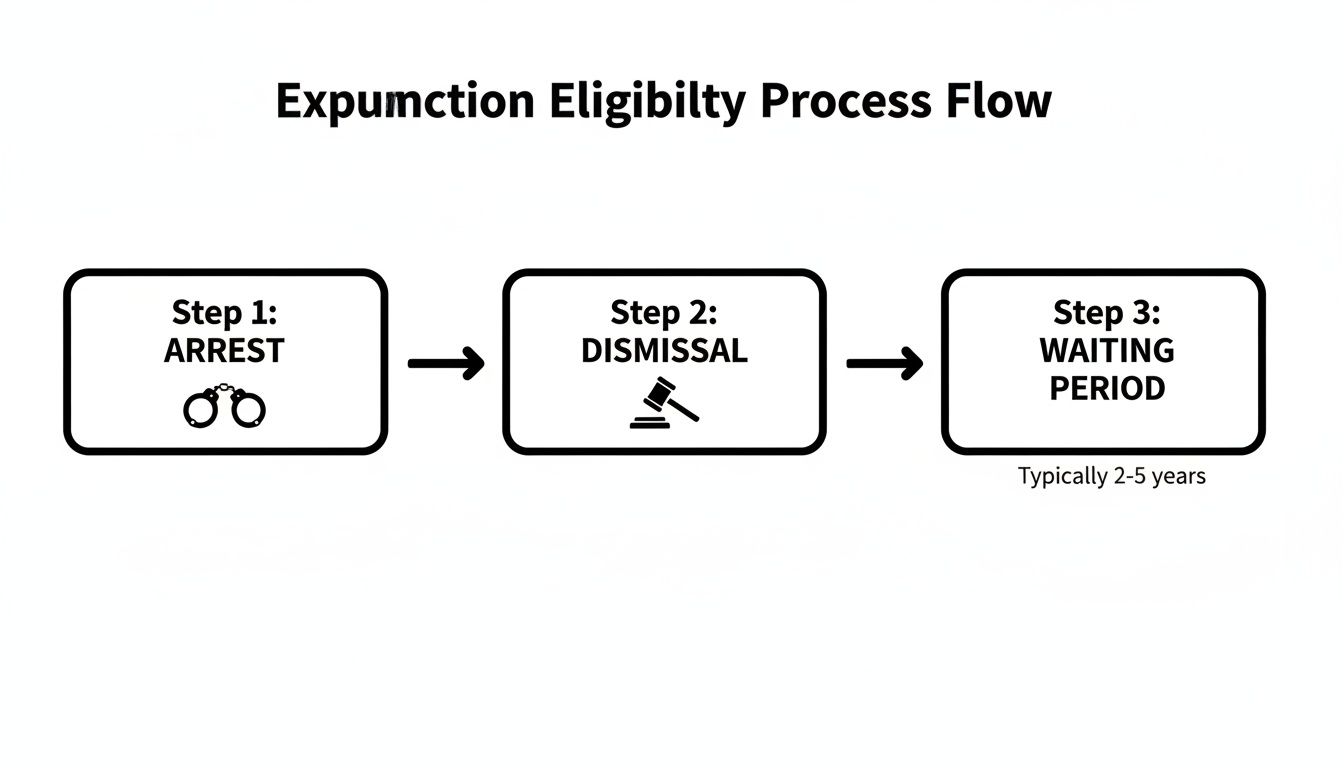
As you can see, the starting line isn't filing paperwork—it’s the outcome of your case and the legally mandated waiting period that has to pass first.
Step 1: Gathering Your Essential Documents
Before you can even think about drafting the official petition, you need to collect all the paperwork related to your arrest and the subsequent case. Accuracy is everything. A single mistake, like a wrong case number or an incorrect date, can bring the entire process to a screeching halt.
Here’s what you’ll need to round up:
- Arrest Records: This is the offense report from the police department that arrested you.
- Court Dispositions: These are the official court documents showing how your case was resolved—whether it was a dismissal, acquittal, or another qualifying outcome.
- Personal Information: You'll need your full name, date of birth, driver's license number, and Social Security number handy.
Having these documents ready from the get-go ensures your petition is complete and accurate, setting you up for a much smoother process down the road.
Step 2: Drafting and Filing the Petition for Expunction
The Petition for Expunction is the formal legal document that officially starts the process. This isn't just a simple form you fill out; it's a sworn statement that must include very specific information required by Texas law. Critically, it has to list every single government agency that might have a record of your arrest.
This petition gets filed in the district court of the county where the arrest happened. For law firms handling a high volume of these cases, using legal document automation software can help manage the complex paperwork involved and reduce the risk of clerical errors.
Filing this petition correctly is more than just a bureaucratic step. It’s what officially puts the entire legal system on notice that you're seeking to have your records wiped clean.
A common and costly mistake is failing to list every relevant agency on the petition. If an agency isn't listed, it won't receive the final order and won't be legally required to destroy your records. This oversight can completely undermine the entire point of getting an expunction.
Step 3: Notifying All State Agencies
After you file the petition, every agency listed in it—legally referred to as a "respondent"—must be formally notified. This isn't optional. Each agency has the right to show up and contest your expunction, though in our experience, it's rare if you clearly meet the eligibility requirements.
These agencies almost always include:
- The arresting police department or sheriff’s office
- The District Attorney’s or County Attorney’s office
- The District and County Clerks
- The Texas Department of Public Safety (DPS)
- The Texas Department of Criminal Justice
Properly serving notice to what could be dozens of different agencies is one of the most logistically tricky parts of the whole process, and it has to be done according to strict legal rules.
Step 4: The Waiting Period and Potential Court Hearing
Once all the agencies have been notified, a waiting period begins. This is typically at least 30 days. This window gives the respondents time to review your petition and decide whether they want to object. Thankfully, most expunctions are "agreed," which means no agency objects, and a hearing might not even be necessary.
However, if an agency does file an objection, or if the judge simply prefers to hold one, a court hearing will be scheduled. This isn't a new trial. It's a formal proceeding where the judge reviews your eligibility and listens to any arguments. You and your attorney would attend, along with a representative from any objecting agency. At the hearing, your lawyer’s job is to present the evidence proving you qualify under Texas law.
Step 5: Securing the Signed Expunction Order
The final step is getting the judge to sign the Final Order of Expunction. This is the golden ticket—the legally binding document that commands all the agencies you notified to destroy their records related to your arrest. It is the victory you've been working toward.
Once it's signed, the court clerk sends a certified copy of that order to every single agency listed in your petition. Those agencies then have a set amount of time, usually up to one year, to comply and confirm in writing that your records have been destroyed.
While you can technically try to navigate this process alone, the risks of making a mistake are incredibly high. An experienced attorney at The Law Office of Bryan Fagan, PLLC can ensure every document is accurate, every agency is properly notified, and every deadline is met. For more insight, you can find a detailed breakdown of the Texas expungement process timeline on our blog.
Common Mistakes to Avoid When Filing for an Expunction
Even if you’re a perfect candidate for an expunction, the process itself is a minefield of potential missteps. A simple clerical error can completely derail your petition, leading to frustrating delays or an outright denial from the court. In our experience helping countless Texans, we've seen the same costly mistakes trip people up time and time again.
One of the biggest misconceptions we see is the belief that a dismissed case automatically vanishes from your record. This is completely false. A dismissal is a fantastic outcome, but the arrest record stays public until you take action. You have to file a formal Petition for Expunction and get a judge to sign an order to destroy it. Without that crucial step, the arrest will keep showing up on background checks.
Miscalculating the Waiting Period
Texas law is incredibly strict about the waiting periods required before you can file for an expunction. These aren't suggestions; they are hard deadlines laid out in the Texas Code of Criminal Procedure. Filing your petition even one day too early will get it automatically rejected by the court.
It sounds simple to calculate, but it can be surprisingly tricky. The clock starts ticking from the date of your arrest, not the date the case was dismissed. The length of the waiting period also depends on the severity of the original charge. Getting this wrong means you've wasted your time and money on filing fees, only to have to start the whole process over.
Failing to Notify All the Right Agencies
Your Petition for Expunction isn't just a request—it's a legal notice. You are required to list every single government agency that might have records related to your arrest. If you leave an agency off that list, they won’t receive the final court order. And if they don't get the order, they are not legally required to destroy your records.
This list can be much longer than people realize. It often includes:
- The arresting police department or sheriff’s office
- The District Attorney’s Office
- The Texas Department of Public Safety (DPS)
- The court clerk where the case was handled
- Any other agency involved, like a crime lab or pretrial services
Forgetting even one of these can leave a gaping hole in your "clean slate," which defeats the entire purpose of the process. A knowledgeable attorney will make sure a complete list is compiled and that every agency is properly served.
Clearing a record does more than open doors to jobs and housing; it’s proven to support rehabilitation. Studies confirm that people with cleared records are less likely to reoffend than the general population. However, a significant "second chance gap" exists, with fewer than 20% of eligible individuals successfully navigating the petition process in some states. Discover more insights about the benefits of second chances from the Clean Slate Initiative.
Submitting an Incomplete or Incorrect Petition
The Petition for Expunction has to be perfect. It requires absolute precision with details like your personal information, the specific offense, case numbers, and the dates of your arrest and dismissal.
Any inaccuracies or omissions can give the prosecutor's office a reason to object or the judge a reason to deny your request. This is not a form you can afford to rush through. An experienced attorney can ensure your petition is drafted correctly, sworn to, and filed in the right court, helping you avoid the common pitfalls that stop so many Texans from getting the fresh start they deserve.
Life After Your Record Is Expunged

Successfully getting an expunction order is a monumental victory. It feels like a massive weight has been lifted, and for good reason. It’s more than just a piece of paper; it’s the legal restoration of your clean slate, giving you the freedom to move forward without a past arrest holding you back. This is where your new chapter truly begins.
The single most powerful outcome of an expunction is your restored legal right to deny the arrest ever happened. Think about it—on applications for jobs, housing, loans, or college, you can lawfully say "no" when asked about prior arrests for the expunged offense. This one change can open doors that may have been slammed shut for years.
What Happens Behind the Scenes
Once the judge signs the order, it sets a legal process in motion. Government agencies are required by law to destroy all records of your case. We're talking about the files held by the arresting police department, the prosecutor's office, the court itself, and any other state agency that had a record of it. The whole point is to erase the event from official view entirely.
A word of advice, though: be patient. While the government agencies must comply, it can take several months for your record to be fully wiped from commercial background check databases. These private companies update their records on their own schedules, so there can be a lag time.
Getting your record expunged is a profound act of hope and reclamation. It provides the closure necessary to rebuild your future on your own terms, without a past mistake unfairly defining your potential.
Once your record is expunged and you're ready for that fresh start, you might wish to explore the benefits of hiring a career coach to guide your professional development. States are increasingly recognizing the importance of second chances, and Texas is no exception.
Answering Your Top Questions About Texas Expunctions
When you start looking into getting your record cleared, a lot of specific questions pop up right away. We get it. Below, we've tackled some of the most common ones we hear from people just like you, hoping to give you some clarity as you figure out your next steps.
How Much Does It Cost To Get a Record Expunged in Texas?
Let's talk numbers. The total cost for an expunction in Texas isn't a single, flat fee—it’s a mix of court filing fees, the costs to serve notice to every government agency holding your record, and of course, attorney fees.
You can expect filing fees alone to run anywhere from $300 to over $500, and that figure can change depending on which county you're in. The real variable, though, is how complex your case is and how many agencies need to be notified. Our firm offers free consultations for this very reason: to give you a transparent, clear-eyed estimate of what it will take to secure your future.
Can a Felony Conviction Be Expunged in Texas?
This is a big one. As a general rule, a final felony or misdemeanor conviction cannot be expunged in Texas. The law saves this powerful fresh start for cases that didn't end with a finding of guilt.
But here's where the details matter. If you were arrested for a felony but the charges were later dismissed, never formally filed, you were found not guilty at trial, or you received a pardon from the governor, then you are very likely eligible for an expunction. An experienced attorney can dig into the specifics of your felony arrest to confirm your eligibility and map out a path forward.
It's a common myth that only minor offenses qualify for expunction. The key isn't how serious the initial charge was; it's the final outcome of the case that truly counts.
How Long Does the Expunction Process Usually Take?
Patience is definitely required here. The entire expunction process in Texas typically takes between three to six months, starting from the day the petition is filed until the moment the judge signs the final order.
This timeline isn't set in stone. It can shift based on how busy the court's docket is and whether any state agencies decide to contest your petition (which can happen). Once the judge signs the order, it can still take several more months for all the different agencies to fully comply and confirm they've destroyed their records of your case.
If you’ve been charged with a crime in Texas, call The Law Office of Bryan Fagan, PLLC for a free and confidential consultation. Our defense team is ready to protect your rights.
Find out more at https://texascriminallawyer.net.