Being arrested in Texas can be terrifying — but you don’t have to face it alone. Receiving an official notice to appear in court can make your stomach drop, and it's easy to panic. But the absolute best thing you can do right now is take a deep breath and make a plan.
The single most crucial first step is to hire an experienced Texas criminal defense attorney. Taking this one action can immediately shift the dynamic in your favor and lay the groundwork for a much stronger defense.
Your First Steps After Getting a Court Notice

When a legal document with your name on it shows up, feeling overwhelmed is completely normal. What you do in the hours and days that follow, however, is critical. Taking immediate, strategic action is the best way to start protecting yourself and your future.
The journey through the Texas criminal justice system starts the moment that notice is in your hand. Let's walk through what you need to do right now, step-by-step.
Contact a Criminal Defense Attorney Immediately
Don't put this off. A skilled lawyer does so much more than just show up with you in court; they become your guide, your advocate, and your shield. As soon as you hire a Houston criminal lawyer, they can start communicating with the prosecutor and the court on your behalf. This helps prevent you from making common mistakes that could seriously damage your case, whether you're facing a DWI, assault, or drug possession charge.
When searching for the right legal partner, it can be useful to understand how different firms find their clients. Knowing about strategies for lawyer lead generation can offer a behind-the-scenes glimpse, giving you a better perspective as you search for an attorney who's the right fit for you.
Key Takeaway: Getting a lawyer involved early is your greatest advantage. They can analyze the charges, spot potential weaknesses in the prosecution's case, and start building your defense strategy long before your first court appearance.
Once you receive that notice, the clock starts ticking. The following table breaks down exactly what to do and why it matters so much.
Immediate Action Checklist After Receiving Your Court Notice
| Action Item | Why It's Critical | When to Do It |
|---|---|---|
| Contact a Defense Attorney | An attorney can prevent you from making mistakes and immediately begins building your defense. | The same day you get the notice. |
| Preserve All Paperwork | Your court notice, bond papers, and charging documents contain case numbers and deadlines. | Immediately. Store them in a dedicated folder. |
| Write Down Your Account | Your memory is freshest right now. Small details can become crucial pieces of evidence later. | Within 24-48 hours. |
| Review Release Conditions | Violating any condition of your bond (e.g., no-contact orders) can land you back in jail. | Immediately. Ask your attorney to clarify anything you don't understand. |
Following these steps methodically will help you regain a sense of control and ensure you're starting your defense on the right foot.
Preserve All Documents and Information
Every single piece of paper you've received is important. Keep your court notice, any charging documents (like an indictment), and any paperwork from your release from jail in a safe, organized folder. These documents contain vital details your lawyer will need.
- Case Number: This is the unique identifier for your case.
- Court Date and Time: Missing this hearing will likely result in a warrant for your arrest.
- Specific Charges: You need to know exactly what you're accused of under the Texas Penal Code to start defending against it.
On top of the official court documents, start gathering any related items you might have, like receipts, text messages, or photos that could be relevant. Don't delete anything.
Write Down Every Detail You Remember
Your memory of what happened is a critical piece of evidence. As soon as you possibly can, sit down and write a detailed account of everything that happened before, during, and after your arrest. Don't filter it or leave things out because they seem small. This written record will be invaluable for your attorney.
For example, if you were arrested for a DWI in Texas, your notes should include details like what you ate and drank that day, where you were headed, how the officer acted during the stop, and exactly what you said to the police. These details can make or break a case.
Understand the Initial Legal Hurdles
After an arrest, you face immediate challenges, with the first often being how to secure your release from jail. This usually means navigating the bail and bond system. Knowing how this works is essential. For a deeper dive, check out our guide on bail and bond in Texas, which explains what to anticipate.
Taking these initial steps will help quiet the anxiety. Instead of just worrying about what's next, you'll be actively participating in your own defense and setting yourself up for the best possible outcome.
Building Your Defense Strategy with Your Attorney
Think of your relationship with your criminal defense lawyer as the engine that drives your entire case. This isn't just someone who shows up for you in court; they are your strategic partner. Working together effectively is one of the most critical parts of preparing for a court hearing, and it all starts the moment you walk in for that first meeting.
This partnership is built on a foundation of open communication and total honesty. It can be tough to share every single detail of what happened, but remember, your attorney is bound by attorney-client privilege. This is a legal rule that means what you say is confidential. They can only build the strongest possible defense when they have all the facts.
The Initial Consultation: Your Strategic Starting Point
That first meeting with a defense lawyer is so much more than a simple introduction. It's a critical strategy session where you and your legal team start to piece together the narrative of your case. Be ready to discuss everything you can remember about the incident and your arrest.
To get the most out of this crucial meeting, it’s smart to come prepared. Thinking ahead about what to ask can make a huge difference in finding the right person to fight for you. We’ve put together a guide on the most important questions to ask a criminal defense attorney before you make a hiring decision.
During this consultation, your attorney will listen carefully, ask probing questions, and start identifying the potential strengths and weaknesses of the case against you. This is also your chance to get a feel for their approach and make sure you feel confident in their ability to represent you.
Demystifying the Discovery Process
Once you’ve hired an attorney, one of the first and most important phases of your case kicks off: discovery. This is the formal legal process where your lawyer gets their hands on all the evidence the prosecutor has against you. Think of it as your attorney getting a look at the prosecution's entire playbook.
Under Texas law, you have a right to this information. Your attorney will file motions to get access to key items, including:
- Police Reports: The official narrative of your arrest, written by the officers involved.
- Witness Statements: Any accounts given to the police by people who saw what happened.
- Body Cam and Dash Cam Footage: Video and audio recordings that can provide an unbiased view of the incident.
- Lab Results: If your case involves substances (like in a DWI or drug possession charge), these are the official test results.
This evidence is the raw material your attorney will use to build your defense. They will meticulously review every document and video, hunting for inconsistencies, procedural errors, or violations of your rights.
A strong defense isn't just about what you can prove; it's often about exposing weaknesses in the prosecution's case. The discovery process is where those weaknesses are found.
In some justice systems, failures in this very process can cause a case to collapse before it ever reaches a courtroom. For instance, in England and Wales, the Crown Prosecution Service spent millions on cases that were later dropped, with a significant portion failing due to incomplete case files from the prosecution. This shows just how vital it is for your defense team to be thorough, as it can reveal fatal flaws in the state’s argument. You can find more insights about the impact of case preparation on the National Audit Office's website.
Your Active Role in Building the Case
While your attorney leads the legal strategy, you are an indispensable member of the defense team. Your participation is vital. Your lawyer will rely on you to provide crucial information and context that they can’t get from police reports alone.
Your role in this partnership often involves several key tasks.
- Creating a Detailed Timeline: You'll work with your lawyer to construct a minute-by-minute timeline of events. This helps organize the facts and can reveal inconsistencies in the prosecution's story.
- Identifying Defense Witnesses: Do you know anyone who can support your side of the story? This could be an alibi witness who can confirm you were elsewhere or a character witness who can speak to your reputation.
- Gathering Your Own Evidence: You may have evidence that the police don't, such as text messages, emails, photos, videos, or social media posts that support your case.
Preparing for a court hearing is a collaborative effort. By being an active, honest, and engaged partner with your attorney, you give yourself the best possible chance at a favorable outcome.
Organizing Your Evidence and Prepping Witnesses

A strong criminal defense in Texas is built on two things: solid evidence and credible witnesses. When we work together to get these elements in order, we’re not just gathering papers and making phone calls—we’re building the foundation of your entire case. This is about strategically telling your side of the story.
Your attorney will absolutely take the lead here, but your help is invaluable. You know the story behind the text messages, the photos, and the documents. Likewise, preparing the people who will speak on your behalf is a delicate but crucial step that can completely change the tone in the courtroom.
Mastering Your Evidence
Think of the evidence in your case as the raw facts that back up your defense. It could be anything from a simple gas station receipt proving you were across town during an alleged assault to a text message thread that adds critical context to a domestic dispute. Your job is to help us hunt down and make sense of these pieces.
We'll categorize every single item into a logical system. Digital evidence, like texts and emails, needs to be preserved in its original format with a clear timeline. Physical items have to be stored carefully to maintain their integrity. If you're curious about the professional standards for handling physical items, this comprehensive guide to evidence storage offers a good look at how the pros do it.
One of the most powerful tools in our arsenal is the Motion to Suppress Evidence. This is a formal request we file asking the judge to throw out specific evidence the prosecution wants to use against you. It's often used when the police obtained evidence illegally—for example, through an improper search that violated your Fourth Amendment rights. You can learn more about how a motion to suppress evidence can be a game-changer in our detailed guide.
The Art of Witness Preparation
Having someone testify on your behalf can be incredibly powerful. But let’s be honest: a nervous, confused, or unprepared witness can sometimes do more harm than good. That’s why we take witness preparation so seriously. It’s important to understand what this process is—and what it isn’t.
Our Goal Is Clarity, Not Coaching. We will never tell a witness what to say. Our job is to prepare them to tell the truth clearly and confidently. We do this by reviewing the facts, explaining the intimidating courtroom environment, and walking them through the types of questions they'll likely face.
This preparation pulls back the curtain on the court process, which helps calm their nerves and allows them to focus on giving honest, accurate testimony.
What Witness Preparation Actually Involves
Getting a witness ready for court is a structured process designed to build their confidence and make sure their testimony lands effectively. It usually includes a few key steps:
- Reviewing the Facts: We’ll sit down and go over their statement and the known facts of the case. This helps refresh their memory and ensures their account is consistent.
- Explaining Courtroom Procedure: We’ll describe the courtroom layout, who will be there, and what to expect when their name is called. This simple step can dramatically reduce that feeling of being overwhelmed.
- Simulating Cross-Examination: We’ll explain the prosecutor's role and practice the kinds of tough questions they might ask during cross-examination. This helps the witness stay calm and focused under pressure instead of getting flustered or defensive on the stand.
For instance, if we’re preparing an alibi witness for a Texas assault defense, we would meticulously walk through their timeline of events with them. For a character witness in a DWI case, we would help them find the right words to describe your reputation for responsibility. This thoughtful prep ensures their testimony is presented in the most impactful way possible, helping the judge or jury see the full picture.
Navigating Texas Courtroom Rules and Etiquette
How you carry yourself in a Texas courtroom speaks volumes before you ever say a word. I’ve seen it time and time again—the judge, the prosecutor, and even the court staff are all observing your conduct. Presenting yourself with respect isn't about being fake; it’s a quiet but powerful way to show you’re taking this seriously.
Let’s be honest, court is intimidating. But understanding the formal and unwritten rules of the room can take away a lot of that anxiety. This isn’t about putting on a show. It’s about respecting the legal process and giving your case the best possible footing.
Your Appearance and Demeanor Matter
That old saying, "dress for success," couldn't be more true in a Texas courtroom. Think of it like a job interview or a church service—your clothes should be conservative and professional. This simple act signals respect for the court's authority before you’ve even been sworn in.
- What to Wear: Business professional is the gold standard. For men, this means slacks and a button-down shirt at a minimum. A tie and jacket are even better. For women, a conservative dress, skirt, or slacks with a blouse is perfect.
- What to Avoid: Steer clear of anything casual. That means no shorts, no t-shirts with logos or graphics, no hats, and no sandals or revealing clothing. The goal is to make your appearance a complete non-issue so the focus stays on the facts of your case.
Your demeanor is just as crucial. Sit up straight at the defense table with your attorney, listen without reacting, and avoid any eye-rolling or dramatic sighs in response to testimony. Your lawyer is your voice in that room. Your job is to stay calm, composed, and engaged.
A Quick Note on Addressing the Court: If you are asked to speak, always stand up first. Address the judge only as "Your Honor." Wait until a question is asked, and never, ever interrupt the judge or the prosecutor. It’s one of the fastest ways to get on a judge’s bad side.
Understanding the Flow of a Hearing
While no two cases are identical, Texas criminal court hearings generally follow a predictable rhythm. Knowing the basic order of events will help you feel more prepared and less caught off guard when things start moving.
A typical hearing kicks off when the judge enters and the clerk calls your case. Your attorney will handle all the initial procedural stuff. If it's a hearing on a specific legal issue, like a Motion to Suppress evidence, your lawyer will present their arguments, and then the prosecutor will get their turn to respond.
The judge might jump in with questions for both attorneys. It is absolutely critical that you follow your attorney's lead. They will tell you when to stand, when to sit, and if you need to answer any direct questions from the judge. Otherwise, your role is to listen and let your lawyer do the talking.
Tips for Virtual Court Hearings
These days, a lot of preliminary hearings are happening over video conference. The setting might be different, but the rules of respect and professionalism are exactly the same. Preparing for a virtual court date just requires a few extra technical checks.
Checklist for a Solid Virtual Appearance:
- Test Your Tech: Make sure your internet is stable and your camera and microphone work perfectly. I always tell my clients to do a test call with a friend the day before.
- Pick a Neutral Background: Find a plain wall or a neat, uncluttered space like a home office. No distracting posters, messy rooms, or anything that draws attention away from you.
- Eliminate All Distractions: This one is non-negotiable. Go into a room and close the door. Make sure kids, pets, and the TV can’t be seen or heard during your hearing.
- Dress the Part: Dress exactly as you would for an in-person hearing—from head to toe. You never know if you'll be asked to stand up.
- Look at the Camera: It feels weird, but when you speak, look directly into your computer's camera, not at your own picture on the screen. This creates the effect of making direct eye contact with the judge.
Treating a Zoom hearing with the same gravity as an in-person appearance shows the court you understand what's at stake.
Understanding Potential Outcomes and Next Steps
Preparing for court isn't just about showing up on time and dressing the part. It's about mentally preparing for the different roads your case can take. The Texas criminal justice system often feels like a maze, but knowing the potential outcomes helps you and your attorney make smarter, more strategic decisions.
Think of it this way: you’re not just reacting to what happens in the courtroom; you're anticipating it. This knowledge helps manage expectations and gives you a sense of control in a process that can feel anything but certain.
Each hearing has a specific purpose. An arraignment, for instance, is where you're officially told the charges against you and enter a plea (almost always "not guilty" at this early stage). A pre-trial conference is where your attorney and the prosecutor discuss legal arguments and potential plea bargains.
This timeline gives you a bird's-eye view of what a typical hearing day looks like.
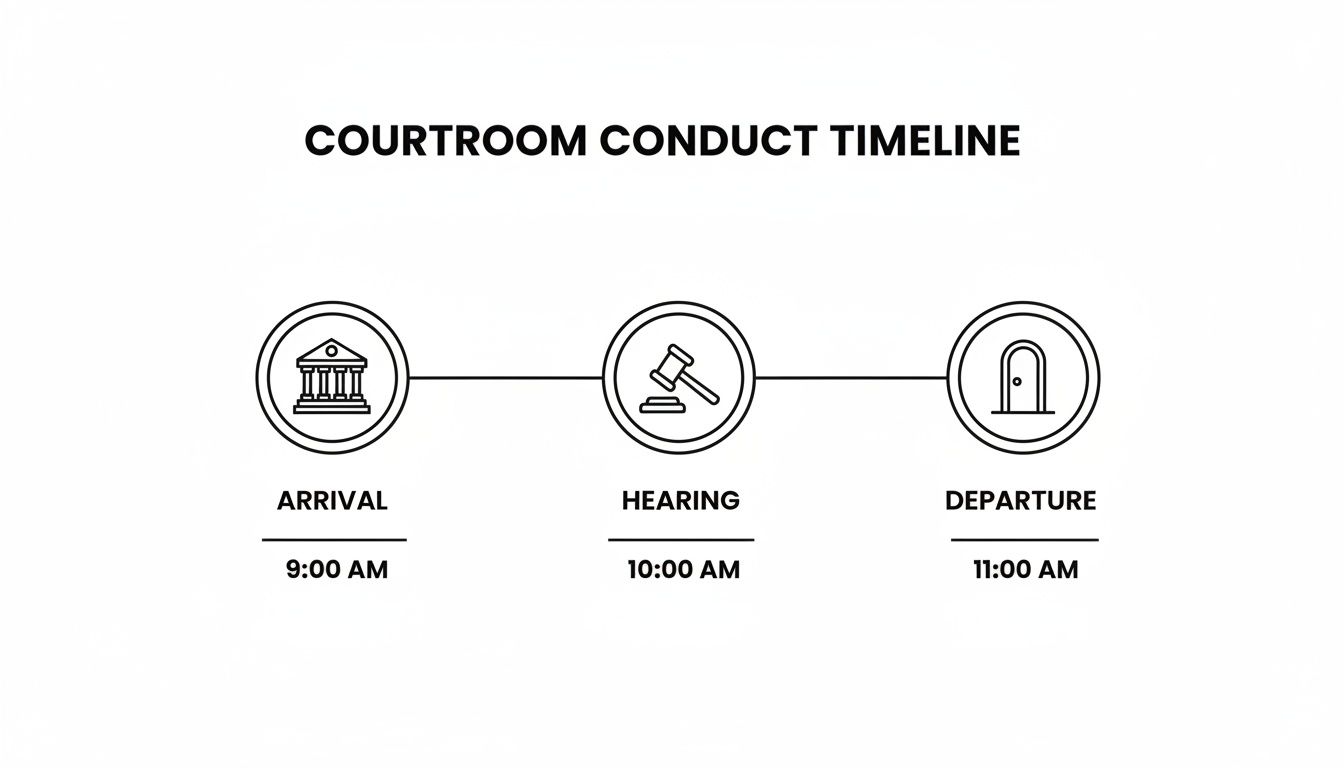
As you can see, the day is a process. Being ready for each phase, from arrival to departure, is key.
The Reality of Delays and Continuances
One of the most maddening parts of the court system is the waiting. Let's be blunt: it's extremely common for hearing dates to get pushed back, or "continued." This happens for a dozen reasons—jam-packed court dockets, a lawyer needing more time to dig into new evidence, or simple scheduling conflicts. Patience isn't just a virtue here; it's a necessity.
This isn't a problem unique to Texas courts. For example, research from the Institute for Government shows that roughly two-thirds of criminal trials in the UK don't happen on their originally scheduled dates because of massive backlogs. This just goes to show why you have to stay focused on the long game with your lawyer, not a single date on the calendar.
A Key Insight: A continuance is not automatically a bad sign. In fact, your attorney might be the one requesting it. That extra time can be used to build a much stronger defense, negotiate more effectively with the prosecutor, or wait for a critical piece of evidence to surface.
Try to see a delay as a strategic pause rather than a frustrating setback. It's a healthier and far more productive way to look at it.
Common Paths Your Case Can Take
As your case winds its way through the Texas courts, a few potential outcomes will start to emerge. Your attorney’s job is to steer you toward the best possible result, but what that "best result" looks like depends entirely on the unique facts of your case.
Here are the most common ways a criminal case is resolved:
Dismissal: This is the best possible outcome. A dismissal means the prosecutor has decided to drop the charges completely. This might happen if your attorney successfully proves there isn't enough evidence to move forward or that your constitutional rights were violated during the arrest or investigation.
Plea Bargain: This is, by far, a very common resolution for criminal cases. Your attorney negotiates a deal with the prosecutor where you agree to plead guilty or "no contest," usually to a lesser charge or for a reduced sentence. It offers certainty and avoids the all-or-nothing risk of a trial.
Trial: If a fair plea agreement can't be reached, your case heads to trial. This is where your lawyer will present your defense to a judge or a jury, who will then deliver a verdict of "guilty" or "not guilty."
Each of these paths demands a completely different strategy. That’s why honest, open communication with your defense lawyer is so critical. By knowing what might happen, you empower yourself to face the road ahead with more clarity and confidence. After a case is resolved, you may even be able to pursue an expunction or have your record sealed, clearing the way for a fresh start.
Answering Your Top Questions About Texas Court Hearings
The courthouse can feel like its own little world, complete with a different language and unwritten rules. As you get ready for your hearing, it’s only natural for a hundred different questions to start swirling in your head. Let's tackle some of the ones we hear the most, so you can walk in feeling prepared and confident.
Getting these basics down clears up a lot of the fog and lets you focus on the most important thing: working with your lawyer on your defense.
What Should I Do If the Prosecutor Tries to Talk to Me?
It happens more than you'd think. You're waiting in the hallway, and the prosecutor or someone from their office walks up and tries to make small talk about your case. You have to handle this perfectly to protect yourself.
Your response needs to be polite but immediate and firm. Just say, "I am represented by an attorney, and I cannot speak with you about my case." That's it. Don't add anything else. The moment they walk away, find your lawyer and tell them exactly what happened. This is non-negotiable—it ensures nothing you say gets twisted or used against you down the road.
Can I Bring My Phone into the Courtroom?
The rules on cell phones change not just from county to county in Texas, but sometimes from one judge's courtroom to the next. The absolute safest approach is to assume you can't bring it in at all.
To sidestep any issues with the bailiff or—even worse—annoying the judge, your best bet is to leave your phone locked in your car. If someone came with you, have them hold it outside the courtroom. Your phone needs to be completely powered off, not just silenced. Your attorney will know the specific rules for that courthouse and can give you the final word.
Your focus inside that courtroom needs to be 100% on your case. A phone ringing or even just vibrating is a huge sign of disrespect to the court and can have real consequences for you.
Ditching the phone is a simple, easy way to show everyone you're taking this process seriously.
How Long Will My Court Hearing Take?
This is a classic "hurry up and wait" situation. While the actual part of the hearing that involves you might only last a few minutes, you should always plan on being at the courthouse for several hours. You might even be there the entire morning or afternoon.
Texas courts have a long list of cases to get through each day, which is called the "docket." You have to wait your turn, and there’s usually no telling exactly when your name will be called.
- A quick procedural hearing, like a simple reset, could be over in less than five minutes once you're in front of the judge.
- A more serious, contested hearing on a legal motion could go on for an hour or more.
The best advice is to clear your schedule for at least half the day. Bring a book or something to read quietly while you wait, but be ready to snap to attention the second you hear your case called.
What Happens If I Miss My Court Date in Texas?
Missing a court date is one of the biggest mistakes you can possibly make in a criminal case. The fallout is fast and harsh. If you don't show up for a scheduled hearing, the judge will almost certainly issue a warrant for your arrest on the spot.
This is called a "failure to appear," and under Texas Penal Code § 38.10, it can trigger brand new criminal charges on top of what you're already dealing with. On top of that, you'll likely forfeit any bond money you posted. That means the money is gone for good, and you'll have to get a new, probably more expensive, bond after you get arrested again.
If a legitimate, verifiable emergency keeps you from getting to court, you must call your attorney immediately. Don't put it off. Your lawyer might be able to get in touch with the court and ask for a reset, which could save you from that arrest warrant and all the headaches that come with it.
If you’ve been charged with a crime in Texas, call The Law Office of Bryan Fagan, PLLC for a free and confidential consultation. Our defense team is ready to protect your rights. Get in touch with our Texas criminal defense lawyers today.