Being hit with a false accusation in Texas can be terrifying — but you don’t have to face it alone. It feels like the ground has vanished beneath your feet, and your first move is absolutely critical. The best thing you can do is simple but powerful: stay calm, say nothing, and call an experienced Texas criminal defense attorney right away. You must resist the urge to explain yourself to the police—it’s the single most important step you can take to protect your rights.
Your Immediate Response to a False Accusation
Learning someone has accused you of a crime can send your world spinning. Your natural instinct is to fight back—to defend yourself, clear up the misunderstanding, or even confront the person who lied. But as understandable as those reactions are, they can cause irreparable damage to your case.
The first few hours after an accusation aren't about proving your innocence. They are about protecting your constitutional rights and avoiding the common mistakes that prosecutors love to use against people later.
The most powerful tool you have at this moment is your right to remain silent. It might feel wrong, but trying to explain your side of the story to the police almost never helps. Investigators are trained to build a case for prosecution, and anything you say can be twisted, taken out of context, or misremembered. All you need to say is this: "I am exercising my right to remain silent, and I would like to speak with my attorney."
This simple flowchart breaks down the essential first steps.
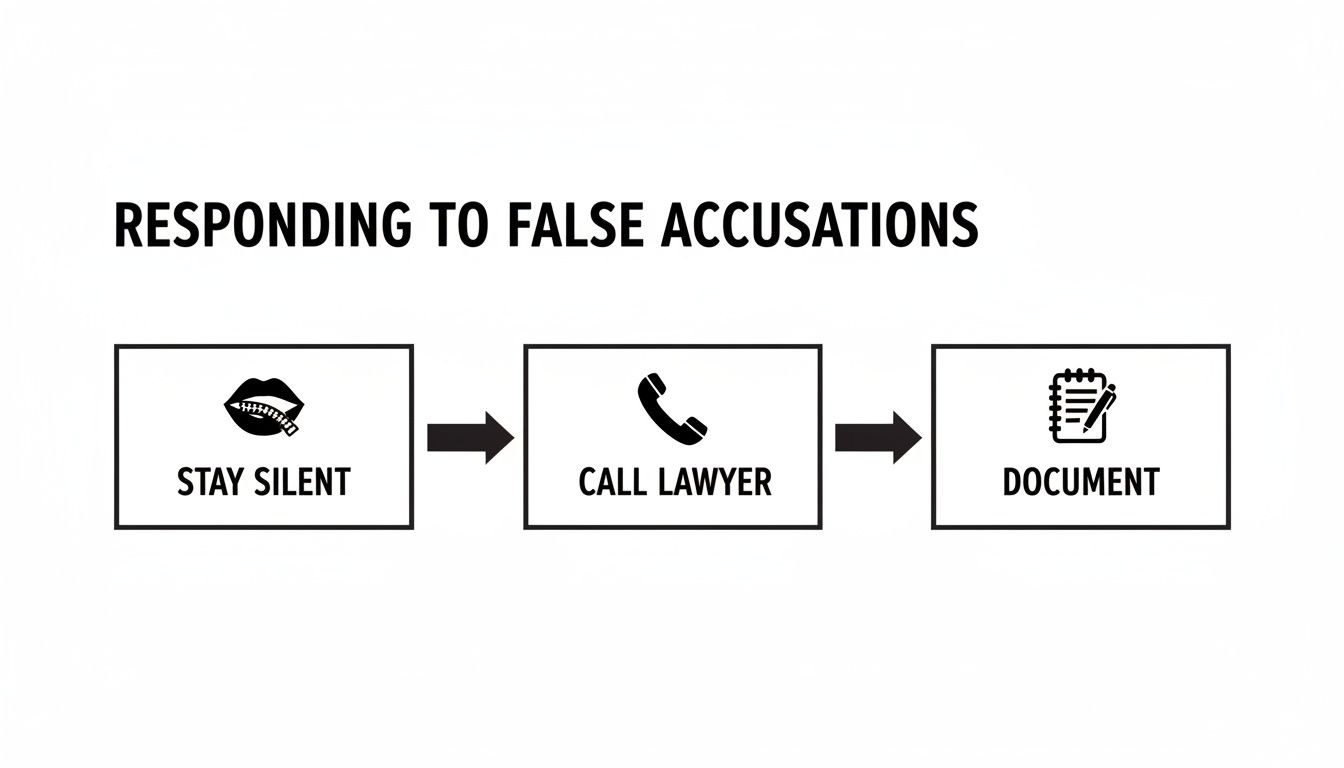
This visual guide reinforces the core strategy: a calm, measured approach focused on silence, legal counsel, and documentation is your strongest initial defense.
Staying Calm and De-Escalating
When law enforcement shows up at your door, your demeanor matters more than you might think. Officers are walking into what could be a tense situation, and any sign of panic or aggression can make things spiral out of control.
- Be Polite and Cooperative (Without Talking): You can follow basic commands like giving your name and ID without answering any questions about what supposedly happened.
- Keep Your Hands Visible: Sudden movements can easily be misinterpreted as a threat.
- Do Not Argue or Resist: Even if you are being wrongfully arrested, fighting back can lead to a separate charge for Resisting Arrest under Texas Penal Code § 38.03. Let your lawyer fight the legal battle for you.
Staying composed helps keep the interaction professional and prevents police from noting you as "uncooperative" in their official report. Remember, your silence is not an admission of guilt; it's a right the Constitution guarantees you.
The Dangers of Talking to Police
Many innocent people believe the truth will set them free and that they can clear their name simply by talking to investigators. Unfortunately, that's not how the criminal justice system works. Any statement you make can—and likely will—become a piece of the prosecution's puzzle.
It's a common mistake to think you can outsmart investigators. Remember, they conduct interrogations for a living. Your words, intended to prove your innocence, can easily be reframed to suggest motive, opportunity, or an inconsistent story.
You also have to fight the urge to contact your accuser. Do not call, text, email, or use social media to reach out and plead your case. Prosecutors can twist this into an attempt at witness tampering or intimidation, which is a separate felony offense. On that note, stay off social media entirely. Public posts filled with emotion or poorly worded statements can destroy your credibility.
Your number one priority is to build a protective wall between you and the accusation. That wall is a skilled Texas criminal defense attorney. Only a lawyer can safely communicate on your behalf, investigate the claims, and build a strategy to expose the truth without putting you at further risk. Your fight begins with two simple acts: staying silent and calling a lawyer.
Building Your Defense by Documenting Everything

After the initial shock of being falsely accused, your most important job is to preserve the truth. While the state carries the burden of proof, you cannot afford to sit back and wait. Building a strong, fact-based defense is your best shot at dismantling the accuser’s story and getting your life back.
Evidence can disappear in a flash, and memories get hazy under stress. You have to move quickly. This is your practical guide to gathering and protecting the proof of your innocence.
Create a Detailed Timeline
Your memory is the very first piece of evidence to secure. As soon as you possibly can, sit down and write out a detailed timeline of everything you did before, during, and after the time the alleged incident supposedly happened.
Don't just jot down a few notes—get as specific as you can. The goal here is to build a minute-by-minute account that leaves zero room for doubt.
- Where were you? List exact addresses, store names, or any specific locations.
- Who were you with? Write down the full names and contact information for anyone who saw you.
- What were you doing? Describe your activities in detail. "Went to the store" isn't enough; "Drove to H-E-B on Main St., bought groceries, and spoke with the cashier, Sarah" is much better.
- What communication occurred? Note every phone call, text, or conversation you had.
This timeline becomes the roadmap for your defense. It helps your attorney pinpoint alibis, track down witnesses, and find the holes in the accuser’s story. A detailed narrative can be incredibly persuasive in court.
Preserve Your Digital Footprint
These days, our digital lives often tell a more accurate story than any one person’s memory. It is absolutely critical to preserve this electronic evidence immediately, but you must do it without changing anything. Do not delete messages, even if you think they make you look bad out of context.
A common mistake is "cleaning up" your digital history, but this can look like the destruction of evidence. Preserve everything as it is and let your attorney determine what is relevant.
Your digital footprint is a goldmine of data that can establish your location and activities:
- Text Messages and Call Logs: Take screenshots of entire conversations and download your call history directly from your mobile provider’s website.
- Emails: Save any emails that relate to the situation or that can help establish where you were and when.
- Social Media Activity: Screenshot your posts, check-ins, photo tags, and direct messages. Location data from apps like Facebook or Instagram can be powerful alibi evidence.
- GPS and Location Data: Your phone’s location history, like Google Maps Timeline, can provide a precise, undeniable alibi.
- Financial Records: Bank and credit card statements show time-stamped proof of exactly where you were making purchases.
Gathering all this information can feel overwhelming, but it provides concrete, objective proof that can directly contradict a false claim.
Identify and Secure Witnesses
A credible witness can be the key to your freedom. Think carefully about anyone who can verify your timeline or speak to your character. This isn't just about finding someone who was with you during the alleged incident; it’s about finding people who can support your version of events.
Make a list of potential witnesses. This could include friends, family, coworkers, neighbors, or even the barista you chatted with at the coffee shop. For each person, collect their full name, phone number, and email address.
Do not try to interview them yourself or tell them what to say. Just gather their information and hand it over to your legal team. Your attorney knows how to conduct a formal interview without raising issues of witness tampering.
In certain complex cases, especially those involving medical or psychological claims, getting help from a medico-legal consultancy can provide expert reports that are critical to your defense.
By methodically documenting every single detail, you aren’t just responding to an accusation—you are actively building the foundation of your defense and taking back control.
Navigating Communication with Police and Others

When you’re facing a false accusation, your words suddenly carry immense weight. What you say—and who you say it to—can become the most critical evidence in your case. Once a statement is out there, you can't take it back.
The pressure to defend yourself is overwhelming. You want to shout your innocence from the rooftops. But this is the moment to be strategic, not emotional. Every text, phone call, and conversation is a potential minefield where one wrong step can have devastating consequences.
Why You Should Never Talk to the Police Without a Lawyer
This is the single most common—and most damaging—mistake people make. A detective calls or shows up at your door, often seeming friendly and reasonable. They'll say things like, "I just want to hear your side of the story," or "Let's just clear this up."
Do not be fooled. This is a tactic. A police officer's job is to close cases by gathering evidence to support a charge, not to prove your innocence.
Even if you are 100% innocent, your own words can be twisted against you. Imagine this common scenario: An officer asks where you were last Tuesday night. You say you were home alone watching a movie, but you can’t recall the title off the top of your head. To you, it’s a simple, honest answer. To a prosecutor, it sounds like a vague, suspicious alibi.
Your only safe and effective response to police questioning is to clearly and calmly state: "I am exercising my right to remain silent, and I will not answer any questions without my attorney present." Say this, and nothing more.
This isn't an admission of guilt; it's you asserting your constitutional rights. Police are legally required to stop questioning you once you invoke your right to an attorney. Any attempt to push past that can be a serious issue.
Avoiding Contact with Your Accuser and Others
The urge to contact your accuser and plead your case can feel irresistible. You want to ask them why they're doing this or beg them to tell the truth. You must resist this urge at all costs.
Any communication—a text, a social media message, a phone call, or even asking a mutual friend to talk to them for you—can be used against you. A prosecutor can easily frame it as:
- Witness Tampering: An attempt to intimidate or influence a witness is a felony under Texas Penal Code § 36.05.
- An Admission of Guilt: A simple, well-intentioned apology like, "I'm so sorry this is all happening," can be twisted in court to sound like, "I'm sorry for what I did."
- A Violation of a Protective Order: If a temporary order is in place, any contact, direct or indirect, is a separate criminal offense.
This rule applies to the accuser’s family and friends, and it absolutely applies to social media. Do not post anything about the accusation, your accuser, or your case. Every post can be screenshotted and used to paint you in a negative light. The only person you should be discussing the details with is your criminal defense attorney.
Discussing the Situation with Your Employer
For many people, a criminal accusation immediately puts their job and professional reputation on the line. Handling this conversation is delicate. You are not automatically obligated to tell your employer about an accusation unless your employment contract or company policy specifically requires it.
Before saying anything, talk to your lawyer. If a conversation is unavoidable, keep it brief and factual. You can state that you are dealing with a personal legal matter and are taking the necessary steps to resolve it. Reassure them of your commitment to your job, but do not offer details about the accusation. Giving them too much information can create unnecessary workplace drama and may not be legally required.
The sad reality is that false accusations are far from rare. One survey from the Center for Prosecutor Integrity found that 8% of Americans—over 20 million adults—report being falsely accused of serious crimes like domestic violence or sexual assault. Despite this, prosecutors almost never pursue charges against false accusers, which makes a strong, proactive defense even more essential.
Communication Guide When Falsely Accused
Navigating these conversations is tough, and it's easy to make a mistake when you're under stress. This quick guide is designed to help you remember the do's and don'ts of communication while you work through this difficult time.
| Who You're Talking To | What to Do (The Right Way) | What to Avoid (Common Mistakes) |
|---|---|---|
| Police / Investigators | State "I want a lawyer" and then remain silent. Be polite, but firm. | Answering questions, offering explanations, or trying to prove your innocence. |
| Your Accuser | Have absolutely zero contact. Block their number and social media profiles. | Texting, calling, emailing, or asking friends to relay messages for you. |
| Social Media | Deactivate your accounts or stop posting entirely until the case is over. | Venting about the case, discussing details, or posting anything that could be misinterpreted. |
| Your Employer | Consult your attorney first. If you must speak, be brief and professional. | Offering a detailed explanation, admitting to any part of the allegation, or oversharing. |
Sticking to these guidelines isn't about being deceptive—it's about being smart. Your freedom and future are on the line, and controlling the narrative starts with controlling what you say and who you say it to.
Why You Need a Texas Criminal Defense Attorney
Trying to navigate the Texas justice system on your own, especially when you're innocent, is a gamble you cannot afford to take. The stakes are sky-high. While it feels like the truth should be your shield, the legal system is a complex and often unforgiving machine. Hiring an experienced Texas criminal defense attorney is the single most critical move you can make to protect yourself and fight back the right way.
From the moment you bring an attorney on board, they become your advocate and your shield. We immediately take over all communication with police, investigators, and the prosecution. This is crucial—it stops you from accidentally saying something that could be twisted and used against you down the road. We absorb the pressure so you can focus on your life.
Building Your Proactive Defense Strategy
A good lawyer does more than just show up for you in court. They launch a full-scale, independent investigation to get to the truth and start dismantling the prosecution’s case before it ever picks up steam. We don't just sit back and wait for the state's evidence—we go on the offensive to build the case for your innocence.
This means taking several key legal actions:
- Filing Discovery Motions: We use the law to force the prosecution to hand over every single piece of evidence they have. This includes police reports, witness statements, and any video or audio recordings.
- Issuing Subpoenas: We can legally demand records the state might have missed, like cell phone location data that proves your alibi, surveillance footage from a nearby business, or financial records.
- Interviewing and Deposing Witnesses: Our legal team will formally interview anyone who might have information and, when necessary, take their sworn testimony in a deposition. This locks in their story and can expose major holes in the accuser's narrative.
- Challenging the Accuser's Credibility: We will meticulously investigate the accuser’s background, their motives, and any past statements to find inconsistencies, a history of dishonesty, or any other reason they might have for making a false claim.
This deep-dive investigation is everything. For instance, a false accusation is often just one person's word against another's, with no real physical evidence to back it up. We make sure to hammer that point home to the court, showing that the entire case hinges on the word of someone we can prove is unreliable.
Leveraging Texas Law to Protect You
Deep knowledge of the Texas Penal Code is one of our most powerful weapons. We'll analyze the exact law you're accused of violating—whether it’s Assault under Texas Penal Code § 22.01, DWI, or theft—and pinpoint every single element the state has to prove beyond a reasonable doubt. Our entire job is to show they cannot meet that incredibly high legal standard.
Navigating the legal process on your own is like trying to perform surgery after reading a medical textbook. A seasoned attorney understands the unwritten rules, the key players, and the strategic moves that can lead to a dismissal long before a trial is ever necessary.
We're with you through every step of the criminal process, from arraignment and bond hearings to plea bargaining and, if necessary, trial. We will make sure you understand what's happening and feel confident in the path forward. A criminal defense attorney will also guide you through official procedures, including understanding the necessity and role of legal court transcription in presenting your defense.
Sadly, false accusations are a massive problem, especially when emotions and relationships are involved. A revealing international survey found that 10% of people in the United States reported being falsely accused of abuse, a number that tracks with other official studies. Even more shocking, about one-third of these false claims worldwide are tied to heated child custody disputes. This data just highlights how critical it is to have a strong legal defense when facing allegations that might be driven by something other than the truth.
Reclaiming Your Life and Clearing Your Name
Just because a false accusation gets dismissed or you’re found not guilty doesn't mean the ordeal is over. The damage to your reputation, career, and overall peace of mind can cast a long shadow, lingering long after the courtroom doors close.
This is where the fight shifts. You’re no longer just proving your innocence; you’re actively taking back your future and restoring your good name.
Fortunately, Texas law provides powerful tools to help you move forward. You don't have to let a wrongful arrest define who you are. There are clear legal paths to wiping your record clean and even holding your accuser accountable for the damage they've caused.
Erasing the Record: Expunctions and Nondisclosures
After a case is resolved in your favor, the public record of your arrest doesn't just vanish. To truly clear your name, you typically need to pursue an expunction or an order of nondisclosure. These are not automatic; you must take proactive steps.
An expunction is the gold standard. Governed by Chapter 55 of the Texas Code of Criminal Procedure, an expunction legally destroys every single record tied to your arrest. It’s as if it never happened.
You may be eligible for an expunction if:
- You were acquitted at trial (found not guilty).
- The prosecutor dismissed your case.
- You were arrested but never formally charged, and the statute of limitations ran out.
Once a judge grants the expunction, you can legally deny the arrest ever occurred on job applications, housing forms, and almost any other situation. It’s a complete reset for your record.
An order of nondisclosure, on the other hand, seals your record instead of destroying it. This means the general public can no longer see it, but law enforcement and certain state agencies still have access. This is a common path for people who successfully complete a deferred adjudication program.
Protecting Your Family and Future
False accusations are often used as a weapon in heated family law disputes, especially during child custody battles. If you've successfully defended yourself against bogus criminal charges, that victory becomes a crucial piece of evidence in your family court case.
A dismissal or acquittal can be presented to a family law judge to prove the allegations were baseless and likely made with malicious intent to gain an unfair advantage. This not only protects your parental rights but also establishes a pattern of bad-faith behavior that the court will take very seriously.
The impact of false accusations on the justice system is devastating. National data shows that false accusations and perjury contribute to a staggering 70% of wrongful convictions, a figure that underscores the importance of a vigorous defense and post-case remedies. Discover more insights about these wrongful conviction statistics.
This isn't just about clearing a record; it’s about restoring trust and ensuring your relationship with your children isn't permanently poisoned by a lie.
Holding the Accuser Accountable
Beyond wiping the slate clean, you might have the option to take civil action against the person who falsely accused you. This isn't the right move for everyone, but it can bring a powerful sense of justice and help you recover damages for the nightmare you've endured.
Two potential legal actions are:
- Defamation: This applies if your accuser knowingly spread false statements about you to other people, damaging your reputation in the process.
- Malicious Prosecution: This is a tougher legal battle. To win, you must prove the accuser initiated a criminal case against you with malice, without probable cause, and that the case ended in your favor.
These civil lawsuits are complex and come with a high burden of proof. However, they can be a powerful way to hold someone accountable for their actions and recover financial compensation for lost wages, legal fees, and emotional distress. Taking these final steps isn't just about closing a chapter—it's about writing a new one where you are back in control of your own story.
Common Questions About False Accusations in Texas

When the shock of a false accusation hits, your mind floods with questions. The uncertainty can feel paralyzing, but getting clear, direct answers is the first step toward taking back control. Let's tackle some of the most common concerns we hear from Texans caught in this exact situation.
Can I Be Arrested Based on Just Someone’s Word?
Unfortunately, yes. In Texas, police only need probable cause to make an arrest. This is a far lower legal standard than the "beyond a reasonable doubt" standard required for a conviction in court.
An accuser’s statement alone—especially if it sounds convincing at first glance—can be enough for an officer to decide probable cause exists. This is precisely why it's so critical to remain silent with investigators and immediately call an attorney who can start punching holes in the accusation from day one.
Should I Take a Polygraph Test to Prove My Innocence?
While it might seem like a quick way to clear your name, our advice is almost always a firm "no." Polygraph (lie detector) test results are generally not admissible as evidence in Texas criminal courts. They are notoriously unreliable, and the anxiety of being falsely accused can easily lead to a "failed" result.
Prosecutors know this. They often use the threat of a failed polygraph as a psychological tool to scare you into a confession or an unfavorable plea deal.
Never agree to a polygraph without your lawyer's explicit advice. This is a strategic decision, not a simple test, and should only be made after weighing all the risks with your defense attorney.
What Happens if My Accuser Admits They Lied?
If an accuser recants their story, it's a huge boost for your defense, but it doesn't automatically make the charges vanish. The prosecutor’s office holds all the cards and makes the final call on whether to drop the case.
Sometimes, the district attorney will suspect the accuser was threatened or coerced into changing their story and may decide to push forward anyway. Your attorney’s job is to immediately get that recantation in front of the prosecutor and use it to argue forcefully for a complete dismissal.
Can I Sue Someone for Falsely Accusing Me?
Yes, once the criminal case is resolved in your favor, you may have grounds to file a civil lawsuit. The two most common routes are defamation (if the accuser knowingly spread lies that damaged your reputation) and malicious prosecution.
Winning a malicious prosecution lawsuit is difficult. You have to prove the accuser initiated criminal charges against you with malice, without probable cause, and that the case was ultimately terminated in your favor. These are complex, high-stakes civil cases, but they offer a path to hold your accuser financially accountable for the nightmare they put you through.
If you’ve been charged with a crime in Texas, call The Law Office of Bryan Fagan, PLLC for a free and confidential consultation. Our defense team is ready to protect your rights.